
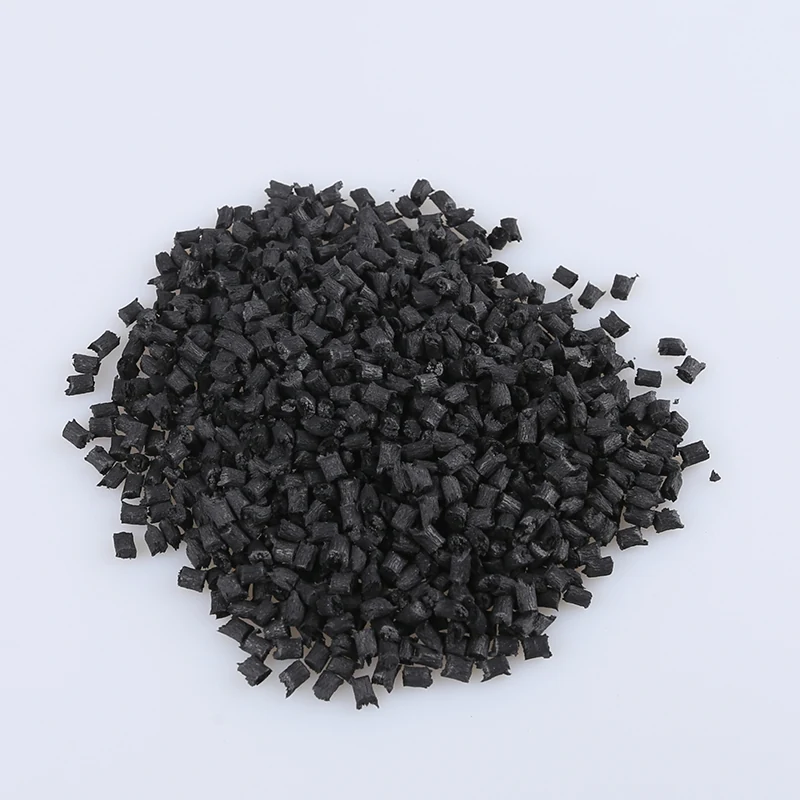
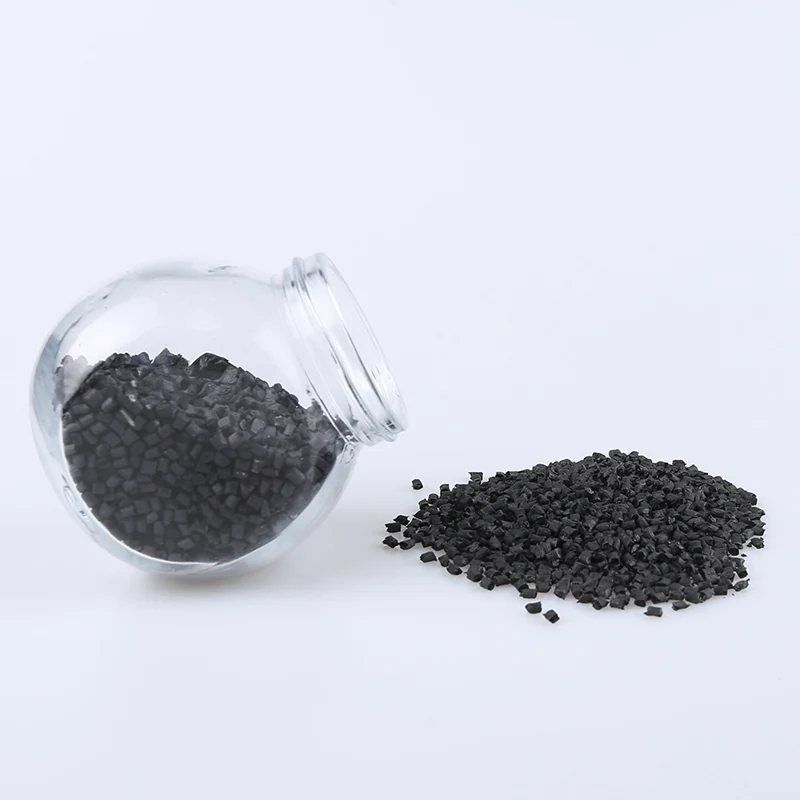
Conductive Wear-Resistant PA66 DGK-PA66 CF35MS
Conductive, wear-resistant PA66 for textile machinery and electronics
DGK-PA66 CF35MS pairs carbon fiber reinforcement with molybdenum disulfide lubrication in a black PA66 compound. It combines 10³–10⁴ Ω surface resistivity, 346 MPa flexural strength and 16800 MPa flexural modulus, so yarn guides and sliding parts stay stiff and wear-resistant while dissipating static.
Textile machinery yarn guides and sliding parts, conductive holders and guides for electronic components, and sliding sleeves or wear strips in industrial assemblies all use this grade. Its 246 °C heat deflection temperature at 1.8 MPa (ASTM D648) keeps stiffness in warm running conditions, and 92 J/m notched Izod impact strength absorbs shock loads.
Important parameters
- Base resin
- PA66
- Model
- DGK-PA66 CF35MS
- Color
- Black
- Processing
- Injection molding
- Key performance
- Surface resistivity of 10³–10⁴ Ω and flexural strength of 346 MPa.
- Status
- Pellets
FAQ
What fillers does this grade contain?
The compound combines carbon fiber for stiffness and electrical conductivity with molybdenum disulfide (MoS₂) for lubrication, all in a PA66 matrix. That package delivers 240 MPa tensile strength, 16800 MPa flexural modulus and 10³–10⁴ Ω surface resistivity to ASTM D257, with 0.4% mold shrinkage in the flow direction.
What is the surface resistivity?
Surface resistivity is 10³–10⁴ Ω measured to ASTM D257, which places the grade in the conductive range for static dissipation. The value comes with 240 MPa tensile strength and 92 J/m notched Izod impact strength to ASTM D256, so conductive parts keep mechanical toughness alongside conductivity.
Which textile parts can use this grade?
Yarn guides and sliding components are the core textile applications, where low friction and static control matter together. Molybdenum disulfide supplies the lubrication and carbon fiber carries load, backed by 346 MPa flexural strength and 1.6% elongation at break. Wear behavior follows the mating surface, speed and load of your machine.
Can I request a molding trial sample?
Share the part drawing, mating material and working conditions and DEYU will supply a DGK-PA66 CF35MS sample for a molding trial. The sheet lists 1.35 g/cm³ density and 0.91% water absorption after 24 hours at 50% RH, so pellets are dried before molding. Conductivity of 10³–10⁴ Ω carries into the molded part.
Application areas
| Application area | Typical parts |
|---|---|
| Textile machinery | Yarn guides and sliding parts |
| Electronic components | Conductive holders and guides |
| Industrial assemblies | Sliding sleeves and wear strips |
Reference quote
- Minimum price
- USD 9.00/kg
- Maximum price
- USD 9.50/kg
Final pricing depends on order quantity and project requirements.
Data sheet
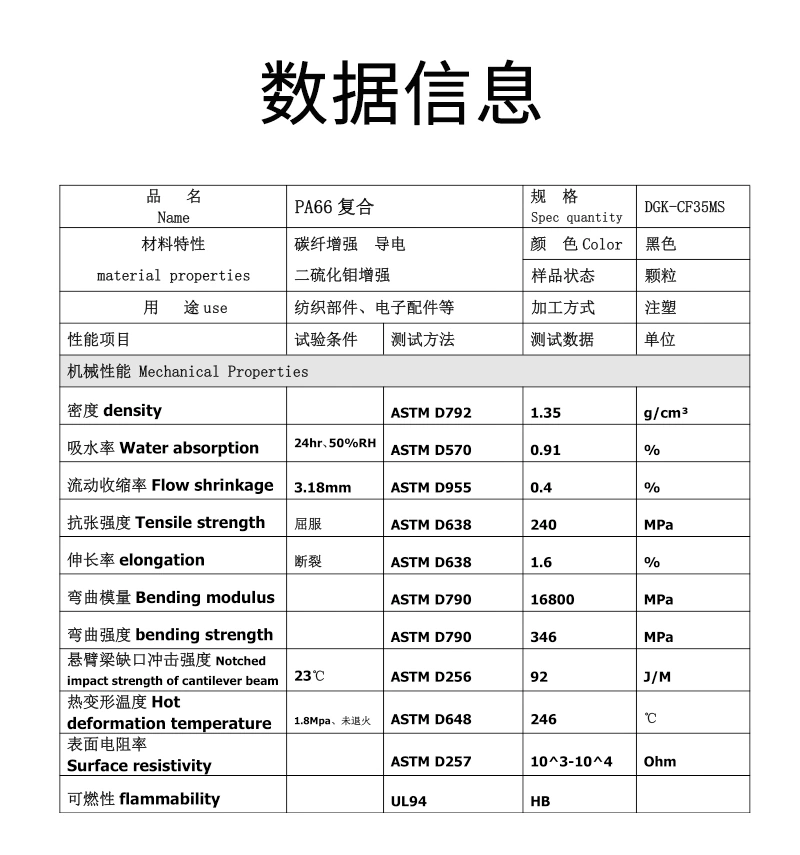
Physical Property Data Sheet
| Name | PA66 compound | Grade | DGK-PA66 CF35MS |
|---|---|---|---|
| Material properties | Carbon fiber and MoS₂ filled, conductive and wear-resistant | Color | Black |
| Applications | Textile machinery, Electronic components | Sample form | Pellets |
| Processing method | Injection molding | — | — |
| Property | Condition | Test method | Value | Unit |
|---|---|---|---|---|
| Physical properties | ||||
| Density | — | ASTM D792 | 1.35 | g/cm³ |
| Water absorption | 24 h, 50% RH | ASTM D570 | 0.91 | % |
| Mold shrinkage in flow direction | 3.18 mm | ASTM D955 | 0.4 | % |
| Mechanical properties | ||||
| Tensile strength at yield | — | ASTM D638 | 240 | MPa |
| Elongation at break | — | ASTM D638 | 1.6 | % |
| Flexural modulus | — | ASTM D790 | 16800 | MPa |
| Flexural strength | — | ASTM D790 | 346 | MPa |
| Notched Izod impact strength | 23 °C | ASTM D256 | 92 | J/m |
| Thermal, electrical and flammability properties | ||||
| Heat deflection temperature | 1.8 MPa, unannealed | ASTM D648 | 246 | °C |
| Surface resistivity | — | ASTM D257 | 10³–10⁴ | Ω |
| Flammability | — | UL 94 | HB | — |
Values are typical for this grade; surface resistivity measured to ASTM D257, notched Izod impact to ASTM D256.
The values are typical results from the supplied data sheet. Confirm wear and electrical performance on the finished part under actual operating conditions.
Contact
Focused on modified plastic R&D and production
We provide professional customization services. If you have material questions, selection difficulties or performance requirements, contact us through any method on the right.
- Email: market@deyuplastics.com
- WeChat: mkx13905842100
- WhatsApp: +86 13905842100+86 15325909695
- Telegram: @deyuplast1