
Antistatic Plastics in Consumer Products: Applications and Production Essentials
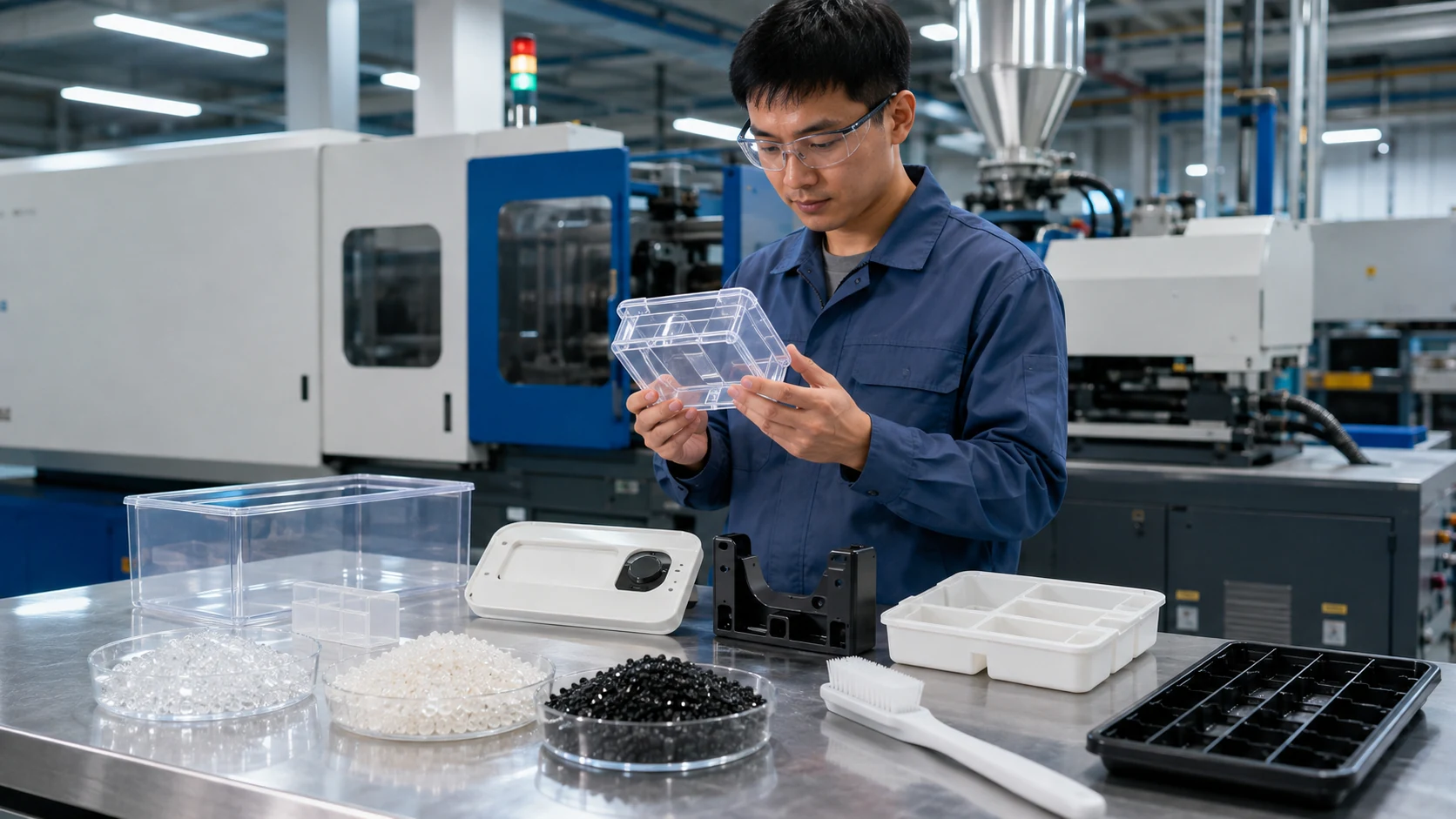
Consumer plastics repeatedly rub against people, textiles and air, so static charge can attract dust and lint or endanger electronic contents. This guide compares four antistatic ABS and PP routes and explains the drying, temperature and equipment controls needed for stable mass production.
Buyer and engineer FAQ
Questions engineers often ask about this material route
Why do consumer plastic products need permanent antistatic performance?
Surface coatings and migrating small molecules are gradually removed by friction, cleaning and environmental changes. A permanent internal network maintains static dissipation without relying on a consumable surface layer.
Which material is suitable for transparent storage boxes or display covers?
DGK-ABS KJD890TM is the relevant transparent ABS route. The current DEYU product page lists light transmittance above 85% and surface resistance of 10^9-10^10 ohm.
What are the main process controls for antistatic ABS?
Dry at 85 C for 4-5 hours with a dehumidifying dryer, keep the barrel at 195-210 C and below 220 C, use about 70 C mold temperature, and validate resistance on the molded part.
Why should antistatic ABS be isolated from carbon-black, glass-fiber and PVC production?
Residues can shift resistance, create black specks or damage appearance. PVC contamination also creates processing risk at ABS temperatures, so a dedicated barrel or thorough purging with virgin ABS is required.
Consumer plastic products repeatedly rub against the human body, textiles and moving air. Ordinary plastics can have surface resistance above 10^14 ohm and readily accumulate static charge. The consequence is not limited to dust attraction: cosmetic packaging can collect airborne particles and weaken the unboxing experience; charged vacuum-cleaner ducts retain lint and reduce airflow; transparent storage boxes lose clarity as dust builds up and require frequent wiping; and failed antistatic packaging for electronics can expose chips to electrostatic discharge damage.
Two short-term antistatic routes are common in consumer products. Surface coating applies an antistatic liquid or conductive coating to ordinary plastic. It works initially and can control cost, but weak bonding to the substrate allows friction and impact during processing, transport and use to wear the layer away. Repeated cleaning, including medical equipment wiped two or three times daily with 75% alcohol, can exhaust the coating within months.
The second route adds a migrating small-molecule antistatic agent, such as a surfactant, to the plastic. Molecules slowly migrate to the part surface and form a moisture-assisted conductive film. Rigid plastics provide restricted migration channels; friction, washing, temperature and humidity continually remove or redistribute the surface agent, and resistance can eventually drift by one or two orders of magnitude. In practical terms, both short-lived routes treat only the surface.
Consumer-product plants run large volumes, short cycles and tight cost targets, and injection molders have little time for extended process trials. A material with a wide processing window, no added coating step and antistatic function that does not decay is therefore more useful in production than a material that only produces attractive laboratory data.
DGK-ABS KJD890TM: Transparent Antistatic Route for Visible Consumer Products
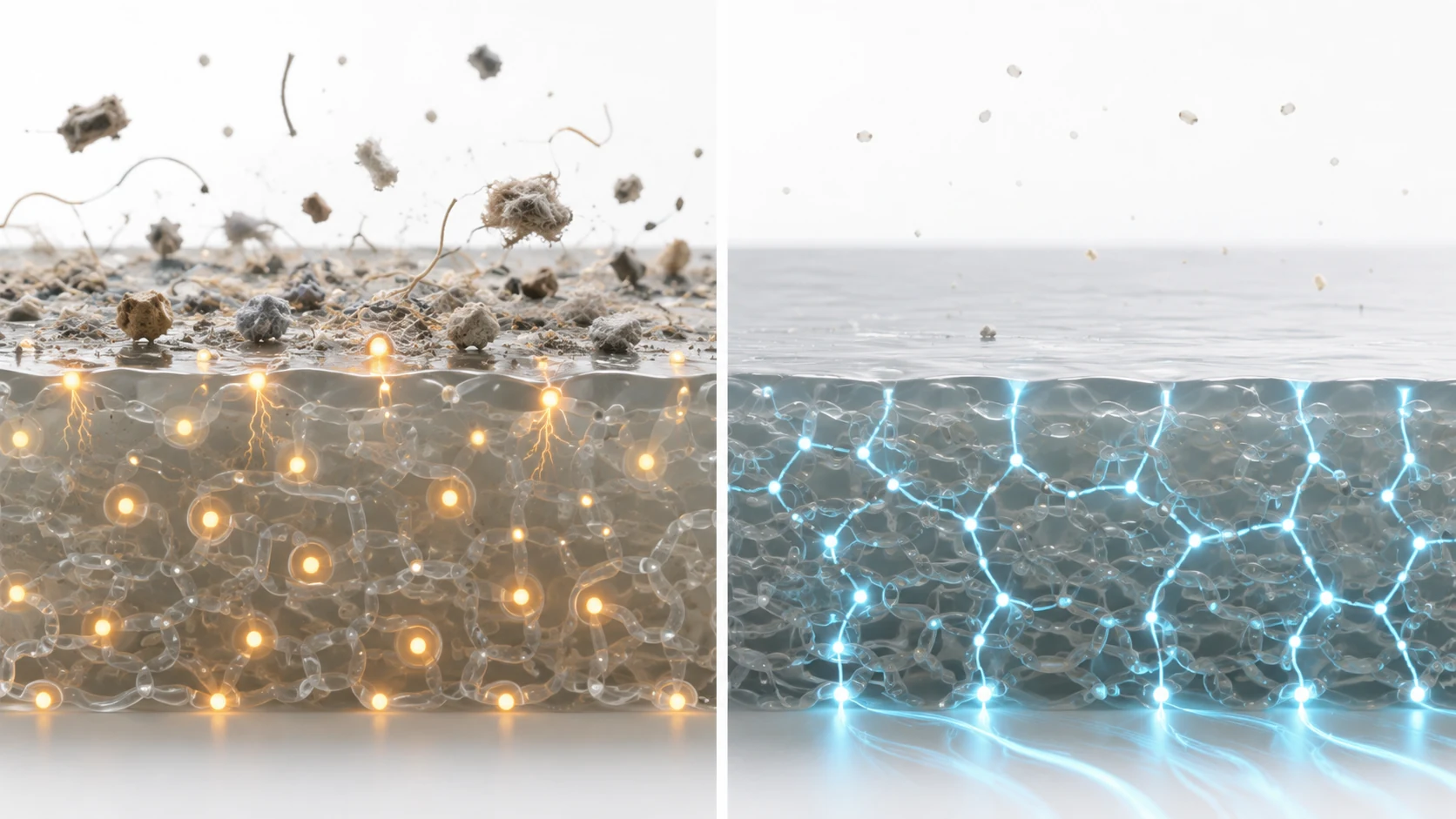
Transparent consumer parts, including cosmetic containers, storage boxes, clear appliance panels and display covers, have an inherent need for static control because dust immediately damages clarity and perceived quality. Conventional options create a structural conflict: carbon black or conductive fillers provide stable static control but make the part black and opaque, while a transparent antistatic coating can decay within months.
DGK-ABS KJD890TM follows a third route: a polymeric permanent antistatic phase is melt compounded with transparent ABS. A submicroscopic conductive network inside the matrix provides a stable dissipation path while limiting visible-light scattering. The antistatic component is anchored in polymer form and does not depend on surface migration.
The current DEYU product data lists light transmittance above 85% at 2 mm, 10^9-10^10 ohm surface resistance, 12.7 kJ/m2 Charpy notched impact, 15.3 kJ/m2 Izod notched impact, 54.6 g/10 min melt flow at 220 C/10 kg and 84.5 C heat-deflection temperature at 0.45 MPa. A haze result below 8% has been used as a project reference, but optical acceptance must be reconfirmed on the actual thickness, mold finish and test method.
Validation case: a domestic medical-equipment brand originally used ordinary ABS display covers with a sprayed antistatic layer. The covers passed at shipment, but ICU staff wiped them with 75% alcohol two or three times every day. After three to six months the layer was depleted, and electrostatically attracted dust interfered with screen reading. After conversion to KJD890TM, resistance changed by less than one order of magnitude after 500 alcohol wipes and in a 15% RH low-humidity test, remaining in the 10^8-10^9 ohm range in that molded-part validation. More than 150,000 parts have been delivered with zero customer complaints. The grade is also used for semiconductor cleanroom observation windows, optical-inspection panels and display covers for UAV ground stations.
Production points for transparent parts: the verified product-page melt-flow value is 54.6 g/10 min at 220 C/10 kg, which supports thin-wall injection molding. Transparent parts remain temperature-sensitive, so barrel temperature should stay within 195-210 C; exceeding 220 C can cause yellowing and loss of transmittance. A mold temperature near 70 C supports surface gloss. A colder mold reduces gloss, while an excessively hot mold lengthens the cycle.
DGK-ABS KJD678: Standard Antistatic Consumer Electronics Parts
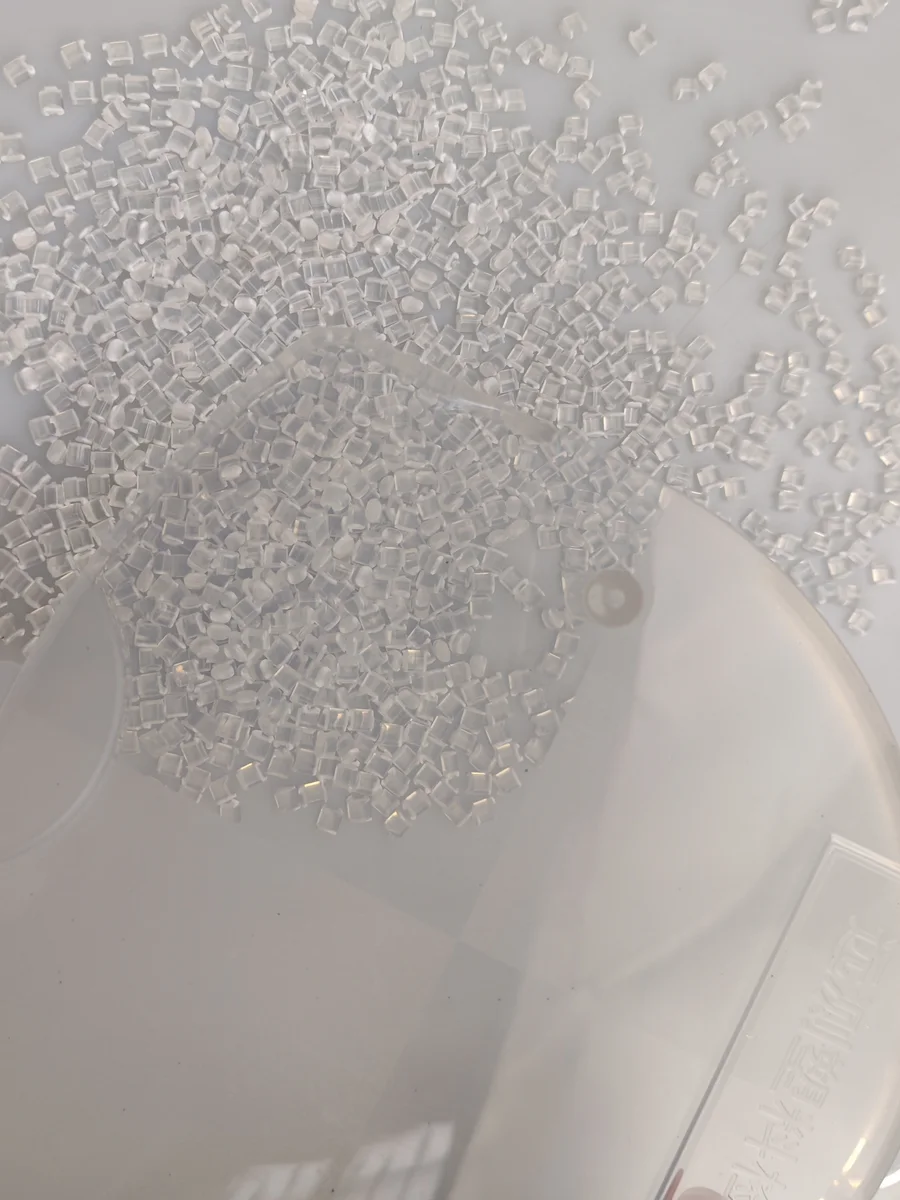
KJD678 is a black injection-grade permanent antistatic ABS described for a 10^6-10^9 ohm surface-resistance range. Its polymeric permanent antistatic system is intended to avoid order-of-magnitude drift after washing or alcohol wiping. Moderate melt flow supports thin walls, multiple ribs and deep cavities. Typical uses include communication-device housings, dust-control brackets inside printers and scanners, protective parts inside notebook computers, and compartment boxes for antistatic workshop parts. This exact grade does not currently have a dedicated website product page, so projects should verify the latest TDS and sample data before approval.
Validation case: an IC-tray injection molder in South China previously used ABS pellets modified with a migrating small-molecule agent. Parts measured 10^8 ohm at shipment, but after three months white bloom appeared and resistance rose above 10^11 ohm, causing a batch return. After switching to KJD678, 12,000 consecutive parts measured within 10^6-10^9 ohm at all points and the within-batch coefficient of variation was below 12%. Accelerated aging at 60 C/90% RH for 72 hours produced no bloom, and resistance remained within the same order of magnitude. The plant made the grade a standard material at about 15 tonnes per month.
Production points: dry at 85 C for 4-5 hours in a dehumidifying dryer with dew point at or below -30 C. Use 195-210 C barrel temperature and do not exceed 220 C; use a 70 C mold, 45-85 MPa injection pressure, medium injection speed, 0.3-0.5 MPa back pressure and 40-60 rpm screw speed. A dedicated screw and barrel are recommended. Do not share production with carbon-black conductive compounds, glass-fiber compounds or PVC. Carbon-black residue can pull resistance below 10^5 ohm and out of the intended dissipative range.
DGK-ABS KJD678R-BZ: High Toughness and a Clean Natural-Color Base
DGK-ABS KJD678R-BZ uses a non-migrating polymeric antistatic system. The antistatic phase is distributed through the ABS matrix to form a continuous static-dissipation path without oily bloom or frosting. DEYU's current product data gives 10^7-10^9 ohm surface resistance, 24 kJ/m2 Izod notched impact, 21 kJ/m2 Charpy notched impact and 1921 MPa flexural modulus. Its clean natural-color base can be used directly or color matched for light blue, light gray and other appearance requirements.
Applications include cleanroom fixtures, inspection-instrument housings, antistatic compartment boxes, light-colored appliance control panels and visible electronic housings that require both appearance quality and toughness.
Validation case: a cleanroom-fixture manufacturer in East China produced antistatic compartment boxes and inspection housings that required a light appearance without oily deposits. The previous online antistatic coating failed within two months of frequent alcohol wiping and accumulated deposits in slot corners. With KJD678R-BZ, surface resistance changed by less than one order of magnitude after 500 alcohol wipes and remained within 10^7-10^9 ohm. Molded surfaces had no oily feel or deposits, and 80,000 parts were delivered with zero complaints.
Production points follow the verified ABS window: dry at 85 C for 4-5 hours, use 195-210 C melt temperature and about 70 C mold temperature. Light-colored parts demand stricter equipment cleanliness. Purge with virgin ABS for 10-15 minutes before material changeover to avoid black specks and pits.
DGK-PP KJD789R-A1: Cost-Sensitive High-Volume Consumer Products
PP is the lightest major commodity plastic, with typical density around 0.90-0.91 g/cm3, and combines chemical resistance with convenient processing. It is suitable for cost-sensitive high-volume consumer products. The exact website grade is DGK-PP KJD789R-A1. Its current TDS lists 10^9-10^10 ohm surface resistance, 0.93 g/cm3 density, 7 g/10 min MFR at 230 C/2.16 kg, 17 MPa tensile strength, 1790 MPa flexural modulus, 6.5 kJ/m2 Charpy notched impact and 93 C heat-deflection temperature. The natural base can be color matched.
Applications include antistatic brushes, tool handles, IC trays, circulation boxes, SMT reels and antistatic hollow-board packaging used as electronic-component dividers and box liners.
Validation data from an East China SMT contractor: a four-cavity reel with 1.8 mm wall thickness measured 1.5 x 10^10 ohm near the gate and an average 4.2 x 10^9 ohm at the four remote corners, for an overall CV of about 28%. After 48 hours at 12% RH, resistance rose from 3.8 x 10^9 to 8.5 x 10^9 ohm, remaining in the same order of magnitude. After 50 alcohol wipes it changed from 4.1 x 10^9 to 5.6 x 10^9 ohm, only 0.15 order of magnitude. Across three consecutive batches with five parts each, batch-average resistance CV ranged from 18% to 22%.
Production points: use 195-210 C barrel temperature, 70-80 C mold temperature and medium-to-low injection speed. Increase gate cross-section where necessary to reduce shear on the antistatic phase, and verify cavity-to-cavity filling balance in multi-cavity molds.
General Production Controls for Antistatic Consumer Parts
Drying is the first control. Antistatic ABS is moisture-sensitive. Water vapor in the melt creates microvoids at the interface between the antistatic phase and the matrix, interrupting dissipation paths and raising resistance. DEYU DGK-ABS grades use 85 C for 4-5 hours in a dehumidifying dryer with dew point at or below -30 C. Use opened bags within 48 hours where possible. If silver streaks or bubbles appear, check drying before changing injection parameters.
Treat 220 C as a hard upper limit. Keep the barrel at 195-210 C; overheating can decompose the antistatic phase, yellow the part and destabilize resistance. A starting profile is 190-195 C at the rear, 200-205 C in the middle, 205-210 C at the front and 200-205 C at the nozzle. About 70 C mold temperature is recommended. Below 50 C, resistance may rise and anisotropy can become more pronounced; above 80 C, cycle time increases.
Equipment isolation cannot be ignored. Use a dedicated screw and barrel for antistatic ABS and do not share with carbon-black conductive compounds, glass-fiber reinforced plastics or PVC. Purge with virgin ABS for 10-15 minutes before changeover. Cross-contamination is often delayed rather than immediate: resistance drifts gradually and isolated black specks appear. In one DEYU investigation, three days of troubleshooting were needed before residue from the previous carbon-black compound was identified.
Quick Selection Table
| Requirement | Recommended grade | Surface resistance | Key characteristics |
|---|---|---|---|
| Transparent visible products: storage boxes, cosmetic packaging and panels | DGK-ABS KJD890TM | 10^9-10^10 ohm | Light transmittance above 85%; permanent transparent route; wipe resistant |
| Standard antistatic electronic parts: housings, brackets and trays | DGK-ABS KJD678 | 10^6-10^9 ohm | Black; cost-effective; current project TDS must be confirmed |
| High toughness and clean light appearance: fixtures, housings and compartment boxes | DGK-ABS KJD678R-BZ | 10^7-10^9 ohm | 24 kJ/m2 Izod notched impact; natural-color base; colorable |
| Cost-sensitive volume products: brushes, handles and circulation boxes | DGK-PP KJD789R-A1 | 10^9-10^10 ohm | Lightweight; chemical resistant; 7 g/10 min MFR; colorable |
The most practical production rule for antistatic consumer plastics is straightforward: control drying at 85 C for 4-5 hours, control melt temperature below 220 C, and control equipment by preventing mixing with conductive compounds. When these three items are managed, resistance stability, appearance yield and antistatic durability become much more predictable. DEYU DGK-ABS materials have been validated in medical monitor panels with 150,000 parts and zero complaints, IC trays with 12,000 consecutive parts and within-batch CV below 12%, and cleanroom fixtures with 80,000 parts and zero complaints.