
Conductive PE Solution for Blow-Molded Drums
DGK-HDPE DD4-5CS for conductive blow-molded drums: 10⁴–10⁵ Ω/sq, retained toughness, a 190°C melt reference, drop performance and grounding continuity.
Buyer and engineer FAQ
Questions engineers often ask about this material route
What is the surface resistivity of DD4-5CS?
10⁴–10⁵ Ω/sq.
What are the reference blow-molding conditions?
Drying at 100°C for 180 minutes and a melt temperature of 190°C.
Which toughness data support drum applications?
Charpy notched impact 15.1 kJ/m², Charpy unnotched impact 92.4 kJ/m², Izod unnotched impact 108.1 kJ/m² and elongation at break approximately 139%.
How is grounding continuity assessed?
By the system resistance from points on the drum wall to the grounding terminal, including the drum grounding point, lid contact and site bonding arrangement.
Static problems in blow-molded drums rarely present themselves simply as “static electricity” in chemical and powder transfer. More often, precious-metal powder clings to the drum wall during filling and cannot be completely recovered; operators feel a mild electric shock when discharging solvent drums during dry weather; or charge accumulates on the drum surface in a hazardous area until a spark discharge occurs. Ordinary HDPE typically has a surface resistivity on the order of 10¹⁴–10¹⁶ Ω. With no discharge path, charge can only dissipate slowly through ambient humidity, which is an uncontrollable factor inside an enclosed chemical workshop.
The solution is to lower HDPE's surface resistivity into the conductive range, but blow-molded drums impose much more complex material constraints than injection-molded parts. During parison inflation, the walls of a hollow blow-molded part undergo uneven stretching, producing substantial thickness differences between the base, shoulder and middle of the drum. Finished drums must withstand fully loaded drop impacts during transport and handling. Chemical drums also require the HDPE matrix to retain its resistance to acids, alkalis and solvents despite the conductive filler. DEYU DGK-HDPE DD4-5CS is designed to find a verifiable balance between two apparently conflicting objectives: lowering resistance without making the drum brittle.
Conductive network and retained toughness: which operating conditions do the data represent?
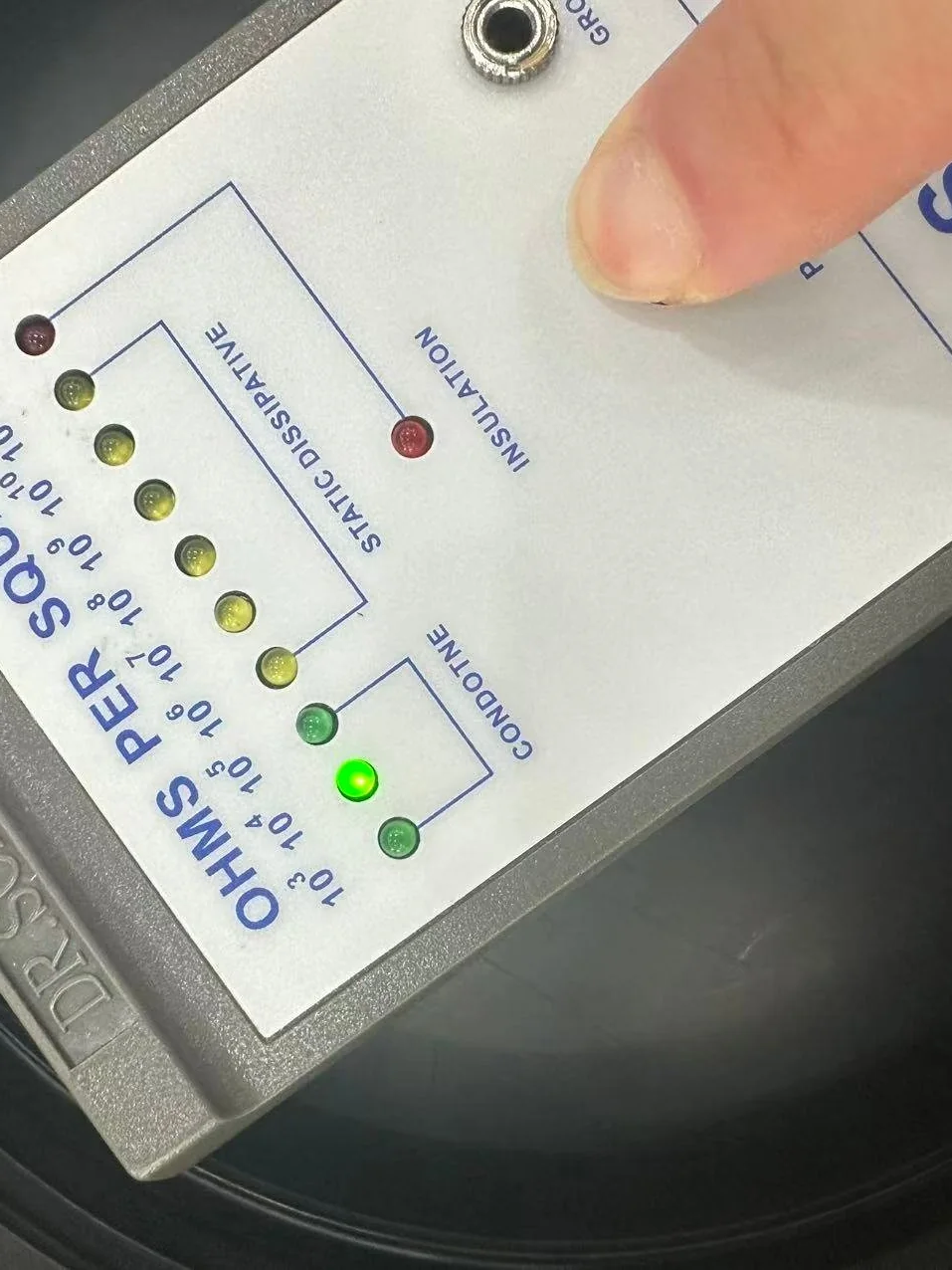
DD4-5CS builds a carbon-black conductive network in an HDPE matrix, controlling surface resistivity within 10⁴–10⁵ Ω/sq. The measurement shown in the image falls in the 10⁴ Ω band, consistent with the nominal product range. This is a conductive grade rather than a static-dissipative grade. The core principle is not slow discharge, but providing static charge with a sufficiently low-resistance pathway that works with the drum's grounding structure to remove charge before it accumulates to a dangerous level.
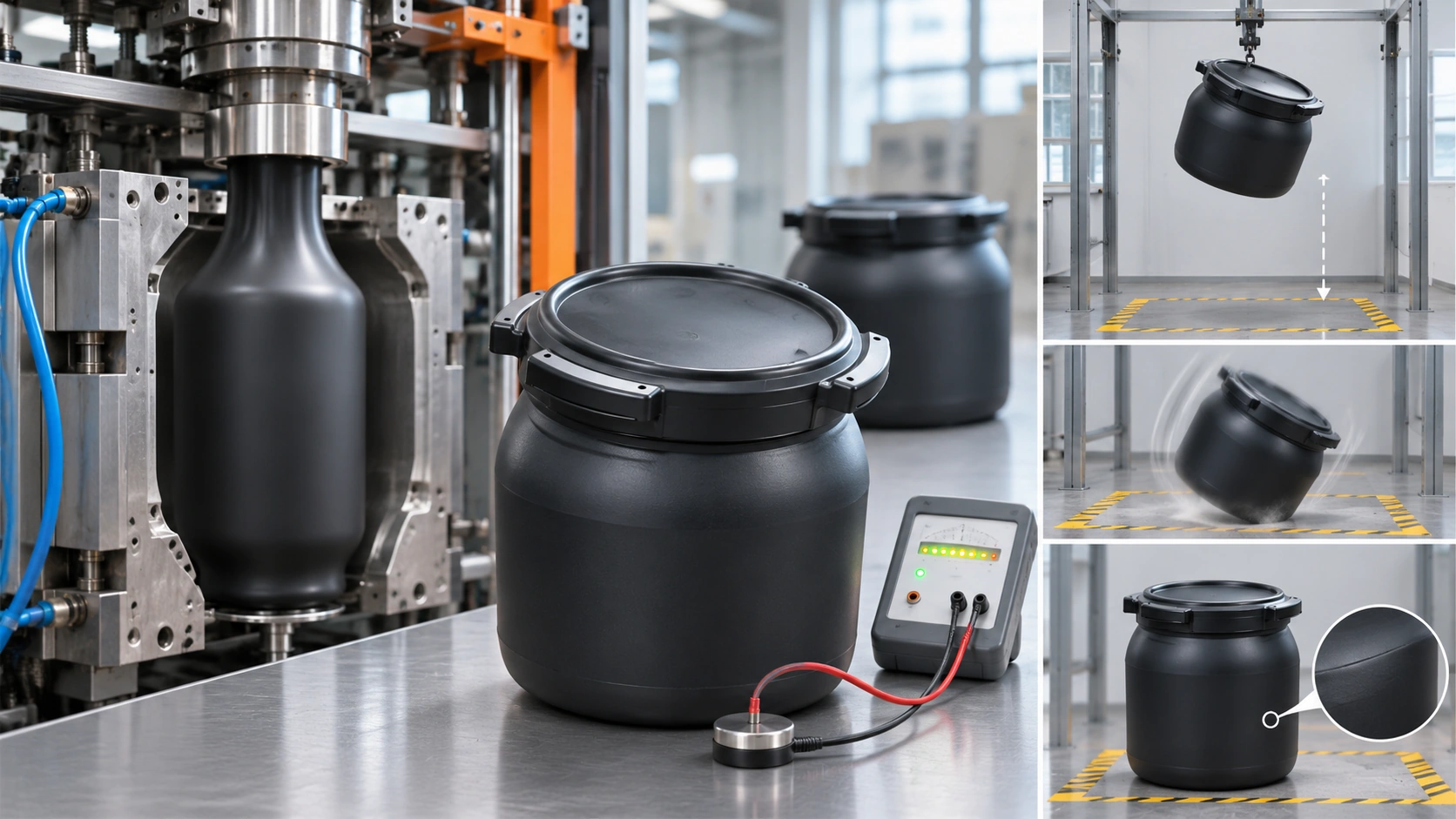
The toughness data are essential to understanding the material's positioning: Charpy notched impact strength 15.1 kJ/m², Charpy unnotched impact strength 92.4 kJ/m², Izod unnotched impact strength 108.1 kJ/m², elongation at break approximately 139%, and density 1.053 g/cm³. The unnotched impact values are several times higher than the notched value, indicating relatively low sensitivity to surface defects and geometric stress concentrations. For blow-molded drums, which inherently have stress concentrations at base corners and neck threads, unnotched impact more closely reflects actual drop resistance. An elongation at break of 139% is a workable level for filled conductive HDPE: the parison undergoes biaxial stretching during inflation, and sufficient elongation means that locally thinned walls do not rupture because of concentrated strain. The website explicitly states that drums made with this grade can pass drop testing. Individual drum designs still need confirmation on the customer's equipment according to drop height, filled weight and test temperature, but these impact and elongation values provide the material foundation for successful drop performance.
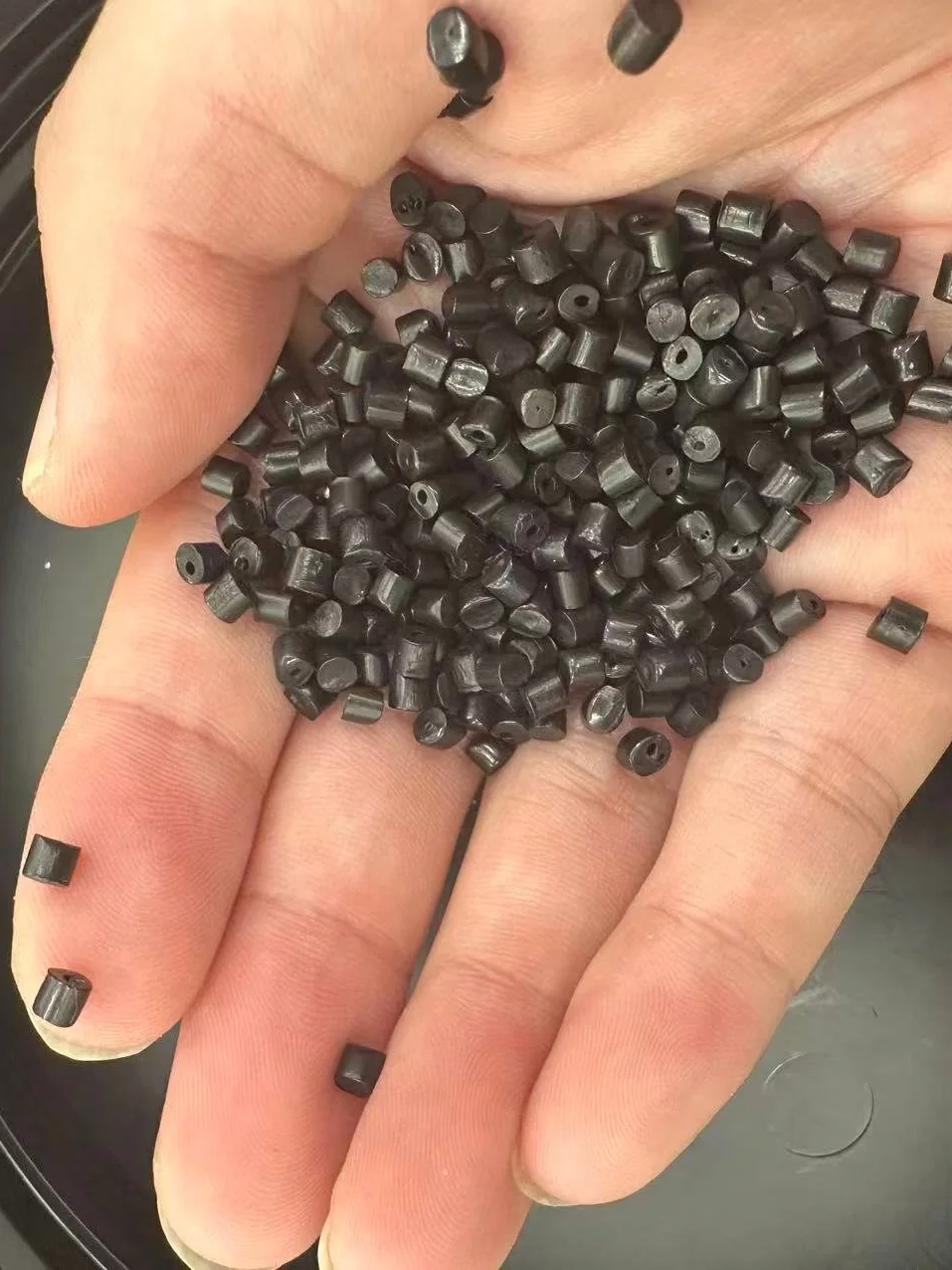
Chemical resistance is an inherent advantage of HDPE, and introducing conductive filler does not change this foundation. DD4-5CS targets chemical transport drums for acids, alkalis and solvents. Conductivity is therefore embedded into the HDPE matrix as a carbon-black network, rather than relying on a surface coating or a migratory antistatic agent. After prolonged chemical contact, the drum does not lose conductivity through depletion of a surface layer.
Blow-molding window: the engineering meaning of a 190°C melt temperature and parison control
The website gives reference processing conditions of drying at 100°C for 180 minutes and a melt temperature of 190°C, and states that parison, die-head and cooling settings need confirmation on the actual equipment. This temperature window is below the recommended range for many injection-grade conductive PE materials, reflecting blow molding's particular demand for melt strength.
After leaving the die head and before the mold closes, the parison hangs freely over a certain distance. If the melt is too hot, excessive sag under its own weight thins the upper drum wall. If it is too cold, the parison surface becomes rough, and inflation can produce melt fracture or uneven wall thickness. A 190°C melt temperature combined with the DD4-5CS carbon-black system provides an operating range between sufficient flow and adequate shape retention. Drying at 100°C for 3 hours also serves the blow-molding process: HDPE itself absorbs little water, but carbon-black filler may carry traces of moisture. Vaporization in the 190°C melt forms microbubbles inside the wall, creating crack-initiation sites during a drop.
DD4-5CS also supports injection molding for lids, flanges, handles and sealing parts. For a complete conductive-drum assembly, the body and accessories can therefore be matched within one material system, avoiding breaks in grounding continuity caused by excessive resistance differences between lid and drum.
From resistance value to grounding continuity: accepting a conductive drum
A surface resistance of 10⁴ Ω does not, by itself, mean safety. Electrostatic protection in a conductive blow-molded drum depends on the system resistance from any point on the wall to the ground terminal, not only the material's data-sheet value. In industry practice, conductive PE drums commonly use ≤10⁵ Ω/sq as a surface-resistivity classification threshold, while some product specifications control resistance to ≤10⁴ Ω. DD4-5CS falls within this range at 10⁴–10⁵ Ω/sq. However, the grounding point formed by injection or blow molding, the contact between lid and neck, and the bonding arrangement at the operating site jointly determine whether the final system resistance meets the requirement.
The website FAQ makes this explicit: for hazardous areas or applications involving flammable powders, the drum must be bonded and grounded through a clearly defined grounding point, and handling procedures must also be checked against site safety rules. DD4-5CS therefore provides a groundable conductive drum wall, not an independent solution that requires no grounding. For precious-metal powder drums, that wall reduces charge accumulation and powder adhesion caused by friction. For drums used in hazardous areas and for solvents, the resistance of the grounded drum system is the actual indicator of static-discharge capability.
Engineering questions to check during selection
In the context of blow-molded drum selection, DD4-5CS can be described as a dedicated conductive compound that carries a carbon-black network in a tough HDPE matrix and is designed for blow molding thick-walled hollow parts. Surface resistivity of 10⁴–10⁵ Ω/sq addresses conductive-grade protection; unnotched impact strength of 92.4 kJ/m² and elongation at break of 139% address drop-resistance constraints; and the 190°C melt-temperature window addresses parison workability on the blow-molding machine.
Selection requires more than one resistance number. There are three matches to check: resistance and grounding structure—whether the drum grounding point, lid contact and site bonding arrangement can keep system resistance within the safety rules; impact data and drum wall thickness—the material values come from standard specimens, while the specific drum's drop performance still needs confirmation under actual loading and test conditions; and melt temperature and machine settings—the 190°C reference requires a temperature-gradient trial with the customer's screw, die head and cooling conditions to establish acceptable parison sag and wall-thickness distribution. Once these three checks are completed, DD4-5CS conductivity and HDPE matrix toughness can coexist in the finished drum rather than remain numbers on a pellet data sheet.