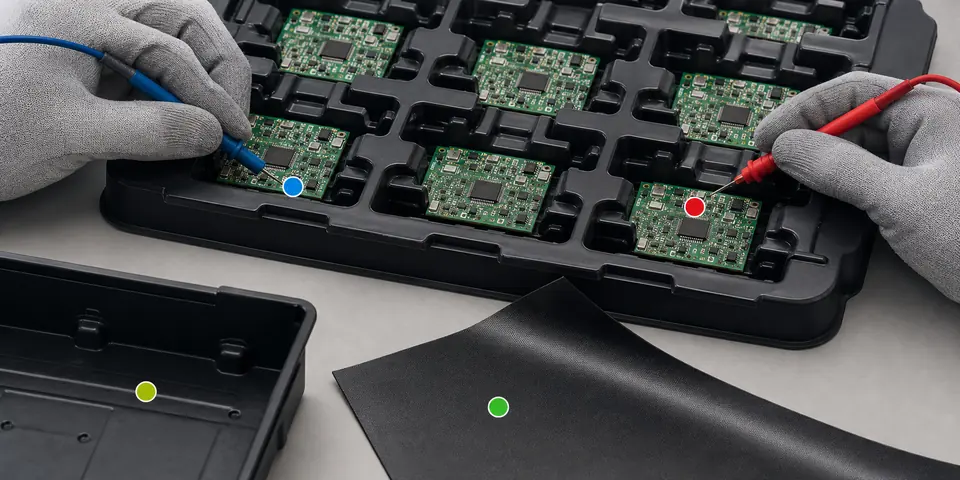
Conductive PE and PP for ESD Trays, Liners and Logistics Components
This page is designed for buyers and engineers who need to select a conductive plastic compound based on real application validation, not only a single resistance value.
Buyer and engineer FAQ
Questions engineers often ask about this material route
Which conductive PP and PE grades cover the 10^2 to 10^5 ohm band for ESD trays and liners?
DGK-PP DD2-3A targets 10^2-10^3 ohm for low-resistance PP parts and shielding-related components. DGK-PP DD4-5A-JC holds 10^3-10^5 ohm with V-0 flame retardancy in black. DGK-LDPE DD4-5 delivers surface resistance around 10^3-10^5 ohm for molded ESD parts and conductive PE applications. Above that band, DGK-POM DD4-5ML covers 10^4-10^5 ohm with a glossy surface and good toughness.
How does the DGK conductive PP and PE direction perform in ESD tray and liner logistics handling?
In the internal customer case, surface resistance moved from >10^13 ohm on the original direction and 10^8-10^10 ohm on the previous trial to a 10^5-10^8 ohm target on the DEYU validation direction. Dust adhesion dropped from high to low, liner sticking during stacking went from obvious to controlled, and the logistics complaint rate fell from 6.0% to 3.4%.
What changes in tray warpage and liner sticking when conductive PP is molded at a 1,500-piece trial quantity?
The DEYU validation direction ran at 1,500 pcs, against 500 pcs for the original direction and 1,000 pcs for the previous trial. Tray warpage, medium on both earlier directions, was reduced by process tuning. Liner sticking during stacking, obvious on the original direction and reduced on the previous trial, came under control. Wall thickness, gate position, filler orientation, cooling rate and drying set the conductive network in the molded part.
When does DGK-ABS CF15L suit rigid ESD trays better than graphite conductive DGK-ABS DD3C compound?
DGK-ABS CF15L delivers flexural strength >=138 MPa and surface resistance <=10^4 ohm-cm, which suits rigid carbon-fiber conductive ABS parts. DGK-ABS DD3C is a graphite conductive ABS around 10^3-10^4 ohm for conductive ABS housings and ESD cases. PA66 structural parts with higher strength demand DGK-PA66 CF15L-CF40L, customizable from 15% to 40% carbon fiber.
What data and samples does DEYU need before quoting a conductive PE or PP compound for ESD trays and logistics boxes?
Send the base resin, target resistance range and test method, plus a part drawing or sample, wall thickness, processing method, color, impact target, warpage limit, flame-retardant or wear requirement, and application environment. For liners and logistics boxes, state the stacking condition. DEYU uses these inputs to match resin, conductive route and resistance target, then adjust the grade in small-batch validation.
For a precise recommendation, share the part drawing, base resin, target performance, processing method and test standard with DEYU.
This page is designed for buyers and engineers who need to select a conductive plastic compound based on real application validation, not only a single resistance value.
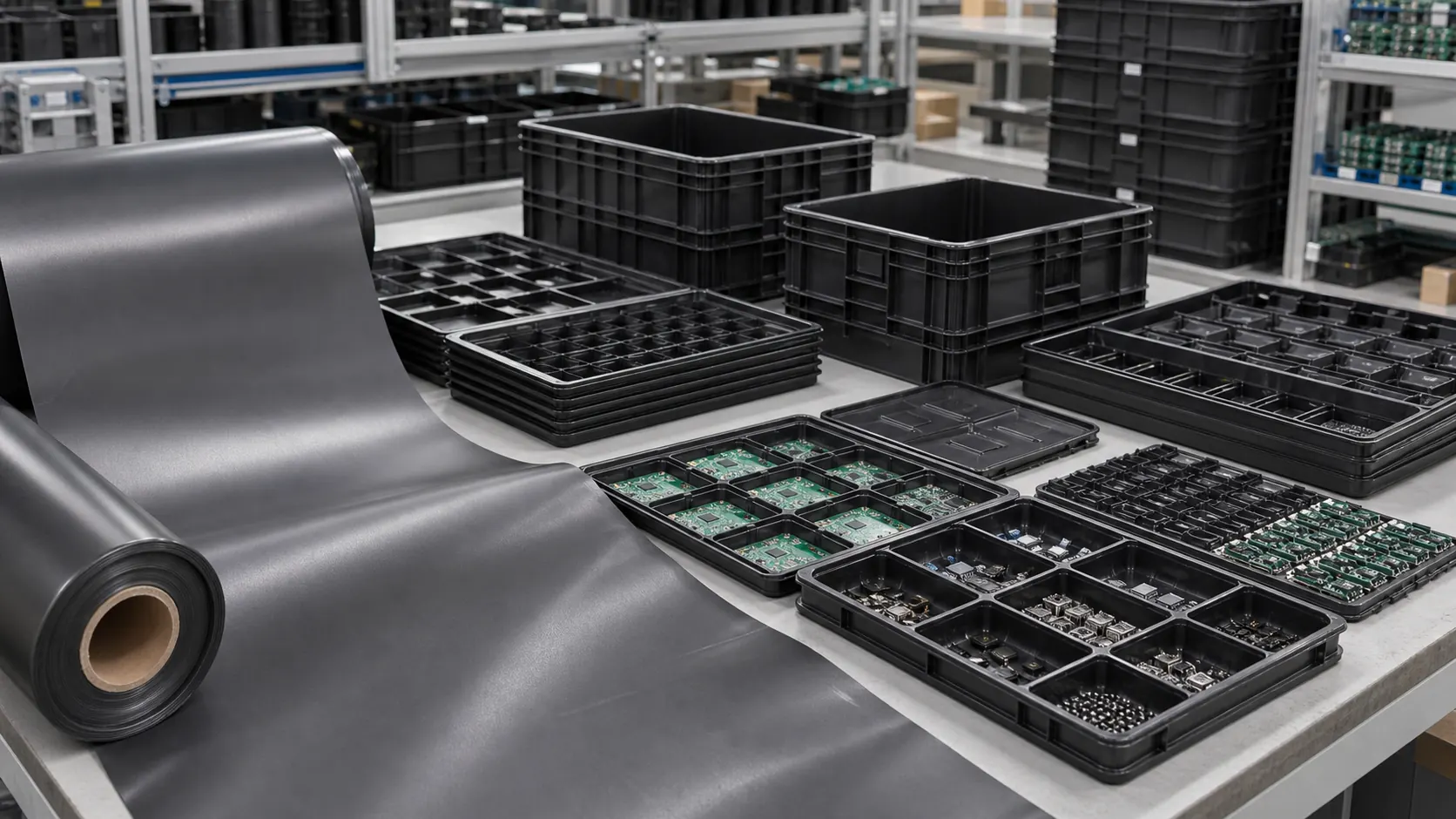
Conductive Plastics and DGK-LDPE DD4-5 Conductive PE. For tray and liner projects, the material route should be confirmed on the final molded tray or extruded liner surface.
1. Background / Problem
Conductive plastics are not selected only by checking whether a material can reach a target resistance value. In production, buyers usually need to balance conductivity, injection molding stability, mechanical strength, surface appearance, cost and long-term reliability.
Passing a pellet or standard plaque test does not automatically mean the final molded part will pass. Wall thickness, gate position, filler orientation, cooling rate, drying and service conditions can all change the conductive network.
2. Technical Difficulty / Why It Happens
Conductive modification changes the original behavior of the base resin. Common technical conflicts include:
- DGK-LDPE DD4-5 provides a corrected direction of around 10^3-10^5 ohm for molded ESD parts.
- PP trays often need impact balance and low-warpage tuning in addition to static control.
- PE liners and sheets should be measured on the final surface after extrusion, cooling and stacking.
- A tray that passes one point of resistance testing can still fail if corners, ribs or flow ends vary too much.
For this reason, DEYU treats conductive plastic selection as an application system: base resin, filler route, resistance target, mechanical balance and final-part validation must be matched together.
3. DEYU Material Direction
DEYU may recommend different DGK material directions according to resistance target, base resin and application environment.
| Grade | Base Resin | Corrected Data Direction | Typical Use |
|---|---|---|---|
| DGK-PP DD2-3A | PP | Conductive 10^2-10^3 ohm | Low-resistance PP parts, shielding-related components |
| DGK-PP DD4-5A-JC | PP | V-0; 10^3-10^5 ohm; black | Flame-retardant conductive PP parts |
| DGK-LDPE DD4-5 | PE | Surface resistance around 10^3-10^5 ohm | Molded ESD parts and conductive PE applications |
| DGK-ABS DD3C | ABS | Graphite conductive ABS, around 10^3-10^4 ohm | Conductive ABS housings and ESD cases |
| DGK-ABS CF15L | ABS | Flexural strength >=138 MPa; surface resistance <=10^4 ohm-cm | Rigid carbon-fiber conductive ABS parts |
| DGK-PA66 CF15L-CF40L | PA66 | 15%-40% carbon fiber customizable | High-strength conductive PA66 structural parts |
| DGK-POM DD4-5ML | POM | Conductive 10^4-10^5 ohm; glossy surface and good toughness | Sliding ESD parts and electronic accessories |
| DGK-TPU DD3-4ML | TPU | Conductive 10^4-10^6 ohm; hardness 66 R | Flexible conductive and wear-resistant parts |
| DGK-TPR DD6-9A | TPR | Conductive 10^6-10^9 ohm; hardness 70 | Soft ESD parts and sealing strips |
4. Reference Product Data
The values above are reference values aligned with current DEYU product data. For a final supply decision, exact values should still be confirmed by DEYU internal testing and customer part validation.
5. Real Customer Application Case
In this internal customer case, a customer compares an original material, a previous trial and a DEYU DGK trial direction. The goal is not only lower resistance, but stable molding, surface quality, mechanical balance and part-level pass rate after internal testing.
6. Validation Data Table
| Item | Original Direction | Previous Trial | DEYU Validation Direction |
|---|---|---|---|
| Trial quantity | 500 pcs | 1,000 pcs | 1,500 pcs |
| Surface resistance | >10^13 ohm | 10^8-10^10 ohm | 10^5-10^8 ohm target |
| Dust adhesion | High | Medium | Low |
| Tray warpage | Medium | Medium | Reduced by process tuning |
| Liner sticking during stacking | Obvious | Reduced | Controlled |
| Logistics complaint rate | 6.0% | 3.4% | Target <1.5% |
This case is based on a real customer scenario from DEYU's internal project records.
7. Result Interpretation
The key improvement is not simply lowering resistance. A correct conductive compound must keep a stable conductive network after compounding, drying, molding and final use.
For PP and PE, dispersion and flowability are usually critical. For ABS and PA66, stiffness, warpage and assembly cracking must be checked. For POM, TPU and TPR, wear, elasticity and contact behavior should also be evaluated.
8. Suitable Applications
- ESD trays and conductive liners
- Conductive housings and fixtures
- Carbon-fiber reinforced ABS and PA66 structural parts
- Conductive POM sliding components
- Conductive TPU and TPR flexible parts
- Flame-retardant conductive PP components
9. What Buyers Should Provide
To improve validation efficiency, buyers should provide the base resin, target resistance range, test method, part drawing or sample, wall thickness, processing method, color requirement, impact target, warpage requirement, flame-retardant or wear requirement and application environment.
Conclusion
Conductive plastic selection should be validated by matching resin system, conductive route, resistance target, mechanical balance and actual molded part performance. DEYU can support DGK conductive PP, PE, ABS, PA66, POM, TPU and TPR material directions for small-batch validation and application-based adjustment.