
Conductive Plastics in Mechanical Equipment: Applications, Routes and Case Data
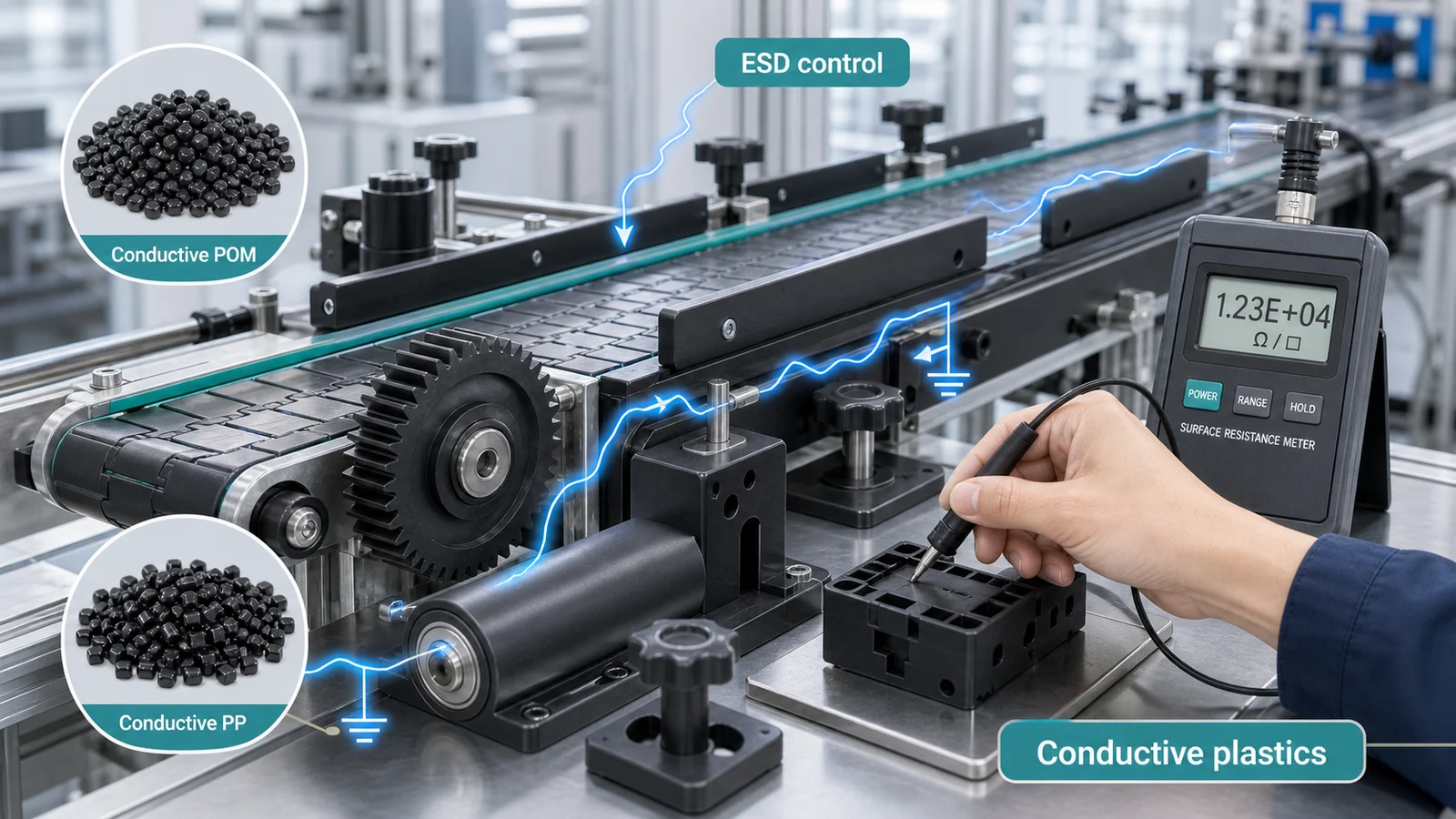
Conductive plastics for mechanical equipment solve static charge, dust adhesion, powder sticking, ESD risk, wear debris and unstable sensing in conveyors, rollers, guides, gears, fixtures and automation parts.
Buyer and engineer FAQ
Questions engineers often ask about this material route
Where can PP with a conductive plastic requirement be used?
Typical fields include ESD trays, electronic housings, fixtures, EMI parts and antistatic logistics parts. For this article, DEYU would first confirm the working environment, wall thickness, expected lifetime and whether DGK-POM DD4-5ML conductive POM, DGK-PP DD2-3A conductive PP matches the part geometry or needs formulation adjustment.
What are the main performance indicators for the "conductive plastic" target on PP?
Focus on surface resistance, volume resistance, dispersion uniformity, impact strength and molding stability. Buyers should ask for data on molded parts, not only pellet data, because gate position, filler orientation and thickness can change the final value.
What should engineers watch during injection molding or processing?
For PP, a practical starting window is 190-230°C melt / 30-60°C mold. Avoid excessive filler loading, control weld lines and verify resistance on the molded part. Final parameters should follow part thickness, gate design and the actual machine.
What details help DEYU recommend DGK-POM DD4-5ML conductive POM, DGK-PP DD2-3A conductive PP more accurately?
Send the current resin or grade, drawing or photo, wall thickness, annual quantity, target standard, failure mode and required color. If a reference grade already passed one test but failed in production, include both data sets.
For a precise recommendation, share the part drawing, base resin, target performance, processing method and test standard with DEYU.
Short Answer
Conductive plastics are used in mechanical equipment not only for electrical conductivity, but also to solve real production problems: static charge accumulation, dust adhesion, powder sticking, unstable sensor triggering, ESD risk near electronic modules, wear debris, noise and frequent cleaning.
In mechanical systems, conductive plastic parts are often used in guide rails, rollers, sliders, gears, bushings, conveyor components, textile machines, packaging machines, powder feeding systems, automatic fixtures, electronic assembly jigs and industrial covers.
The key is selecting the correct resistance range. Not every mechanical part needs extremely low resistance. Some parts only need antistatic control around 10^9 to 10^11 ohm. Some need static-dissipative behavior around 10^6 to 10^9 ohm. Other parts need conductive behavior around 10^3 to 10^6 ohm. If resistance is too low, cost, color, impact strength and molding may become more difficult. If resistance is too high, static control may be insufficient.
Yuyao Deyu DEYU plastics develops DGK conductive materials according to real equipment requirements: base resin, target resistance, wear resistance, strength, dimensional stability, flame retardancy, low dust, low noise and molding process. Related product directions include DGK-POM DD4-5ML conductive POM and DGK-PP DD2-3A conductive PP.
Why Mechanical Equipment Needs Conductive Plastics
In many factories, static electricity is not only an electrical issue. It directly affects mechanical stability and production quality.
Static charge can cause:
- dust and powder adhesion
- plastic sheets sticking together
- unstable feeding
- unstable sensor signals
- film or paper misalignment
- ESD damage near electronic modules
- surface contamination
- operator discomfort
- more frequent cleaning
- unexpected downtime
Traditional metal parts conduct electricity, but they are heavy, noisy, may require lubrication, may damage mating parts and are not always suitable for complex molded shapes.
Ordinary insulating plastics are lightweight and easy to mold, but they may accumulate static charge.
Conductive plastics provide an intermediate solution. They keep the molding and lightweight advantages of plastics while adding controlled electrical function. For mechanical equipment, the best conductive material is not always the material with the lowest resistance. The best material is the one that solves the equipment problem while keeping wear resistance, strength, dimensional stability, molding reliability and cost under control.
1. Conductivity Levels for Mechanical Equipment
| Electrical Level | Typical Surface Resistance Direction | Main Goal | Equipment Use |
|---|---|---|---|
| Antistatic | 10^9 to 10^11 ohm | Reduce charge accumulation | Covers, housings, low-risk parts |
| Static-dissipative | 10^6 to 10^9 ohm | Controlled discharge | Fixtures, trays, guide rails, rollers |
| Conductive | 10^3 to 10^6 ohm | Faster conductive path | Powder equipment, rollers, ESD parts |
| High-conductive | 10^2 to 10^3 ohm direction | Strong conductivity | Special industrial parts, grounding elements |
The correct range depends on the application. A paper guide may only need static dissipation. A powder feeding part may need stronger conductivity. A gear may need wear resistance first and conductivity second.
2. Technical Routes for Conductive Plastics
Conductive Carbon Black Route
Conductive carbon black is economical and widely used. It is suitable for black conductive PP, ABS, POM, PA and other materials.
Advantages:
- stable conductivity when dispersion is controlled
- good cost control
- suitable for black industrial parts
- usable in static-dissipative and conductive ranges
Risks:
- usually limited to black color
- high loading may reduce impact strength
- flowability may decrease
- surface quality must be controlled
Carbon Fiber Route
Carbon fiber provides conductivity, stiffness, dimensional stability and lower shrinkage.
Advantages:
- conductivity plus reinforcement
- good dimensional stability
- suitable for PA66, PA6, POM, PPS, PPA and other engineering plastics
- useful for structural conductive parts
Risks:
- higher brittleness risk
- fiber orientation affects resistance
- surface may become rougher
- mating surface wear must be evaluated
Conductive Masterbatch Route
Conductive masterbatch can improve dispersion, feeding stability and production repeatability.
Advantages:
- easier production adjustment
- better dispersion than direct powder addition
- more stable surface resistance
- suitable for trials and customized materials
DEYU has conductive masterbatch routes for PP, ABS, POM, nylon and other systems.
Hybrid Route: Conductivity Plus Wear Resistance
Many mechanical parts need conductivity and wear resistance at the same time. In this case, a hybrid formulation is used.
Typical combinations include:
- conductive carbon black plus PTFE
- carbon fiber plus PTFE
- carbon fiber plus MoS2
- conductive network plus aramid fiber
- conductive masterbatch plus wear-resistant POM
- conductive PA66 plus self-lubricating additive
This route is often used for gears, sliders, rollers, guide rails, bushings and dry sliding parts.
3. Case 1: Conductive POM Guide Rail for Conveyor Equipment
Initial Situation
A customer used ordinary POM guide rails on an automatic conveyor line. The material had good dimensional stability and low friction, but it accumulated static charge during long dry sliding.
The problem appeared as:
- lightweight plastic parts were attracted to the guide rail
- dust accumulated on the rail surface
- sensors became unstable after several hours of operation
- cleaning frequency increased
Initial Data
| Parameter | Ordinary POM Guide Rail |
|---|---|
| Surface resistance | >10^13 ohm |
| Internal friction coefficient | 0.32 |
| Wear depth after sliding test | 0.18 mm |
| Dust adhesion after 8 hours | 4.6 g/m2 |
| False sensor triggers | 7 to 10 times per shift |
| Cleaning frequency | every shift |
DEYU Solution
DEYU developed a conductive wear-resistant POM route.
Formulation focus:
- conductive network design
- POM dimensional stability
- low-friction additive balance
- wear-resistant stabilizer
- controlled shrinkage
- stable injection molding
Final Data
| Parameter | Ordinary POM | DEYU Conductive Wear-Resistant POM |
|---|---|---|
| Surface resistance | >10^13 ohm | 10^6 to 10^8 ohm |
| Friction coefficient | 0.32 | 0.24 |
| Wear depth after sliding test | 0.18 mm | 0.07 mm |
| Dust adhesion after 8 hours | 4.6 g/m2 | 1.2 g/m2 |
| False sensor triggers | 7 to 10 per shift | 0 to 1 per shift |
| Cleaning frequency | every shift | every 3 shifts |
Case Conclusion
For conveyor guide rails, conductive plastic should not only control static. It must also keep low friction, wear resistance and dimensional stability. The DEYU route reduced static accumulation, dust adhesion and sensor instability while keeping the rail suitable for continuous mechanical operation.
4. Case 2: Conductive PA66 Roller for Textile Machinery
Initial Situation
In textile equipment, the customer used reinforced nylon rollers. The rollers had good strength, but fiber dust and static charge caused yarn adhesion and unstable tension.
Initial Data
| Parameter | Ordinary Reinforced PA66 Roller |
|---|---|
| Surface resistance | >10^12 ohm |
| Dust adhesion after 12 hours | High |
| Yarn tension fluctuation | +/- 14% |
| Roller surface wear after test | 0.10 mm |
| Cleaning interval | 1 day |
DEYU Solution
DEYU developed a static-dissipative PA66 route with reinforcement and wear balance.
Key adjustments:
- conductive filler dispersion
- PA66 strength retention
- low-dust surface control
- wear-resistant additive balance
- stable molding shrinkage
Final Data
| Parameter | Ordinary PA66 | DEYU Static-Dissipative PA66 |
|---|---|---|
| Surface resistance | >10^12 ohm | 10^7 to 10^9 ohm |
| Dust adhesion | High | Low to medium |
| Yarn tension fluctuation | +/- 14% | +/- 5% |
| Roller wear after test | 0.10 mm | 0.06 mm |
| Cleaning interval | 1 day | 3 days |
5. Case 3: Conductive PP Tray for Packaging Equipment
Initial Situation
A packaging line used PP trays and sliding plates. Film pieces and lightweight caps stuck to the tray surface, causing unstable feeding and manual adjustment.
DEYU Solution
DEYU developed a conductive PP material with controlled resistance and improved flowability for injection molding.
Final result:
- surface resistance reached 10^5 to 10^7 ohm
- cap sticking decreased clearly
- feeding became more stable
- molded tray warpage stayed within the customer’s tolerance
- cleaning frequency was reduced
This type of route is suitable for packaging machines, sorting equipment, conveyor trays and industrial covers where cost control and static control are both important.
6. Case 4: Conductive Wear-Resistant POM Gear for Automation Drive Module
Initial Situation
A customer used ordinary POM gears in an automation drive module. The gear had stable dimensions, but static charge and wear dust affected long-term operation.
The customer wanted:
- less static accumulation
- better wear resistance
- noise control
- stable tooth profile after long testing
Initial Data
| Parameter | Ordinary POM Gear |
|---|---|
| Surface resistance | >10^13 ohm |
| Noise after 100 hours | 62 dB |
| Tooth wear after 200 hours | 0.12 mm |
| Wear dust accumulation | Medium to high |
| Transmission interruptions | 4 times / 200 hours |
DEYU Solution
DEYU developed conductive wear-resistant POM with a conductive network, PTFE low-friction system, wear-resistant stabilizer, POM dimensional control and shrinkage correction.
Final Data
| Parameter | Ordinary POM | DEYU Conductive Wear-Resistant POM |
|---|---|---|
| Surface resistance | >10^13 ohm | 10^6 to 10^8 ohm |
| Noise after 100 hours | 62 dB | 56 dB |
| Tooth wear after 200 hours | 0.12 mm | 0.05 mm |
| Wear dust accumulation | Medium to high | Low |
| Transmission interruptions | 4 times / 200 hours | 0 to 1 time / 200 hours |
7. Case 5: Static-Dissipative PC/ABS Fixture for Electronics Assembly
Initial Situation
A customer used PC/ABS fixtures in an automatic electronics assembly line. The fixtures were strong and dimensionally stable, but the surface resistance was too high. Static accumulation near electronic modules created ESD risk.
DEYU Solution
DEYU developed a DGK-PC/ABS static-dissipative compound.
Formulation focus:
- surface resistance around 10^7 to 10^9 ohm
- impact retention
- dimensional stability
- low dust adhesion
- stable injection molding
Final Data
| Parameter | Ordinary PC/ABS | DEYU DGK-PC/ABS Static-Dissipative |
|---|---|---|
| Surface resistance | 10^12 to 10^13 ohm | 10^7 to 10^9 ohm |
| Dimensional change after 500 cycles | 0.18 mm | 0.09 mm |
| ESD warnings | 9 times / week | 0 to 1 time / week |
| Dust adhesion | Medium | Low |
| Fixture service life | 4 weeks | 6 to 8 weeks |
8. Application Scenario Summary
| Equipment Area | Typical Problem | Recommended Material Direction |
|---|---|---|
| Conveyor systems | Dust, static attraction, sensor issues | Conductive POM, conductive PP, static-dissipative PA |
| Textile machinery | Yarn sticking, dust, unstable tension | Conductive PA66, conductive PA6, wear-resistant nylon |
| Packaging machines | Film sticking, cap sticking, unstable feeding | Conductive PP, conductive ABS, antistatic PC/ABS |
| Powder equipment | Powder adhesion, difficult cleaning | Conductive ABS, conductive PP, conductive PA |
| Automation drive modules | Wear dust, static, noise | Conductive wear-resistant POM, PA/PTFE, POM/PTFE |
| Electronics assembly fixtures | ESD, dust, positioning | Static-dissipative PC/ABS, conductive POM, conductive PA |
| Industrial rollers | Static, dust, poor release | Conductive TPU, conductive PP, conductive POM |
| Protective covers | Dust adhesion, frequent cleaning | Conductive ABS, conductive PC/ABS, antistatic PP |
9. DEYU DGK Solutions for Mechanical Equipment
Yuyao Deyu DEYU plastics provides customized conductive plastic solutions for mechanical equipment.
DEYU can support:
- DGK-POM conductive wear-resistant series
- DGK-PA66 conductive reinforced series
- DGK-PA6 static-dissipative wear-resistant series
- DGK-PP conductive masterbatch series
- DGK-ABS conductive series
- DGK-PC/ABS static-dissipative series
- DGK-PPS conductive high-temperature series
- DGK-TPU conductive roller material series
- conductivity plus wear resistance
- conductivity plus flame retardancy
- conductivity plus carbon fiber
- conductivity plus low friction
DEYU can adjust base resin, surface resistance range, volume resistance range, conductive filler, conductive masterbatch dosage, wear-resistant additive, PTFE, MoS2, graphite, aramid, carbon fiber or silicone, strength, impact toughness, flowability, friction coefficient, wear rate, dimensional stability, color, flame retardancy and molding process.
To develop a suitable conductive plastic for mechanical equipment, DEYU recommends customers provide equipment type, part function, current material, current resistance, target resistance, mating material, load, sliding speed, temperature, dry or lubricated condition, dust or powder condition, wear type, static-related problem, part drawing or sample, test method, mechanical requirements, flame-retardant requirements, color and noise requirements.
Conclusion
Conductive plastics are becoming more important in mechanical equipment because they solve real production problems: static accumulation, dust adhesion, unstable feeding, powder sticking, ESD warnings, wear dust, noise and frequent cleaning.
A successful solution should not only reduce surface resistance. It should also keep strength, wear resistance, dimensional stability, flowability, surface quality and equipment reliability. Customer case data shows that conductive plastics can improve conveyor guide rails, textile machine rollers, packaging trays, automation gears and electronics assembly fixtures.
Yuyao Deyu DEYU plastics provides DGK conductive, antistatic, static-dissipative, wear-resistant, reinforced and flame-retardant compound solutions for mechanical equipment. For POM, PA6, PA66, PP, ABS, PC/ABS, PPS, TPU and other resin systems, DEYU can help customers develop materials around the real part problem, target resistance, mechanical requirements and production data.