
Conductive Plastics Selection Guide: How to Choose PP, PE, ABS, PA66, POM, TPU and TPR
Conductive plastics are engineered polymer materials that carry electrical current while maintaining the processing advantages of plastics — lightweight, corrosion resistance, design flexibility and cost-effective manufacturing. In their raw resin form, most synthetic polymers are natural insulators. Conductivity is achieved by blending insulating base polymers with conductive fillers such as carbon black, carbon fibers, graphite, carbon nanotubes (CNT), graphene, or metal-based fillers (stainless steel fibers, nickel-coated graphite, silver-coated particles).
Buyer and engineer FAQ
Questions engineers often ask about this material route
Where can ABS / PA66 / PE / POM / PP / TPR / TPU with a conductive plastic requirement be used?
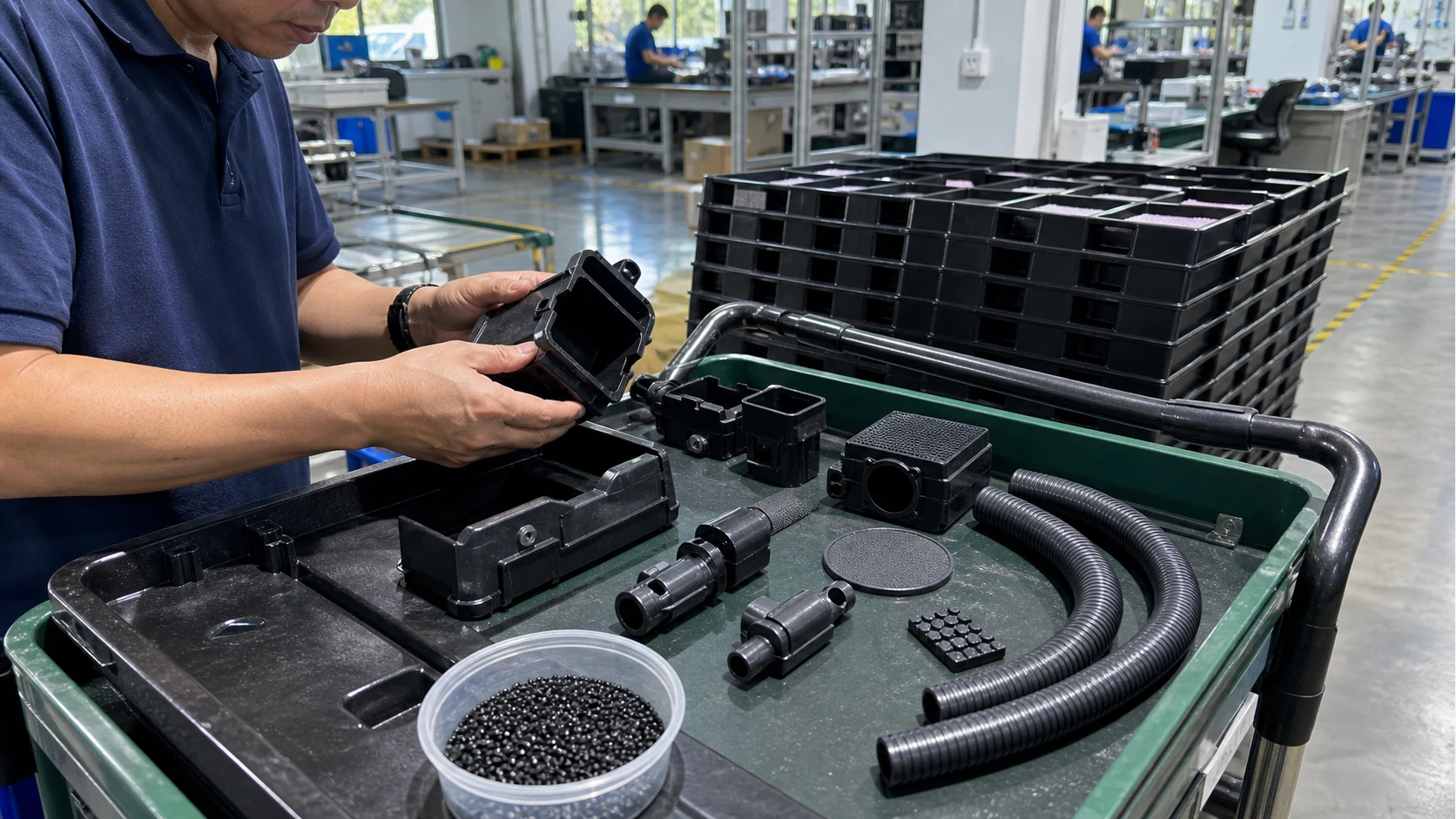
Typical fields include ESD trays, electronic housings, fixtures, EMI parts and antistatic logistics parts. For this article, DEYU would first confirm the working environment, wall thickness, expected lifetime and whether DGK-PP DD2-3A conductive PP, DGK-POM DD4-5ML conductive POM matches the part geometry or needs formulation adjustment.
What are the main performance indicators for the "conductive plastic" target on ABS / PA66 / PE / POM / PP / TPR / TPU?
Focus on surface resistance, volume resistance, dispersion uniformity, impact strength and molding stability. Buyers should ask for data on molded parts, not only pellet data, because gate position, filler orientation and thickness can change the final value.
What should engineers watch during injection molding or processing?
For ABS / PA66 / PE / POM / PP / TPR / TPU, a practical starting window is 210-245°C melt / 50-80°C mold. Avoid excessive filler loading, control weld lines and verify resistance on the molded part. Final parameters should follow part thickness, gate design and the actual machine.
What details help DEYU recommend DGK-PP DD2-3A conductive PP, DGK-POM DD4-5ML conductive POM more accurately?
Send the current resin or grade, drawing or photo, wall thickness, annual quantity, target standard, failure mode and required color. If a reference grade already passed one test but failed in production, include both data sets.
For a precise recommendation, share the part drawing, base resin, target performance, processing method and test standard with DEYU.
Background / Market Context
Conductive plastics are engineered polymer materials that carry electrical current while maintaining the processing advantages of plastics — lightweight, corrosion resistance, design flexibility and cost-effective manufacturing. In their raw resin form, most synthetic polymers are natural insulators. Conductivity is achieved by blending insulating base polymers with conductive fillers such as carbon black, carbon fibers, graphite, carbon nanotubes (CNT), graphene, or metal-based fillers (stainless steel fibers, nickel-coated graphite, silver-coated particles).
Related DEYU plastics material references for this selection topic: DGK-PP DD2-3A conductive PP and DGK-POM DD4-5ML conductive POM.
The market for conductive plastics is expanding rapidly. The global conductive plastic compounds market was valued at approximately USD 9.45 billion in 2025 and is projected to reach USD 14.56 billion by 2032, growing at a CAGR of 6.3%. The conductive plastics with carbon-based fillers segment alone is expected to grow from USD 2.02 billion in 2025 to USD 3.76 billion by 2032 at a CAGR of 9.2%. The ESD-safe plastics market, a key sub-segment, was valued at USD 328 million in 2024 and is projected to reach USD 488 million by 2032.
Key growth drivers include:
Electronics industry expansion — miniaturization and increasing sensitivity of electronic components drive demand for ESD protection
Automotive electrification — EV components require lightweight, durable conductive materials for ESD protection and EMI shielding
5G and IoT deployment — demand for EMI shielding and signal integrity management in telecommunications hardware
Stringent safety regulations — ESD control requirements across electronics manufacturing, medical devices and hazardous environments
The two primary reasons to specify conductive plastics are: (1) to reduce the risk of electrostatic discharge (ESD) that can damage sensitive electronics or ignite flammable substances, and (2) to reduce dust accumulation caused by tribocharging.
Technical Foundation: How Conductivity Works in Plastics
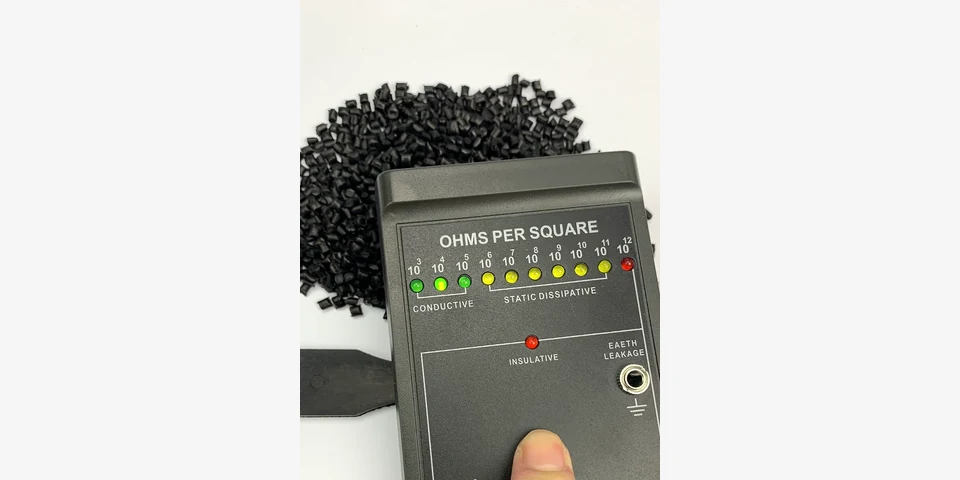
Conductive plastics are classified by surface resistivity (measured in Ω/sq) or volume resistivity (Ω·cm). The resistivity range determines the functional category:
| Category | Surface Resistivity (Ω/sq) | Volume Resistivity (Ω·cm) | Primary Function |
|---|---|---|---|
| Conductive | < 10⁴ | < 10⁵ | Rapid charge dissipation, grounding, EMI shielding |
| Static Dissipative (ESD) | 10⁴ – 10¹¹ | 10⁵ – 10¹² | Protects sensitive electronics from electrostatic discharge |
| Insulative | > 10¹¹ | > 10¹² | Standard plastics — no static control |
Conductive plastics with surface resistivity in the 10² to 10⁴ Ω/sq range have electric current decay rates measured in nanoseconds. Conductive materials are typically chosen for grounding components, ESD flooring, EMI/RFI shielding housings, and fixtures in high-risk environments where instant charge equalization is critical.
Conductive Filler Technologies
The choice of conductive filler significantly affects performance, cost and processing:
Carbon Black — Most cost-effective. Achieves conductivity at high loadings (15-20%+), which can reduce mechanical properties. Used for static dissipation and modest EMI shielding.
Carbon Fibers — Superior balance of conductivity and mechanical strength. Lower loadings (10-15%) achieve good conductivity while enhancing stiffness. Anisotropic — conductivity can vary with flow direction.
Graphene & Carbon Nanotubes (CNT) — Advanced nanofillers creating conductive networks at very low loadings (2-5%), preserving the polymer's original properties. Higher cost but enable high-performance, lightweight solutions.
Stainless Steel Fibers — Excellent EMI shielding (60+ dB) at low loadings (5-10%). Durable but abrasive to processing equipment.
Nickel-Coated Graphite — Flake-like particles ideal for shielding. Good performance but sensitive to high-shear processing.
Silver-Coated Particles — Highest performance, unparalleled conductivity. Cost limits use to critical medical or aerospace applications.
The fundamental challenge in conductive compound formulation is balancing conductivity against mechanical properties — higher filler loadings increase conductivity but often reduce impact strength and flexibility.
Material-by-Material Selection Guide
1. Conductive Polypropylene (PP)
Base Resin Characteristics: PP is a low-cost, lightweight general-purpose thermoplastic with good chemical resistance, low moisture absorption, and excellent processability. Heat deflection temperature (HDT) approximately 100°C (212°F).
Conductive Modification Routes: Carbon black-filled PP is the most common and cost-effective conductive PP grade. Carbon fiber-filled PP offers improved stiffness and mechanical strength. CNT/graphene-modified PP achieves conductivity at lower loadings while preserving impact resistance.
Typical Surface Resistivity Range: 10³ – 10⁵ Ω/sq (conductive grades); 10³ – 10¹¹ Ω/sq across the full product range.
Key Applications:
Conductive containers, IC carrier tapes, and corrugated boards for electronics packaging
Automotive interior and under-hood components requiring ESD protection
Healthcare consumables and laboratory equipment (low-extractable grades)
Lightweight structural parts in EV battery systems
Selection Considerations:
Advantages: Lowest cost among conductive thermoplastics; lightweight (density ~0.91-0.95 g/cm³); excellent chemical resistance; good processability
Limitations: Lower mechanical strength and HDT compared to engineering plastics; carbon black-filled grades can have reduced impact strength at high loadings
Best suited for: Large-volume, cost-sensitive applications where mechanical demands are moderate
Reference Product Data (PP-based conductive compound):
| Property | Value | Test Method | Notes |
|---|---|---|---|
| Base Resin | PP | — | Homopolymer or copolymer |
| Modification Route | Carbon black / Carbon fiber | — | Reference direction |
| Processing Method | Injection molding, extrusion | — | — |
| Density | 0.95 – 1.10 g/cm³ | ASTM D792 | Reference direction |
| MFR | 5 – 20 g/10min | ASTM D1238 | Grade-dependent |
| Tensile Strength | 20 – 35 MPa | ASTM D638 | Reference direction |
| Flexural Modulus | 1,500 – 3,500 MPa | ASTM D790 | Reference direction |
| Notched Impact Strength | 2 – 6 kJ/m² | ISO 179 | Reference direction |
| HDT (1.82 MPa) | 90 – 110 °C | ASTM D648 | Reference direction |
| Surface Resistivity | 10³ – 10⁵ Ω/sq | ASTM D257 | Reference direction |
2. Conductive Polyethylene (PE)
Base Resin Characteristics: PE is a low-cost, flexible polyolefin with excellent chemical resistance, low moisture absorption, and good electrical insulation properties in its base form. Available in HDPE, LDPE, and LLDPE variants.
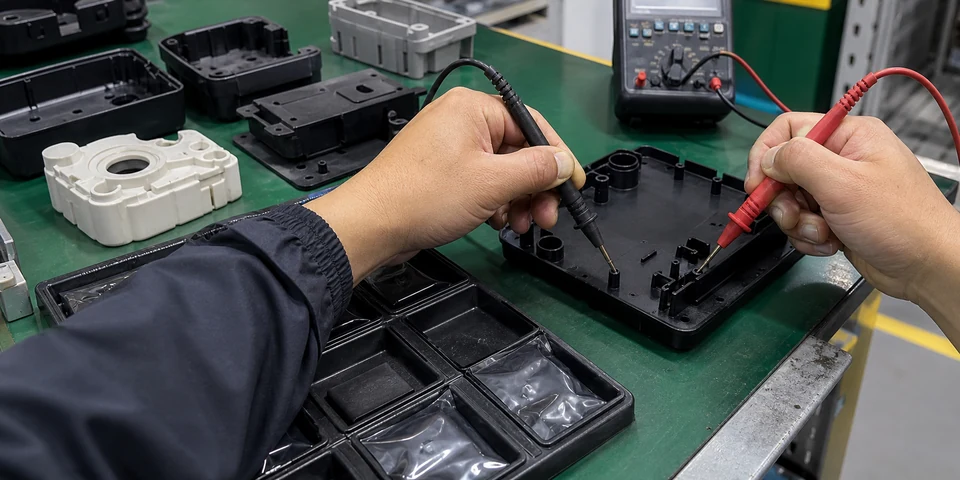
Conductive Modification Routes: Carbon black-filled HDPE is the most common conductive PE grade. Also available with carbon fiber reinforcement for improved stiffness. Conductive PE compounds are often used in extrusion applications.
Typical Surface Resistivity Range: 10³ – 10⁶ Ω/sq (conductive grades).
Key Applications:
Conductive tubing and hoses for safe transfer of flammable gases, powders, and liquids
ESD-safe packaging films and sheets
Conductive layers in co-extrusion structures
Fuel system components
Selection Considerations:
Advantages: Low cost; excellent chemical resistance; good flexibility; suitable for thin-wall extrusion
Limitations: Lower HDT (~80-100°C) and mechanical strength; limited to moderate-temperature applications
Best suited for: Extruded profiles, tubing, films, and packaging applications where flexibility and chemical resistance are priorities
3. Conductive ABS (Acrylonitrile Butadiene Styrene)
Base Resin Characteristics: ABS is an amorphous engineering thermoplastic offering excellent impact resistance, good dimensional stability, attractive surface finish, and ease of processing. Widely used in electronics housings and consumer products.
Conductive Modification Routes: Carbon fiber-reinforced ABS (typically 8-20% carbon fiber) provides conductivity while maintaining good mechanical properties and surface aesthetics. Carbon powder-filled ABS grades offer surface resistivity in the 10⁴ – 10⁶ Ω/sq range.
Typical Surface Resistivity Range: 10⁴ – 10⁶ Ω/sq (carbon powder-filled); 10³ – 10⁵ Ω/sq (carbon fiber-filled).
Key Applications:
Electronic housings and enclosures
ESD trays, shipping containers, and storage racks for semiconductor handling
Instrument panel bezels and automotive interior components
Work surfaces and fixtures in electronic assembly environments
Aerospace business equipment
Selection Considerations:
Advantages: Excellent surface finish and aesthetics; good impact resistance; dimensional stability; easy to paint and plate
Limitations: Lower HDT (~85-100°C) compared to engineering plastics; UV sensitivity (requires stabilization for outdoor use)
Best suited for: Enclosures, housings, and handling equipment where aesthetics and dimensional accuracy are important
Reference Product Data (ABS-based conductive compound):
| Property | Value | Test Method | Notes |
|---|---|---|---|
| Base Resin | ABS | — | — |
| Modification Route | Carbon fiber (8-20%) | — | Reference direction |
| Processing Method | Injection molding | — | — |
| Density | 1.10 – 1.25 g/cm³ | ASTM D792 | Reference direction |
| MFR | 5 – 20 g/10min | ASTM D1238 | Reference direction |
| Tensile Strength | 40 – 70 MPa | ASTM D638 | Reference direction |
| Flexural Modulus | 3,500 – 7,000 MPa | ASTM D790 | Reference direction |
| Notched Impact Strength | 4 – 10 kJ/m² | ISO 179 | Reference direction |
| HDT (1.82 MPa) | 85 – 100 °C | ASTM D648 | Reference direction |
| Surface Resistivity | 10⁴ – 10⁶ Ω/sq | ASTM D257 | Reference direction |
4. Conductive PA66 (Nylon 66)
Base Resin Characteristics: PA66 is a semi-crystalline engineering thermoplastic offering high mechanical strength, stiffness, excellent heat resistance, good wear resistance, and chemical resistance. HDT approximately 100-120°C (210-250°F) depending on reinforcement.
Conductive Modification Routes: Carbon fiber-reinforced PA66 is the dominant conductive nylon grade, typically with 10-30% carbon fiber content. Carbon black-filled grades are also available. Carbon fiber provides both electrical conductivity and significant mechanical reinforcement.
Typical Surface Resistivity Range: 10³ – 10⁶ Ω/sq depending on filler type and loading.
Key Applications:
Automotive functional components — housings, brackets, fuel system parts
Gears and mechanical components requiring wear resistance and conductivity
Electrical and electronic components
Industrial machinery parts
Textile and office machinery components
Selection Considerations:
Advantages: High strength and stiffness; excellent heat resistance (up to 140°C long-term); good wear resistance; carbon fiber reinforcement enhances both conductivity and mechanical properties
Limitations: Higher cost than PP and ABS; moisture absorption (up to 2-3%) affects dimensional stability; requires drying before processing
Best suited for: High-performance structural components requiring both mechanical strength and ESD/conductive properties in elevated temperature environments
Reference Product Data (PA66-based conductive compound):
| Property | Value | Test Method | Notes |
|---|---|---|---|
| Base Resin | PA66 | — | — |
| Modification Route | Carbon fiber (10-30%) | — | Reference direction |
| Processing Method | Injection molding | — | — |
| Density | 1.15 – 1.35 g/cm³ | ASTM D792 | Reference direction |
| MFR | 5 – 30 g/10min | ASTM D1238 | Reference direction |
| Tensile Strength | 80 – 180 MPa | ASTM D638 | Reference direction |
| Flexural Modulus | 6,000 – 15,000 MPa | ASTM D790 | Reference direction |
| Notched Impact Strength | 4 – 12 kJ/m² | ISO 179 | Reference direction |
| HDT (1.82 MPa) | 100 – 250 °C | ASTM D648 | Reference direction |
| Surface Resistivity | 10³ – 10⁶ Ω/sq | ASTM D257 | Reference direction |
5. Conductive POM (Polyoxymethylene / Acetal)
Base Resin Characteristics: POM (acetal) is a high-performance engineering thermoplastic offering excellent stiffness, low friction, high wear resistance, good dimensional stability, and low moisture absorption. HDT approximately 107°C (225°F). POM has inherently good electrical and dielectric properties in its base form.
Conductive Modification Routes: Carbon fiber-reinforced POM (typically 10-20% carbon fiber) provides conductivity while enhancing strength and stiffness. Carbon powder-filled POM grades offer consistent surface resistivity in the 10⁴ – 10⁶ Ω/sq range.
Typical Surface Resistivity Range: 10² – 10⁶ Ω/sq.
Key Applications:
Gears, bearings, and mechanical components requiring wear resistance and ESD protection
Automotive fuel system components and wiper parts
Conveyor belts and material handling equipment
Disk drive assembly fixtures and semiconductor handling components
Precision engineering components (cam, control disks, sleeves)
Selection Considerations:
Advantages: Excellent wear resistance and low friction; good dimensional stability; low moisture absorption; high stiffness; chemically resistant to many solvents
Limitations: Higher cost than PP and ABS; limited to moderate temperatures (continuous use ~80-100°C); not suitable for high-temperature applications
Best suited for: Moving mechanical parts (gears, bearings) where both wear resistance and static dissipation are required
Reference Product Data (POM-based conductive compound):
| Property | Value | Test Method | Notes |
|---|---|---|---|
| Base Resin | POM (copolymer) | — | — |
| Modification Route | Carbon fiber (10-20%) | — | Reference direction |
| Processing Method | Injection molding | — | — |
| Density | 1.35 – 1.50 g/cm³ | ASTM D792 | Reference direction |
| MFR | 5 – 15 g/10min | ASTM D1238 | Reference direction |
| Tensile Strength | 50 – 120 MPa | ASTM D638 | Reference direction |
| Flexural Modulus | 4,000 – 10,000 MPa | ASTM D790 | Reference direction |
| Notched Impact Strength | 3 – 8 kJ/m² | ISO 179 | Reference direction |
| HDT (1.82 MPa) | 100 – 150 °C | ASTM D648 | Reference direction |
| Surface Resistivity | 10² – 10⁶ Ω/sq | ASTM D257 | Reference direction |
6. Conductive TPU (Thermoplastic Polyurethane)
Base Resin Characteristics: TPU is a thermoplastic elastomer offering excellent flexibility, abrasion resistance, toughness, and good chemical resistance. Available in a range of hardnesses (typically 70A to 70D). Combines elastomeric properties with thermoplastic processability.
Conductive Modification Routes: Carbon black and graphene-filled TPU compounds provide conductivity while maintaining flexibility. TPU can be formulated for ESD-safe conductivity (surface resistivity 10⁷ – 10⁹ Ω/sq) or higher conductivity grades (surface resistivity < 10⁵ Ω/sq).
Typical Surface Resistivity Range: 10⁵ – 10⁹ Ω/sq depending on grade.
Key Applications:
Flexible conductive tubing and hoses
ESD-safe flexible components — gaskets, seals, boots
Wearable electronics and smart device components
Automotive interior and instrument panel components
Medical devices and healthcare equipment
Conductive 3D printing filaments
Selection Considerations:
Advantages: Excellent flexibility and elasticity; high abrasion resistance; good toughness; can be formulated for a wide hardness range; good low-temperature performance
Limitations: Higher cost than rigid thermoplastics; more challenging to process than PE/PP; limited to moderate temperatures (continuous use ~80-100°C)
Best suited for: Flexible components requiring ESD protection, seals, gaskets, tubing, and applications where elastomeric properties are essential
7. Conductive TPR (Thermoplastic Rubber)
Base Resin Characteristics: TPR (thermoplastic rubber) is a family of thermoplastic elastomers (often styrenic block copolymers) offering rubber-like flexibility, good processability, and lower cost than TPU. Generally has lower abrasion resistance and mechanical strength than TPU.
Conductive Modification Routes: Carbon black-filled TPR compounds provide conductivity for elastomeric applications. Conductive grade TPR/TPE can achieve surface resistivity below 10⁵ Ω/sq.
Typical Surface Resistivity Range: 10⁵ – 10⁹ Ω/sq depending on grade and filler loading.
Key Applications:
Conductive seals and gaskets for electronic enclosures
ESD-safe flexible handles and grips
Conductive rollers and wheels
Flexible packaging and film applications
Industrial and automotive components requiring flexibility and static control
Selection Considerations:
Advantages: Lower cost than TPU; good flexibility; easy processing; rubber-like feel
Limitations: Lower abrasion and tear resistance than TPU; lower tensile strength; limited temperature range
Best suited for: Cost-sensitive flexible ESD applications where TPU performance is not required
Material Comparison Summary
| Material | Relative Cost | HDT (°C) | Flexural Modulus (MPa) | Impact Resistance | Wear Resistance | Chemical Resistance | Moisture Sensitivity | Primary Applications |
|---|---|---|---|---|---|---|---|---|
| PP | $ | ~100 | 1,500-3,500 | Moderate | Low | Excellent | Low | Packaging, automotive, containers |
| PE | $ | ~80-100 | 800-1,500 | Moderate | Low | Excellent | Low | Tubing, films, extrusion profiles |
| ABS | $$ | ~85-100 | 3,500-7,000 | High | Moderate | Moderate | Low | Housings, enclosures, trays |
| PA66 | $$$ | 100-250 | 6,000-15,000 | Moderate-High | High | Moderate | High | Automotive, structural, gears |
| POM | $$$ | 100-150 | 4,000-10,000 | Moderate | Very High | Moderate-Good | Low | Gears, bearings, precision parts |
| TPU | $$$ | ~80-100 | 100-1,000 (flexural) | Very High | Very High | Good | Moderate | Flexible parts, seals, wearables |
| TPR | $$ | ~60-80 | 50-500 (flexural) | High | Moderate | Moderate | Low | Seals, grips, cost-sensitive flexibles |
Customer Validation Scenario
Context: An electronics contract manufacturer producing semiconductor handling trays experienced inconsistent ESD performance across different production batches. The existing ABS-based tray material showed surface resistivity drifting from the target range of 10⁴–10⁶ Ω/sq to above 10⁸ Ω/sq after multiple molding cycles, resulting in increased electrostatic damage to sensitive components during handling.
Trial Structure:
| Parameter | Value |
|---|---|
| Trial Quantity | 500 trays (5 injection molding shots) |
| Monthly Production | 50,000 trays |
| Molding Scrap Rate (before) | 3.2% |
| Assembly Scrap Rate (before) | 1.8% (ESD-related failures) |
| Defect Rate (before) | 5.0% total |
| Surface Resistivity Stability (before) | ±2 decades drift |
DEYU Material Evaluated: Conductive ABS compound (carbon fiber-reinforced grade) — DGK-ABS series
Validation Results (Directional):
| Parameter | Before | After (DEYU material) | Improvement Direction |
|---|---|---|---|
| Surface Resistivity | 10⁴–10⁸ Ω/sq (unstable) | 10⁴–10⁶ Ω/sq (stable) | Stabilized |
| Molding Scrap Rate | 3.2% | 2.1% | Reduced |
| Assembly Scrap Rate (ESD-related) | 1.8% | 0.6% | Significantly reduced |
| Total Defect Rate | 5.0% | 2.7% | Improved |
| Resistivity Drift (after 10 molding cycles) | ±2 decades | ±0.5 decade | Stabilized |
Result Interpretation: The DEYU conductive ABS compound demonstrated improved consistency in surface resistivity across multiple molding cycles. The reduced resistivity drift correlates with lower ESD-related assembly failures. DEYU plastics' approach focused on optimizing carbon fiber dispersion and selecting a base resin with better thermal stability to minimize degradation during processing.
Next Steps: Small-batch validation on full production scale recommended. DEYU can support formulation adjustments based on specific molding conditions and part geometry.
Suitable Applications by Material
| Application Type | Recommended Material | Rationale |
|---|---|---|
| Electronic enclosures, housings | Conductive ABS | Surface finish, impact resistance, dimensional stability |
| Semiconductor handling trays, IC carriers | Conductive ABS or PP | Cost-effective, good ESD performance |
| Automotive fuel system components | Conductive PA66 | Heat resistance, chemical resistance, strength |
| Automotive interior ESD parts | Conductive PP or ABS | Lightweight, cost-effective |
| Gears, bearings, precision mechanisms | Conductive POM | Wear resistance, low friction, dimensional stability |
| Conductive tubing, hoses | Conductive PE or TPU | Flexibility, chemical resistance |
| ESD-safe seals, gaskets, flexible parts | Conductive TPU or TPR | Elasticity, sealing performance |
| EV battery components | Conductive PP or PA66 | Lightweight, heat resistance (PA66) |
| Medical device components | Conductive PP or TPU | Purity (PP), flexibility (TPU) |
| EMI shielding housings | Conductive ABS or PA66 | Carbon fiber grades for shielding effectiveness |
What Buyers Should Provide for Material Selection
To facilitate accurate material recommendation, buyers and engineers should provide the following information:
Part drawing / geometry — wall thickness, minimum radius, overall dimensions
Base resin preference — any existing material family requirements
Target conductivity level — surface resistivity range (Ω/sq) or application category (conductive / ESD / antistatic)
Mechanical requirements — tensile strength, flexural modulus, impact strength, wear resistance
Thermal requirements — continuous use temperature, peak temperature, HDT requirement
Processing method — injection molding, extrusion, blow molding, thermoforming
Environmental conditions — temperature range, humidity, chemical exposure, UV exposure
Regulatory requirements — UL94, RoHS, REACH, food contact, medical-grade
Production volume — annual quantity for cost optimization
Current material and known issues — if replacing an existing material, what problems need to be solved
Conclusion
Selecting the right conductive plastic requires a systematic evaluation of electrical, mechanical, thermal, and economic requirements. No single material is optimal for all applications — the choice depends on the specific balance of properties required.
PP and PE offer the lowest cost and are suitable for high-volume, moderate-performance applications
ABS provides excellent aesthetics and impact resistance for enclosures and handling equipment
PA66 delivers high strength and heat resistance for demanding structural and automotive applications
POM excels in wear-resistant moving parts requiring both mechanical durability and static dissipation
TPU and TPR provide flexibility for seals, gaskets, and elastomeric components
DEYU can support material evaluation through small-batch validation, formulation optimization based on specific application requirements, and technical consultation throughout the selection and qualification process.