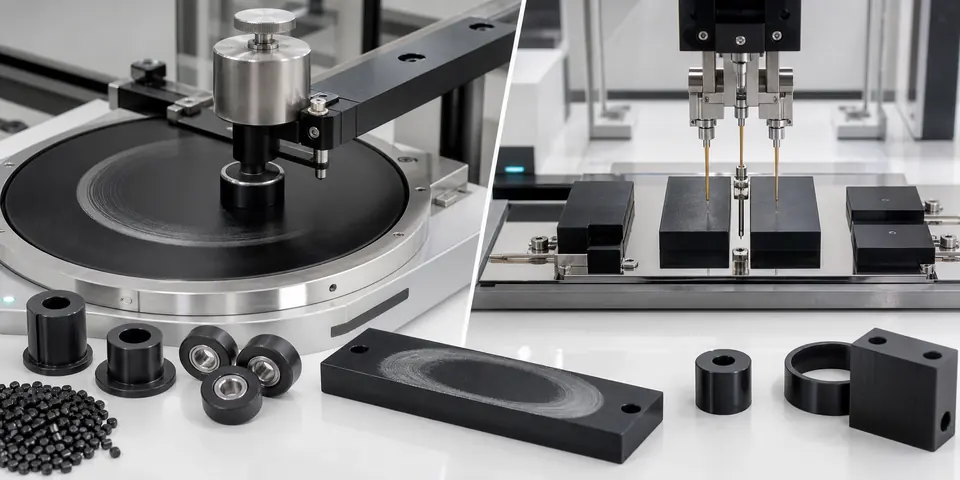
Conductive POM (Acetal) for Sliding Parts, Rollers and Precision Components
This page is for buyers and engineers who need a conductive plastic solution based on real molded-part validation, not only a single resistance reading.
Buyer and engineer FAQ
Questions engineers often ask about this material route
Where can POM with a conductive plastic requirement be used?
Typical fields include ESD trays, electronic housings, fixtures, EMI parts and antistatic logistics parts. For this article, DEYU would first confirm the working environment, wall thickness, expected lifetime and whether DGK-POM DD4-5ML Conductive POM, Conductive Plastics matches the part geometry or needs formulation adjustment.
What are the main performance indicators for the "conductive plastic" target on POM?
Focus on surface resistance, volume resistance, dispersion uniformity, impact strength and molding stability. Buyers should ask for data on molded parts, not only pellet data, because gate position, filler orientation and thickness can change the final value.
What should engineers watch during injection molding or processing?
For POM, a practical starting window is 180-210°C melt / 70-100°C mold. Avoid excessive filler loading, control weld lines and verify resistance on the molded part. Final parameters should follow part thickness, gate design and the actual machine.
What details help DEYU recommend DGK-POM DD4-5ML Conductive POM, Conductive Plastics more accurately?
Send the current resin or grade, drawing or photo, wall thickness, annual quantity, target standard, failure mode and required color. If a reference grade already passed one test but failed in production, include both data sets.
For a precise recommendation, share the part drawing, base resin, target performance, processing method and test standard with DEYU.
This page is for buyers and engineers who need a conductive plastic solution based on real molded-part validation, not only a single resistance reading.
DGK-POM DD4-5ML Conductive POM and Conductive Plastics. This route is relevant when ESD behavior must be combined with sliding wear performance and precision molding.
1. Background / Problem
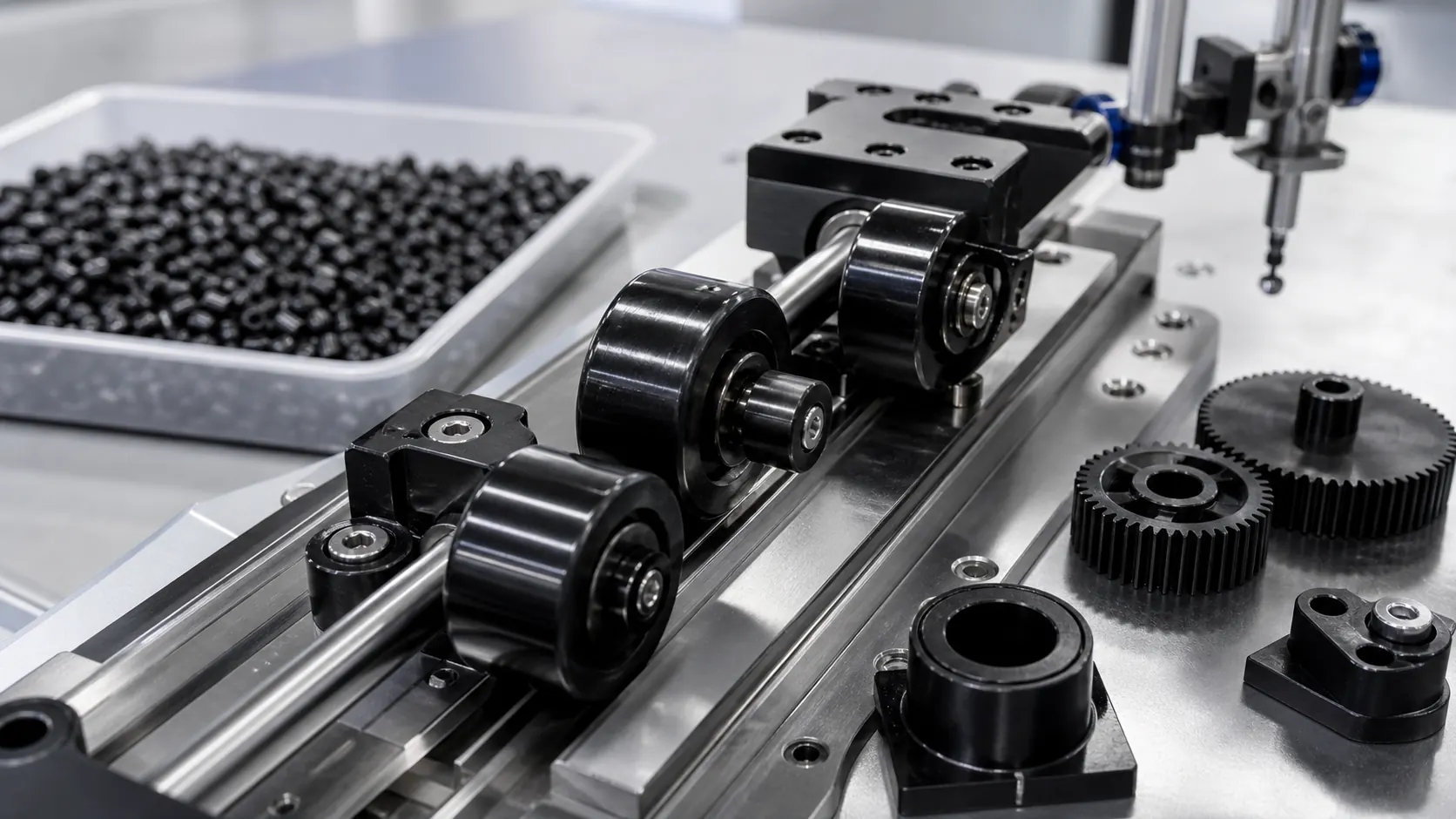
POM is widely used in gears, rollers, bushings and sliding blocks because it has low friction, good dimensional stability and a naturally smooth surface. In electronics handling or precision equipment, the same part may also need controlled ESD behavior.
A material that is only wear-resistant may remain insulating. A material that is only conductive may lose the low-friction and surface-quality advantages that made POM attractive in the first place.
2. Technical Difficulty / Why It Happens
Conductive modification can change POM friction behavior, toughness, gloss and molding shrinkage. If the conductive network is not stable, resistance may vary after sliding wear or after polishing of the contact surface.
For rollers and precision components, the validation should include resistance, surface finish, dimensional tolerance, wear track condition and noise or vibration behavior.
3. DEYU Material Direction
DEYU may recommend DGK-POM DD4-5ML as the conductive POM direction. Existing product data positions this grade at 10^4-10^5 ohm, with glossy surface and good toughness, for ESD wear-resistant structural parts and electronic accessories.
4. Reference Product Data
| Property | DGK-POM DD4-5ML Direction |
|---|---|
| Base resin | POM |
| Conductive direction | 10^4-10^5 ohm |
| Surface / toughness | Glossy surface and good toughness |
| Processing | Injection molding |
| Typical applications | ESD wear-resistant structural parts, rollers, sliding blocks and electronic accessories |
5. Real Customer Application Case
A customer used standard POM rollers in a precision transport module. Wear and noise were acceptable, but static accumulation caused dust attraction and unstable electronic handling. A previous conductive trial improved resistance but increased surface roughness and early wear marks.
6. Validation Data Table
| Item | Standard POM | Previous conductive POM trial | DEYU DGK-POM DD4-5ML trial direction |
|---|---|---|---|
| Trial quantity | 600 pcs | 800 pcs | 1,200 pcs |
| Surface resistance | >10^12 ohm | 10^5-10^7 ohm | Target 10^4-10^5 ohm |
| Visible wear track after internal cycle test | Low | Medium | Target low to medium |
| Surface gloss rejection | 0.8% | 4.5% | Target <2.0% |
| Roller noise complaint | 2.5% | 5.0% | Target <3.0% |
| Dimensional rejection | 1.8% | 3.6% | Target <2.5% |
| Internal pass rate | 82% | 78% | Target >90% |
This case is based on a real customer scenario from DEYU's internal project records.
7. Result Interpretation
For conductive POM, the question is not only whether the part becomes conductive. The part must still keep the low-friction, smooth-surface and dimensional advantages expected from POM.
The best validation sequence is plaque resistance first, then molded-part resistance, then wear and dimensional checks on the actual roller or sliding geometry.
8. Suitable Applications
- Conductive POM rollers
- ESD sliding blocks
- Precision gears and bushings
- Electronic handling accessories
- Wear-resistant structural parts requiring resistance control
9. What Buyers Should Provide
Buyers should provide the target resistance range, current POM grade, sliding speed, contact load, wear or noise data, part drawing, tolerance requirement, lubrication condition and expected production volume.
Conclusion
Final selection should be confirmed on the actual molded part: resistance, processing, mechanical behavior, appearance and service conditions need to be evaluated together.