Conductive PP Compound: Technical Routes and 12 Validation Scenarios for Polypropylene Applications
Conductive PP is not one fixed material. It is a modified polypropylene compound designed around resistance range, part structure, molding method, extrusion process, color, impact requirement, and final service environment.
Buyer and engineer FAQ
Questions engineers often ask about this material route
Where can PP with a conductive plastic requirement be used?
Typical fields include ESD trays, electronic housings, fixtures, EMI parts and antistatic logistics parts. For this article, DEYU would first confirm the working environment, wall thickness, expected lifetime and whether conductive plastics, DGK-PP DD2-3A Conductive PP matches the part geometry or needs formulation adjustment.
What are the main performance indicators for the "conductive plastic" target on PP?
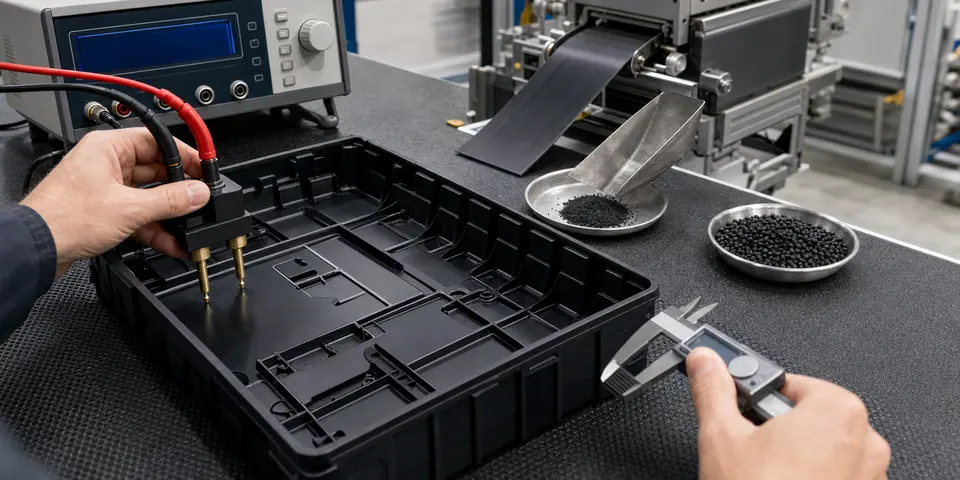
Focus on surface resistance, volume resistance, dispersion uniformity, impact strength and molding stability. Buyers should ask for data on molded parts, not only pellet data, because gate position, filler orientation and thickness can change the final value.
What should engineers watch during injection molding or processing?
For PP, a practical starting window is 190-230°C melt / 30-60°C mold. Avoid excessive filler loading, control weld lines and verify resistance on the molded part. Final parameters should follow part thickness, gate design and the actual machine.
What details help DEYU recommend conductive plastics, DGK-PP DD2-3A Conductive PP more accurately?
Send the current resin or grade, drawing or photo, wall thickness, annual quantity, target standard, failure mode and required color. If a reference grade already passed one test but failed in production, include both data sets.
For a precise recommendation, share the part drawing, base resin, target performance, processing method and test standard with DEYU.
1. Why Conductive PP Should Be Validated by Application
Conductive PP is not one fixed material. It is a modified polypropylene compound designed around resistance range, part structure, molding method, extrusion process, color, impact requirement, and final service environment.
For projects that need a defined resistance window, start from the broader conductive plastics route, then tune DGK-PP DD2-3A Conductive PP style formulations for molding, extrusion, and small-batch validation.
In real projects, engineers rarely need conductive polypropylene in a general way. They usually need to solve a specific problem:
- static charge causes dust adhesion;
- light parts stick during feeding;
- powder adheres to PP plastic surfaces;
- electronic components need ESD-safe handling;
- industrial trays require stable surface resistance;
- electrical PP parts need both flame retardancy and conductivity;
- outdoor polypropylene covers need UV resistance and static control;
- large conductive PP trays need low warpage.
That is why a conductive PP compound should be judged by electrical and mechanical performance at the same time: surface resistance, volume resistance when required, impact strength, flexural modulus, melt flow rate, warpage, surface quality, part release, color stability, and resistance consistency on the final molded part.
A test bar can only provide a starting point. For conductive polypropylene materials, wall thickness, gate position, flow direction, cooling rate, and filler orientation may all change the final resistance value.
2. Main Technical Routes for Conductive Polypropylene
2.1 Conductive Carbon Black Route
Conductive carbon black is one of the most common routes for black conductive PP plastic. It is mature, cost-effective, and suitable for trays, covers, powder-contact parts, packaging parts, and industrial PP components.
The main risk is balance. More conductive filler may reduce impact strength, reduce flowability, or make the surface more matte. Resistance stability also depends heavily on filler dispersion.
2.2 Conductive PP Masterbatch Route
A conductive polypropylene masterbatch allows resistance adjustment through dosage and is useful for early-stage validation. It helps engineers test several resistance levels before locking the final compound.
DEYU commonly uses this route for small-batch validation, resistance tuning, trial molding, and transition projects from antistatic PP to static-dissipative PP or conductive PP.
2.3 Static-Dissipative PP Route
Not every product needs very low resistance. Static-dissipative polypropylene is often more suitable for ESD trays, electronic handling parts, automation fixtures, and dust-reducing covers.
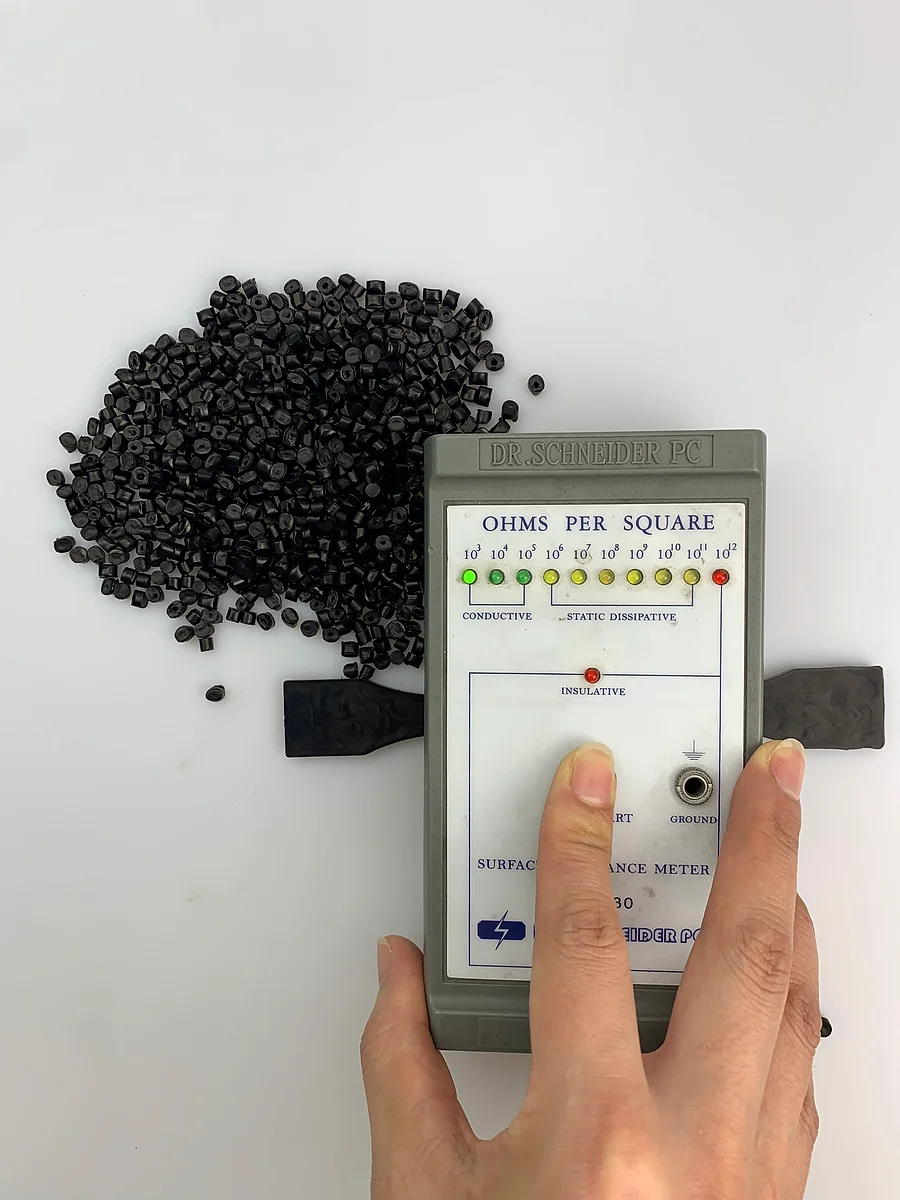
Typical target direction: 10^6 to 10^9 ohm surface resistance. This range usually keeps better toughness, better surface quality, and more controlled charge dissipation than an aggressively conductive formulation.
2.4 Low-Resistance Conductive PP Route
For powder handling, severe static accumulation, or grounding-related plastic parts, the material may need a lower resistance range.
Typical target direction: 10^3 to 10^6 ohm, with selected low-resistance PP projects moving toward 10^2 to 10^3 ohm. This route is suitable for powder-contact parts, industrial conductive trays, shielding-related PP components, and static-control parts that require fast discharge.
2.5 Hybrid Functional Conductive PP
Conductive PP is often combined with additional properties: flame retardancy, UV resistance, low warpage, impact balance, reinforced stiffness, color formulation, or wear-resistant adjustment.
In these projects, the material is no longer a standard conductive PP grade. It becomes an application-specific polypropylene compound.
3. Validation Scenario 1: ESD Tray for Electronic Components
Original Pain Point
A customer used ordinary PP trays for electronic components. The trays were inexpensive, but static charge accumulated during handling.
Problems included ESD warning events, dust on the tray surface, component handling complaints, and unstable surface cleanliness.
DEYU Solution
DEYU recommended a static-dissipative PP material instead of a very low-resistance conductive polypropylene compound.
Target direction:
- surface resistance: 10^6 to 10^9 ohm;
- controlled charge dissipation;
- tray impact strength retention;
- stable flatness.
Validation Data
| Item | Ordinary PP Tray | DEYU Static-Dissipative PP |
|---|---|---|
| Surface resistance | >10^13 ohm | 10^6 to 10^9 ohm |
| ESD warning events | 8 times/week | 0 to 1 time/week |
| Dust adhesion | Medium-high | Low |
| Handling complaints | 4 times/month | 0 to 1 time/month |
| Tray flatness | General | Stable after cooling adjustment |
Case Conclusion
The product did not need the lowest possible resistance. A static-dissipative polypropylene route solved the ESD issue while keeping tray toughness and molding stability.
4. Validation Scenario 2: Lightweight Cap Feeding Tray
Original Pain Point
A packaging equipment customer used a PP plastic tray to feed lightweight caps. The caps stuck to the tray surface because of static charge.
Problems included cap release abnormality, manual correction, feeding interruption, and lower production speed.
DEYU Solution
DEYU first used a conductive PP masterbatch route for small-batch validation, then adjusted the final compound according to tray size, wall thickness, and gate position.
Target direction:
- surface resistance: 10^5 to 10^8 ohm;
- better cap release;
- impact balance at tray corners;
- stable molding process.
Validation Data
| Item | Ordinary PP Tray | DEYU Conductive PP Compound |
|---|---|---|
| Surface resistance | >10^13 ohm | 10^5 to 10^8 ohm |
| Cap release abnormality | 12 to 18 times/hour | 1 to 3 times/hour |
| Production speed | 84% to 88% of target | 97% to 99% of target |
| Rejection caused by feeding issue | 3.4% | 0.6% |
| Corner cracking | Occasional | Not obvious after impact adjustment |
Case Conclusion
Small-batch testing helped confirm the required resistance range before full production. The final solution was not only conductive PP pellets, but a tray-specific formulation with impact and processing adjustment.
5. Validation Scenario 3: Powder Handling Equipment Part
Original Pain Point
A powder equipment customer used ordinary polypropylene parts in a powder-contact area. Powder strongly adhered to the plastic surface.
Problems included powder sticking, long cleaning time, powder flow interruption, and contamination risk.
DEYU Solution
DEYU recommended a low-resistance conductive PP compound.
Target direction:
- surface resistance: 10^3 to 10^6 ohm;
- reduced powder adhesion;
- acceptable flowability;
- black conductive surface.
Validation Data
| Item | Ordinary Polypropylene | DEYU Conductive PP |
|---|---|---|
| Surface resistance | >10^13 ohm | 10^3 to 10^6 ohm |
| Powder adhesion after 4 h | 7.2 g/m2 | 1.5 g/m2 |
| Cleaning time | 28 min/shift | 8 min/shift |
| Powder flow interruption | 5 to 7 times/shift | 0 to 1 time/shift |
| Impact performance | Acceptable | Acceptable after adjustment |
Case Conclusion
For powder-contact applications, ordinary antistatic PP was not enough. A lower-resistance conductive polypropylene route reduced powder adhesion and cleaning time.
6. Validation Scenario 4: Gray Industrial Cover With Dust Adhesion
Original Pain Point
A gray PP equipment cover attracted dust around ventilation areas. The customer wanted dust reduction but did not want a black conductive PP material.
DEYU Solution
DEYU recommended a colored antistatic PP formulation instead of carbon-black conductive PP.
DEYU support included gray color matching, resistance adjustment, and surface appearance control.
Validation Data
| Item | Ordinary Gray PP | DEYU Colored Antistatic PP |
|---|---|---|
| Surface resistance | >10^13 ohm | 10^8 to 10^11 ohm |
| Dust adhesion after 7 days | High | Reduced by about 60% |
| Cleaning frequency | Once every 2 days | Once every 5 to 6 days |
| Color | Gray | Matched gray |
| Surface appearance | Good | Good |
Case Conclusion
The customer's real target was dust reduction and gray appearance, not strong conductivity. A color-compatible antistatic polypropylene formulation was more suitable than a black low-resistance compound.
7. Validation Scenario 5: Flame-Retardant Conductive PP Electrical Tray
Original Pain Point
An electrical tray used flame-retardant PP, but the surface resistance was too high and dust accumulated during operation.
The material needed static control, flame-retardant performance, dimensional stability, and acceptable flowability at the same time.
DEYU Solution
DEYU developed a flame-retardant conductive PP compound based on the required part thickness.
Target direction:
- surface resistance: 10^5 to 10^8 ohm;
- flame-retardant target by thickness validation;
- low-warpage balance;
- acceptable flowability.
Validation Data
| Item | Original FR PP | DEYU FR Conductive PP |
|---|---|---|
| Surface resistance | >10^12 ohm | 10^5 to 10^8 ohm |
| Flame-retardant target | V-0 direction | V-0 direction by thickness validation |
| Dust adhesion after 8 h | 4.5 g/m2 | 1.2 g/m2 |
| Flatness deviation after heat exposure | 1.9 mm | 0.8 mm |
| Flowability | Good | Acceptable after formulation adjustment |
Case Conclusion
This project could not be solved by adding conductive filler only. The material had to balance flame retardancy, conductivity, warpage, and flowability.
8. Validation Scenario 6: Outdoor Battery Peripheral Cover
Original Pain Point
A PP cover used near battery equipment outdoors showed dust adhesion, color fading, surface dullness, and flatness change after exposure.
DEYU Solution
DEYU recommended a UV-resistant antistatic PP material with a weather-resistant pigment package and low-warpage adjustment.
Validation Data
| Item | Ordinary PP | DEYU UV Antistatic PP |
|---|---|---|
| Surface resistance | >10^13 ohm | 10^8 to 10^11 ohm |
| Color difference after aging | Delta E 5.6 | Delta E 2.3 |
| Gloss retention | 55% | 76% |
| Dust adhesion | High | Reduced by about 58% |
| Flatness deviation after aging | 2.2 mm | 0.9 mm |
Case Conclusion
The application required UV resistance and antistatic performance together. DEYU adjusted the PP compound around outdoor service conditions rather than treating it as a simple conductive plastic project.
9. Validation Scenario 7: Low-Warpage Conductive PP Tray
Original Pain Point
A large conductive polypropylene tray passed the resistance test but warped after molding.
Problems included edge lifting, poor flatness, assembly gap, and dimension change after 48 hours.
DEYU Solution
DEYU adjusted the conductive PP formulation through filler balance, shrinkage control, and molding process guidance.
Validation Data
| Item | Previous Conductive PP | DEYU Low-Warpage Conductive PP |
|---|---|---|
| Surface resistance | 10^6 to 10^9 ohm | 10^6 to 10^9 ohm |
| Flatness after molding | 3.0 mm | 1.1 mm |
| Flatness after 48 h | 3.8 mm | 1.4 mm |
| Assembly gap | 1.5 to 2.2 mm | 0.4 to 0.8 mm |
| Corner impact | Medium | Improved after toughening |
Case Conclusion
The resistance range was already acceptable. The real improvement came from low-warpage adjustment and dimensional stability control.
10. Validation Scenario 8: Conductive PP Logistics Box
Original Pain Point
A logistics box for semi-electronic parts had static and dust issues. The customer also needed impact resistance during transport.
DEYU Solution
DEYU used an impact-balanced conductive PP compound and provided black color formulation support.
Validation Data
| Item | Ordinary PP Logistics Box | DEYU Conductive PP |
|---|---|---|
| Surface resistance | >10^13 ohm | 10^6 to 10^9 ohm |
| Dust adhesion | High | Low |
| Drop test | 3 failures / 10 | 0 to 1 failure / 10 |
| Color consistency | General | Improved |
| Box deformation after stacking | Medium | Reduced |
Case Conclusion
The project required more than conductive PP granules. Transport durability, color consistency, and impact adjustment were also important.
11. Validation Scenario 9: PP Fixture for Automation Line
Original Pain Point
An automation fixture made from ordinary PP caused dust accumulation and occasional sensor misdetection.
Problems included dust near the sensor area, static charge on the fixture, positioning fluctuation, and high cleaning frequency.
DEYU Solution
DEYU recommended a static-dissipative PP fixture material and supported small-batch validation before the customer changed the full fixture material.
Validation Data
| Item | Ordinary PP Fixture | DEYU Static-Dissipative PP |
|---|---|---|
| Surface resistance | >10^13 ohm | 10^7 to 10^10 ohm |
| Sensor misdetection | 6 times/week | 0 to 1 time/week |
| Cleaning interval | Every day | Every 4 to 5 days |
| Dimensional change after cycling | 0.18 mm | 0.08 mm |
| Trial method | Full batch required | Small-batch validation available |
Case Conclusion
Small-batch validation helped the customer confirm resistance and dimensional stability before full material replacement.
12. Validation Scenario 10: Conductive PP Sheet and Extrusion Profile
Original Pain Point
A customer produced PP sheet by extrusion. Ordinary PP sheet accumulated static during cutting and stacking.
DEYU Solution
DEYU adjusted the conductive polypropylene formulation for extrusion processing, with attention to melt strength, cooling, thickness, and extrusion orientation.
Validation Data
| Item | Ordinary PP Sheet | DEYU Conductive PP Sheet Trial |
|---|---|---|
| Surface resistance | >10^13 ohm | 10^6 to 10^9 ohm |
| Sheet sticking | Obvious | Reduced |
| Dust adhesion | High | Lower |
| Surface quality | Good | Acceptable-good |
| Sheet flatness | General | Improved after cooling adjustment |
Case Conclusion
For extrusion products, resistance must be measured on the final sheet or profile, not only on injection test bars.
13. Validation Scenario 11: Conductive PP Roller Cover
Original Pain Point
A low-load PP roller cover accumulated static and dust during rotation. The roller surface became dirty, contact stability declined, and operating noise increased slightly after long running.
DEYU Solution
DEYU recommended a conductive PP plastic with improved surface smoothness and wear resistance.
Validation Data
| Item | Ordinary PP Roller Cover | DEYU Conductive PP |
|---|---|---|
| Surface resistance | >10^13 ohm | 10^5 to 10^8 ohm |
| Dust accumulation | High | Reduced |
| Roughness after testing | Medium | Improved |
| Noise after 100 h | 58 dB | 54 dB |
| Wear marks | Obvious | Reduced |
Case Conclusion
For rotating parts, conductivity alone is not enough. Surface smoothness, contact stability, and wear resistance must be checked together.
14. Validation Scenario 12: Small Custom Conductive PP Molded Part
Original Pain Point
A customer needed a small black part made from conductive PP, but the exact resistance range had not been defined.
Challenges included unclear target resistance, small order volume, uncertain molding result, and the need for fine property adjustment.
DEYU Solution
DEYU proposed three small trial directions:
- antistatic PP: 10^8 to 10^11 ohm;
- static-dissipative PP: 10^6 to 10^9 ohm;
- conductive PP: 10^3 to 10^6 ohm.
The team compared resistance, impact strength, flowability, and molded-part appearance before selecting the final direction.
Validation Data
| Trial Direction | Surface Resistance | Result |
|---|---|---|
| Antistatic PP | 10^8 to 10^11 ohm | Dust was reduced, but charge dissipation was slow |
| Static-dissipative PP | 10^6 to 10^9 ohm | Best balance of resistance, impact, and molding |
| Conductive PP | 10^3 to 10^6 ohm | Strong conductivity, but impact strength decreased slightly |
Case Conclusion
After comparing resistance, impact strength, and molding result, the customer selected the static-dissipative direction. This avoided unnecessary over-engineering where very low resistance was not required.
15. What to Provide Before Conductive PP Validation
To shorten testing cycles and choose the right conductive polypropylene compound, DEYU recommends providing:
- application area;
- current material;
- target resistance range;
- surface or volume resistance test method;
- part drawing or sample;
- wall thickness;
- processing method;
- color requirement;
- impact requirement;
- warpage requirement;
- flame-retardant requirement;
- UV-resistance requirement;
- current production problem;
- desired trial batch volume;
- acceptance criteria.
This information helps select a specific polypropylene compound for the final part, instead of choosing conductive PP only by a single resistance number.
Conclusion
Conductive PP cannot be selected by resistance value alone. The right material depends on the technical route, part structure, processing method, resistance range, color, impact strength, warpage, flame retardancy, UV resistance, and service conditions.
The 12 validation scenarios show how conductive polypropylene can be used in ESD trays, feeding trays, powder equipment, industrial covers, electrical trays, outdoor covers, large trays, logistics boxes, automation fixtures, extrusion sheets, rollers, and customized small parts.
DEYU's value is not only supplying conductive PP granules. The company also supports application-level validation: small trial batches, resistance tuning, color matching, impact balance, low-warpage adjustment, UV or flame-retardant combinations, and testing on the final molded part.