
Conductive TPR for Soft-Touch Anti-Static Parts: Hardness and Resistance Control
Soft-touch anti-static parts need the feel of an elastomer and the electrical stability of an ESD material. This guide explains how conductive TPR hardness, filler network, overmolding conditions and validation data should be controlled for grips, handles, instrument housings and wearable-contact parts.
Conductive TPR FAQ
Conductive TPR for Soft-Touch Anti-Static Parts: Hardness and Resistance Control
Why does softer conductive TPR often show higher resistance?
Softer TPR usually contains more oil or soft segment and less reinforcing structure. That can widen the gap between conductive particles, weaken the percolation network and raise surface resistance unless filler dispersion is carefully controlled.
When should a buyer choose 55A instead of 70A conductive TPR?
Use 55A when tactile comfort, wearable contact or soft grip feel is the priority and a dissipative 10^7-10^9 ohm range is acceptable. Choose 70A when overmolded housings or tool grips need lower resistance, better adhesion and tighter dimensional stability.
Why use a carbon black and CNT hybrid instead of carbon black only?
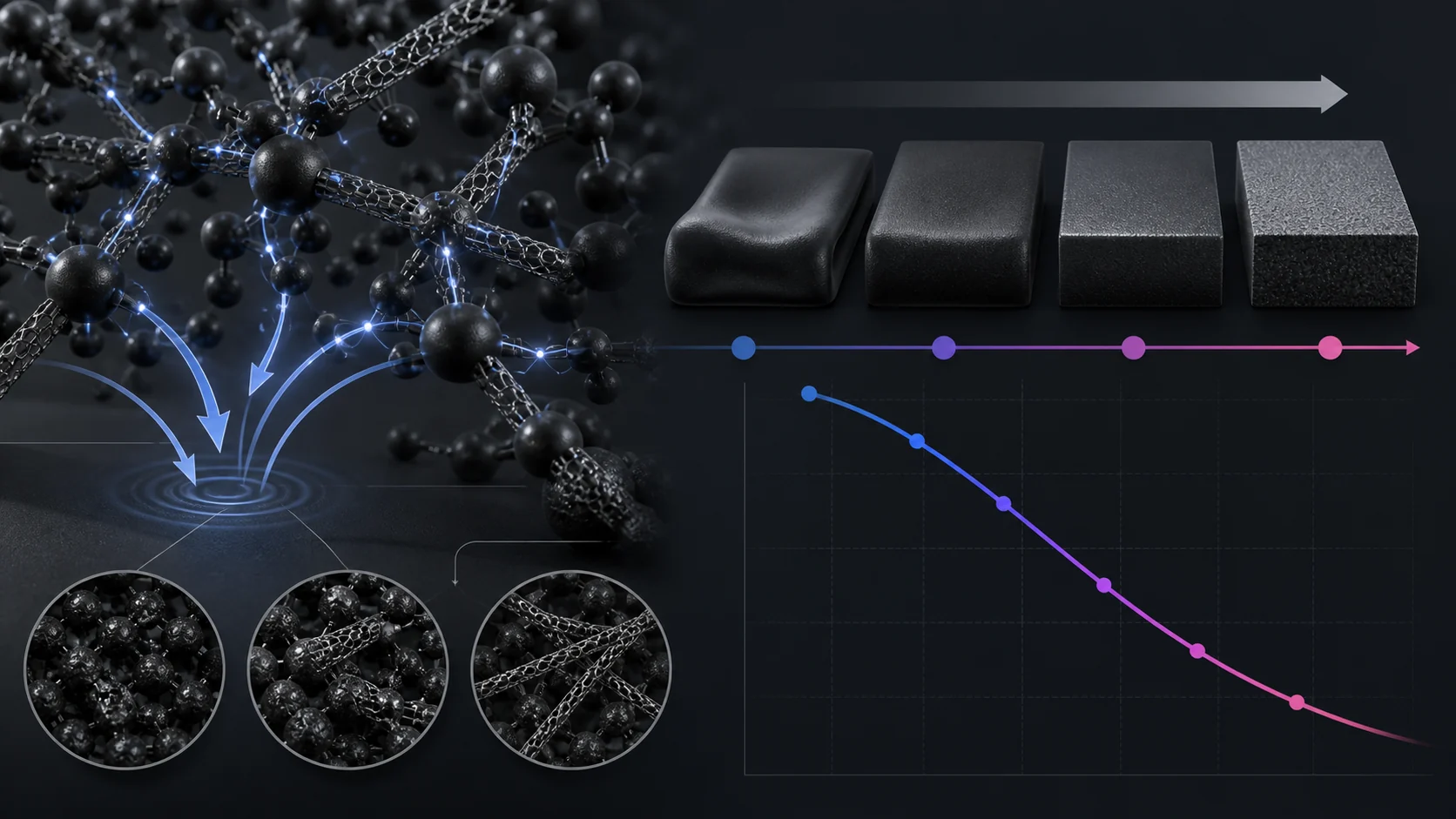
Carbon black supplies the main conductive network, while CNT helps bridge gaps in the elastomer matrix. The hybrid route can reduce part-to-part resistance variation and keep the compound less overloaded than a carbon-black-only formulation.
What information should be sent for conductive TPR screening?
Send target hardness, resistance range and test method, part drawing, substrate resin, overmolding process, cleaning chemical, expected grip cycles, color and surface finish requirement, current defect photos and monthly volume.
Application background: soft feel plus ESD safety
TPR is widely used where a part needs a warmer, softer touch than rigid engineering plastic. In consumer electronics, industrial tools, medical devices and automotive interiors, that soft surface may also need to discharge static safely instead of behaving like an insulator.
The difficulty is that touch feel and electrical performance are coupled. A very soft grade can feel right in the hand but lose conductive continuity. A heavily filled grade can reach low resistance but become stiff, rough or hard to bond to the substrate. Conductive TPR selection therefore has to be built around hardness and resistance together.
Hardness and resistance are linked by the percolation network
Conductive TPR works when carbon black, CNT or other conductive fillers form a continuous percolation network inside the elastomer. If the network is interrupted by excessive softening oil, poor dispersion, shear damage or local flow orientation, surface resistivity can rise by several orders of magnitude.
This is why the same compound must be checked on molded parts, not only on plaques. Gate location, wall thickness, rib geometry, melt temperature and injection speed can all change local filler distribution. The target should be a realistic resistance window on the actual soft-touch area.
| Resistivity Range | Classification | Typical Applications |
|---|---|---|
| 10^5-10^6 ohm | Conductive / low static dissipative | Rapid charge dissipation, ESD-critical components |
| 10^6-10^9 ohm | Static dissipative | Standard ESD-safe grips, overmolded housings |
| 10^9-10^12 ohm | Anti-static | Charge suppression, non-critical ESD applications |
| >10^12 ohm | Insulative | Standard non-ESD applications |
| Hardness Range (Shore A) | Typical Applications | Resistivity Achievable |
|---|---|---|
| 50A-60A | Wearable device contacts, soft grips | 10^7-10^9 ohm |
| 60A-75A | Power tool grips, overmolded housings | 10^6-10^8 ohm |
| 75A-90A | Industrial handles, ESD mats | 10^5-10^7 ohm |
| 90A-110A | Durable ESD components, casters | 10^3-10^6 ohm |
DEYU material direction and the most relevant product link
For this application, the most relevant existing DEYU product page is DGK-TPR DD6-9A conductive TPR. It is used as the public product reference for conductive TPR soft-touch parts, while the exact hardness and resistance window can still be adjusted by project.
DEYU's recommended route for demanding soft ESD components is SEBS-based TPR modified by a carbon black and CNT hybrid system. SEBS gives better aging and cleaning stability than common SBS-based TPR, while the hybrid conductive route helps reduce resistance drift without relying only on high filler loading.
| Property | Unit | Test Method | DEYU Conductive TPR Soft Grade | DEYU Conductive TPR Medium Grade | DEYU Conductive TPR Firm Grade |
|---|---|---|---|---|---|
| Base resin | - | - | SEBS | SEBS | SEBS |
| Modification route | - | - | CB + CNT hybrid | CB + CNT hybrid | CB + CNT hybrid |
| Processing method | - | - | Injection molding | Injection molding | Injection molding |
| Shore hardness | - | ASTM D2240 | 55A +/- 5 | 70A +/- 5 | 85A +/- 5 |
| Surface resistivity | ohm | ANSI/ESD STM11.11 | 10^7-10^9 | 10^6-10^8 | 10^5-10^7 |
| Density | g/cm3 | ASTM D792 | 1.08-1.14 | 1.10-1.16 | 1.12-1.18 |
| MFR (190 C/5 kg) | g/10 min | ASTM D1238 | 10-20 | 8-15 | 6-12 |
| Tensile strength | MPa | ASTM D412 | 6-10 | 10-14 | 14-18 |
| Elongation at break | % | ASTM D412 | 500-800 | 400-600 | 300-500 |
| Tear strength | kN/m | ASTM D624 | 25-35 | 35-50 | 45-60 |
| Compression set (22 hr/70 C) | % | ASTM D395 | 50-65 | 45-55 | 40-50 |
| Service temperature | C | - | -30 to +60 | -30 to +70 | -30 to +75 |
| Adhesion to PP/PE/ABS/PC | - | - | Good-Excellent | Excellent | Excellent |
| Typical applications | - | - | Wearables, soft grips | Tool handles, overmolds | Industrial handles, ESD mats |
Customer case: soft overmolded grips for handheld instruments
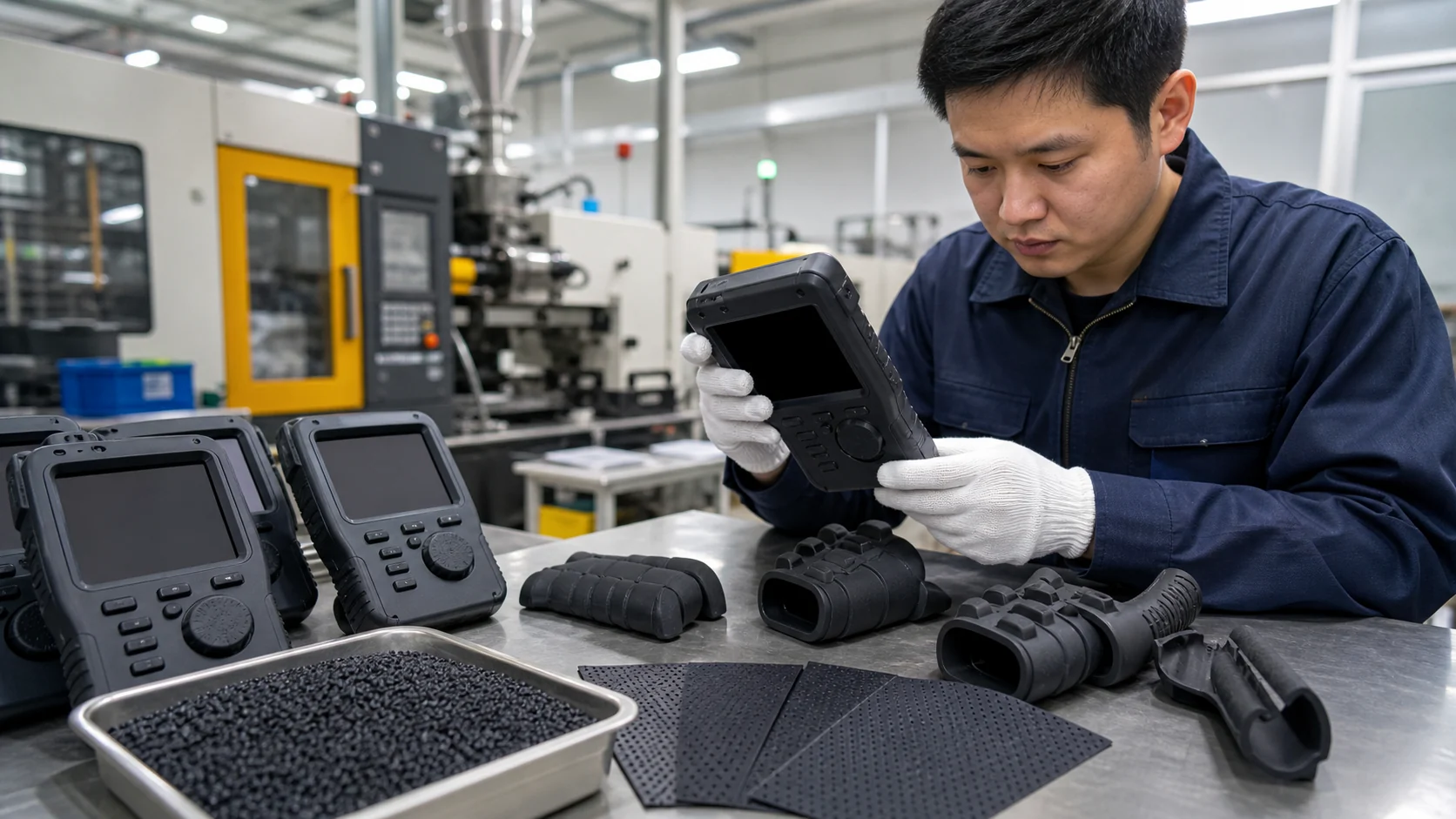
A manufacturer of professional handheld electronic test instruments needed soft black overmolded grips on ABS housings. The parts had to remain ESD-safe, survive more than 10,000 grip cycles, tolerate IPA cleaning and keep a clean matte black appearance after assembly.
The previous SBS-based conductive TPR showed unstable surface resistivity from 10^7 to 10^11 ohm, hardness drifting from 60A to 72A, and occasional delamination from the ABS housing. DEYU treated the issue as a material-and-process problem rather than only changing the nominal hardness.
| Parameter | Original Material | DEYU Trial Grade Soft | DEYU Trial Grade Medium |
|---|---|---|---|
| Base resin | SBS-based TPR | SEBS-based TPR | SEBS-based TPR |
| Conductive filler | CB only | CB + CNT hybrid | CB + CNT hybrid |
| Target hardness | 65A | 55A | 70A |
| Target resistivity | 10^8-10^9 ohm | 10^7-10^9 ohm | 10^6-10^8 ohm |
| Trial quantity | 100 parts | 100 parts | 100 parts |
| Target monthly production | 10,000 units | 10,000 units | 10,000 units |
| Substrate | ABS | ABS | ABS |
| Substrate temperature | 25 C | 50 C | 50 C |
| Melt temperature | 190-210 C | 200-220 C | 200-220 C |
| Mold temperature | 30 C | 40 C | 40 C |
| Parameter | Original Material | DEYU Soft 55A | DEYU Medium 70A |
|---|---|---|---|
| Hardness average | 66A | 56A | 71A |
| Hardness part-to-part range | 60A-72A | 54A-58A | 69A-73A |
| Hardness within-part variation | +/-4A | +/-1A | +/-1A |
| Surface resistivity average | 2 x 10^9 ohm | 5 x 10^8 ohm | 8 x 10^6 ohm |
| Resistivity part-to-part range | 10^7-10^11 ohm | 10^7-10^9 ohm | 10^6-10^8 ohm |
| Resistivity within-part variation | +/-1.5 orders | +/-0.4 orders | +/-0.3 orders |
| Adhesion peel strength | 0.6 N/mm | 1.4 N/mm | 1.8 N/mm |
| Delamination after thermal cycling | 8/20 parts (40%) | 0/20 parts (0%) | 0/20 parts (0%) |
| Resistivity after 100 IPA cycles | 5 x 10^10 ohm | 8 x 10^8 ohm | 2 x 10^7 ohm |
| Resistivity increase after cleaning | +1.4 orders | +0.2 orders | +0.4 orders |
| Molding scrap rate | 14% | 4% | 3% |
| Assembly scrap rate | 7% | 2% | 1% |
| Overall defect rate | 21% | 6% | 4% |
| Tactile comfort rating | 3.2 / 5 | 4.6 / 5 | 4.1 / 5 |
How the validation data should be read
The 55A DEYU soft grade gave the best tactile comfort and stabilized resistance in the 10^7-10^9 ohm range. It was suitable where a soft grip feel was the main requirement and the ESD target allowed a dissipative range. The 70A medium grade delivered lower and tighter resistance, stronger adhesion and lower scrap, making it better for instrument housings and power-tool grips.
The case also shows why substrate temperature matters. Raising the ABS substrate temperature from 25 C to 50 C improved wetting and bonding during overmolding. Combined with the SEBS base and hybrid filler network, delamination after thermal cycling was eliminated in the trial parts.
Suitable parts and buyer input checklist
Soft conductive TPR is suitable for wearable-device contacts, stylus tips, lightweight soft grips, earbud housings, handheld instrument grips, power-tool grips, electronic housing overmolds, game-controller grips, industrial ESD handles, soft rollers, wheels, mats and sealing strips.
For fast screening, send the required Shore A hardness, target surface resistance and test standard, part drawing, wall thickness, grip texture, substrate resin, overmolding or injection route, cleaning chemical, expected cycling condition, color requirement, current resistance data and monthly demand. These inputs allow DEYU to choose between soft, medium and firm conductive TPR routes without guessing.
Conclusion
Conductive TPR for soft-touch anti-static parts is not only a question of adding conductive filler. Hardness, tactile comfort, filler dispersion, process shear, substrate temperature and cleaning stability must be balanced in one validation plan.
For soft grips and wearable contacts, a 55A dissipative route can be appropriate. For overmolded instrument housings and tool grips, the 70A SEBS-based CB+CNT route normally gives a stronger combination of resistance control, adhesion and production stability.