
Conductive TPU for Elastic Contact Pads: Resistance Under Compression
A technical application and validation guide for conductive TPU elastic contact pads, covering piezoresistive behavior, contact resistance under operating force, cycle-life testing, environmental aging and DGK-TPU DD3-4ML material selection.
Conductive TPU contact pad FAQ
Conductive TPU for Elastic Contact Pads: Resistance Under Compression
Why must conductive TPU contact pads be tested under compression?
Because their resistance is pressure-sensitive. A zero-load resistance value cannot confirm electrical behavior at the actual actuation force, so DEYU measures resistance at the operating force and across the force range.
What resistance target is practical for an elastic ESD contact pad?
The target depends on circuit design and ESD standard. DGK-TPU DD3-4ML provides a permanent conductive TPU route with 10^8-10^9 ohm-cm surface resistivity, while contact resistance should be validated on the real pad geometry at the specified force.
Why use permanent conductive fillers instead of migratory antistatic additives?
Contact pads experience repeated compression, rubbing and surface wear. Permanent carbon-based conductive networks remain in the material volume, while migratory additives can be depleted or cleaned from the surface.
What should be provided for DEYU material selection?
Send the part drawing, pad geometry, target contact resistance, actuation force, cycle-life requirement, operating environment, mating contact surface, current failure mode and expected production volume.
Application background: contact pads are pressure-loaded electrical parts
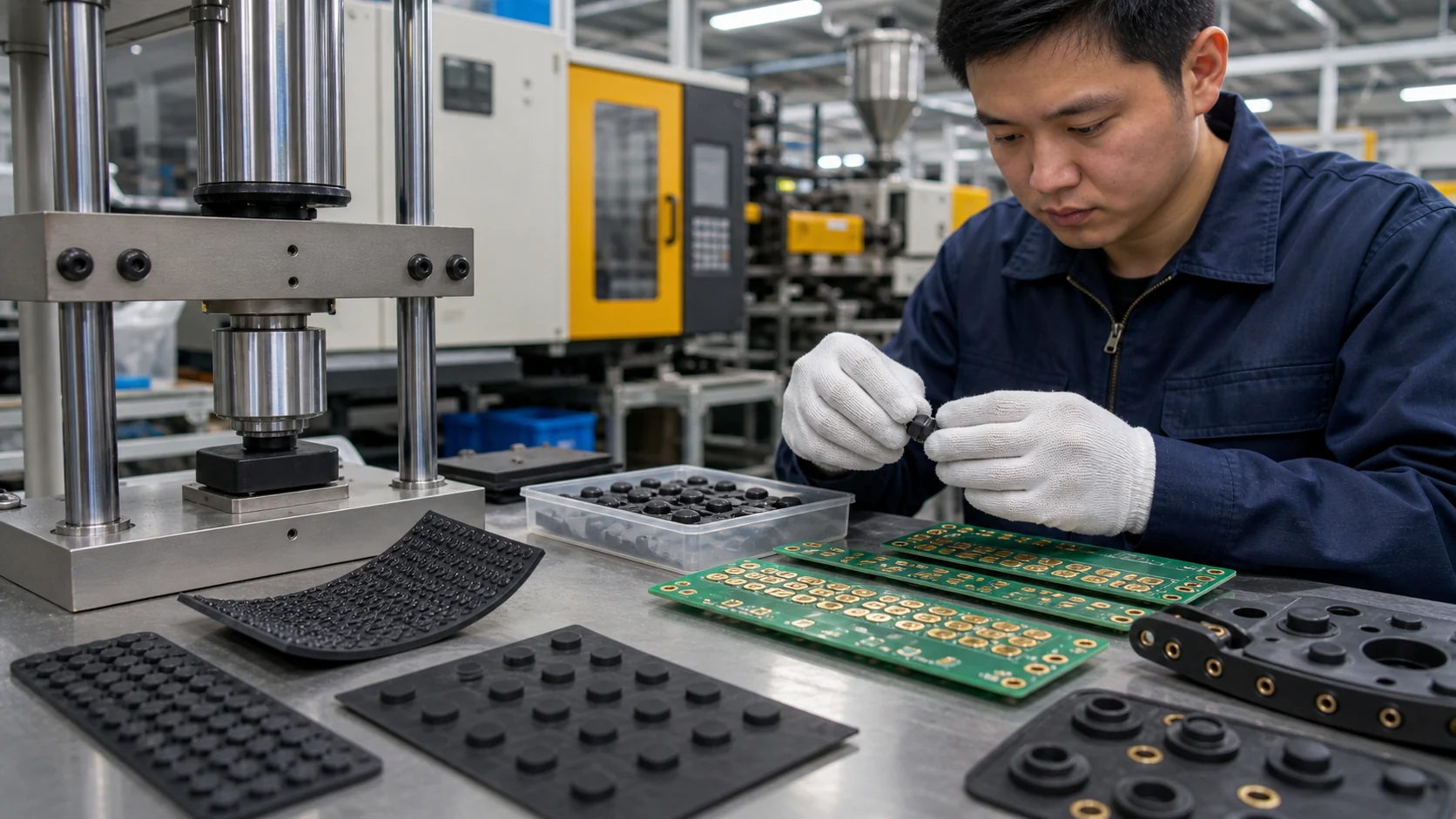
Elastic contact pads are used in tactile switches, pushbuttons, keyboard contacts, PCB test probes, ESD grounding contacts, sensor interfaces and automotive control modules. They must behave as electrical contacts while still recovering like elastomers after repeated compression.
Standard TPU is an excellent insulator and cannot dissipate charge or provide a reliable electrical path. Conductive TPU compounds add carbon black, CNT or carbon fiber networks to give permanent, humidity-independent conductivity while keeping TPU elasticity, resilience and tear resistance.
| Requirement | Why it matters |
|---|---|
| Stable contact resistance under compression | Resistance must stay low and consistent across the operating force range. |
| Resilience and low compression set | Pads must return to shape after thousands or millions of actuations. |
| Permanent ESD protection | Conductivity must not degrade with wear, cleaning or humidity. |
| Cycle durability | Electrical and mechanical behavior must remain stable through the service life. |
Why compression changes resistance
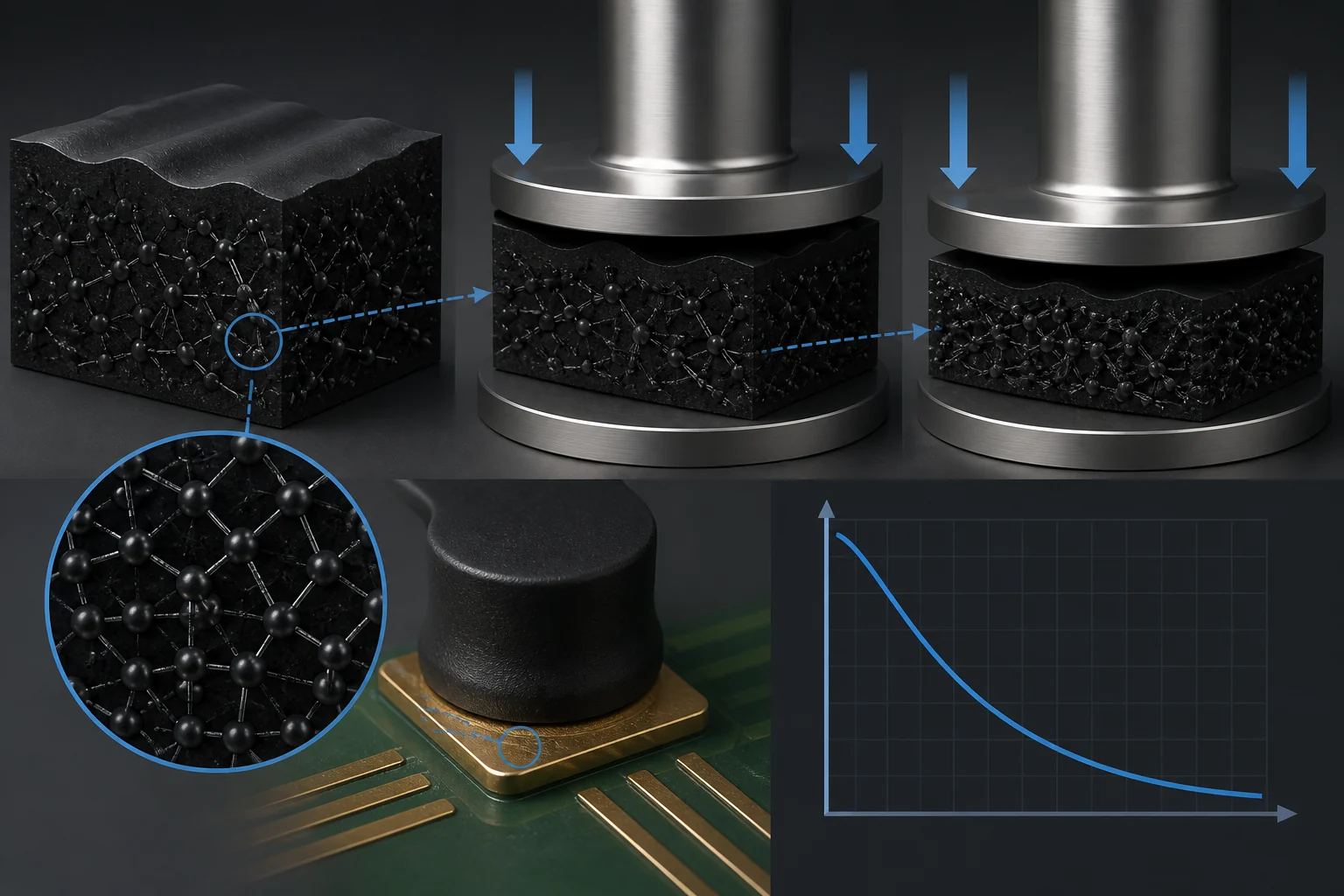
Conductive TPU shows piezoresistive behavior: resistance changes when the material is compressed. As the pad is loaded, the conductive filler network becomes denser and the real contact area against the mating surface grows. Resistance often decreases quickly from initial touch to the normal operating force.
The engineering point is simple but often missed: the resistance value must be specified at the operating compression force, not only on a flat plaque or unloaded specimen.
| Compression force | Contact resistance | Mechanism |
|---|---|---|
| Low initial contact | High | Limited contact area and few conductive pathways. |
| Moderate operating force | Low and stable | Contact area and conductive network are engaged. |
| Over-compression | May increase | Filler displacement or material deformation can disturb the network. |
| Resistance component | Description | Compression effect |
|---|---|---|
| Bulk resistance | Resistance through the TPU volume | Usually decreases as the filler network densifies. |
| Contact resistance | Resistance at the pad-to-metal interface | Decreases quickly as real contact area grows. |
Contact resistance is not the same as bulk resistance
The total electrical path includes resistance through the TPU volume and resistance at the interface between the pad and the metal or PCB surface. Interface resistance can dominate at low force, especially when contact area is small or the mating surface is oxidized, plated differently or contaminated.
For this reason, DEYU recommends a four-wire Kelvin test fixture when the project target is contact resistance. Two-wire measurements can include lead resistance and make low-resistance contact data misleading.
| Conductivity route | Mechanism | Suitability for contact pads |
|---|---|---|
| Migratory antistatic additives | Surface-active additives migrate to the surface | Poor for repeated compression and wear. |
| Permanent conductive fillers | Conductive network throughout the material volume | Excellent because fresh conductive material is exposed with wear. |
| Measurement point | Recommended method | Reason |
|---|---|---|
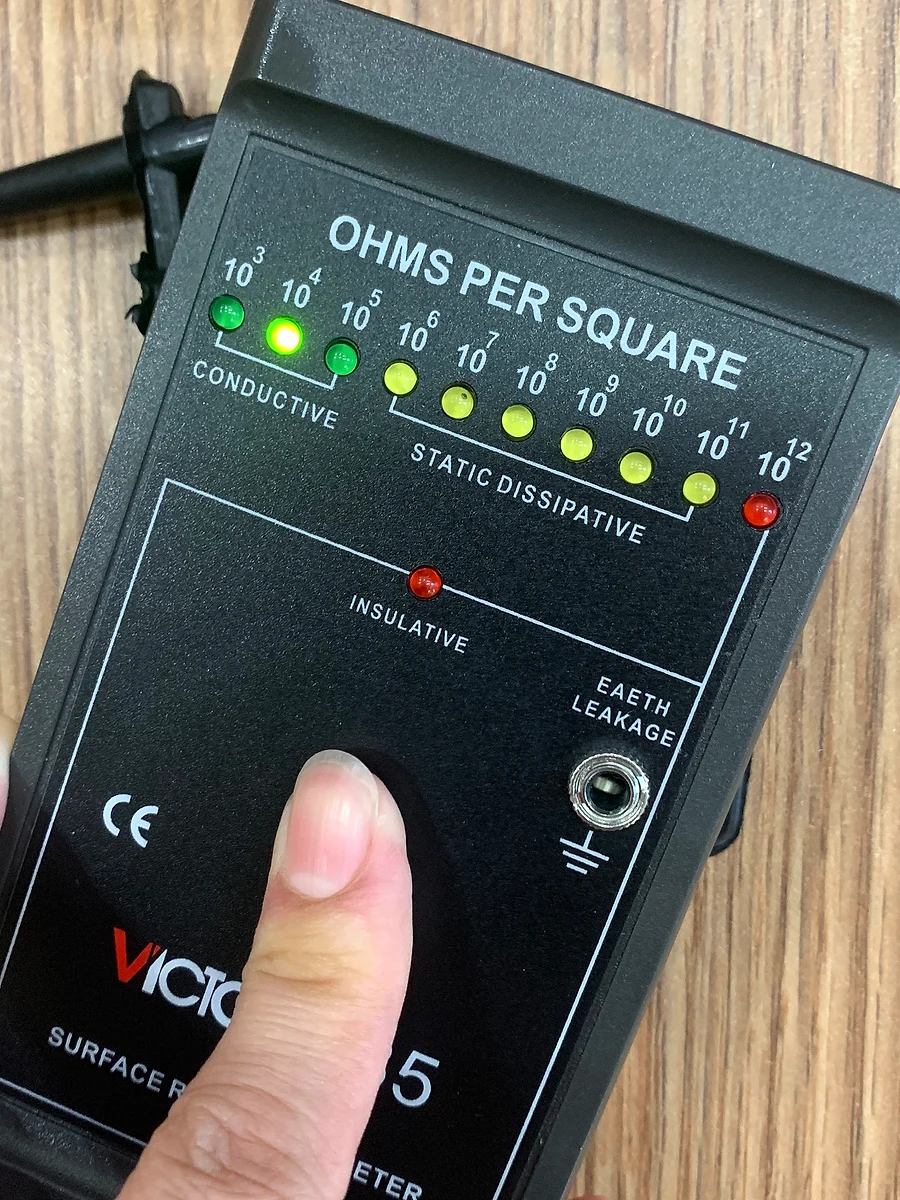
| Surface resistivity | ASTM D257 / ANSI ESD method | Confirms the conductive TPU range. |
| Contact resistance | Four-wire Kelvin fixture | Removes lead resistance and focuses on the contact path. |
| Resistance vs force | Controlled compression fixture | Defines the working-force resistance curve. |
Permanent conductive networks matter in high-cycle pads
Migratory antistatic additives can be useful for simple surface charge reduction, but they are a poor fit for contact pads that are pressed, rubbed and cleaned repeatedly. A permanent carbon-based conductive network remains distributed through the TPU volume, so surface wear exposes fresh conductive material rather than removing the function.
For a public product reference, see DGK-TPU DD3-4ML conductive TPU. It is a carbon-black-filled conductive TPU route used for elastic ESD parts that need stable conductivity and balanced mechanical properties.
| Property | DGK-TPU DD3-4ML | Unit |
|---|---|---|
| Surface resistivity | 10^8-10^9 | ohm-cm |
| Tensile strength | 45 | MPa |
| Elongation at break | 400 | % |
| Tear strength | 200 | kN/m |
| Density | 1.23 | g/cm3 |
| Rockwell hardness | 66 | R |
| Processing | Injection molding | - |
| Flammability | UL94 HB | - |
| Feature | Benefit for contact pads |
|---|---|
| Permanent carbon black network | Conductivity is not depleted by surface wear. |
| High elongation | Pads flex without cracking. |
| Good tear strength | Edges and contact ribs resist damage. |
| TPU resilience | Normal force is retained after compression cycles. |
Compression set and force retention
Electrical stability depends on mechanical recovery. If a contact pad takes excessive compression set, the normal force drops and the resistance curve shifts upward even if the material itself remains conductive. Pad hardness, filler loading, dwell time, temperature and cycle count must be evaluated together.
| Compression-set factor | Effect |
|---|---|
| Filler loading | Higher loading can increase compression set. |
| Hardness | Softer grades often recover better, but contact force must remain sufficient. |
| Temperature | Elevated temperature accelerates set. |
| Dwell time | Long compression dwell can increase permanent deformation. |
| Cycle count | Repeated cycling gradually shifts force and resistance. |
Validation protocol for conductive TPU contact pads
A useful validation plan starts with material-level properties and then moves to the real contact geometry. DEYU checks surface resistivity, tensile strength, elongation, tear strength and hardness, then measures resistance versus force on actual pads or representative specimens.
For switching and grounding contacts, cycle testing and environmental exposure are not optional. The same pad should be checked before cycling, during intervals, after the required number of actuations and after temperature or humidity aging.
| Test setup parameter | Specification |
|---|---|
| Sample | Actual contact pad geometry or representative specimen |
| Fixture | Gold-plated or copper metal plate simulating PCB pad |
| Force application | Controlled compression at specified rates |
| Resistance measurement | Four-wire Kelvin measurement |
| Data | Resistance vs force or displacement |
| Step | Action |
|---|---|
| 1 | Place the contact pad on the metal test fixture. |
| 2 | Apply incremental compressive force, for example 0.1 N steps. |
| 3 | Measure resistance at each force level after stabilization. |
| 4 | Record the force-resistance curve. |
| 5 | Repeat across multiple molded samples. |
| Compression force | Expected resistance | Interpretation |
|---|---|---|
| 0 N | Open circuit | No electrical connection. |
| 0.5 N | 10^7-10^8 ohm | Initial contact, high resistance. |
| 1.0 N | 10^6-10^7 ohm | Conductive paths forming. |
| 2.0 N | 10^5-10^6 ohm | Stable operating region. |
| 5.0 N+ | 10^4-10^5 ohm | Fully compressed, minimum resistance. |
| Reliability test | Condition | Acceptance |
|---|---|---|
| Mechanical cycling | 100,000-1,000,000 actuations | No failure and resistance within specification. |
| Contact force retention | After cycle test | At least 90% of initial contact force. |
| Temperature aging | 85 C for 1,000 hours | Resistance remains stable. |
| Humidity | 85 C / 85% RH for 168 hours | No unacceptable resistance drift. |
| Thermal cycling | -40 C to 85 C, 500 cycles | No mechanical or electrical failure. |
Customer validation scenario: tactile switch contact pad
An electronics manufacturer was developing a tactile switch for a consumer device. The contact pad needed contact resistance below 10^6 ohm at 1.5 N, surface resistivity below 10^9 ohm-cm for ESD protection, a service life of 500,000 actuations and stable resistance after temperature and humidity cycling.
The customer evaluated DGK-TPU DD3-4ML in injection-molded contact pads. DEYU recommended drying at 90-100 C for 3-4 hours, a melt temperature of 190-210 C, and a fixture that measured contact resistance at the actual actuation force instead of relying only on plaque data.
| Trial parameter | Detail |
|---|---|
| Trial quantity | 500 contact pads |
| Material | DGK-TPU DD3-4ML |
| Processing | Injection molding |
| Drying | 90-100 C for 3-4 hours |
| Melt temperature | 190-210 C |
| Target contact resistance | <10^6 ohm at 1.5 N |
| Cycle test | 500,000 actuations |
| Metric | Specification | DGK-TPU DD3-4ML result | Status |
|---|---|---|---|
| Surface resistivity | <10^9 ohm-cm | 10^8-10^9 ohm-cm | Pass |
| Contact resistance @ 1.5 N | <10^6 ohm | 2x10^5-5x10^5 ohm | Pass |
| Contact resistance stability | +/-1 order | +/-0.5 order | Pass |
| Actuation force retention | >=90% after 500k cycles | 92% | Pass |
| Resistance after 500k cycles | <10^6 ohm | 3x10^5-6x10^5 ohm | Pass |
| Thermal / humidity exposure | No failure | Pass | Pass |
The result met the contact-pad requirements. The conductive carbon black network kept resistance stable through 500,000 actuations, and the TPU resilience retained more than 90% of the initial contact force. Permanent conductivity also removed the risk of migratory additive depletion during service life.
Suitable applications and buyer input
This route is suitable for tactile switches, pushbuttons, keyboard contacts, ESD grounding pads, PCB test probes, automotive switch contacts, pressure-sensing interfaces, medical device contacts and industrial control-panel buttons.
To shorten material screening, send DEYU the drawing or 3D model, pad size, compression distance, target contact resistance, actuation force, target cycles, operating temperature, humidity or chemical exposure, mating contact material, present failure mode and expected production volume.
| Application | Key requirement | Recommended direction |
|---|---|---|
| Tactile switches and pushbuttons | Low contact resistance and high cycle life | DGK-TPU DD3-4ML |
| Keyboard contacts | Flexible recovery and consistent force | Conductive TPU soft grade |
| ESD grounding pads | Permanent conductivity | DGK-TPU DD3-4ML or CNT route |
| PCB test probes | Low variation at defined force | CNT conductive TPU route |
| Automotive switch contacts | Heat aging and low compression set | TPU / CF conductive route |
| Sensor interface pads | Repeatable piezoresistive response | Project-specific TPU route |
Conclusion
Conductive TPU contact pads should be approved by their behavior under force, not only by a static resistance value. The decisive data are resistance versus compression, contact resistance stability, force retention, cycle-life drift and environmental aging.
DGK-TPU DD3-4ML provides a practical DEYU material route when elastic ESD contacts require permanent conductivity, TPU resilience and validation data tied to the real contact geometry.