
DGK-ABS KJD890TM Transparent Antistatic ABS Material Procurement Guide
In semiconductor packaging, medical device manufacturing and precision electronic assembly, transparent antistatic ABS selection directly affects yield and reliability. DGK-ABS KJD890TM combines about 85% transmittance with stable 10^8-10^10 ohm surface resistivity, and this guide turns its data, validation methods and customer cases into a practical procurement checklist.
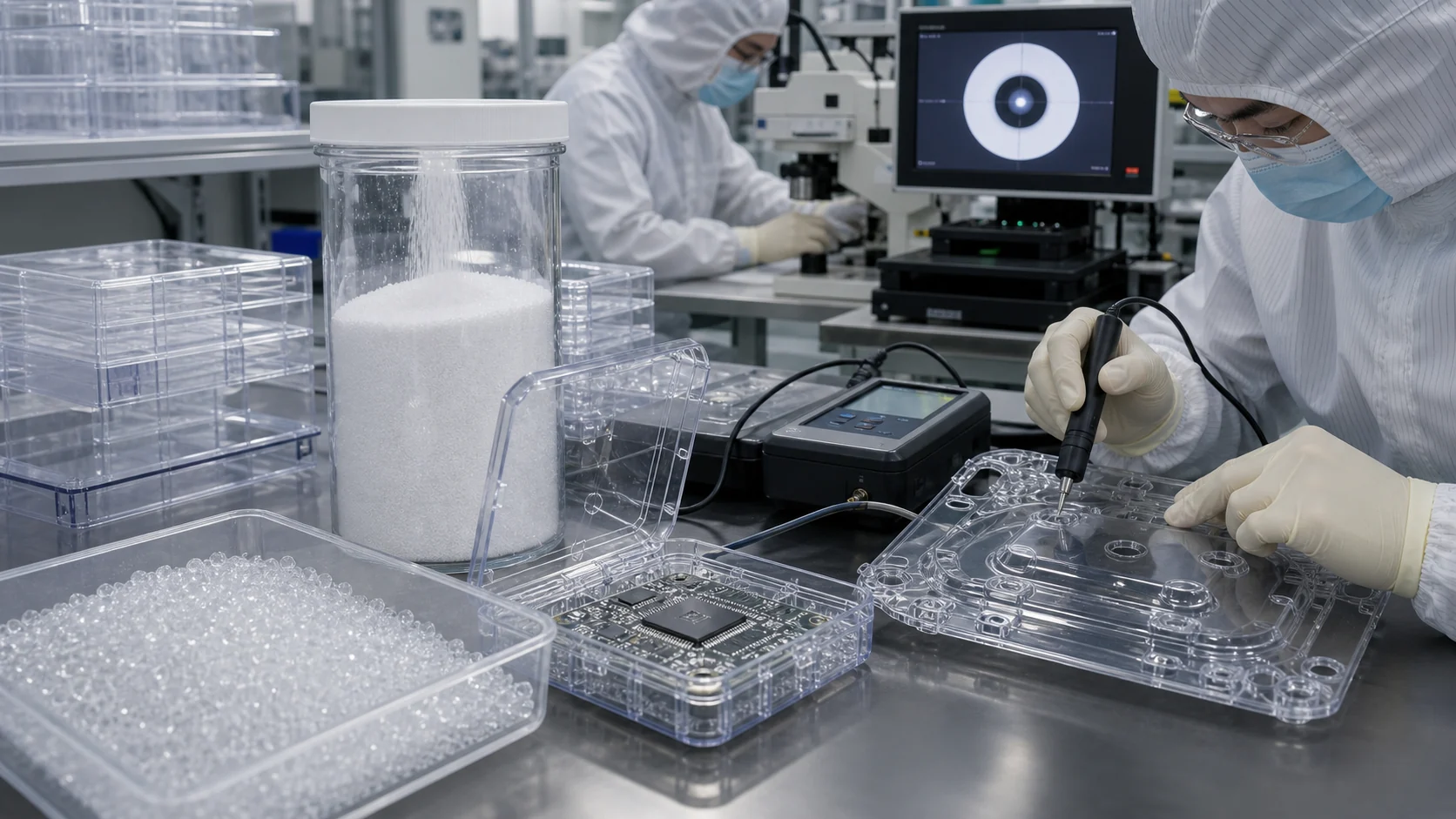
Transparent antistatic ABS procurement FAQ
DGK-ABS KJD890TM Transparent Antistatic ABS Procurement Guide
Why choose polymeric permanent antistatic ABS instead of a surface coating?
A coating can be transparent at first, but alcohol wiping, washing and low humidity can reduce its antistatic effect. KJD890TM uses a polymeric antistatic route compounded into the ABS, so the resistance is more stable during cleaning and storage.
What data should purchasing verify before a bulk order?
Ask for surface resistivity, transmittance and batch consistency data from at least three lots, then confirm Cpk, molded-part resistance mapping, haze, alcohol wiping, low-humidity performance and supply terms.
How should the mold trial validate resistance uniformity and haze?
Use the target mold and measure the gate side, middle, thin wall, weld line and flow end. The resistance spread should stay within the project limit, and haze should be checked after adjusting drying, mold temperature and injection speed.
Which applications fit DGK-ABS KJD890TM best?
It fits transparent chip packaging boxes, medical sterile packaging boxes, cleanroom observation windows, optical inspection covers, monitor panels and powder storage jars that need visibility plus long-term static dissipation.
Market demand for transparent antistatic ABS procurement
In semiconductor packaging and testing, medical device manufacturing and precision electronic assembly, the selection of transparent antistatic plastics is not a cosmetic decision. It directly affects production yield, cleanliness, ESD safety and long-term reliability. DGK-ABS KJD890TM is a transparent ABS material modified through a polymeric permanent antistatic route. Its typical transmittance is about 85%, and its surface resistivity remains in the 10^8-10^10 ohm range. It has already been used in medical monitor panels, semiconductor cleanroom observation windows, transparent antistatic chip packaging boxes and powder storage jars.
This procurement guide is written for buyers and engineers who need a material decision, not only a data-sheet comparison. It keeps the key technical parameters, industry test references, validation methods, cost and supply considerations, and three real customer cases together so that purchasing, engineering and quality teams can use the same approval logic.
Three common pain points when purchasing transparent antistatic ABS
Pain point one: transparency is not high enough and haze exceeds the target. Transmittance and haze are core quality indicators for transparent ABS injection molded parts. Because transparent ABS development and application started later in China than in some overseas markets, differences still exist in raw material development, molding equipment and process research. In real production, injection temperature, mold temperature and drying conditions can all reduce transparency. This is especially critical for thin-wall packaging boxes, medical device windows and observation covers where operators must visually confirm the object behind the plastic.
Pain point two: antistatic performance is unstable and resistance drifts. Surface-coated antistatic solutions can give a short-term transparent ESD effect, but the antistatic layer can decay after wiping, washing or changes in environmental humidity. In cleanroom trays and panels that are frequently wiped with alcohol, the antistatic function may weaken after several months. Conductive filler routes can also introduce filler shedding or unstable surfaces. A more hidden issue is humidity dependence: under low humidity, static charge accumulates more easily and resistance increases. The same molded part may pass in summer and fail in winter.
Pain point three: transparency and antistatic behavior are hard to balance. Conductive carbon black can create stable 10^3-10^6 ohm resistance, but the material becomes black and opaque. Surface coating can keep transparency, but the antistatic effect is not durable enough. CNT and carbon black can also darken ABS and create dispersion-related optical defects. For transparent ABS applications, the core technical challenge is to combine high visual clarity with long-term static dissipation.
| Selection pain point | Technical cause | Procurement risk |
|---|---|---|
| Transparency is insufficient and haze is too high | Drying, injection temperature, mold temperature and thin-wall shear can increase light scattering. | Visual inspection fails in chip boxes, medical windows and clear covers. |
| Antistatic performance drifts | Coatings wear away, small-molecule agents depend on humidity, and filler routes can create unstable surfaces. | Summer approval and winter failure, or loss of ESD control after cleaning. |
| Transparency and antistatic behavior are hard to balance | Carbon black is stable but opaque; coating is clear but short-lived; CNT or carbon black can darken ABS. | Buyers may choose a material that passes one target while failing the other. |
DGK-ABS KJD890TM material route and technical specification
DGK-ABS KJD890TM transparent permanent antistatic ABS uses a polymeric permanent antistatic additive compounded with transparent ABS. The antistatic component is present in polymer form and is anchored inside the resin matrix. Unlike small-molecule antistatic agents that rely on migration to the surface and environmental moisture, this route does not lose its antistatic performance significantly after repeated washing, wiping or long-term storage.
The electrical target is surface resistivity in the 10^8-10^10 ohm range, tested according to GB/T 1401-2002 / IEC 61340-5-1. This range belongs to static dissipative materials and supports controlled charge release rather than uncontrolled charge accumulation. The optical target is about 85% transmittance at 2 mm thickness according to ASTM D1003, which makes it suitable for transparent packaging covers, medical observation parts and visual inspection panels.
Mechanical and processing data should be reviewed together. The material has tensile strength of 39 MPa, yield strength of 40.3 MPa, elongation at break of 35.8%, flexural strength of 57 MPa and flexural modulus of 1612 MPa. Impact references include Charpy notched impact strength of 10.5 kJ/m2, Charpy unnotched impact strength of 86 kJ/m2 and Izod notched impact strength of 12.3 kJ/m2. The heat deflection temperature is 85 C at 0.45 MPa. Its MFR is 48 g/10 min at 220 C / 10 kg, which places it in a high-flow injection molding window. Density is 1.118 g/cm3.
The recommended molding window starts with drying at 85 C for 4-5 hours. Injection temperature is typically 195-210 C, and mold temperature starts around 70 C. For thin-wall transparent parts or flow-end haze, mold temperature can be raised carefully, as shown in the first customer case below.
| Property | Test reference | Typical value | Procurement meaning |
|---|---|---|---|
| Surface resistivity | GB/T 1401-2002 / IEC 61340-5-1 | 10^8-10^10 ohm | Static dissipative range for controlled charge release. |
| Transmittance, 2 mm | ASTM D1003 | About 85% | Clear enough for visual inspection of packages, panels and jars. |
| Tensile strength / yield strength | GB/T | 39 MPa / 40.3 MPa | Useful for molded lids, windows and packaging shells. |
| Elongation at break | GB/T | 35.8% | Helps avoid brittle failure during handling. |
| Flexural strength / modulus | GB/T | 57 MPa / 1612 MPa | Stiffness reference for panels and covers. |
| Charpy notched / unnotched impact | GB/T | 10.5 / 86 kJ/m2 | Screens drop and handling resistance. |
| Izod notched impact | GB/T | 12.3 kJ/m2 | Checks local notch sensitivity. |
| HDT, 0.45 MPa | GB/T | 85 C | Reference for service-temperature screening. |
| MFR | 220 C / 10 kg | 48 g/10 min | High-flow grade for thin-wall injection molding. |
| Density | GB/T | 1.118 g/cm3 | Used for cost-per-part calculation. |
| Process item | Recommended setting | Purpose |
|---|---|---|
| Drying temperature | 85 C | Remove moisture before transparent molding. |
| Drying time | 4-5 h | Reduce silver streaks, haze and local defects. |
| Injection temperature | 195-210 C | Maintain flow while avoiding optical degradation. |
| Mold temperature | 70 C as baseline; 75 C in the thin-wall case | Improve relaxation of the antistatic phase and reduce haze. |
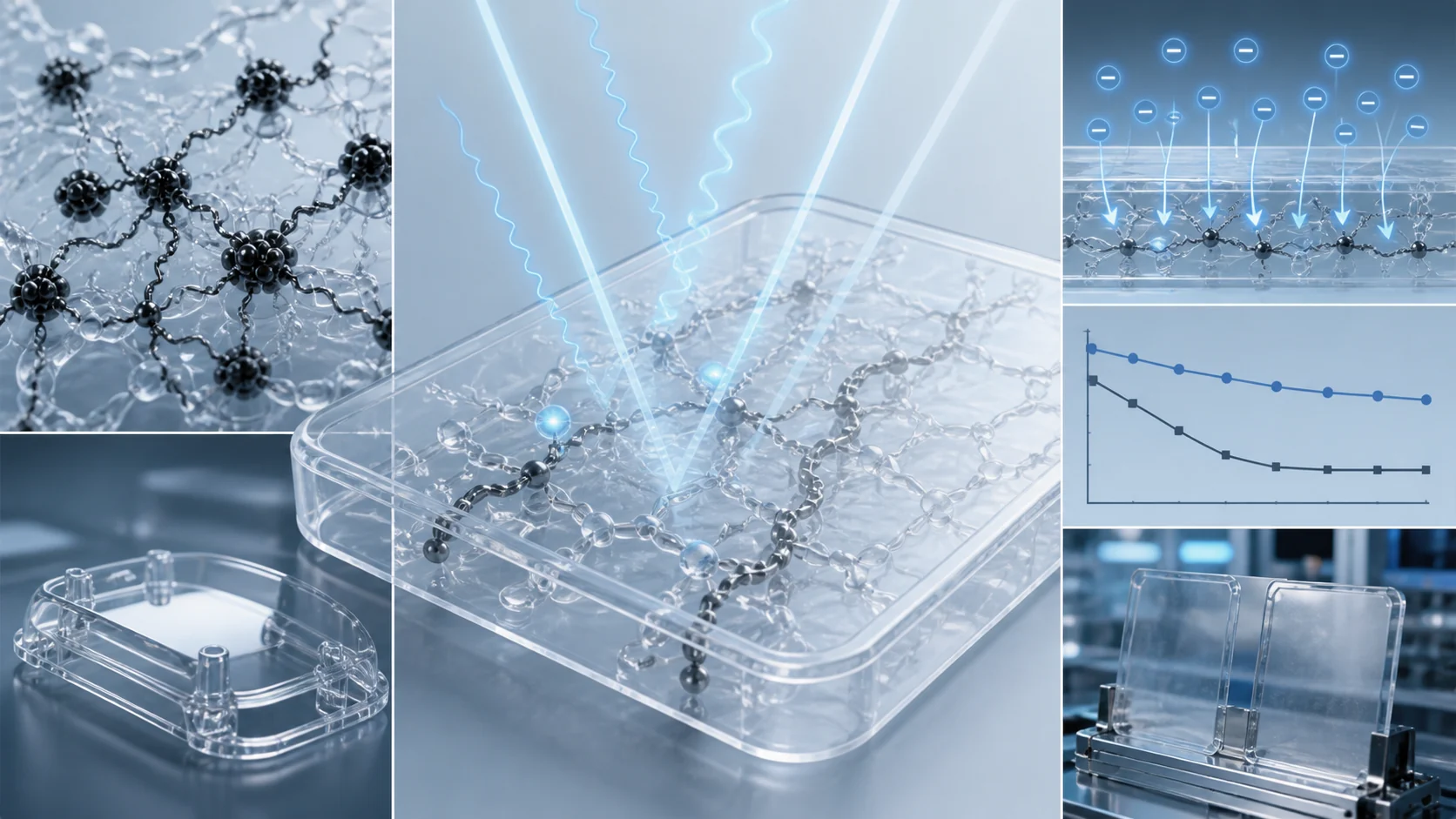
Customer case 1: transparent antistatic chip packaging box
Customer background and initial requirement. A precision packaging manufacturer in East China supplied transparent antistatic packaging boxes for semiconductor packaging and testing customers. The boxes were used for chip and sensor storage and transfer. The upper cover had to remain transparent so operators could identify material type and quantity without opening the box, and surface resistivity had to stay in the 10^8-10^10 ohm range to avoid dust attraction and ESD risk.
Initial problem. The customer previously used an imported transparent antistatic ABS. Incoming transmittance and resistance data were acceptable, but during mass injection molding, two defects appeared repeatedly. The first was local haze: some areas of the molded part showed white fog and nonuniform transparency. The second was resistance nonuniformity: different positions on the same molded part varied by more than one order of magnitude, with lower resistance near the gate and higher resistance at the far end. Finished-part yield stayed around 82%, and scrap remained high.
The customer adjusted injection temperature, injection speed and holding pressure, but improvement was limited. The root cause was insufficient compatibility between the antistatic agent and the ABS base. During injection flow, the antistatic phase oriented along the flow direction. It became richer near the gate and diluted toward the far end, causing resistance distribution problems. At the same time, the dispersed antistatic phase was not controlled finely enough, which increased light scattering and created haze.
Material switching and trial process. After the customer learned about DGK-ABS KJD890TM, DEYU supported a small-batch trial at the customer site. In the first round, the recommended process was used: drying at 85 C for 4-5 hours, injection at 195-210 C and mold temperature at 70 C. Transmittance was about 85%, and surface resistivity reached 3.2 x 10^9 ohm, but slight haze remained.
In the second round, DEYU engineers traced the haze to the thin-wall area of about 1.2 mm and to the flow end. The analysis was that high melt velocity and strong shear in the thin wall caused orientation of the antistatic dispersed phase. The effective particle/domain size increased, which strengthened Rayleigh scattering. The adjustment was to raise mold temperature from 70 C to 75 C, giving the antistatic phase more relaxation time before cooling, and to change the injection profile to slow-medium-slow to avoid excessive shear at the flow end.
In the third round, the haze disappeared and transmittance stabilized above 85%. Surface resistivity variation across the molded part was controlled within half an order of magnitude: about 2.8 x 10^9 ohm near the gate and 3.5 x 10^9 ohm at the far end.
| Comparison item | Original imported material | KJD890TM first trial | KJD890TM locked setting |
|---|---|---|---|
| Transmittance, 2 mm | ~86% | ~85% | >=85% |
| Surface resistivity | 10^8-10^10 ohm | 3.2 x 10^9 ohm | 2.8-3.5 x 10^9 ohm |
| Resistance uniformity spread | >1 order | ~0.8 order | <0.5 order |
| Appearance defect rate | 18% haze / local white fog | 8% slight haze | <2% |
| Finished-part yield | 82% | 92% | 98% |
Result. The customer listed DGK-ABS KJD890TM as the standard material for this packaging box. It has been supplied continuously for six months, and batch-to-batch resistance Cpk stayed at or above 1.33.
Customer case 2: medical sterile packaging box
Customer background and initial requirement. A domestic medical equipment brand manufactured sterile transparent packaging boxes for surgical instruments, implant accessories and precision diagnostic instruments. The box had to provide high transparency for visual confirmation of instrument type and quantity, antistatic behavior to prevent fine dust attraction, and resistance to frequent alcohol wiping and disinfection.
Problem with the original route. The customer originally used ordinary transparent ABS with a sprayed antistatic coating. Surface resistance and transmittance were acceptable at delivery, but after three to six months of use, daily alcohol wiping consumed the antistatic coating. Resistance failed, and static dust attraction on instrument surfaces became a recurring cleanliness issue. In medical applications, fine dust can create a serious risk because cleanliness requirements are strict for surgical instruments and implant-related parts.
Material switching and verification. The customer switched to DGK-ABS KJD890TM, and DEYU helped complete a verification plan. Alcohol wiping durability was tested for 500 cycles. After wiping, resistance changed by less than one order of magnitude and remained in the 10^8-10^9 ohm/sq range. Low-humidity testing at 15% RH showed resistance variation below 2x, confirming that the material did not rely strongly on environmental humidity. Warm water durability was also checked: after 60 C water exposure for 24 hours, resistance increased by less than 30%.
| Validation item | Method | Result |
|---|---|---|
| Alcohol wiping durability | 500 alcohol wipes | Resistance change below one order; still 10^8-10^9 ohm/sq. |
| Low-humidity stability | 15% RH test | Resistance change below 2x. |
| Water-boiling durability | 60 C water for 24 h | Resistance increase below 30%. |
| Production feedback | Accumulated delivery | 150,000 pieces delivered with zero customer complaints. |
Implementation effect. The customer has delivered 150,000 pieces with zero customer complaints. The switch solved the original pain point of a coated solution failing after roughly half a year. In addition to medical monitor panels, the material has also been used for semiconductor cleanroom observation windows, optical inspection equipment panels and drone ground-station display covers.
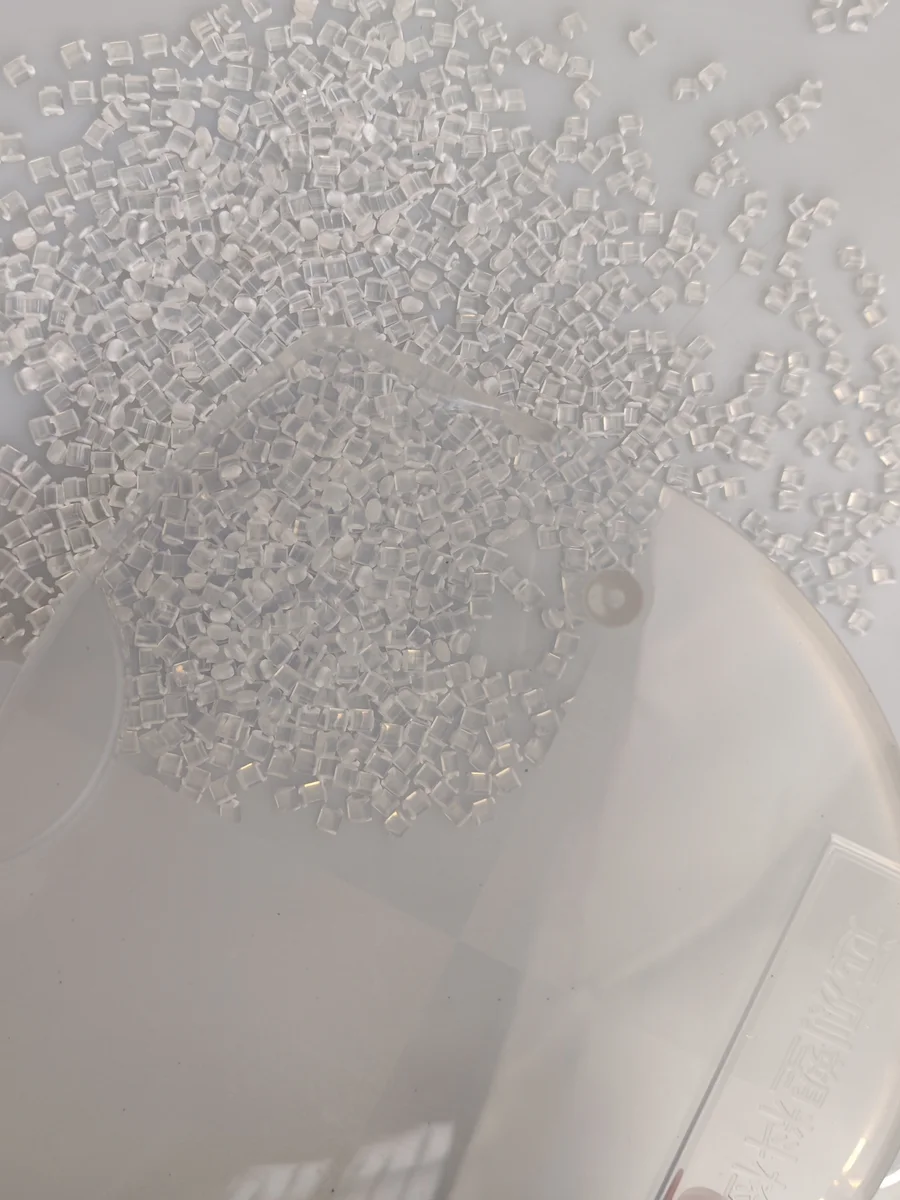
Customer case 3: transparent powder storage jar
Customer background and initial requirement. A pharmaceutical equipment company produced transparent powder storage jars for drug intermediate packaging and powder dosing containers. The jar body had to remain transparent so operators could observe powder level and flow state, while antistatic performance was needed to prevent powder adhesion to the jar wall and maintain dosing accuracy.
Original problem. The customer previously used ordinary transparent ABS. Because ABS is an excellent insulator, powder filling, pouring and conveying generated a large amount of static charge through friction with the jar wall. Fine powder adhered to the inner wall, creating a wall-sticking problem. This not only affected visual judgment of powder level, but also made each dosing amount less stable, reducing precision in pharmaceutical dosage control.
The customer tried spraying antistatic agent on the jar surface, but continuous powder friction and cleaning wore the coating down quickly. Black conductive ABS could solve the static problem, but it was opaque and could not meet the visual observation requirement.
Material switching and verification. The customer selected DGK-ABS KJD890TM for injection molding the powder storage jar. DEYU helped verify powder adhesion, transparency and cleaning durability. In simulated filling and pouring, surface resistivity stayed around 10^8-10^9 ohm/sq and charge dissipated quickly enough to significantly reduce powder wall sticking. At 2 mm thickness, transmittance remained at or above 85%, allowing clear observation of powder level and flow. After 500 alcohol wipes, resistance remained stable.
| Validation item | Before | After KJD890TM |
|---|---|---|
| Powder wall sticking | Fine powder adsorbed to ordinary clear ABS walls. | Wall sticking was significantly reduced by 10^8-10^9 ohm/sq dissipation. |
| Powder-level observation | Clear body existed, but powder residue blocked visual judgment. | 85% transmittance at 2 mm allowed clear powder-level observation. |
| Cleaning durability | Sprayed antistatic coating wore away during cleaning. | 500 alcohol wipes kept resistance stable. |
| Dosing accuracy | Powder residue affected each dispensing amount. | More accurate powder dosing and cleaner vessel walls. |
Implementation effect. Powder wall sticking was significantly reduced, powder level observation became clearer, dosing accuracy improved, and the jar retained permanent antistatic behavior after cleaning.
Procurement validation process
Step one: request complete property data and test reports. The supplier should provide surface resistivity and transmittance data for at least three consecutive production lots. Buyers should calculate or request batch Cpk where applicable. For DGK-ABS KJD890TM, validated batch resistance Cpk can reach at least 1.33.
Step two: run a small-batch mold trial. The target mold should be used instead of only standard plaques. The trial should verify surface resistance uniformity at different positions, including gate area, middle area, thin wall, weld line and flow end. Resistance spread should generally be below one order of magnitude unless the project defines another limit. Transmittance, haze and molding-window compatibility must also be checked.
Step three: perform accelerated aging. The validation should simulate real use conditions. Alcohol wiping should be no fewer than 500 cycles when the application involves disinfection or cleaning. Low-humidity testing at 15% RH for 48 hours should confirm that the material does not depend on humidity. Damp-heat aging or storage aging should be added when the end-use environment requires long-term reliability.
Step four: confirm supply assurance. Purchasing should confirm MOQ, lead time, batch consistency guarantee and after-sales technical support. DEYU supports 5 kg small-batch validation and 72-hour sample delivery for this material direction, which allows the customer to verify the material before committing to bulk order.
| Step | Buyer action | Acceptance focus |
|---|---|---|
| 1. Datasheet and reports | Request at least three consecutive lots of resistance and transmittance data. | Confirm batch Cpk >= 1.33 where applicable. |
| 2. Small-batch mold trial | Run the target mold and measure different positions. | Resistance spread below one order unless the project defines another limit; haze and process window approved. |
| 3. Accelerated aging | Run 500 alcohol wipes, 15% RH for 48 h and damp-heat aging. | Long-term antistatic stability does not depend on surface coating or humidity. |
| 4. Supply assurance | Confirm MOQ, lead time, batch consistency and technical service. | DEYU supports 5 kg validation and 72 h sample delivery for this project type. |
Selection decision logic and conclusion
| Application | Core requirement | KJD890TM match |
|---|---|---|
| Transparent chip antistatic packaging box | Transparency + antistatic behavior + thin-wall molding | 85% transmittance, 10^8-10^10 ohm and MFR 48 g/10 min. |
| Medical sterile packaging | Transparency + wipe resistance + long-term stability | Stable after 500 alcohol wipes; 150,000 pieces delivered with zero complaints. |
| Powder storage jar | Transparency + anti-wall-sticking + cleanability | Powder adhesion reduced and transparent visual checking retained. |
DGK-ABS KJD890TM can be summarized by four procurement parameters: surface resistivity of 10^8-10^10 ohm according to GB/T 1401-2002 / IEC 61340-5-1, transmittance of about 85% at 2 mm according to ASTM D1003, MFR of 48 g/10 min at 220 C / 10 kg, and validated resistance Cpk at or above 1.33. It has already been used in chip antistatic packaging boxes, medical sterile packaging boxes and powder storage jars, with more than 150,000 pieces delivered in the medical packaging case.
For buyers, the key is not to approve transparent antistatic ABS only by a single resistance value or a transparent plaque. The final decision should combine optical clarity, resistance uniformity across the molded part, alcohol wiping durability, low-humidity stability, cleaning durability, moldability, supply lead time and cost per accepted part. When those checks are completed, DGK-ABS KJD890TM provides a practical domestic material route for transparent parts that must stay visible, clean and permanently antistatic.