
Flame-Retardant Plastics Selection Guide: PP, ABS, PC/ABS, PA66 and PBT
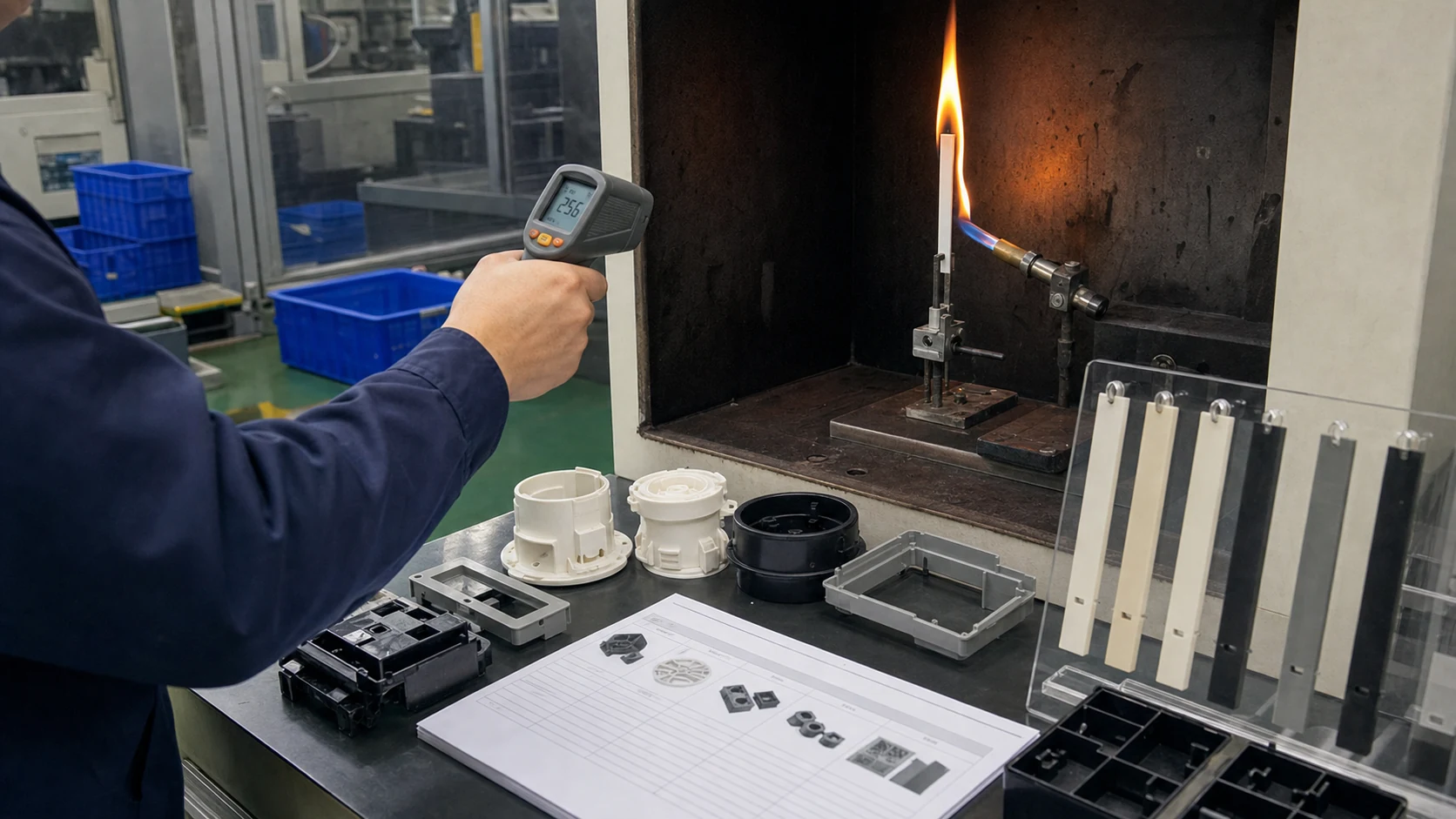
Flame retardancy has become a non-negotiable requirement across electronics, automotive, construction, and household appliance sectors. Regulatory frameworks such as UL94, IEC, RoHS, and REACH continue to tighten, driving demand for materials that combine fire safety with mechanical performance, processability, and environmental compliance.
Buyer and engineer FAQ
Questions engineers often ask about this material route
Where can ABS / PA66 / PBT / PC / PC/ABS / PP with a flame-retardant plastic requirement be used?
Typical fields include electrical enclosures, battery parts, connectors, appliance housings and industrial covers. For this article, DEYU would first confirm the working environment, wall thickness, expected lifetime and whether flame-retardant plastics product category, DGK-PC FR3000 flame-retardant PC matches the part geometry or needs formulation adjustment.
What are the main performance indicators for the "flame-retardant plastic" target on ABS / PA66 / PBT / PC / PC/ABS / PP?
Focus on UL94 rating, GWFI/GWIT when needed, CTI, mechanical retention, color stability and flame-retardant precipitation. Buyers should ask for data on molded parts, not only pellet data, because gate position, filler orientation and thickness can change the final value.
What should engineers watch during injection molding or processing?
For ABS / PA66 / PBT / PC / PC/ABS / PP, a practical starting window is 210-245°C melt / 50-80°C mold. Avoid excessive residence time, use moderate screw speed and confirm the rating at the actual wall thickness. Final parameters should follow part thickness, gate design and the actual machine.
What details help DEYU recommend flame-retardant plastics product category, DGK-PC FR3000 flame-retardant PC more accurately?
Send the current resin or grade, drawing or photo, wall thickness, annual quantity, target standard, failure mode and required color. If a reference grade already passed one test but failed in production, include both data sets.
For a precise recommendation, share the part drawing, base resin, target performance, processing method and test standard with DEYU.
1. Background / Market Context
Flame retardancy has become a non-negotiable requirement across electronics, automotive, construction, and household appliance sectors. Regulatory frameworks such as UL94, IEC, RoHS, and REACH continue to tighten, driving demand for materials that combine fire safety with mechanical performance, processability, and environmental compliance.
Related DEYU plastics material references for this selection topic: flame-retardant plastics product category and DGK-PC FR3000 flame-retardant PC.
Pure PP and ABS resins are inherently flammable —flame retardancy must be achieved through modification. PC inherently possesses some flame retardancy (LOI 21-24%, UL94 V-2), but still requires modification for higher grades. PA66 and PBT, while offering superior mechanical and thermal properties, also require flame-retardant additives especially when glass-fibre reinforced due to the “wicking effect—along fibre surfaces.
The market has seen accelerating adoption of halogen-free flame-retardant systems, driven by EU directives and China’s GB standards. However, halogenated systems remain widely used in cost-sensitive applications where high efficiency and low loading are prioritised.
2. Material-by-Material Analysis
2.1 Flame-Retardant PP (Polypropylene)
Base Properties: PP is a non-polar, semi-crystalline thermoplastic with low density, good chemical resistance, and excellent cost-effectiveness. However, its high crystallinity and flammability make achieving high flame-retardant grades challenging.
Modification Routes:
Halogenated system: decabromodiphenyl ethane + antimony trioxide synergist —high efficiency, low loading, cost-effective for general applications.
Halogen-free system: intumescent flame retardants (phosphorus-nitrogen based) that form a char layer upon heating, suppressing combustion. Some grades achieve UL94 V-0 at 0.75 mm, 1.5 mm, and 3.0 mm.
Performance Profile:
Density: low (~0.95-1.05 g/cm³) —lightweight advantage.
Heat resistance: superior to FR ABS.
Cost: most economical among the five materials.
Limitation: low-temperature brittleness, notch sensitivity, higher mould shrinkage.
Typical Applications: TV housings, washing machine control panels, refrigerator evaporator trays, ventilation ducts, appliance components requiring UL94 V-0 or GWIT 750°C+.
2.2 Flame-Retardant ABS (Acrylonitrile-Butadiene-Styrene)
Base Properties: ABS offers excellent surface gloss, good impact resistance, and outstanding mouldability. Its amorphous nature provides dimensional stability but also higher smoke generation during combustion.
Modification Routes:
Halogenated system: decabromodiphenyl ethane + antimony synergist —traditional approach for electronic housings.
Halogen-free system: phosphorus-nitrogen compound systems (e.g. SOL-DP + MCA) achieving UL94 V-0 with mechanical property retention above 80%. Red phosphorus and ammonium dihydrogen phosphate systems can achieve V-0 at 10 wt% loading.
Performance Profile:
Surface finish: excellent gloss —superior to FR PP.
Toughness: better impact resistance than FR PP.
Low-temperature performance: superior to FR PP.
Limitation: outdoor weatherability is poor; heat resistance up to ~85°C.
Typical Applications: signal lamp housings, automotive interior trim, electronic device enclosures, consumer goods requiring aesthetic surfaces.
2.3 Flame-Retardant PC/ABS (Polycarbonate/ABS Alloy)
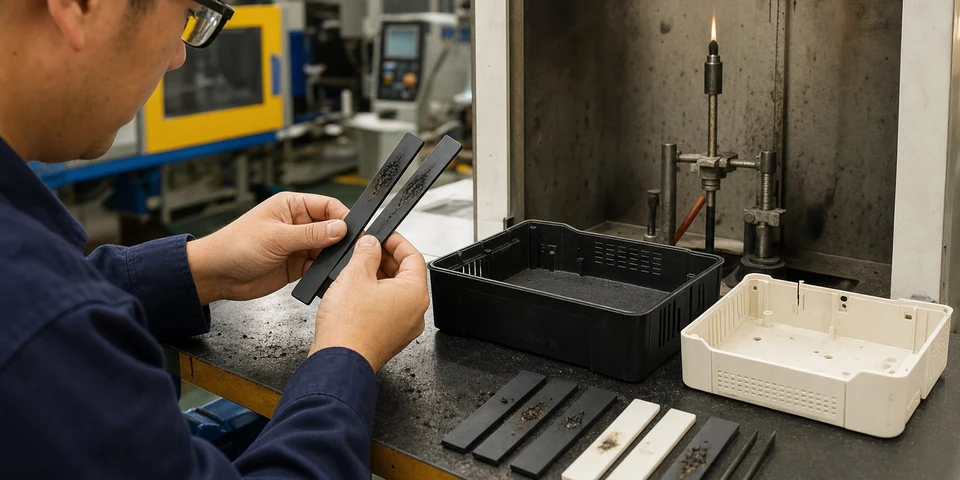
Base Properties: PC/ABS alloy combines PC’s high strength, heat resistance, and dimensional stability with ABS’s excellent processability and toughness. This blend offers one of the best balanced property profiles among flame-retardant engineering plastics.
Modification Routes:
Halogen-free system: BDP (bisphenol A diphenyl phosphate) or RDP (resorcinol bis(diphenyl phosphate)) phosphate esters —optimised for PC/ABS two-phase compatibility.
Synergistic systems: BDP + TPP (triphenyl phosphate) compounding achieves better flame retardancy than BDP alone.
Advanced systems: ADP (aluminium diethylphosphinate) + DOPO synergist; or graphene + POSS + PTFE + potassium sulphonate quaternary synergy with low additive loading.
Performance Profile:
Flame retardancy: UL94 V-0 achievable at 1.5 mm.
LOI: 27.9%+ with optimised formulations.
Heat resistance: up to ~120°C.
Impact strength: excellent —significantly better than FR ABS.
Limitation: chemical resistance is moderate; PC component is susceptible to hydrolysis at high processing temperatures.
Typical Applications: TV housings (especially large-screen), notebook computer enclosures, signal lamp housings, interior automotive components, battery enclosures, electrical cabinets.
2.4 Flame-Retardant PA66 (Polyamide 66)
Base Properties: PA66 offers high strength, excellent thermal stability, good chemical resistance, and low friction. However, its high processing temperature (~280-300°C) and the “wicking effect—in glass-fibre reinforced grades present challenges for flame-retardant modification.
Modification Routes:
Halogenated system: decabromodiphenyl ethane or brominated polystyrene —traditional approach.
Halogen-free systems:
Red phosphorus: high phosphorus content, high efficiency, cost-effective —but suffers from moisture absorption, oxidation, and surface migration issues.
Organic phosphinates (e.g. aluminium diethylphosphinate) + MPP (melamine polyphosphate) synergist —achieving UL94 V-0 at 1.6 mm with ~17 phr loading.
Melamine cyanurate (MCA): effective for unfilled PA66.
Reactive flame retardants: P-N type monomers chemically bonded into PA66 backbone —improves compatibility and permanence.
Performance Profile:
Flame retardancy: UL94 V-0 achievable in both unfilled and glass-filled grades.
Mechanical strength: excellent —glass-filled grades offer superior stiffness and strength.
Heat resistance: HDT >200°C —highest among the five.
Limitation: moisture absorption affects dimensional stability and electrical properties.
Typical Applications: connectors, relay housings, terminal blocks, automotive engine components, battery module brackets, electrical enclosures.
2.5 Flame-Retardant PBT (Polybutylene Terephthalate)
Base Properties: PBT offers excellent dimensional stability, low moisture absorption, good chemical resistance, and outstanding electrical properties. Fast crystallisation provides rapid mould cycle times.
Modification Routes:
Halogenated system: brominated flame retardants + antimony synergist.
Halogen-free system: organic phosphinates (e.g. OP series) or phosphinate esters (EPFR series); aluminium phosphinate encapsulated with cyclodextrin.
Glass-fibre reinforced: 20-30% glass fibre + flame retardant —common for structural applications.
Performance Profile:
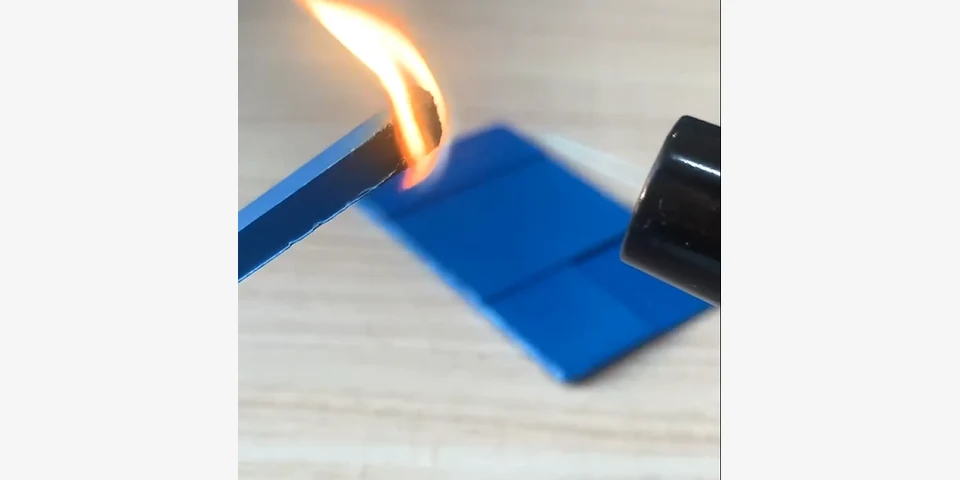
Flame retardancy: UL94 V-0 achievable.
Mechanical: glass-filled grades achieve tensile strength ~96 MPa, flexural strength ~140 MPa.
Electrical: CTI up to 500 V achievable.
Moisture: very low water absorption —superior to PA66.
Limitation: notch sensitivity; susceptible to ester exchange degradation at processing temperatures.
Typical Applications: headlamp bezels, electrical connectors, coil bobbins, relay sockets, automotive electrical components, EV high-voltage applications.
3. Reference Product Data Table
| Property | FR PP | FR ABS | FR PC/ABS | FR PA66 (GF30) | FR PBT (GF30) |
|---|---|---|---|---|---|
| Base Resin | Polypropylene | ABS | PC/ABS alloy | PA66 + 30% GF | PBT + 30% GF |
| Modification Route | Intumescent / Halogenated | Phosphorus-nitrogen / Halogenated | BDP/RDP phosphate esters | Organic phosphinate + MPP | Organic phosphinate |
| Processing Method | Injection moulding | Injection moulding | Injection moulding | Injection moulding | Injection moulding |
| Density (g/cm³) | 0.95-1.05 | 1.05-1.20 | 1.18-1.22 | 1.50-1.65 | 1.50-1.65 |
| MFR (g/10 min) | 5-15 | 10-30 | 10-25 | 5-15 | 10-25 |
| Tensile Strength (MPa) | 25-35 | 35-45 | 55-65 | 140-180 | 90-120 |
| Flexural Modulus (MPa) | 1500-2500 | 2000-2800 | 2300-2800 | 8000-11000 | 7000-9000 |
| Notched Impact (kJ/m²) | 3-6 | 10-18 | 35-55 | 7-12 | 6-10 |
| HDT (°C, 1.82 MPa) | 90-110 | 80-95 | 100-120 | 230-250 | 200-220 |
| UL94 Rating | V-0 (0.75-3.0 mm) | V-0 (1.6 mm) | V-0 (1.5 mm) | V-0 (1.6 mm) | V-0 |
| Halogen-Free Option | Yes | Yes | Yes | Yes | Yes |
| Typical Applications | Appliance housings, components | Electronic enclosures, automotive trim | TV housings, battery enclosures | Connectors, relay housings | Headlamp bezels, electrical connectors |
4. Customer Validation Scenario
Scenario: An electronics manufacturer developing a new smart home device housing required UL94 V-0 flame retardancy at 1.5 mm wall thickness, combined with good surface aesthetics and impact resistance for drop-test compliance.
Initial Trial:
Trial quantity: 500 parts (injection moulded)
Monthly production target: 50,000 units
Initial material: standard FR ABS (halogenated system)
Validation Data:
| Parameter | Initial FR ABS | Target | Result Interpretation |
|---|---|---|---|
| UL94 (1.5 mm) | V-0 | V-0 | Passed |
| Surface gloss (60°) | 85 | >80 | Passed |
| Notched impact (23°C) | 12 kJ/m² | >15 kJ/m² | Below target |
| Notched impact (-20°C) | 6 kJ/m² | >8 kJ/m² | Below target |
| Moulding scrap rate | 4.2% | <2% | High |
| Colour consistency (ΔE) | 1.8 | <1.0 | Below target |
Root Cause Analysis: The halogenated FR system, while achieving V-0, introduced flow irregularities and reduced low-temperature impact resistance. The high loading of flame-retardant additives also affected pigment dispersion.
DEYU Material Direction: DEYU may recommend evaluating a halogen-free FR PC/ABS alloy with BDP-based flame-retardant system, which offers better impact retention and improved flow characteristics while maintaining V-0 at 1.5 mm. For applications prioritising cost, an optimised FR ABS with phosphorus-nitrogen system could be considered, achieving V-0 with impact retention above 80%.
Validation After DEYU Support:
| Parameter | FR ABS (Initial) | FR PC/ABS (DEYU Recommended) | Improvement |
|---|---|---|---|
| Notched impact (23°C) | 12 kJ/m² | 42 kJ/m² | +250% |
| Notched impact (-20°C) | 6 kJ/m² | 28 kJ/m² | +367% |
| Moulding scrap rate | 4.2% | 1.5% | -64% |
| Colour consistency (ΔE) | 1.8 | 0.6 | -67% |
| UL94 (1.5 mm) | V-0 | V-0 | Maintained |
Direction After Trial: The FR PC/ABS alloy demonstrated superior overall balance. DEYU can support further optimisation of the formulation for specific colour requirements and can provide small-batch validation for production-scale qualification. For customers with cost constraints, DEYU usually evaluates alternative FR ABS formulations with improved impact modifiers.
5. Result Interpretation
Each material family offers distinct advantages that must be mapped to application requirements:
FR PP is the cost leader and offers the lightest weight, but sacrifices toughness and surface aesthetics. Best for large, non-structural housings where cost and weight are primary drivers.
FR ABS provides excellent surface finish and good toughness at moderate cost. Ideal for visible consumer electronics and automotive interior applications where aesthetics matter.
FR PC/ABS delivers the best overall balance: high impact resistance, good heat resistance, excellent flame retardancy, and superior surface quality. The premium choice for demanding electronic housings.
FR PA66 offers the highest heat resistance and mechanical strength, particularly in glass-filled grades. Essential for under-hood automotive and high-temperature electrical applications.
FR PBT provides excellent dimensional stability, low moisture absorption, and good electrical properties. Preferred for precision electrical components and automotive lighting.
6. Suitable Applications
| Material | Primary Applications | Secondary Applications |
|---|---|---|
| FR PP | Appliance housings, ventilation ducts, refrigerator components | Automotive interior, battery trays (low-load) |
| FR ABS | Consumer electronics enclosures, signal lamp housings, automotive trim | Toys, office equipment |
| FR PC/ABS | TV housings, notebook enclosures, battery enclosures, electrical cabinets | Automotive interior (high-end), medical device housings |
| FR PA66 | Connectors, relay housings, terminal blocks, engine components | Power tool housings, industrial electrical |
| FR PBT | Headlamp bezels, coil bobbins, relay sockets, EV high-voltage components | Automotive sensors, electrical connectors |
7. What Buyers Should Provide for Effective Selection
To ensure accurate material recommendation, DEYU typically requests:
Part drawing / 3D model: wall thickness, geometry complexity, critical dimensions.
Target flame-retardant rating: UL94 grade (V-0, V-1, V-2, 5VA/B), glow-wire requirements (GWIT/GWFI), or other standards.
Mechanical requirements: tensile, flexural, impact (including low-temperature if applicable).
Thermal requirements: continuous operating temperature, peak temperature exposure.
Environmental conditions: indoor/outdoor, UV exposure, chemical contact, humidity.
Aesthetic requirements: colour, gloss level, surface finish, transparency needs.
Regulatory requirements: halogen-free? RoHS/REACH compliance? low smoke?
Production volume: estimated annual quantity, target cycle time.
Processing method: injection moulding, extrusion, or other.
Current material issues: defect data, failure modes, rejection rates —if applicable.
Providing this information enables DEYU to conduct targeted formulation evaluation and recommend the optimal material balance for each specific application.
8. Conclusion
Selecting the right flame-retardant plastic requires a systematic evaluation of flame-retardant rating, mechanical performance, thermal capability, processing behaviour, regulatory compliance, and cost. No single material is universally optimal:
Choose FR PP for large parts where cost and weight dominate.
Choose FR ABS for aesthetic surface and moderate toughness at competitive cost.
Choose FR PC/ABS for demanding enclosures requiring the best overall balance.
Choose FR PA66 for high-temperature, high-strength structural applications.
Choose FR PBT for precision electrical components requiring dimensional stability.
DEYU can support material evaluation across all five families, providing formulation recommendations, small-batch validation, and technical support throughout the qualification process. Engineers are encouraged to engage early in the design cycle to optimise material selection for both performance and manufacturability.