
Flame-Retardant PP for Electrical Plug Housings: From UL94 V-0 Performance to Injection Molding Cracks, Molding Defects, and Material Selection
DGK-PP WPP-V0 for electrical plug housings: V-0 at 1.6 mm, snap-fit cracking, molding defects, trial results and material selection.
Buyer and engineer FAQ
Questions engineers often ask about this material route
What UL94 V-0 rating and burning times does DGK-PP WPP-V0 achieve at 1.6 mm in plug housings?
DGK-PP WPP-V0 is a halogen-free flame-retardant PP that achieves UL94 V-0 at 1.6 mm. In 1.6 mm bar tests, five specimens recorded 12.2 s total flaming time in the first application and 12.3 s in the second, a 24.5 s cumulative time over 10 flame applications, with each individual flaming time under 10 s. Surface resistivity is 10¹⁵ Ω/sq.
Is DGK-PP WPP-V0 suited to a two-pole power plug housing with 1.8–2.2 mm main walls and snap-fits?
The grade fits that housing: flexural modulus 1450 MPa supports rigidity, elongation at break 30% and Izod notched impact 60 J/m give snap-fit tolerance, and heat deflection temperature 140°C covers local temperature rise near terminals. In the second trial, 500 parts molded with the grade gave 0 short shots, 0 snap-fit cracks and 0 silver streaks, a 0% defect rate, against 9.7% in the first round.
Which injection settings does DGK-PP WPP-V0 need to stop short shots and silver streaks in plug housings?
Dry the resin at 90°C for 4–5 hours and keep the melt at 190–210°C. In the project, raising injection temperature from 195°C to 205°C, mold temperature from 45°C to 80°C and cooling time from 17 s to 23 s removed short shots, snap-fit cracks and silver streaks. The average cycle moved from 34 s to 41 s while defect rate fell from 9.7% to 0%.
Why does a UL94 V-0 result on standard bars not settle glow-wire selection for a flame-retardant PP plug housing?
UL94 V-0 covers small-flame burning of standard specimens; glow-wire behavior is a different thermal load measured by GWFI and GWIT, so the V-0 result does not settle it. V-0 also does not guarantee a molded part: the first round reached the target rating yet produced 29 defective parts in 300 samples, a 9.7% rate. Heat deflection temperature 140°C is not a continuous service temperature.
What should a buyer specify when requesting DGK-PP WPP-V0 for an electrical plug housing?
State minimum functional wall thickness, here 1.6 mm, main wall 1.8–2.2 mm and rib 1.2–1.4 mm; the required rating, UL94 V-0; color, black without silver streaks; assembly, snap-fit; and whether glow-wire GWFI and GWIT limits apply. Part weight should be calculated from the grade's 1.20 g/cm³ density, not general-purpose PP density. These inputs let DEYU match formulation and process.
In the production of power plugs, electrical connectors, and wiring harness connection components, plastic materials not only provide electrical insulation and structural protection but also directly affect flame-retardant safety, assembly strength, and long-term service stability. For plug manufacturers, material selection is not simply a matter of finding a plastic that meets the UL94 V-0 rating. It must also take into account the relationship among housing wall thickness, metal terminal fixing methods, injection molding shrinkage, material toughness, and the production process.
Polypropylene (PP) has long been an important base resin for modified electrical plastics because of its good electrical insulation, chemical resistance, and injection molding processability. The main shortcomings of ordinary PP are that it burns easily and has limitations in certain structures that require higher heat resistance and dimensional stability. Through the coordinated design of halogen-free flame-retardant modification, toughening, and processing aids, PP can be given flame-retardant performance suitable for electrical structural parts while retaining good molding processability.
DGK-PP WPP-V0, a halogen-free flame-retardant polypropylene developed by Yuyao Deyu Plastics, provides a material solution for electrical housings, connectors, control boxes, and other flame-retardant structural parts. This grade can achieve the UL94 V-0 flame-retardant rating at a thickness of 1.6 mm, balances rigidity, impact resistance, and injection molding processability, and supports formulation adjustments according to specific product requirements.
This article combines material technical parameters with a power plug housing trial molding project to analyze the material selection basis, common processing problems, and optimization methods for flame-retardant PP in electrical components.
I. Requirements for Flame-Retardant PP in Power Plugs Go Far Beyond UL94 V-0
The operating environment of a power plug is clearly different from that of an ordinary plastic housing. It contains metal pins, conductive connection structures, and insulating support components. During normal use, the plastic must not only isolate conductive parts but also withstand mechanical loads caused by insertion and removal, gripping, dropping, and local temperature changes.
In particular, when contact resistance increases abnormally, contact between the plug and socket is poor, or the circuit is overloaded, the local metal connection area may experience significant temperature rise. Therefore, plastic materials for power plugs usually need to consider combustion behavior, heat deformation resistance, electrical insulation performance, and structural integrity at the same time.
From a material perspective, there are three interrelated issues.
The first is the relationship between flame-retardant performance and wall thickness. UL94 V-0 is a commonly used flame-retardant rating for electrical plastics. Its evaluation includes the burning time after the material is removed from the flame, afterglow behavior, and dripping behavior. For the same flame-retardant formulation, flame-retardant performance may differ at thicknesses of 1.6 mm, 2.0 mm, and 3.2 mm. Plug housings often contain relatively thin outer walls, internal ribs, and terminal isolation structures. Therefore, when selecting materials, attention should be focused on flame-retardant data corresponding to the actual product wall thickness, rather than merely checking whether the material name includes V-0.
The second is the effect of the flame-retardant system on mechanical properties. Conventional PP can be toughened through copolymerization or elastomer modification to improve impact performance, but halogen-free flame-retardant systems usually require a certain proportion of functional components. These components change the crystallization behavior, flowability, and stress transfer mode of the resin. If the flame retardant is not uniformly dispersed, or if there is insufficient formulation compatibility between the flame-retardant and toughening systems, problems such as material embrittlement, snap-fit breakage, and insufficient weld-line strength are likely to occur.
The third is injection molding dimensional stability. PP is a semi-crystalline polymer and undergoes crystallization shrinkage during cooling. For ordinary flat structures, this shrinkage can usually be compensated for by the mold. However, plug housings often contain metal inserts, mounting posts, ribs, and asymmetric wall thickness structures, which easily create local cooling differences and further cause deformation and residual stress.
Therefore, the real challenge for flame-retardant PP used in plugs is to achieve a comprehensive balance among flame-retardant performance, toughness, rigidity, and molding stability.
II. Material Properties of DGK-PP WPP-V0 and Their Engineering Significance
Deyu Plastics DGK-PP WPP-V0 is a modified polypropylene using a halogen-free flame-retardant system, developed for electrical components and injection-molded structural parts requiring flame retardancy. Its technical data include not only the flame-retardant rating but also data on material strength, flowability, impact performance, and electrical insulation.
1. Typical Material Properties
| Property | DGK-PP WPP-V0 |
|---|---|
| Base resin | PP |
| Flame-retardant system | Halogen-free flame retardant |
| UL94 flame-retardant rating | V-0 achievable at 1.6 mm |
| Tensile strength | 26 MPa |
| Flexural strength | 35 MPa |
| Flexural modulus | 1450 MPa |
| Elongation at break | 30% |
| Izod notched impact strength | 60 J/m |
| Charpy notched impact strength | 40 J/m |
| Melt flow rate | 10 g/10 min |
| Density | 1.20 g/cm³ |
| Heat deflection temperature | 140°C |
| Surface resistivity | 10¹⁵ Ω/sq |
| Main processing method | Injection molding; extrusion adaptable by formulation |
The above data are taken from the publicly available technical data for this grade.
2. Why Must Flexural Modulus and Impact Strength Be Analyzed Together?
For a rigid plug housing, flexural modulus reflects the material's ability to resist elastic deformation. The flexural modulus of DGK-PP WPP-V0 is 1450 MPa, meaning that the material has a certain structural rigidity and can provide support for the plug shell, fixing structures, and protective components.
However, higher rigidity does not mean that the material will not easily fracture under local stress. Snap-fits, screw bosses, and thin-wall structures around terminals in plugs usually create obvious stress concentration. Therefore, impact performance and elongation at break still need to be considered together.
The material's elongation at break is 30%, and its Izod notched impact strength is 60 J/m, indicating that while maintaining a certain rigidity, it also has corresponding deformation tolerance and impact resistance.
For actual products, the impact strength of the material also needs to be understood in combination with structural wall thickness and notch shape. Two plug housings made of the same material may have significantly different probabilities of assembly cracking if one has a sharp snap-fit root and the other uses a rounded transition.
This is also why the development of electrical structural parts needs to combine material formulation with product structure, rather than judging reliability based on a single impact data point.
3. Relationship Between Electrical Insulation Performance and the Flame-Retardant System
The publicly available surface resistivity of DGK-PP WPP-V0 is 10¹⁵ Ω/sq, reflecting the material's high-resistance characteristics.
For plug housings and insulating protective structures, high resistance is an important material basis. However, in specific electrical designs, dielectric strength, tracking resistance, and insulation performance under different temperature and humidity conditions also need to be further considered.
Some flame-retardant additive systems may affect the material's moisture absorption behavior, surface condition, and long-term electrical performance. Therefore, a high-quality flame-retardant PP requires integrated design among flame retardancy, mechanical properties, and the insulation system.
Deyu carries out targeted development of flame-retardant rating, mechanical properties, and electrical insulation-related indicators according to the actual requirements of different electrical components.
III. Project Case: Why Do Cracks and Injection Molding Defects Still Occur After the Plug Housing Achieves V-0?
The following power connector plug project illustrates the material adjustment and trial molding analysis process for flame-retardant PP.
1. Project Background: Three Requirements for a Thin-Wall Plug Housing
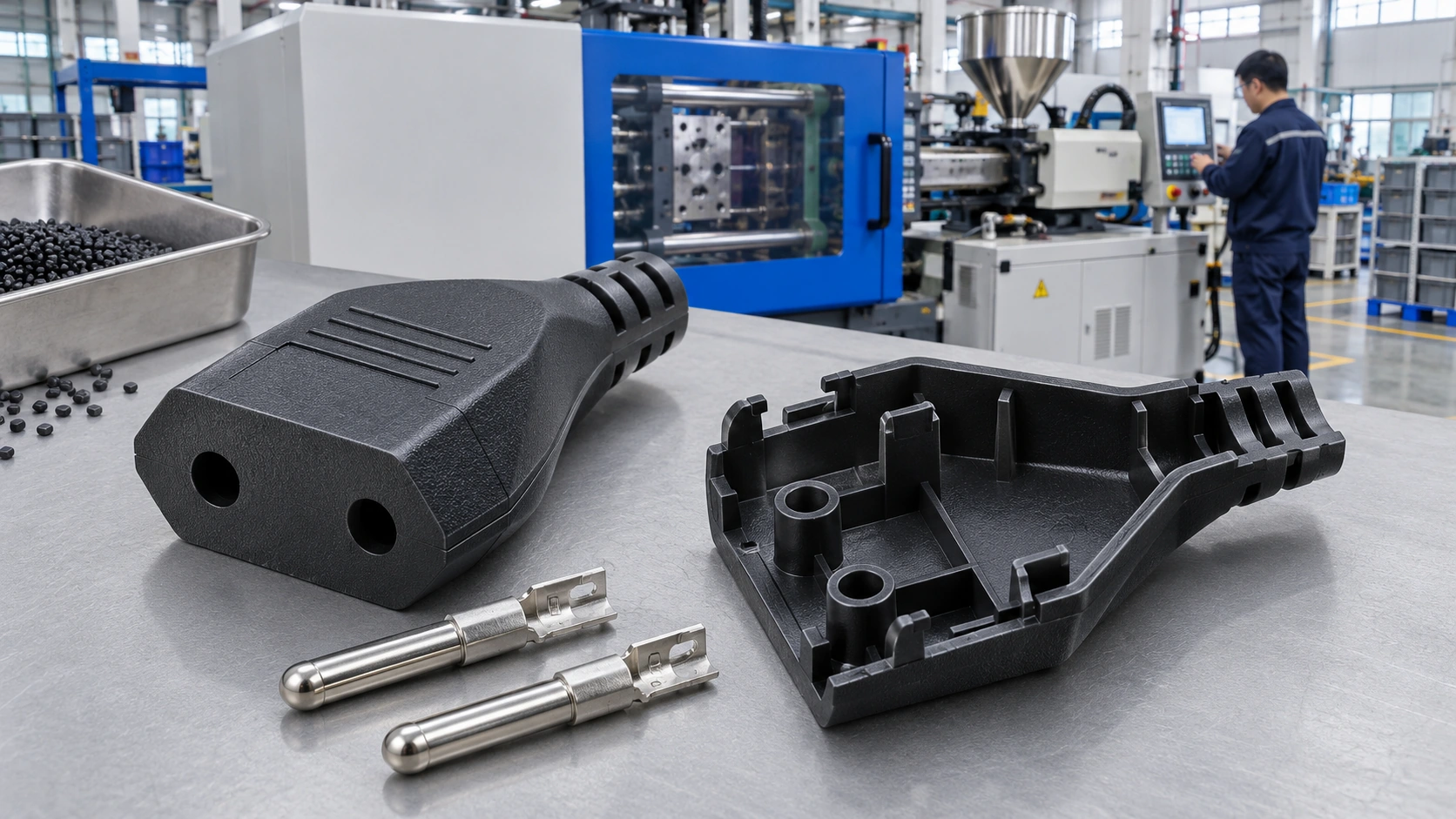
A manufacturer of power connection components for home appliances planned to develop a rigid insulating housing for a two-pole power plug. The product uses an upper and lower housing assembly structure, with an internal metal terminal mounting base, two plastic snap-fits, and local ribs. The customer wanted to use halogen-free flame-retardant PP as the housing material and reduce the risk of material cracking and production defects while retaining the existing injection molding equipment.
The main project requirements were as follows:
| Item | Design Requirement |
|---|---|
| Product type | Rigid housing for two-pole power plug |
| Material type | Halogen-free flame-retardant PP |
| Flame-retardant requirement | UL94 V-0 |
| Main housing wall thickness | 1.8–2.2 mm |
| Minimum functional wall thickness | 1.6 mm |
| Local rib thickness | 1.2–1.4 mm |
| Appearance requirement | Black, no obvious silver streaks on the surface |
| Molding method | Injection molding |
| Assembly method | Snap-fit connection |
| Trial production evaluation | Appearance, dimensions, snap-fits, and flame-retardant performance |
The difficulty of this product was that although the main wall thickness was relatively uniform, there was a local thick-wall structure between the terminal mounting base and the housing, and a thin-wall transition at the snap-fit root. The two structures imposed different requirements on the material. Thick-wall areas were prone to shrinkage and sink marks, while thin-wall snap-fits were more sensitive to toughness and weld-line strength.
2. First Trial Molding: Flame-Retardant Performance Met the Target, but Molding Quality Was Unsatisfactory
In the trial molding, the customer first used a conventional halogen-free flame-retardant PP solution and produced 300 samples. Standard specimens made from the material reached the project's target flame-retardant rating, but the housing exposed many problems during actual injection molding and assembly.
The injection temperature was approximately 195°C, the mold temperature was approximately 45°C, and the average molding cycle was 34 seconds.
Among the 300 samples, there were 16 cases of local short shots, 9 cases of snap-fit cracking, and 4 cases of silver streaks, totaling 29 defective parts, for a trial production defect rate of 9.7%.
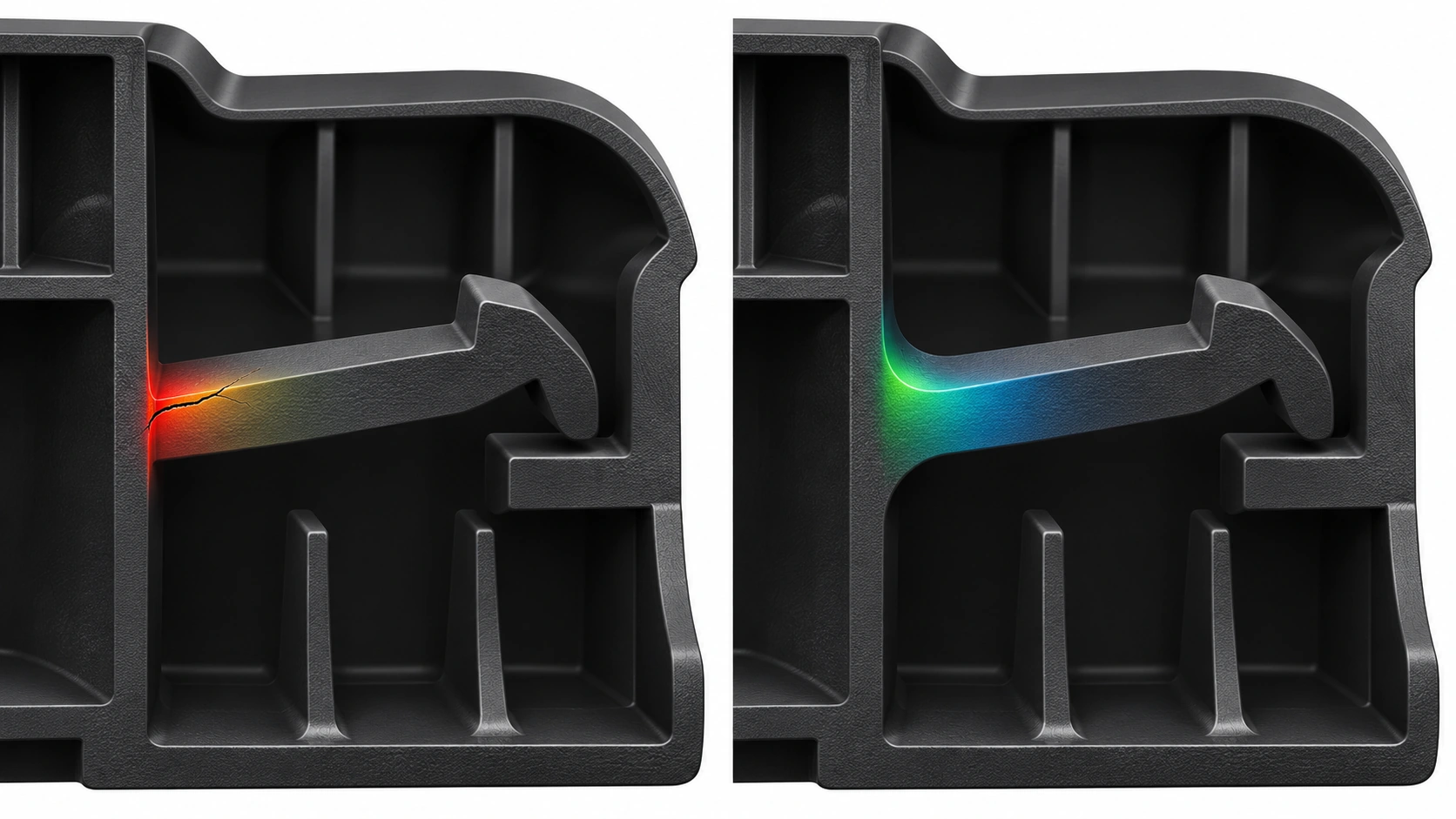
Among these, snap-fit cracking mainly occurred during assembly. Some products showed no obvious abnormality during the first assembly, but after disassembly and reassembly, whitening gradually formed at the snap-fit root, followed by cracks. Short shots were mainly concentrated at the thinner housing edges and in the areas connecting the ribs.
Judging from the phenomena, these problems did not come from a single factor.
On the one hand, there was a mismatch between the flowability of the raw material and the complex mold runner system, leading to filling difficulties in local thin-wall areas. On the other hand, the flame-retardant system affected the fracture behavior of the material, while the sharp corners and weld lines at the snap-fit root further amplified the material's notch sensitivity.
In addition, the mold temperature of approximately 45°C, combined with the local thickness variation of the product, also caused large cooling differences and residual stress in some areas.
This shows that good flame-retardant performance in standard specimens does not mean that actual injection-molded parts with complex structures will necessarily have good assembly performance.
3. Material Optimization Direction Using DGK-PP WPP-V0
In response to the above problems, material development should not simply increase the proportion of toughening agent.
For halogen-free flame-retardant PP, directly increasing the elastomer content may improve impact performance, but at the same time it affects material rigidity, flowability, and the relative concentration of flame retardant in the resin, thereby changing flame-retardant performance.
Therefore, the optimization direction needs to cover the flame-retardant system, resin matrix, and processing technology at the same time.
This project used DGK-PP WPP-V0 as the material platform and carried out optimization in three areas.
First, the synergistic relationship between the resin matrix and the toughening system was adjusted so that the material could improve fracture performance at the snap-fit root while maintaining structural rigidity.
Second, the dispersion state of the flame-retardant system was controlled to reduce local stress concentration caused by agglomeration of flame-retardant components and to ensure that the material maintained flame-retardant performance at the target wall thickness.
Third, the material's melt flow rate of 10 g/10 min was used as a flowability reference, and injection temperature, filling speed, and holding pressure conditions were optimized in combination with the mold structure to improve filling and welding quality in thin-wall areas.
During material optimization, the focus was not on maximizing a single physical property data point, but on bringing flame retardancy, flowability, and mechanical properties into a range more suitable for the customer's product.
4. Second Trial Molding: Coordinated Adjustment of Material, Mold, and Process
In response to the problems exposed in the first trial molding, the second trial molding used the DGK-PP WPP-V0 adaptation solution and simultaneously adjusted the mold and process.
The injection temperature was adjusted from 195°C to 205°C, the mold temperature was increased to approximately 80°C, and the cooling time was appropriately extended. For local short shots, filling consistency in thin-wall areas was improved by optimizing filling speed and the holding-pressure switchover position.
At the same time, rounded transitions were added at the snap-fit root to reduce local stress concentration. The connection structures between some ribs and the outer wall were also optimized to make material cooling shrinkage more uniform.
| Trial Molding Parameter | First-Round Solution | Optimized Solution |
|---|---|---|
| Injection temperature | 195°C | 205°C |
| Mold temperature | 45°C | 80°C |
| Cooling time | 17 s | 23 s |
| Average molding cycle | 34 s | 41 s |
| Number of test samples | 300 pcs | 500 pcs |
| Number of short shots | 16 pcs | 0 pcs |
| Number of snap-fit cracks | 9 pcs | 0 pcs |
| Appearance defects such as silver streaks | 4 pcs | 0 pcs |
| Total defective parts | 29 pcs | 0 pcs |
| Overall defect rate | 9.7% | 0% |
The trial molding data show that the overall defect rate after optimization dropped from 9.7% to 0%, a reduction of 9.7 percentage points.
This result reflects that the actual processing quality of flame-retardant PP is not entirely determined by the material grade. The material's flowability, injection temperature, mold temperature, and plastic structure design jointly determine the performance of the final product.
The molding cycle of the optimized solution also increased from 34 seconds to 41 seconds, indicating that improving part quality requires comprehensive consideration of production efficiency. When batch production has higher cycle-time requirements, further optimization can be achieved through cooling channels, mold temperature control, and holding-pressure strategy, rather than sacrificing the material's molding stability to shorten the cycle.
5. Snap-Fit Performance: Why Is Improving Toughness Alone Not Enough?
In the second trial molding, another 50 samples per group were selected for repeated assembly evaluation, with each sample completing 10 assembly and disassembly cycles.
In the first-round solution, 7 samples developed snap-fit cracks or obvious damage during testing. In the optimized solution, no samples experienced the same problem.
| Test Item | First-Round Solution | Optimized Solution |
|---|---|---|
| Number of test samples | 50 pcs | 50 pcs |
| Assembly cycles per sample | 10 | 10 |
| Cracking or damage | 7 pcs | 0 pcs |
| Damage rate | 14% | 0% |
From an engineering perspective, the improvement came from the combined effect of material and structure.
The toughening system in flame-retardant PP affects how the material absorbs energy during local deformation, while snap-fit fillets, weld-line positions, and cooling stress determine whether these properties can be effectively utilized in the actual product.
For products with snap-fits, such as electrical connectors and plug housings, simply increasing the material's notched impact strength does not necessarily completely solve assembly cracking. Only by evaluating against the real structure can the material formulation and processing window suitable for the product be found.
IV. How to Evaluate the Actual Flame-Retardant Performance of Flame-Retardant PP in Plug Housings?
Flame-retardant performance is one of the core indicators for material selection in electrical components, but when evaluating flame-retardant PP, it is necessary to distinguish between standard flame-retardant specimens and actual injection-molded finished parts.
The publicly available product data for DGK-PP WPP-V0 show that the material can achieve the UL94 V-0 rating at a thickness of 1.6 mm.
According to the UL94 vertical burning test requirements, the V-0 rating not only focuses on the single burning time after the flame is removed but also involves the cumulative burning time over multiple flame applications, afterglow, and whether burning drips ignite the cotton below.
1. Analysis of Burning Behavior of 1.6 mm Specimens
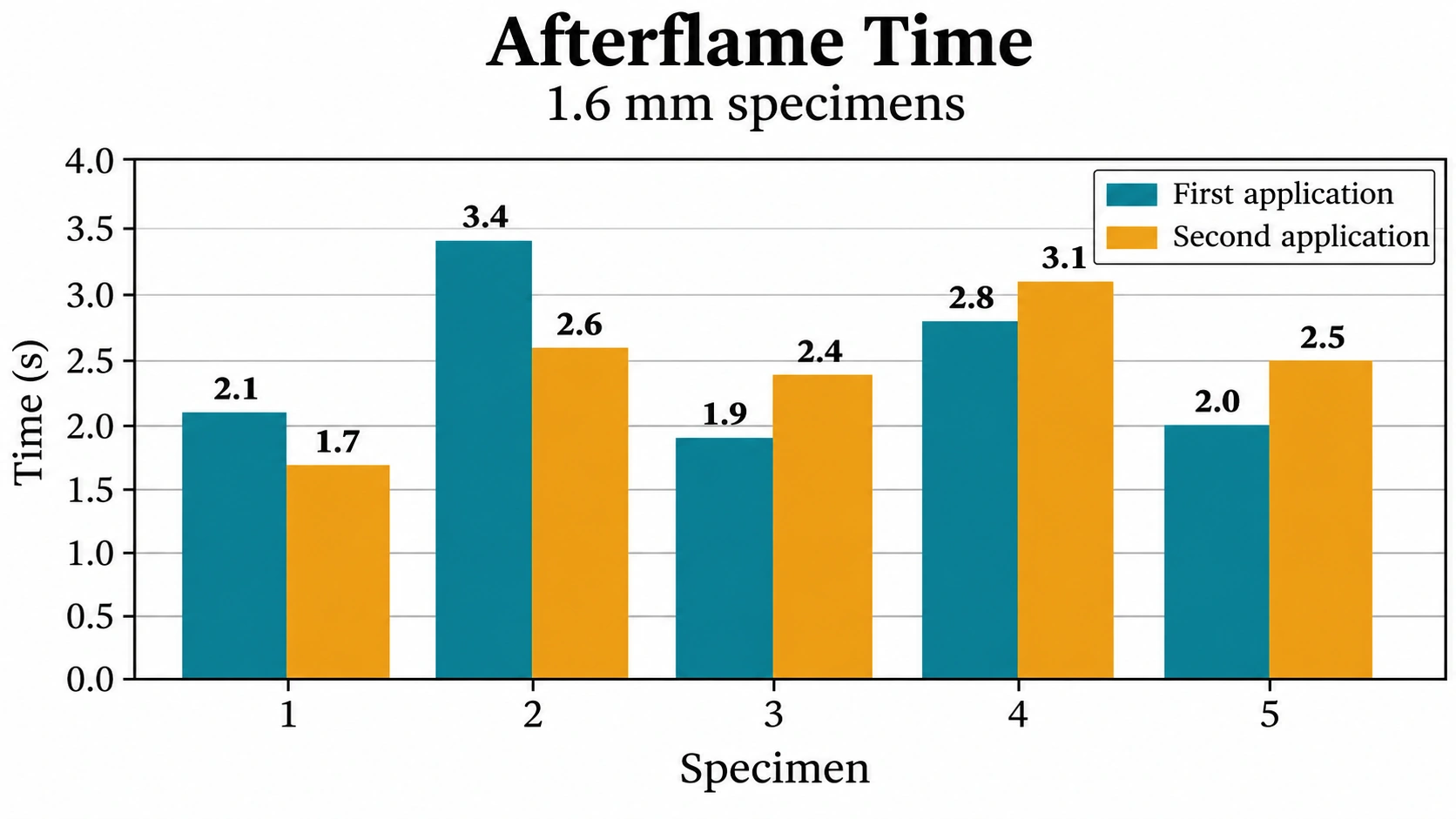
The following is a set of burning test records for 1.6 mm specimens. The specimen thickness was 1.6 mm, and each group contained 5 standard bars. The flaming combustion time after the first and second flame applications was recorded separately.
| Specimen No. | First Burning Time | Second Burning Time |
|---|---|---|
| 1 | 2.1 s | 1.7 s |
| 2 | 3.4 s | 2.6 s |
| 3 | 1.9 s | 2.4 s |
| 4 | 2.8 s | 3.1 s |
| 5 | 2.0 s | 2.5 s |
| Total | 12.2 s | 12.3 s |
In the test results, the cumulative flaming combustion time after 10 flame applications was 24.5 seconds, and each individual flaming combustion time was less than 10 seconds. When the other judgment criteria, such as afterflame and afterglow time, dripping, and clamp burning, are also met, the material complies with the relevant requirements of the V-0 rating.
These data demonstrate why material test reports need to record specific burning times rather than merely providing a V-0 rating name.
For power plug housings, the flame-retardant performance of standard specimens serves as a basic material selection basis, while thin walls, holes, edges, and complex structures in actual products are evaluated according to the corresponding product standards.
2. Why Can V-0 Not Replace Glow-Wire Performance Evaluation?
In some electrical products, materials need to meet not only UL94 flame-retardant requirements but also glow-wire test requirements.
UL94 mainly evaluates the burning behavior of materials under specified small-flame conditions, while the glow-wire test simulates the performance of electrical components under high-temperature contact in abnormal heating conditions. The two test methods have different forms of thermal action and evaluation indicators.
Common material-level glow-wire indicators include GWFI (Glow-Wire Flammability Index) and GWIT (Glow-Wire Ignition Temperature), which correspond to different test methods.
Therefore, when specifying material requirements for plug housings or electrical connectors, it is necessary to clarify whether the product has additional glow-wire requirements. For such applications, Deyu adjusts the flame-retardant system of DGK-PP WPP-V0 around the target wall thickness and relevant glow-wire performance requirements and conducts corresponding sample verification.
V. Four Most Easily Overlooked Issues in Injection Molding Flame-Retardant PP
1. Material Drying, Silver Streaks, and Gas Evolution
PP resin itself has low hygroscopicity, but halogen-free flame-retardant PP is a composite material, and its flame retardants, fillers, and processing aids may have different moisture sensitivities. In particular, some phosphorus-containing flame-retardant systems are more sensitive to moisture and processing temperature control.
If production is carried out directly according to the habits used for ordinary PP and material pretreatment is ignored, silver streaks, gas evolution, or uneven appearance may occur during injection molding.
The publicly available reference drying conditions for DGK-PP WPP-V0 are 90°C for 4–5 hours, with an injection temperature of 190–210°C. For appearance parts such as plug housings, drying according to material characteristics and controlling barrel residence time help reduce processing problems related to moisture and thermal degradation.
When silver streaks appear, the causes should first be distinguished among moisture, air entrapment, melt decomposition, and insufficient mold venting, and then the process adjustment direction should be determined. They should not be addressed simply by increasing the barrel temperature.
2. Flame-Retardant Dispersion and Local Property Non-Uniformity
Halogen-free flame-retardant PP is usually a multi-component composite system, and the dispersion state of the flame retardant and PP matrix affects the mechanical behavior and combustion performance of the material.
Uneven local dispersion of flame-retardant components can cause melt flow differences and local stress concentration. Aggregated areas can also become crack initiation sites when subjected to impact or bending.
For plastic parts such as power plugs that contain snap-fits and thin walls, this effect is particularly obvious. Even if standard specimens perform well, local cracking may still occur at locations with sharp corners, weld lines, or obvious residual stress.
Therefore, the development of flame-retardant PP formulations requires not only determining the flame-retardant addition ratio but also considering the dispersion of flame-retardant components, matrix compatibility, and toughening system design. This is also an important difference between modified plastic formulations and simple blending of ordinary plastics.
3. Mold Temperature and PP Crystallization Shrinkage
The semi-crystalline characteristics of PP determine that its cooling shrinkage is closely related to the crystallization process. Mold temperature, holding pressure conditions, wall thickness, and cooling rate all affect final dimensions.
For plug housings containing metal mounting bases, assembly slots, and ribs, local shrinkage differences can cause warpage, sink marks, and snap-fit fit deviations.
In the preceding project case, adjusting the mold temperature from 45°C to 80°C and appropriately extending the cooling time helped improve molding consistency in complex structural areas.
However, higher mold temperatures also affect the degree of crystallization, shrinkage behavior, and cooling cycle. Therefore, in batch production, a stable process window should be determined based on measured dimensions, demolding deformation, and production efficiency.
4. Material Thermal Properties and Long-Term Operating Temperature
The technical data for DGK-PP WPP-V0 list a heat deflection temperature of 140°C, indicating that the material has heat deformation resistance under the corresponding test conditions.
However, heat deflection temperature and long-term continuous service temperature are not the same concept.
For power plugs and electrical connection components, the actual temperature experienced by the material is related to metal terminal heating, contact condition, ambient temperature, and product structure. Long-term heat aging can also affect the material's impact toughness, color, and dimensions.
Therefore, when developing actual products, the material's heat deformation performance should be analyzed together with the plug's temperature-rise test, assembly state, and expected operating environment to form a complete material selection basis.
VI. From Material Cost to Production Efficiency: How to Conduct Comprehensive Material Selection for Flame-Retardant PP?
In the manufacturing of electrical components, material price is an important factor, but it does not fully represent the final manufacturing cost.
For plug housings, material density, part weight, injection molding cycle, yield, and subsequent assembly efficiency all affect product cost.
The density of DGK-PP WPP-V0 is 1.20 g/cm³. Because the flame-retardant system contains a certain proportion of functional components, its density is higher than that of ordinary unfilled PP. Therefore, when replacing materials, part weight should be calculated based on the density of the actual modified grade rather than directly using the density data of general-purpose PP.
Taking the project as an example, assuming a single housing weighs 18 g, the theoretical net material consumption for producing 10,000 housings is approximately 180 kg. After accounting for sprue and runner scrap, production loss, and defective parts, the actual raw material demand will further increase.
Material and process optimization reduced the defect rate from 9.7% to 0%. At the same output, this reduces scrap or rework caused by short shots, snap-fit damage, and appearance problems.
At the same time, however, the production cycle increased from 34 seconds to 41 seconds, meaning that there is new room for optimizing production efficiency.
Therefore, the selection of flame-retardant PP requires a comprehensive comparison of material unit cost, molding cycle, yield, and subsequent assembly quality, rather than merely comparing the price per kilogram of raw material.
For electrical components in stable mass production, materials that can meet flame-retardant requirements while maintaining a zero defect rate and stable dimensions usually offer better overall production value.
VII. Deyu Plastics' Halogen-Free Flame-Retardant PP Material Solution
Yuyao Deyu Plastics (DEYU Plastics) is a Chinese material manufacturer engaged in the formulation development, production, and application verification of functional modified plastics. The company carries out flame-retardant, conductive, antistatic, toughening, and wear-resistant modifications of engineering plastics such as PP, ABS, PC, PA, and POM, providing material solutions for injection molding and extrusion processing enterprises.
In the field of flame-retardant PP, Deyu offers existing products such as DGK-PP WPP-V0 and also carries out formulation customization according to the actual needs of electrical components.
For plug housings, connectors, and related structural parts, material development is designed comprehensively around the product's minimum wall thickness, flame-retardant rating, snap-fit toughness, color, flowability, and glow-wire requirements.
When customers already have molds and production equipment, Deyu provides material adaptation solutions based on existing process conditions. When customers are still in the product development stage, Deyu combines material performance requirements with structural design, sample trial molding, and performance testing.
The value of DGK-PP WPP-V0 lies not only in its V-0 flame-retardant capability at 1.6 mm thickness but also in its ability to be further optimized around the structural and processing requirements of different electrical components, achieving a better match among flame retardancy, mechanical properties, and processing stability.
Product Model: DGK-PP WPP-V0 Halogen-Free Flame-Retardant Polypropylene
Product Technical Data: https://www.deyuplast.com/products/dgk-pp-wpp-v0/
Conclusion
For rigid housings of electrical plugs and electrical connectors, the application focus of flame-retardant PP is not simply to upgrade ordinary PP to a V-0 material. Rather, it is necessary to simultaneously address the matching among material flame-retardant performance, injection molding, structural strength, and electrical insulation.
From the flame self-extinguishing behavior in thin-wall areas to the cracking risk at snap-fit roots, and further to mold temperature, flame-retardant dispersion, and dimensional shrinkage, the factors affecting final product quality are often interrelated.
Based on a halogen-free flame-retardant system, Deyu DGK-PP WPP-V0 can achieve the UL94 V-0 rating at a thickness of 1.6 mm while balancing material rigidity, toughness, and injection molding processability, providing a material choice with practical application value for power plug housings, connectors, and other electrical insulating structural parts.
Through coordinated optimization of formulation design, material testing, and trial molding processes, flame-retardant PP can better adapt to the manufacturing requirements of complex electrical components and provide material support for customers to improve product quality and production stability.