
What Modifications Can PP Plastic Support? Performance Challenges and Application Limits
This page is written for buyers, product engineers and mold engineers who want to understand what polypropylene can be modified to achieve, which PP compound route fits their part, and what performance challenges should be checked before mass production.
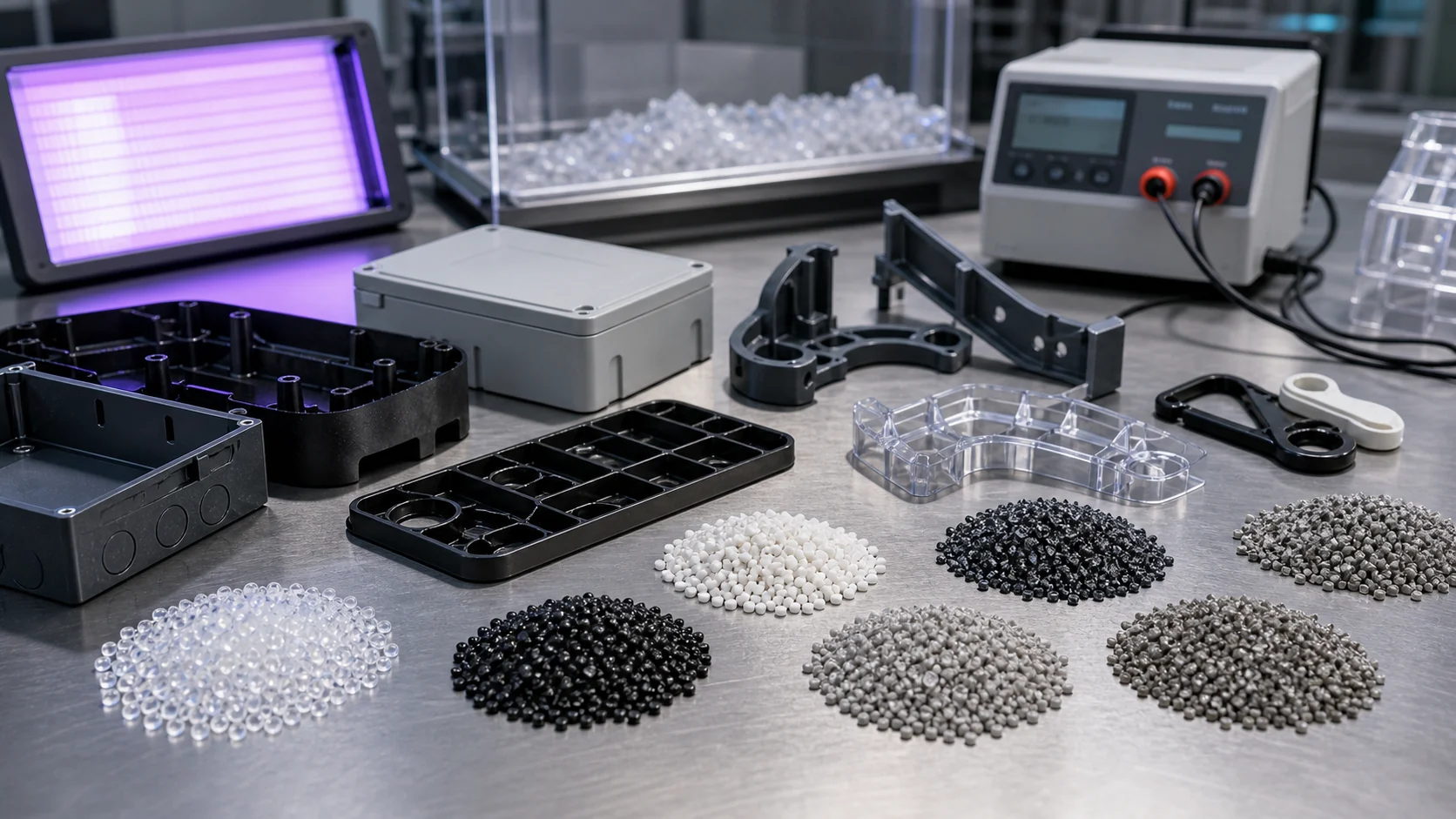
Buyer and engineer FAQ
Questions engineers often ask about this material route
Where can PP with a conductive plastic requirement be used?
Typical fields include ESD trays, electronic housings, fixtures, EMI parts and antistatic logistics parts. For this article, DEYU would first confirm the working environment, wall thickness, expected lifetime and whether DGK-PP DD2-3A Conductive PP, DGK-PP KJD789R-A1 Permanent Antistatic PP, Flame-Retardant Conductive PP Pellets DGK-PP DD4-5A-JC matches the part geometry or needs formulation adjustment.
What are the main performance indicators for the "conductive plastic" target on PP?
Focus on surface resistance, volume resistance, dispersion uniformity, impact strength and molding stability. Buyers should ask for data on molded parts, not only pellet data, because gate position, filler orientation and thickness can change the final value.
What should engineers watch during injection molding or processing?
For PP, a practical starting window is 190-230°C melt / 30-60°C mold. Avoid excessive filler loading, control weld lines and verify resistance on the molded part. Final parameters should follow part thickness, gate design and the actual machine.
What details help DEYU recommend DGK-PP DD2-3A Conductive PP, DGK-PP KJD789R-A1 Permanent Antistatic PP, Flame-Retardant Conductive PP Pellets DGK-PP DD4-5A-JC more accurately?
Send the current resin or grade, drawing or photo, wall thickness, annual quantity, target standard, failure mode and required color. If a reference grade already passed one test but failed in production, include both data sets.
For a precise recommendation, share the part drawing, base resin, target performance, processing method and test standard with DEYU.
This page is written for buyers, product engineers and mold engineers who want to understand what polypropylene can be modified to achieve, which PP compound route fits their part, and what performance challenges should be checked before mass production.
DGK-PP DD2-3A Conductive PP and DGK-PP KJD789R-A1 Permanent Antistatic PP. Use DGK-PP DD2-3A when the project needs a conductive PP route around 10^2-10^3 ohm, and compare DGK-PP KJD789R-A1 when a permanent anti-static PP direction around 10^7-10^8 ohm is more suitable.
1. Background / Problem
PP, or polypropylene, is one of the most widely used plastic materials because it is lightweight, processable, chemically resistant and cost-effective for many molded and extruded products. In real industrial applications, standard PP resin often needs modification before it can meet functional requirements.
Buyers commonly search for modified PP plastic, PP compound, polypropylene compound, PP pellets for injection molding, conductive PP resin, anti-static PP granules, flame-retardant PP plastic, UV-resistant polypropylene, glass fiber reinforced PP and low-temperature impact PP.
The key question is not only whether PP can be modified. The more useful question is which PP modification route fits the actual part, and where the current engineering boundaries are.
PP can be modified for conductivity, anti-static performance, flame retardancy, UV resistance, impact resistance, low-temperature toughness, wear resistance, light blocking, glass fiber reinforcement, carbon fiber reinforcement and plant-fiber composite applications. Each route has its own processing difficulty and application limit.
2. What Modifications Can PP Support?
| PP modification direction | Common search terms | Engineering purpose | Typical applications |
|---|---|---|---|
| Conductive PP | conductive PP compound, conductive polypropylene, black conductive PP pellets | Reduce resistance and create a conductive path | ESD trays, conductive molded parts, low-resistance functional components |
| Anti-static PP | anti-static PP plastic, ESD PP resin, static dissipative PP | Reduce static accumulation and dust attraction | Electronic trays, packaging, turnover boxes |
| Flame-retardant PP | flame-retardant PP, V-0 PP compound, halogen-free FR PP | Improve flame-retardant direction | Electrical housings, appliance components, battery-related parts |
| UV-resistant PP | UV-resistant PP, weather-resistant polypropylene, outdoor PP compound | Improve outdoor aging resistance | Outdoor clips, covers, garden parts, automotive auxiliary parts |
| Glass fiber reinforced PP | GF reinforced PP, PP GF20, PP GF30, glass-filled polypropylene | Improve stiffness, HDT and dimensional stability | Brackets, structural parts, automotive components |
| Carbon fiber reinforced PP | carbon fiber PP, CF reinforced polypropylene, conductive reinforced PP | Improve stiffness and possible conductive direction | Lightweight structural parts, functional components |
| Low-temperature toughened PP | low-temperature PP, cold-resistant polypropylene, impact modified PP | Improve impact performance under cold conditions | Cold-chain boxes, freezer parts, outdoor housings |
| Wear-resistant PP | wear-resistant PP compound, low-friction PP | Improve sliding and light abrasion direction | Guides, pads, light-duty sliding parts |
| Light-blocking PP | opaque PP, light-blocking PP, black PP compound | Reduce light transmission | Covers, packaging, internal shielding parts |
| Plant-fiber PP composite | natural fiber PP, plant fiber reinforced polypropylene | Build a natural-fiber composite direction | Consumer products, decorative parts, packaging components |
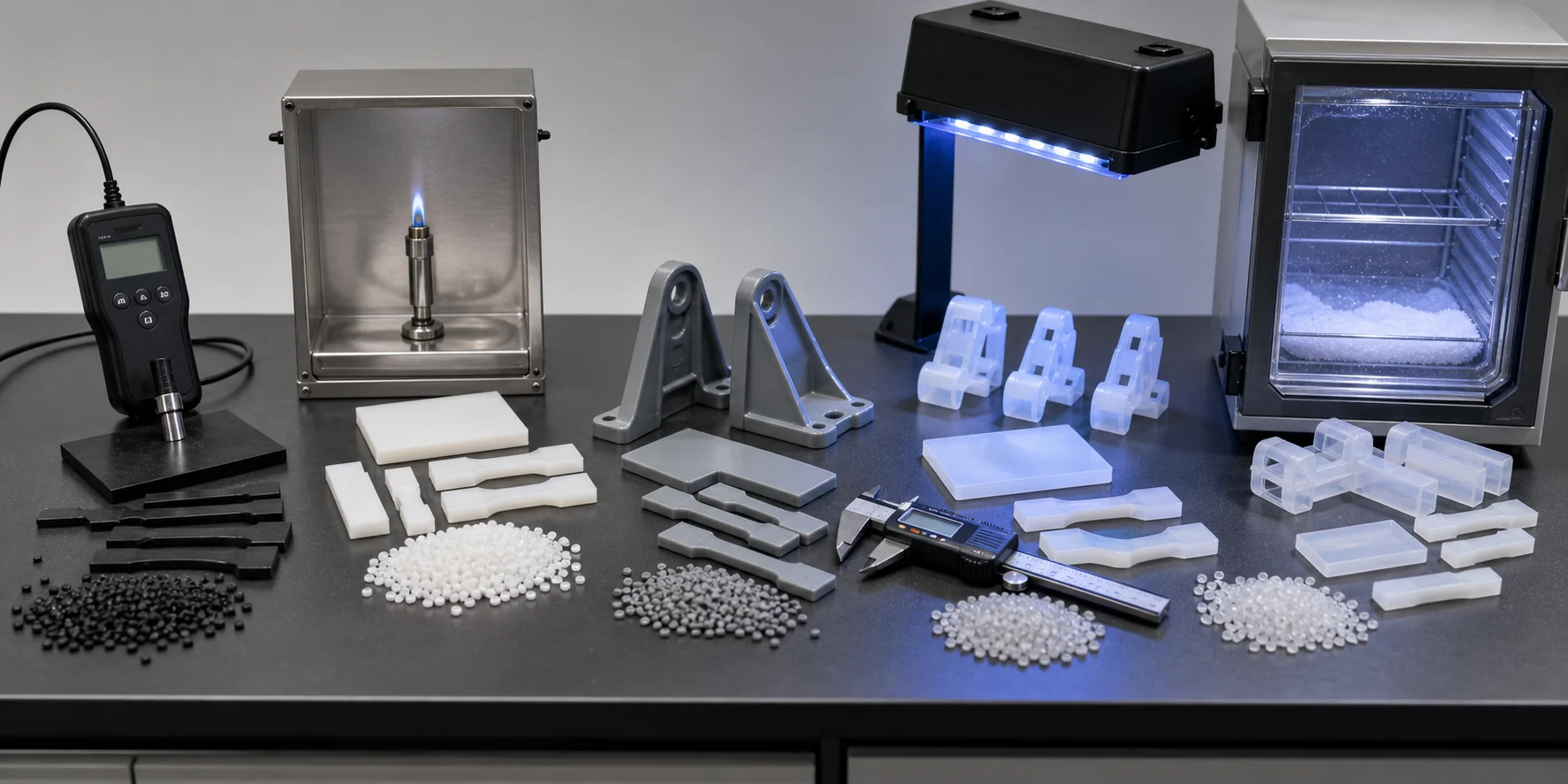
3. Current Performance Challenges and Application Limits
3.1 Conductive PP
Conductive PP usually relies on carbon black, graphite, carbon fiber or hybrid conductive systems. The main challenge is to build a stable conductive network while keeping acceptable flowability, impact strength and dimensional stability.
Typical limits include black or dark appearance, reduced toughness and flow at high filler loading, resistance variation caused by wall thickness or gate design, and the need to test thin-wall parts at the finished-part level.
3.2 Anti-Static PP
Anti-static PP is used when the part needs to reduce static accumulation rather than become highly conductive. It is common in electronic packaging, trays and turnover boxes.
Surface resistance should be tested after molding. Humidity and test method can affect readings, and the anti-static route should match the customer's dust-control or ESD requirement. Long-term stability should also be checked according to the real application.
3.3 Flame-Retardant PP
Flame-retardant PP is used for electrical parts, appliance housings and battery-related components. The formulation must balance flame-retardant direction, mechanical performance and processing stability.
Flame-retardant ratings should be claimed only after actual testing. Impact strength, melt flow, glass fiber, conductive fillers and color requirements can all change the formulation balance.
3.4 UV-Resistant PP
UV-resistant PP, also searched as weather-resistant polypropylene, is used for outdoor parts. The goal is to slow color change, surface aging and performance loss under sunlight.
Outdoor exposure differs by region and season. Color, pigment and UV stabilizer system should be designed together, and accelerated aging data should be connected with real outdoor validation. Dark and light colors may require different stabilization routes.
3.5 Reinforced PP
Glass fiber reinforced PP can improve stiffness, HDT and dimensional stability. Carbon fiber reinforced PP may support higher stiffness and lightweight structural direction.
Fiber reinforcement may influence shrinkage, warpage, surface appearance and weld line strength. Screw columns, ribs and snap-fits should be checked carefully because higher stiffness does not automatically mean better impact performance.
3.6 Low-Temperature Toughened PP
Cold-resistant PP is used when standard PP becomes less reliable under low-temperature impact or outdoor winter conditions.
Low-temperature impact must be tested at the actual service temperature. Toughening may reduce stiffness or HDT direction, and part thickness, notch sensitivity, freezer use, cold-chain handling and outdoor exposure need different validation plans.
4. DEYU Material Direction
DEYU usually evaluates PP modification from the following engineering dimensions.
| Evaluation point | DEYU PP compound direction |
|---|---|
| Base resin | PP homopolymer, PP copolymer or customized polypropylene resin |
| Functional target | Conductive, anti-static, flame-retardant, UV-resistant, reinforced, toughened or light-blocking |
| Processing method | Injection molding, extrusion, sheet extrusion or profile extrusion |
| Mechanical target | Tensile strength, flexural modulus, impact strength and HDT |
| Electrical target | Surface resistance, volume resistance or static dissipative range |
| Environment | Indoor, outdoor, low temperature, chemical exposure or repeated use |
| Part design | Wall thickness, ribs, snap-fits, screw columns and gate location |
| Validation method | Standard specimen test, molded part test and customer production trial |
DEYU can support customized PP compound development and small-batch validation based on customer drawings, target performance and actual processing conditions.
5. Reference Product Data
The table below uses existing DEYU product-page data where defined and keeps other PP modification directions as project-specific development routes.
| PP route | DEYU reference direction | Confirmed data or selection note |
|---|---|---|
| Conductive PP | DGK-PP DD2-3A | Conductive PP with 10^2-10^3 ohm resistance; extrusion and injection molding direction |
| Permanent anti-static PP | DGK-PP KJD789R-A1 | Permanent anti-static PP with 10^7-10^8 ohm resistance; high impact and high toughness direction |
| Flame-retardant conductive PP | DGK-PP DD4-5A-JC | V-0 direction, 10^3-10^5 ohm and black color, subject to test confirmation |
| UV-resistant PP | Customized PP compound | UV stabilizer, pigment and outdoor aging plan should be developed together |
| Glass fiber reinforced PP | Customized PP GF compound | Fiber content, warpage and weld line strength should be validated on the molded part |
| Low-temperature toughened PP | Customized impact-modified PP | Impact target should be tested at the actual service temperature |
| Light-blocking PP | Customized opaque PP | Color, wall thickness and opacity target should be validated together |
Final quotation and specification should use the customer's drawing, test method, target performance and production process.
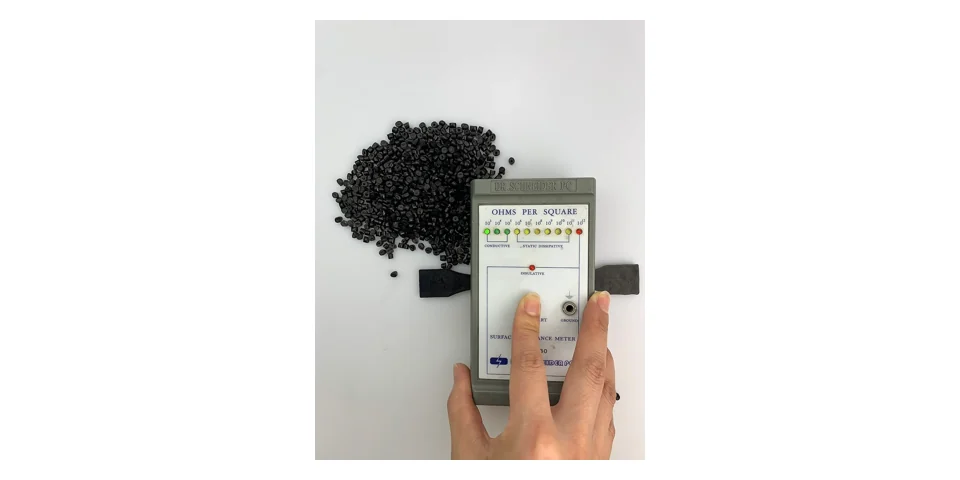
6. DEYU Internal Customer Application Validation Data
The following is an anonymized internal validation structure for an electronic turnover tray. Exact customer name, equipment model and unpublished report information are not disclosed.
6.1 Original Application Data
A customer used ordinary PP for an electronic turnover tray. The tray had acceptable weight and molding cost, but dust adhesion and static-related handling issues appeared during repeated use in the assembly area.
| Original item | Internal validation direction |
|---|---|
| Application | Electronic turnover tray |
| Original material | Standard injection molding PP |
| Main wall thickness | 2.0-2.5 mm |
| Surface resistance | Greater than 10^13 ohm, reference direction |
| Dust adhesion area after 8 hours | 30-45%, reference direction |
| Molding scrap rate | 3-5%, reference direction |
| Handling complaint rate | 6-10%, reference direction |
| Tray deformation rate | 2-4%, reference direction |
| Monthly usage | 20,000-40,000 pieces, customer planning range |
| Customer target | Reduce static-related dust adhesion while keeping PP molding efficiency |
6.2 DEYU Debugging Direction and Trial Result
| Validation item | Original data | DEYU trial direction | Engineering interpretation |
|---|---|---|---|
| Surface resistance | Greater than 10^13 ohm | 10^6-10^9 ohm, reference direction | Anti-static PP route helped reduce surface charge accumulation. |
| Dust adhesion area after 8 hours | 30-45% | 8-18%, reference direction | Static-related dust adhesion tendency decreased during internal trial. |
| Molding scrap rate | 3-5% | 2-4%, reference direction | Flow and shrinkage balance supported tray molding stability. |
| Handling complaint rate | 6-10% | 2-4%, reference direction | Tray cleanliness and handling consistency improved in the trial direction. |
| Tray deformation rate | 2-4% | 1-3%, reference direction | PP resin and processing balance supported dimensional consistency. |
| Impact or drop trial | Project-specific | Project-specific | Final evaluation should follow customer drop and handling conditions. |
6.3 Solution Analysis
In this internal customer application, DEYU focused on helping the customer move from ordinary PP to a functional anti-static PP compound route. The improvement came from combining a more suitable PP resin direction, anti-static modification and processing-window adjustment for the tray structure.
The measurable improvement appeared in lower surface resistance, reduced dust adhesion area and improved handling feedback during internal validation. At the same time, DEYU kept the evaluation connected with molding stability and tray dimensional consistency, which are important for repeated-use logistics parts.
7. Suitable Applications
Modified PP compounds can be considered for electronic trays, turnover boxes, ESD packaging, conductive molded components, appliance housings, battery-related plastic parts, outdoor clips and covers, automotive auxiliary parts, glass fiber reinforced brackets, cold-chain containers, light-blocking packaging parts and general industrial injection-molded parts.
8. What Buyers Should Provide
| Buyer input | Why it matters |
|---|---|
| Base PP requirement | Homopolymer or copolymer changes toughness and stiffness direction. |
| Target function | Conductive, anti-static, flame-retardant, UV-resistant, reinforced or toughened route changes formulation. |
| Target test standard | Resistance, flame rating, UV aging or impact testing should be defined. |
| Part drawing | Wall thickness, ribs and gate position affect performance. |
| Processing method | Injection molding and extrusion require different flow design. |
| Current defect data | Warpage, cracking, static dust, unstable resistance or aging helps guide adjustment. |
| Mechanical requirement | Tensile, flexural, impact and HDT targets affect route selection. |
| Color requirement | Black, white, natural or custom color changes pigment and additive route. |
| Monthly usage | Supports cost, stability and supply planning. |
| Application environment | Indoor, outdoor, low temperature or chemical exposure changes material direction. |
9. Conclusion
PP can support many modification routes, including conductive PP, anti-static PP, flame-retardant PP, UV-resistant PP, reinforced PP, low-temperature toughened PP, wear-resistant PP and light-blocking PP. However, each route has its own engineering boundary.
The right PP compound should be selected according to target function, base resin, wall thickness, processing method, testing standard and real application environment. DEYU can support customized modified polypropylene compounds and small-batch validation for customers who need functional PP pellets, PP granules or PP resin solutions for industrial parts.