
Plant-Based Eco-Friendly Plastics: Applications and Common Material Routes
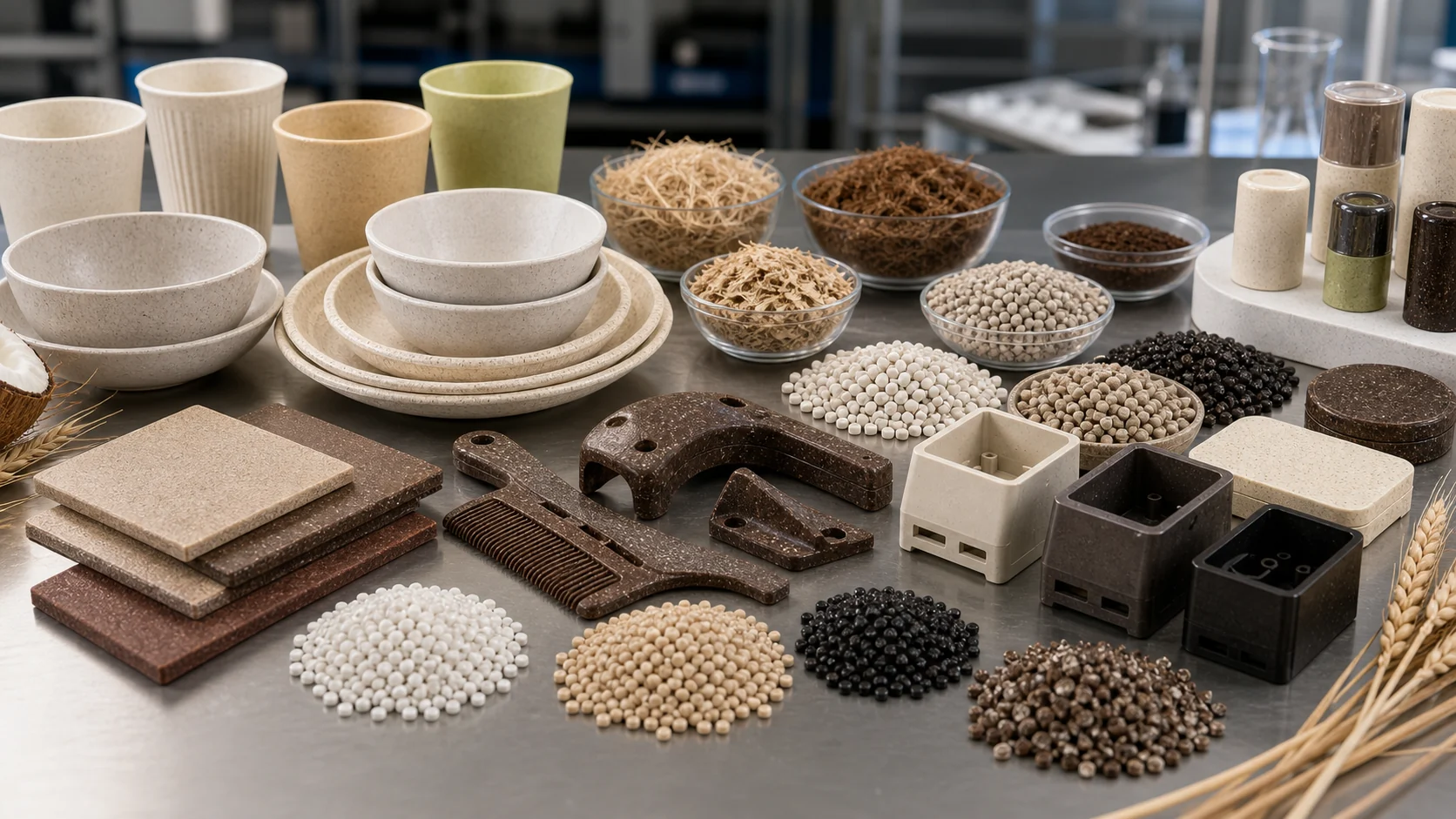
Plant-based and natural-fiber modified plastics are used more often in consumer products, packaging, household goods, cosmetic packaging and decorative molded parts. Buyers may search for plant-based plastic, eco-friendly plastic compound, natural fiber plastic, bio-filled plastic pellets or plant fiber reinforced plastic.
Buyer and engineer FAQ
Questions engineers often ask about this material route
Where can ABS / PA6 / PP with a plant-fiber modified plastic requirement be used?
Typical fields include consumer goods, household shells, packaging parts and lower-carbon appearance components. For this article, DEYU would first confirm the working environment, wall thickness, expected lifetime and whether Wheat Straw PP Masterbatch, Coffee Grounds ABS Composite matches the part geometry or needs formulation adjustment.
What are the main performance indicators for the "plant-fiber modified plastic" target on ABS / PA6 / PP?
Focus on odor, moisture, stiffness, impact strength, color stability and fiber dispersion. Buyers should ask for data on molded parts, not only pellet data, because gate position, filler orientation and thickness can change the final value.
What should engineers watch during injection molding or processing?
For ABS / PA6 / PP, a practical starting window is 210-245°C melt / 50-80°C mold. Dry the compound, avoid excessive melt temperature and protect natural fiber from burning. Final parameters should follow part thickness, gate design and the actual machine.
What details help DEYU recommend Wheat Straw PP Masterbatch, Coffee Grounds ABS Composite more accurately?
Send the current resin or grade, drawing or photo, wall thickness, annual quantity, target standard, failure mode and required color. If a reference grade already passed one test but failed in production, include both data sets.
For a precise recommendation, share the part drawing, base resin, target performance, processing method and test standard with DEYU.
1. Background / Problem
Plant-based and natural-fiber modified plastics are used more often in consumer products, packaging, household goods, cosmetic packaging and decorative molded parts. Buyers may search for plant-based plastic, eco-friendly plastic compound, natural fiber plastic, bio-filled plastic pellets or plant fiber reinforced plastic.
Wheat Straw PP Masterbatch and Coffee Grounds ABS Composite. Compare these two existing DEYU routes when a project needs either a PP-based wheat-straw texture or an ABS-based coffee-ground speckled appearance.
Wheat Straw PP Masterbatch and Coffee Grounds ABS Composite are two existing DEYU reference routes for this type of material. The first is used when a PP product needs wheat-straw texture and adjustable color effects; the second is used when an ABS product needs a visible coffee-ground speckled appearance.
These materials should be described accurately. Wheat straw PP, coconut fiber composites, wood fiber PA6, red pine PP, grain-filled ABS and coffee ground ABS are not automatically biodegradable, compostable or fully bio-based. In many projects, they are conventional resin systems filled or modified with plant-based materials. The base resin may still be PP, PE, ABS, PA6 or another thermoplastic.
The practical value usually comes from using agricultural or plant-based fillers, creating a natural surface texture, reducing part of mineral filler usage, differentiating the product appearance and supporting a material story that is easier for consumers to recognize.
The better engineering question is not simply whether the material is eco-friendly. The useful question is which plant-based filler can work with the resin, product appearance, processing method, mechanical requirement and final application environment.
2. Common Applications of Plant-Based Modified Plastics
Plant-fiber filled plastics are suitable when natural appearance, tactile texture and product positioning matter, while the part still needs stable injection molding, extrusion or sheet processing.
| Application Area | Suitable Material Direction | Engineering Focus |
|---|---|---|
| Consumer goods | Wheat straw PP, coffee ground ABS, grain-filled ABS | Natural texture, surface feel, color consistency and molding stability |
| Household products | Wheat straw PP, red pine PP, coconut fiber PE or PP | Daily-use strength, odor control and appearance repeatability |
| Packaging components | Wheat straw PP, grain-filled PP or ABS | Lightweight design, natural appearance and processability |
| Appliance decorative parts | Coffee ground ABS, grain-filled ABS, red pine PP | Surface texture, color stability and dimensional control |
| Automotive interior trim | Wood fiber PA6, red pine PP, natural fiber PP | Heat resistance, stiffness and warpage control |
| Office and stationery products | Wheat straw PP, coffee ground ABS | Moldability, natural look and color matching |
| Cosmetic packaging | Coffee ground ABS, grain-filled ABS, wheat straw PP | Appearance, odor, touch feel and surface quality |
| Furniture accessories | Wood fiber PA6, red pine PP, coconut fiber composite | Stiffness, screw-holding direction and decorative texture |
| Light-duty structural parts | Wood fiber PA6, natural fiber reinforced PP | Stiffness and dimensional balance |
| Brand-customized products | Coffee ground ABS, grain-filled ABS, wheat straw PP | Material storytelling and visual differentiation |
3. Common Material Routes
3.1 Wheat Straw PP
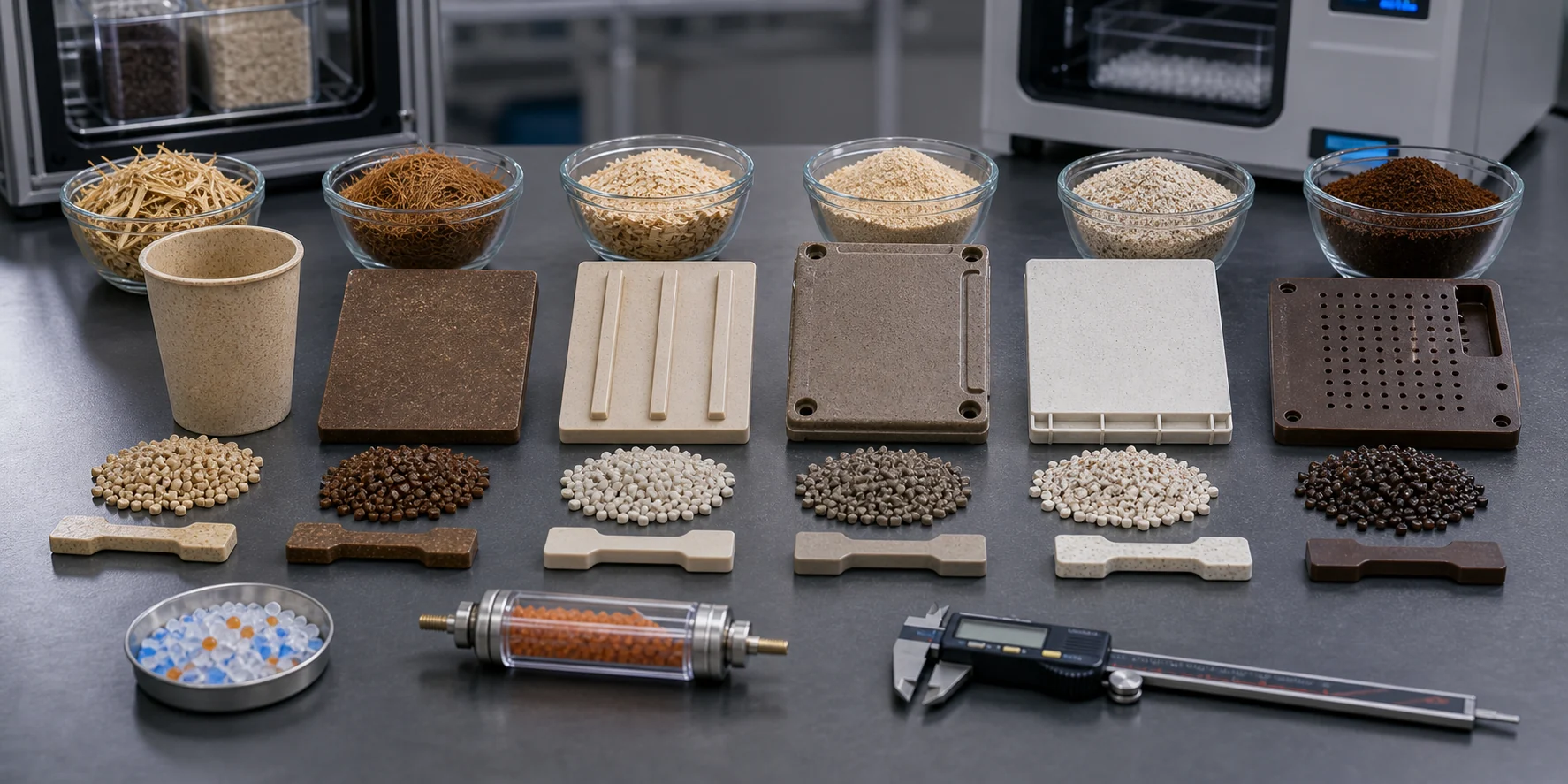
Wheat straw PP is a common route for consumer products and household goods. It may be supplied as a PP compound or as a wheat-straw PP masterbatch blended with regular PP during processing.
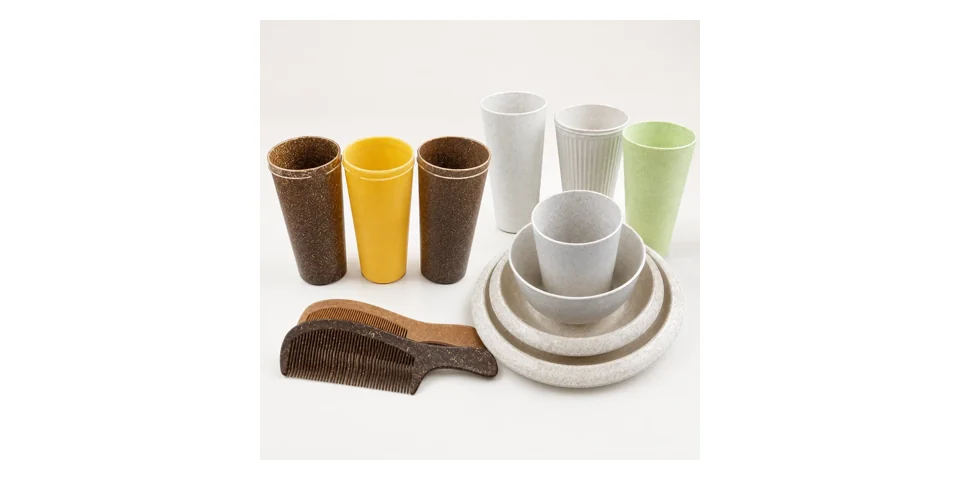
Typical features include natural plant-fiber texture, adjustable color direction, practical PP processing behavior and suitability for cups, bowls, plates, combs, containers and daily-use molded products.
The main limits are moisture control, color consistency, odor management, impact balance and part-level validation. A product may look natural on a sample plaque but still need checking on ribs, thin walls, snap-fits and visible surfaces.
3.2 Coconut Fiber Plastic Route
Coconut fiber plastics use coconut fiber or coconut-shell-based filler in a thermoplastic matrix. In industry this may be discussed as coconut fiber PP, coconut shell PP compound, coconut fiber PE composite or natural fiber plastic granules. DEYU has an existing coconut fiber PE composite route, so the base resin should be confirmed instead of assuming it is always PP.
This route is useful for household parts, packaging parts, trays and molded products that need a stronger natural-fiber identity. The main checks are fiber dispersion, odor, moisture, surface roughness and the effect of fiber color on the final product.
3.3 Wood Fiber PA6
Wood fiber PA6 combines natural wood fiber with nylon 6. Compared with PP routes, PA6 can support a more engineering-oriented direction, but it requires stricter drying and processing control.
Wood fiber PA6 may be considered for decorative parts, semi-structural parts or interior components that need better heat resistance and stiffness than common PP compounds. The limits are PA6 moisture absorption, fiber thermal stability, warpage, toughness and weld-line behavior.
3.4 Red Pine PP
Red pine PP usually means PP modified with red pine fiber, pine wood flour or pine-based natural filler. It is selected when the product needs a warm wood-like tone or a visible natural-fiber surface.
The route can be useful for covers, packaging, household components and decorative molded parts. Batch color variation, odor, UV exposure and fiber exposure on the surface should be checked before mass production.
3.5 Grain-Filled ABS or PP
Grain-filled ABS or PP uses agricultural grain-based filler in a thermoplastic resin. It can create a softer natural texture than some coarse fiber systems and is often discussed for consumer housings, packaging and customized brand products.
The formulation must balance filler-resin compatibility, particle size, impact strength, surface appearance and odor. If the product has a glossy visible surface, molded-part trials are more important than plaque testing alone.
3.6 Coffee Ground ABS
Coffee ground ABS is used when the product needs a visible natural or recycled-material story. It can produce a warm brown, speckled surface and is suitable for lifestyle goods, cosmetic packaging, office products, small housings and decorative consumer parts.
The key limits are odor control, coffee particle size, color repeatability, impact strength and heat resistance. For appliance or housing parts, screw columns, weld lines and assembly surfaces should be validated.
4. DEYU Material Direction
DEYU evaluates plant-fiber modified plastics by combining appearance goals with material and process validation.
| Evaluation Point | DEYU Material Direction |
|---|---|
| Base resin | PP, PE, ABS, PA6 or customized resin system |
| Plant filler type | Wheat straw, coconut fiber, wood fiber, red pine fiber, grain filler or coffee grounds |
| Product positioning | Eco-style product, natural texture product, decorative part or packaging component |
| Processing method | Injection molding, extrusion, sheet extrusion or blending with masterbatch |
| Appearance target | Natural texture, speckled effect, matte surface or customized color |
| Mechanical requirement | Impact strength, stiffness, screw-holding, snap-fit and dimensional stability |
| Odor control | Important for household, cosmetic, food-contact-adjacent and consumer products |
| Moisture control | Natural fibers need drying, storage and processing-window management |
| Color consistency | Natural filler batch variation should be managed through selection and color adjustment |
| Validation method | Material test, molded part inspection and customer application trial |
The material should be selected with the part drawing, visible-surface requirement, target color, process method and final use environment. If the project needs a biodegradable, compostable or certified bio-based claim, that requirement must be confirmed separately with the resin route, certification target and test standard.
5. Reference Product Data and Selection Direction
The table below uses existing DEYU product directions where available and keeps customized routes as project-specific development items. Final values such as density, MFR, tensile strength, flexural modulus, impact strength and HDT should be confirmed by DEYU internal testing or customer part validation before publication as guaranteed data.
| Material Route | DEYU Reference Direction | Base Resin | Processing Direction | Typical Applications |
|---|---|---|---|---|
| Wheat straw PP masterbatch | Existing DEYU wheat-straw PP masterbatch for blending with regular PP | PP | Injection molding or extrusion blending | Cups, bowls, plates, combs, household goods, daily-use molded products and eco-style PP parts |
| Grain fiber PP composite | Existing DEYU plant-fiber PP composite direction | PP | Injection molding | Tableware, lunch boxes, household articles, molded packaging and consumer products |
| Coffee ground ABS composite | Existing DEYU coffee-ground ABS composite | ABS | Injection molding | Cups, household goods, small appliance housings, trays and textured consumer housings |
| Coconut fiber composite | Existing DEYU coconut fiber PE composite direction; PP route should be confirmed by project | PE or customized PP/PE | Injection molding | Pallets, trays, packaging, household products and molded parts |
| Wood fiber PA6 | Customized development direction | PA6 | Injection molding after drying control | Decorative or semi-structural parts needing higher heat and stiffness direction |
| Red pine PP | Customized development direction | PP | Injection molding or extrusion | Covers, packaging parts, household components and wood-like decorative parts |
6. Application Validation Scenario
The following scenario is an anonymized validation structure for a consumer product that changed from ordinary PP to a plant-fiber filled PP route. It should be treated as an engineering validation format, not a public guarantee of fixed values.
| Validation Item | Original Direction | DEYU Trial Direction | Engineering Interpretation |
|---|---|---|---|
| Product appearance | Smooth ordinary PP surface | Natural plant-fiber texture | The material route improves visible natural-material recognition. |
| Base material | Standard injection molding PP | Wheat-straw PP masterbatch blended with PP | The blend ratio and color system can be adjusted to the product target. |
| Molding scrap tendency | Project-specific baseline | Reduced or controlled after flow adjustment | Resin flow, drying and filler dispersion affect production stability. |
| Odor feedback | Project-specific baseline | Checked through drying and filler selection | Odor is important for consumer goods and packaging-adjacent parts. |
| Color difference between batches | Project-specific baseline | Managed through filler selection and color correction | Natural fillers may vary, so batch color control is part of validation. |
| Drop or handling performance | Project-specific baseline | Confirmed by molded part trial | Toughness must be checked on the finished part, not only on test bars. |
| Final pass decision | Customer internal standard | Combined appearance, odor, molding and mechanical review | The material should pass both product-design and production-line checks. |
For coffee ground ABS, coconut fiber composite and wood fiber PA6 projects, the same validation logic applies. The key difference is which risk is most important: odor and appearance for coffee ground ABS, moisture and dispersion for coconut fiber composites, and drying plus warpage for wood fiber PA6.
7. Suitable Applications
Plant-fiber modified plastics can be considered for household cups, bowls, plates, combs, storage boxes, stationery, cosmetic packaging, lifestyle products, decorative appliance parts, office products, trays, covers, light-duty housings, molded packaging and brand-customized consumer goods.
They are less suitable when the buyer requires transparent appearance, high-gloss Class A surfaces, very high impact strength, high-load engineering performance, strict high-temperature use or a certified biodegradable or compostable claim without a compatible resin and test standard.
8. What Buyers Should Provide
| Buyer Input | Why It Matters |
|---|---|
| Target material story | Plant-fiber appearance, bio-based content, recycled-content story, biodegradable claim and compostable claim are different requirements. |
| Base resin preference | PP, PE, ABS and PA6 have different cost, strength, heat and processing boundaries. |
| Target product photos or drawings | Wall thickness, ribs, screw columns and visible surfaces affect filler exposure and molding stability. |
| Color and texture requirement | Natural fillers create batch variation, so color tolerance should be defined. |
| Odor requirement | Household, cosmetic and packaging-adjacent products need stricter odor checks. |
| Processing method | Injection molding, extrusion and masterbatch blending need different flow and dispersion design. |
| Mechanical requirement | Impact, stiffness, screw-holding and drop performance determine filler loading and resin selection. |
| Certification target | Biodegradable, compostable, bio-based or recycled-content claims require separate standards and documentation. |
| Monthly usage | Helps evaluate formulation stability, cost and supply planning. |
9. Conclusion
Plant-based or natural-fiber modified plastics can help products gain a recognizable natural texture and a more distinctive material story. Common routes include wheat straw PP, coconut fiber composites, wood fiber PA6, red pine PP, grain-filled ABS and coffee ground ABS.
These materials should not be selected only by the word eco-friendly. The correct selection depends on base resin, filler type, appearance target, odor control, moisture control, processing method, mechanical performance and finished-part validation.
DEYU can support customized plant-fiber plastic compounds and small-batch validation for PP, PE, ABS, PA6 and related modified plastic systems. Final formulation and public data should be confirmed by internal testing and customer part-level validation.