
Plant-Fiber Composites Offer a More Practical Path to Plastic Reduction
WOOYOPET's consumer survey and product examples show how plant-fiber composites can reduce petroleum-based plastic in everyday products without pretending that partial substitution solves every sustainability question.
Buyer and engineer FAQ
Questions engineers often ask about this material route
Does plant fiber make a plastic product biodegradable?
Not automatically. The base resin, fiber treatment, product design and local end-of-life route determine whether biodegradation or composting is relevant. Plant-fiber composite is first a material-reduction route, not a blanket biodegradability claim.
How is Plastic Displacement calculated?
It is the finished-part mass multiplied by the plant-material fraction. It expresses the theoretical petroleum-based resin displaced per part and can be scaled by planned output. It is not a life-cycle assessment or a complete carbon-footprint calculation.
What must be validated before a plant-fiber composite enters production?
Validate moisture control, odor, particle size, appearance, impact and flexural performance, molding stability, dimensional requirements and any application-specific food-contact, safety or regulatory requirements.
Is a higher plant-fiber percentage always better?
No. The appropriate level is governed by product life, strength, water exposure, appearance, reject rate and processing stability. A lower percentage that runs reliably at volume can create more practical reduction than a high-content laboratory sample.
Plant-fiber composites offer a more practical path to reducing plastic
DEYU supports WOOYOPET's continuing product innovation with material selection and validation for plant-fiber composite routes. The work includes PP-based rice-husk and wheat-straw directions, ABS routes using coffee grounds, and application-specific assessment of moisture, odor, appearance, molding stability and daily-use performance.
For years, sustainable-material conversations have returned to the same question: can one material completely replace conventional plastic? The answer remains complicated. Paper, wood, bio-based polymers, biodegradable plastics and recycled plastics have all advanced in particular applications. Yet many everyday goods, appliances, pet products, automotive interiors and industrial products still depend on the water resistance, impact resistance, dimensional stability, scalable processing and cost profile supplied by conventional plastics.
That makes a more immediate question useful: instead of waiting for one material to solve every problem, how much petroleum-based plastic can be reduced in products that still need conventional resin for performance? Plant-fiber composites put rice husk, coffee grounds, wheat straw, wood fiber or bamboo fiber into products formerly made entirely from PP, PE, ABS or similar resins. The plant component may be 15%, 20% or 30%. The polymer remains responsible for essential performance, but its share is lower.
WOOYOPET’s 300-consumer research and product-development examples offer a grounded view of how customers receive that route. The research does not claim that partial substitution is a final answer. It indicates that consumers may accept a product that meaningfully uses less conventional plastic even when it is not completely plastic-free. Read WOOYOPET’s 300-consumer survey and product-development cases for the detailed research and product summary.
Partial plastic reduction can still matter
The question “if it is not 100% plastic-free, does it have any value?” is common in sustainability discussions. In an ideal future, eliminating petroleum-based plastic could be the objective. Manufacturing, however, has immediate functional constraints. A pet bowl must repeatedly contact food and water. A litter scoop must withstand drops, bending and daily use. A small appliance housing must retain dimensions through high-volume injection molding. Outdoor components must also tolerate ultraviolet light, humidity and temperature changes.
Plant-fiber composites therefore do not claim that plastic disappears overnight. They offer a practical intermediate route: a product that once relied entirely on petroleum-based polymer can replace a portion with plant-derived material while keeping the base resin where it is needed. In WOOYOPET’s survey, 87% of respondents said that reducing conventional plastic still has environmental value even if a product is not fully plastic-free. About 7% took the view that a product containing any conventional plastic cannot count as an environmental improvement.
The useful signal is not simply a preference for plant fiber. It is a more realistic environmental view. A long-term goal and the changes possible today are not the same thing. If a product can reduce its petroleum-derived content by 25% now, that reduction still exists even before a future solution reaches 100%.
Scale changes the significance of a percentage
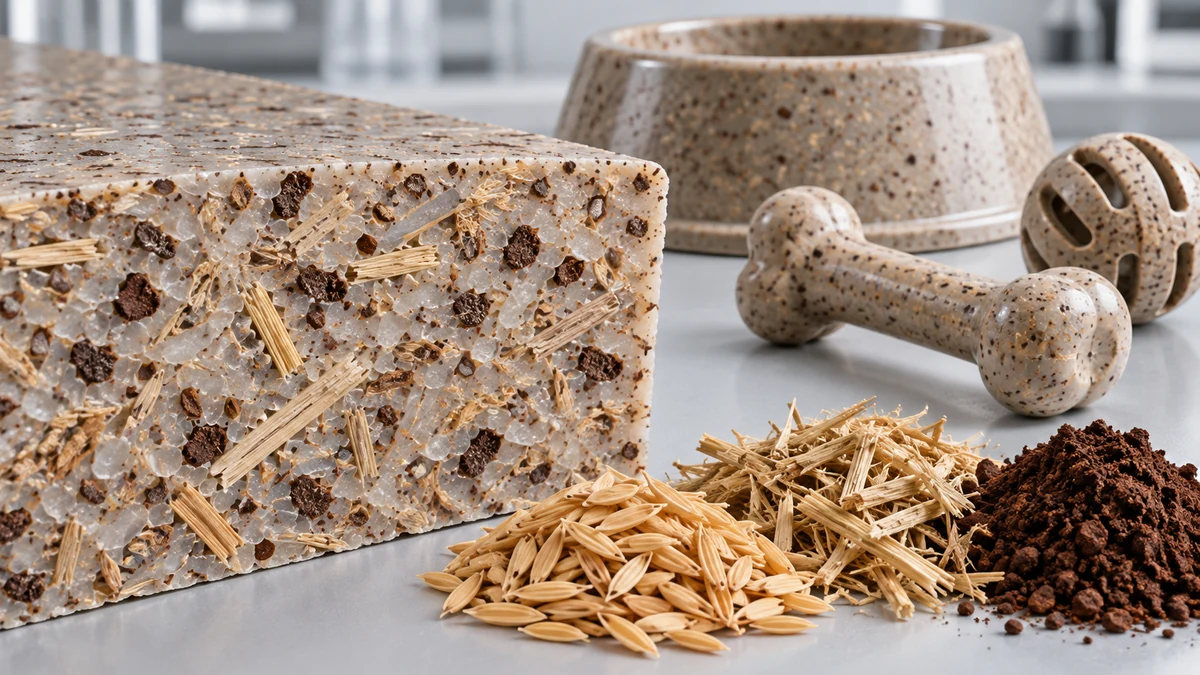
A 20% or 25% plant content can look modest when viewed only as a formulation number. Manufacturing scale changes it. In a 100 g product with 25% plant component, 25 g of material is plant-derived. That becomes 250 kg across 10,000 parts, 2.5 tonnes across 100,000 parts, and 25 tonnes across one million parts. The important question is whether the compound can enter real production volumes rather than remain a laboratory sample.
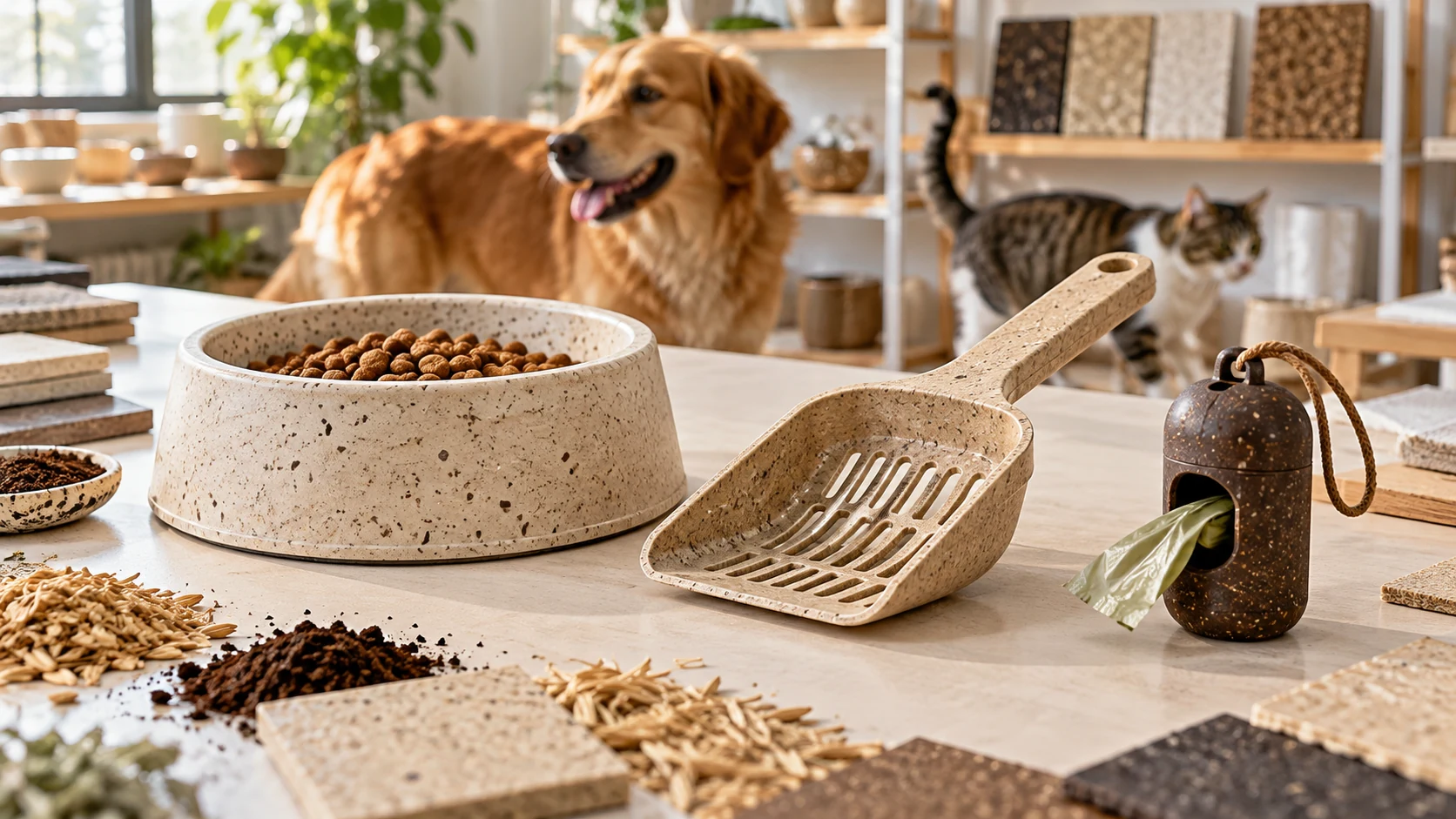
One WOOYOPET pet-bowl example makes the arithmetic visible. The original PP bowl weighed 186 g. In the revised material, rice-husk plant content represented 28% by mass, so the theoretical petroleum-based material displacement was about 52 g per bowl. At a projected annual quantity of 350,000 bowls, the theoretical annual displacement exceeds 18 tonnes. The reduction comes from a material-formulation change in a product that would already have been made, not from asking consumers to stop using pet products or from producing fewer units.
The same scaling effect applies to much smaller objects. WOOYOPET’s bag-dispenser example weighs only 45 g. With 25% wheat straw, its theoretical displacement is about 11 g per part. At 500,000 units per year, that becomes more than 5.6 tonnes. A small change repeated hundreds of thousands of times can be material; modern manufacturing is particularly good at repeatability.
Coffee grounds make the material story easy to understand
Plant fillers can reduce conventional resin, but they also make material origin easier for customers to understand. Coffee grounds are a direct example. A consumer may not know the source or chemistry of a particular bio-based polymer, but they understand used coffee grounds. Telling someone that a litter scoop includes processed coffee grounds needs little explanation: a material already used once is being given another use.
In a WOOYOPET Japanese pet-product project, a litter scoop formerly made from ABS used 22% coffee-ground plant component. The scoop weighed 78 g and had a projected annual quantity of 120,000 units, representing roughly two tonnes of theoretical petroleum-based displacement per year. The technical work was not merely “adding coffee grounds”: they had to be dried, their particle size controlled, odor managed, and their compound tested for the product’s required drop and strength performance.
For users, the resulting story is simpler: dark coffee speckles, a slightly matte handle, and a recognizable material origin. That clarity helps circularity become concrete rather than abstract. A material story works best when the product still looks finished, feels deliberate and performs as expected.
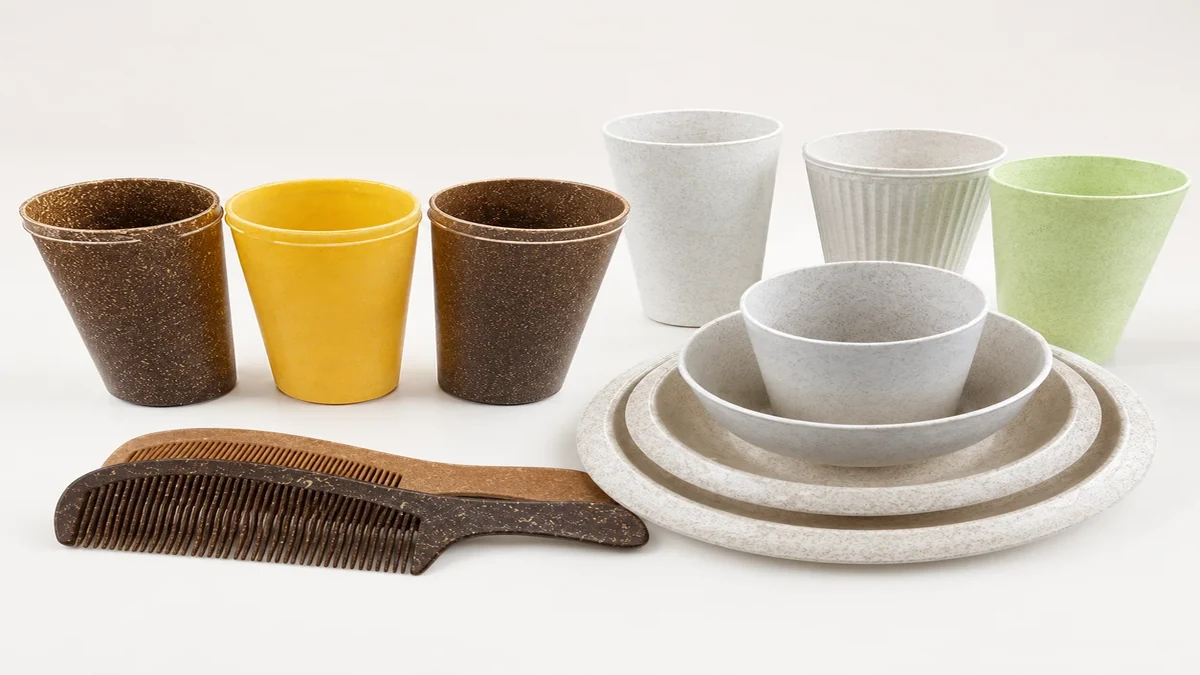
For PP-based products, see the closest published material reference: Wheat Straw PP Masterbatch WYC-PP.
Consumers want specific information, not just green language
The WOOYOPET research also suggests a change in the way people judge environmental claims. Green packaging, leaf icons and words such as “eco-friendly,” “natural” and “sustainable” are common, but they say little about what changed. More than 80% of respondents wanted to know how much plastic a product actually uses less. Nearly 80% said “this product uses XX grams less plastic” is more credible than a generic environmental claim.
That preference favors specific information: which plant material is present, its proportion, whether it is an agricultural or food-processing byproduct rather than newly cultivated feedstock, the grams of petroleum-based material displaced per product, and the estimated annual total. WOOYOPET calls this measure “Plastic Displacement.” It is not a complete carbon-footprint calculation and cannot replace a lifecycle assessment. It answers a simpler question: because plant-derived material was added, how much petroleum-based plastic is used less in this product?
Visible plant content also becomes part of product design. Rice husk can leave natural particles, coffee grounds can form dark flecks, wood fiber can give a warmer appearance, and bamboo fiber or wheat straw can produce fine irregular texture. WOOYOPET reports that more than 70% of respondents liked products where plant fiber or particles were visible. They did not, however, prefer maximum roughness. The favored appearance was a finished product with recognizable natural particles, not an object that looked like untreated agricultural waste.
This is a meaningful design change. Conventional plastic has often sought perfect uniformity: identical color, identical surface and repeated visual sameness. With plant fiber, controlled variation can become part of the product’s identity as long as quality, usability and finish remain intact.
Existing byproducts have a stronger material logic
Rice husk, coffee grounds, wood-processing residues and wheat straw ranked highly in plant-source preferences. More than two thirds of respondents said they preferred byproducts already produced by agriculture or food processing over crops grown specifically to make filler. The logic is direct: if an “environmental” material requires new land, irrigation, transport and production, customers reasonably ask whether it reduces the overall burden.
Byproducts follow a simpler sequence. The rice husk, coffee grounds, wheat straw or wood residue already exist because their first use has happened. The material question becomes whether they can be used again. That second-life logic can be more important than the fact that an ingredient is merely natural; it shifts the discussion from using natural resources to using existing resources more efficiently.
The survey also found higher acceptance among people who already pay close attention to environmental issues. Acceptance of plant-fiber composite plastic exceeded 94% among respondents who described themselves as very concerned about the environment and reached 87% among those who were fairly concerned. Together, those groups had 90% overall acceptance. This suggests that people who follow sustainability issues may understand the practical difficulty of moving directly to zero conventional plastic and may support credible, transparent reductions during the transition.
Price, performance and manufacturability remain decisive
Environmental interest does not make consumers willing to accept unlimited price increases. About 85.7% of respondents said they would accept some premium for a product with more environmentally considered materials, but most acceptable premiums fell within 0–10%. A material route that provides a strong story but causes a large cost increase is unlikely to scale.
For that reason, viable plant-fiber composites have to balance manufacturability, product usability, acceptable price and explainable environmental value. They are not only a material experiment. They involve product design, brand positioning, supply chain, processing control and production cost.
The material can also make an otherwise invisible supply-chain improvement visible. A rice-husk bowl can show its husk particles. A coffee-ground product can show its naturally different tone and flecks. A wood-fiber handle can look and feel different from pure ABS. The material itself becomes a communication surface: a consumer can ask what it contains, and a brand can answer with a specific ingredient and a specific amount of plastic displaced.
Higher plant content is not automatically better
If plant-fiber materials become more common, a new numerical race could emerge: 20%, 30%, 40% or 50% plant content. But the highest proportion is not automatically the best environmental or engineering choice. A water-exposed product, a load-bearing clip, an indoor decorative part and a simple housing require different performance. If higher plant content shortens product life, raises breakage or increases processing scrap, the overall environmental result may deteriorate.
WOOYOPET’s public examples cluster broadly around 20–30% plant content. That does not mean higher levels are impossible. It reflects that the product must first work reliably. A compound that consistently produces 500,000 parts at 20% plant component may be more consequential than a 60% sample that cannot enter normal production, because the former delivers a real reduction at scale.
Across five disclosed WOOYOPET projects, the product weights, plant proportions and projected annual quantities produce a combined theoretical petroleum-based displacement of about 37.4 tonnes per year. Thirty-seven tonnes is small compared with the global plastics sector. The more interesting point is that the five items are ordinary pet products: a bowl, a litter scoop, a pet comb, a bag dispenser and a smart water-fountain base. They were already going to be manufactured. The material is what changed.
From a revolution story to a reduction story
Plant-fiber composites do not solve every sustainability question. They still require disciplined work on material performance, processing stability, cost, supply chain, lifecycle assessment and end-of-life recovery. Their practical value may be strongest precisely because they allow existing industrial systems to move gradually: factories can retain familiar equipment, brands do not have to redesign every product at once, and users do not need to change their daily behavior while part of the petroleum-based polymer is reduced.
The question is therefore not whether five products can solve global plastic use. It is what happens when the same approach reaches 50, 500 or 5,000 products. Environmental-material communication can become more precise as well: rather than saying only that a product is green, explain what changed, which plant-derived material was added, and how much conventional plastic was displaced.
For many products, the first realistic move may be to change 100% petroleum-based plastic to 80%, then perhaps to 70% where performance allows. Reducing ten or several dozen grams per part and repeating that change a million times is a practical design logic. Before deciding how much plastic to continue using, it asks a useful question: how much can already be avoided?
For brands moving from an all-petroleum formulation to a practical reduction route, DEYU also provides plant-fiber composite material options and application-validation support. The objective is not a generic green claim, but a material route that can be made consistently, used reliably and explained with concrete numbers.