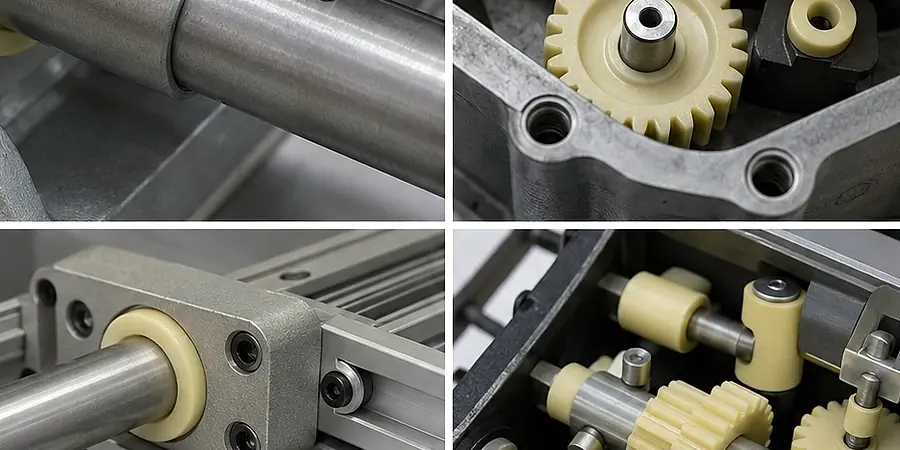
POM + PTFE Wear-Resistant Plastic for Low-Friction Gears and Sliding Parts
POM, also called acetal or polyoxymethylene, is widely used in moving plastic parts because it has good dimensional stability, low friction, and good moldability. However, in long-cycle sliding or gear movement, ordinary POM may still show wear marks, noise, friction increase, or white wear powder.
Buyer and engineer FAQ
Questions engineers often ask about this material route
Where can POM with a wear-resistant plastic requirement be used?
Typical fields include gears, rollers, bushings, sliding blocks, guide rails and low-noise moving parts. For this article, DEYU would first confirm the working environment, wall thickness, expected lifetime and whether DGK-POM TF90M, wear-resistant plastics matches the part geometry or needs formulation adjustment.
What are the main performance indicators for the "wear-resistant plastic" target on POM?
Focus on friction coefficient, wear depth, PV value, noise, dimensional stability and mating material compatibility. Buyers should ask for data on molded parts, not only pellet data, because gate position, filler orientation and thickness can change the final value.
What should engineers watch during injection molding or processing?
For POM, a practical starting window is 180-210°C melt / 70-100°C mold. Dry PA grades correctly, control glass or aramid fiber orientation and validate wear on the real mating surface. Final parameters should follow part thickness, gate design and the actual machine.
What details help DEYU recommend DGK-POM TF90M, wear-resistant plastics more accurately?
Send the current resin or grade, drawing or photo, wall thickness, annual quantity, target standard, failure mode and required color. If a reference grade already passed one test but failed in production, include both data sets.
For a precise recommendation, share the part drawing, base resin, target performance, processing method and test standard with DEYU.
1. Why POM + PTFE Is Used in Wear-Resistant Parts
POM, also called acetal or polyoxymethylene, is widely used in moving plastic parts because it has good dimensional stability, low friction, and good moldability. However, in long-cycle sliding or gear movement, ordinary POM may still show wear marks, noise, friction increase, or white wear powder.
DGK-POM TF90M and wear-resistant plastics. DGK-POM TF90M uses a PTFE wear-additive route for low-friction gears, sliders, bearings, and moving parts
Adding PTFE is one common route for improving sliding behavior. The goal is not simply to make the material “more slippery,” but to reduce friction while keeping dimensional accuracy, impact strength, and molding stability.
POM + PTFE compounds are commonly considered for:
plastic gears; sliding blocks; rollers; guide parts; small transmission parts; low-noise mechanisms; plastic-metal friction pairs; precision moving parts.
For this route, DEYU can start validation with DGK-POM TF90M, a POM compound containing a PTFE wear-additive package for low-friction gears, sliders, bearings, and moving parts.
2. Technical Difficulty
POM + PTFE looks simple, but the formulation is not only “POM plus lubricant.”
The main difficulties include:
PTFE dosage too low may not reduce friction enough; PTFE dosage too high may affect strength or surface quality; flowability must still support injection molding; gear shrinkage and dimensional accuracy must remain stable; the friction pair may change the wear result; noise reduction must be validated on the final part.
For this reason, DEYU usually recommends comparing ordinary POM, low-friction POM, and POM + PTFE on the customer’s actual part rather than judging only by test-bar data.
3. Internal Customer Case: Low-Friction POM Gear
Original Pain Point
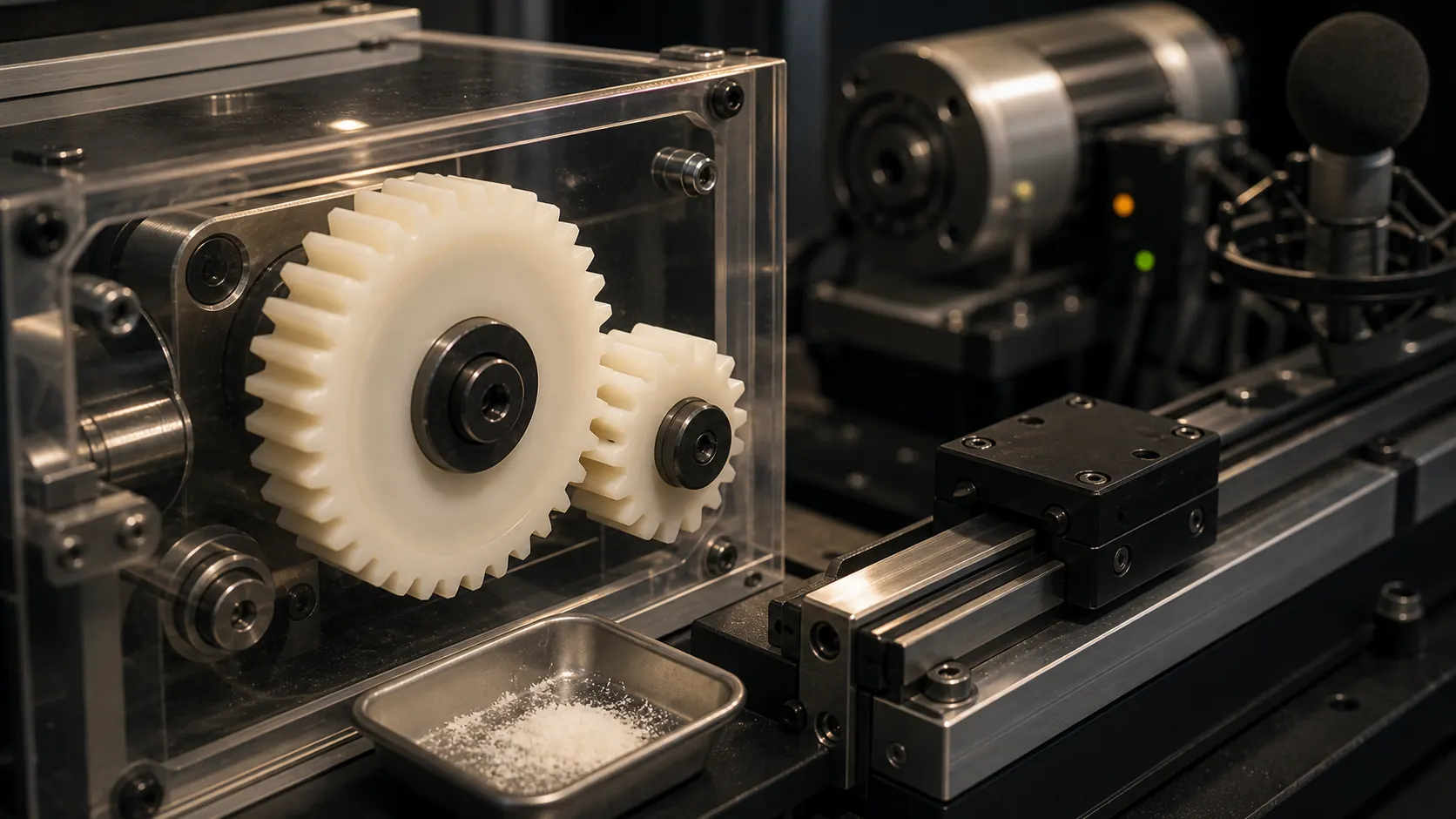
A customer used ordinary POM for a small gear. The first batch could run normally, but after continuous operation, gear noise increased and white wear powder appeared near the meshing area.
Original production and failure record:
monthly production: 38,000 pieces; inspection batch: 3,000 pieces; noise complaint rate: 4.8%; visible wear powder rate after life-cycle test: 7.2%; average wear depth after internal test: 0.082 mm; main complaint: noise and unstable sliding after long operation.
DEYU Material Direction
DEYU recommended a POM + PTFE route, using DGK-POM TF90M as the trial reference grade for validation.
Development target:
reduce gear friction; reduce wear powder; control noise increase; keep tooth dimensional stability; avoid excessive strength loss; maintain injection molding stability.
Trial Adjustment
The first trial reduced friction but showed slightly lower tooth impact strength.
DEYU adjusted:
PTFE balance; base POM flow direction; molding temperature window; holding pressure to reduce internal stress; tooth shrinkage compensation with the customer’s mold team.
The second trial focused on gear meshing noise and wear depth.
4. Validation Data
| Item | Ordinary POM | DEYU DGK-POM TF90M POM + PTFE Trial |
|---|---|---|
| Monthly production record | 38,000 pcs | 36,500 pcs trial batch |
| Noise complaint rate | 4.8% | 1.1% |
| Wear powder rate after life-cycle test | 7.2% | 1.8% |
| Average wear depth | 0.082 mm | 0.034 mm |
| Gear noise after 100 h | 59 dB | 53–54 dB |
| Tooth chipping during assembly | 2.6% | 0.8% |
| Molding scrap rate | 3.1% | 1.4% after process tuning |
Case Result
Compared with ordinary POM, the POM + PTFE trial direction reduced the measured wear depth by about 58% and lowered noise during the customer’s internal running test. The final result depended not only on the material, but also on molding stress control and gear tooth fit.
This is the main reason DEYU evaluates POM + PTFE as a system solution rather than only a material substitution.
5. When Buyers Should Consider This Route
POM + PTFE may be suitable when:
ordinary POM shows wear powder; gear noise increases after operation; sliding resistance becomes unstable; the part works under dry sliding; the mating part is metal or another engineering plastic; low-friction performance is more important than maximum stiffness.
It may not be the best first choice if the product mainly needs high stiffness, high impact, or high-temperature load-bearing performance. In those cases, DEYU may compare glass-fiber reinforced POM or another engineering plastic route.
6. Information Needed for Validation
For accurate evaluation, buyers should provide:
part drawing; current POM grade; mating material; load and speed; life-cycle test method; current defect rate; wear depth or mass loss data; noise target; monthly production quantity; molding scrap rate; color requirement; whether antistatic or conductive performance is also needed.
Conclusion
POM + PTFE is a practical wear-resistant plastic route for low-friction gears, sliders, and precision moving parts. The value is not only lower friction, but also reduced wear powder, lower noise, and more stable movement after long-cycle testing.
DEYU can support small-batch validation, grade adjustment around DGK-POM TF90M, flowability tuning, wear-depth comparison, and final-part testing for POM-based wear-resistant applications.
Contact DEYU: market@deyuplastics.com Website: www.deyuplast.com