
Self-Developed Carbon Nanotubes, In-House Compounding: Multi-Base Polymer Composite Pellets Recommended
In the field of conductive and antistatic modified plastics, the adoption of carbon nanotubes (CNTs) has long been held back by two bottlenecks: high material cost and an extremely demanding dispersion process. CNTs are inherently hydrophobic, chemically inert and have a huge specific surface area, making uniform dispersion in a polymer matrix a well-known industry challenge. Even slight process deviations can lead to inconsistent resistivity and poor batch-to-batch repeatability. Most compounders choose to sidestep the issue by relying on carbon black as a good-enough solution.
Buyer and engineer FAQ
Questions engineers often ask about this material route
Where can ABS / PA / PC / PE / POM / PP with a conductive plastic requirement be used?
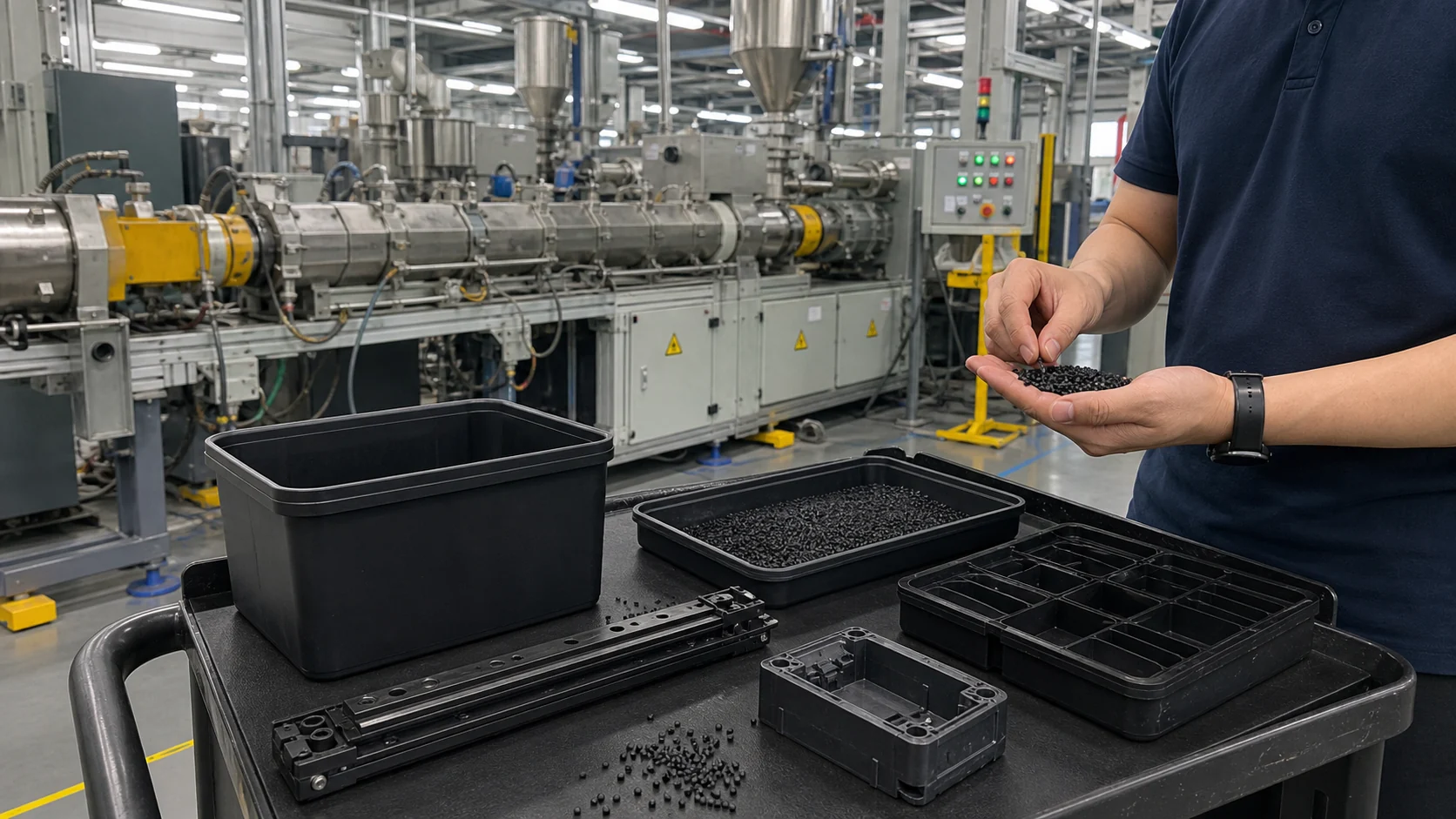
Typical fields include ESD trays, electronic housings, fixtures, EMI parts and antistatic logistics parts. For this article, DEYU would first confirm the working environment, wall thickness, expected lifetime and whether DGK-PP DD2-3A conductive PP, DGK-PP KJD789R-A1 permanent antistatic PP matches the part geometry or needs formulation adjustment.
What are the main performance indicators for the "conductive plastic" target on ABS / PA / PC / PE / POM / PP?
Focus on surface resistance, volume resistance, dispersion uniformity, impact strength and molding stability. Buyers should ask for data on molded parts, not only pellet data, because gate position, filler orientation and thickness can change the final value.
What should engineers watch during injection molding or processing?
For ABS / PA / PC / PE / POM / PP, a practical starting window is 210-245°C melt / 50-80°C mold. Avoid excessive filler loading, control weld lines and verify resistance on the molded part. Final parameters should follow part thickness, gate design and the actual machine.
What details help DEYU recommend DGK-PP DD2-3A conductive PP, DGK-PP KJD789R-A1 permanent antistatic PP more accurately?
Send the current resin or grade, drawing or photo, wall thickness, annual quantity, target standard, failure mode and required color. If a reference grade already passed one test but failed in production, include both data sets.
For a precise recommendation, share the part drawing, base resin, target performance, processing method and test standard with DEYU.
Introduction
In the field of conductive and antistatic modified plastics, the adoption of carbon nanotubes (CNTs) has long been held back by two bottlenecks: high material cost and an extremely demanding dispersion process. CNTs are inherently hydrophobic, chemically inert and have a huge specific surface area, making uniform dispersion in a polymer matrix a well-known industry challenge. Even slight process deviations can lead to inconsistent resistivity and poor batch-to-batch repeatability. Most compounders choose to sidestep the issue by relying on carbon black as a good-enough solution.
DGK-PP DD2-3A conductive PP and DGK-PP KJD789R-A1 permanent antistatic PP. These product pages connect the article's conductive PP and permanent antistatic PP selection logic with existing DEYU material options.
Yuyao Deyu Plastic Technology Co., Ltd. (DEYU plastics) chose a harder path: developing and using CNTs in-house, and mastering the core dispersion technology independently, turning CNTs from expensive laboratory materials into engineering plastics that can be delivered at scale. Backed by over 30 years of modification experience, 8,000 square meters of manufacturing space and eight twin-screw extrusion lines, DEYU plastics has built a full portfolio of CNT-compound pellets across mainstream polymers including POM, PP, PE, PA, ABS and PC. Mature, volume-supplied solutions are now available for conductive POM, ultra-conductive PP, antistatic HDPE and more.
Why the Market Needs CNT-Based Solutions
The global conductive plastic compounds market was valued at USD 2.9 billion in 2025 and is projected to reach USD 5.23 billion by 2036, growing at a CAGR of 5.5%. Within this market, CNT- and graphene-reinforced formulations are increasingly replacing traditional carbon-black solutions. Recent advances in materials science enable finer filler dispersion, achieving significantly higher conductivity at much lower loadings.
In the automotive electrification trend, conductive plastics already account for 15-20% of material volume in EV components. Semiconductor manufacturing and electronics assembly are also tightening ESD protection requirements. At the same time, the global carbon nanotube market is expanding at a CAGR of 16.6%, from USD 5.85 billion in 2025 to an estimated USD 12.15 billion by 2030. CNTs are moving decisively from laboratory-scale novelty to industrial-grade solutions.
What Makes DEYU plastics' CNT Approach Different
Compared with imported brands, DEYU plastics' CNT-compound solutions deliver better value for money. They match or exceed leading international grades in conductivity and mechanical retention, while offering faster supply-chain response, greater customization flexibility and significantly lower total cost.
This is not only a domestic equivalent. It is a performance-cost rebalancing built on proprietary dispersion know-how and a local supply chain, making CNT-modified plastics accessible for volume manufacturing in China rather than reserved for high-cost imports.
I. Recommended CNT-Compound Pellet Grades
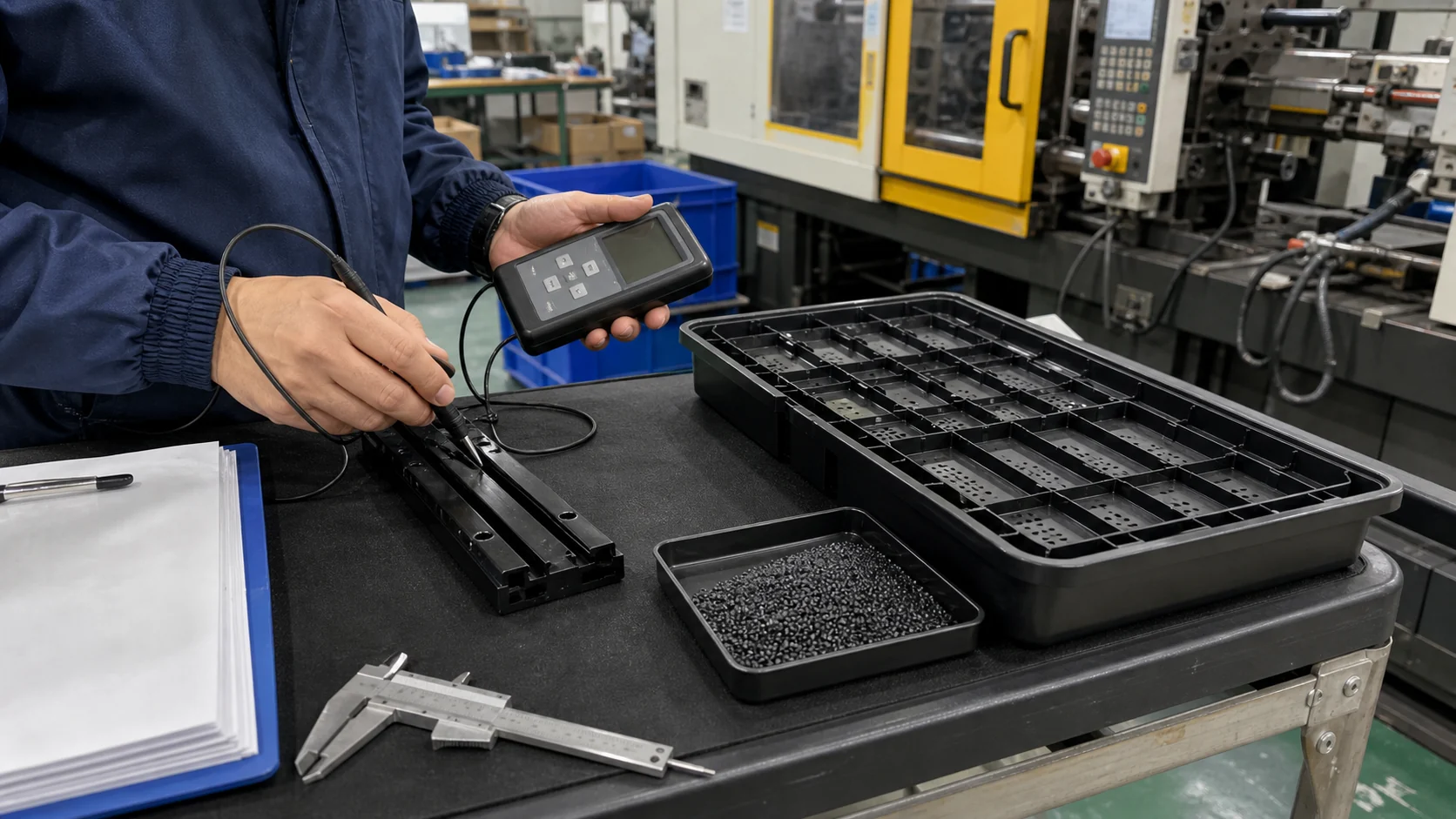
Below are core, customer-validated grades and real-world application cases.
| Grade | Base polymer | Surface resistivity | Key features | Typical applications |
|---|---|---|---|---|
| DGK-POM DD3-4A | POM | 10^3-10^4 ohm | Mechanical properties close to neat POM, glossy surface | Precision guide rails, wear-resistant slides, drive gears |
| DGK-PP DD2-3A | PP | 10^2-10^4 ohm | Ultra-conductive level, low loading | Medical device parts, ESD trays, cleanroom utensils |
| DGK-PE CNT-modified | HDPE | Conductive grade | Impact and puncture resistance doubled, antistatic | Explosion-proof drums, hazardous-goods containers, safety equipment |
| DGK-PA66 DD4-5A G30 | PA66 | 10^5 ohm.cm | Glass-fiber reinforced, tensile strength 120-130 MPa | Sensor housings, automotive engine-bay components |
II. Customer Case Studies, Anonymized
Case 1: Suzhou Automation Equipment Manufacturer, POM Guide-Rail Slides
Background and pain points
The manufacturer supplies POM guide-rail slides for panel production lines. It had long used a carbon-black-filled conductive POM from another supplier. Two chronic issues affected that solution.
First, the surface was rough. Carbon-black agglomerates embedded in the slide surface acted like abrasive paper, wearing down aluminum guide rails. After 100,000 reciprocating cycles, rail wear reached 0.08 mm.
Second, the mold temperature was limited. Carbon black tended to bloom at elevated temperatures, so mold temperature was capped at 55 C. This prevented full crystallization of POM. After one month of use, micro-cracks radiated from the gate area, leading to an annual slide replacement rate of 35%.
Switch and process tuning
After switching to DEYU DGK-POM DD3-4A using the CNT route, the DEYU technical team visited the factory for on-site process optimization. Three key adjustments were made.
| Parameter | Previous carbon-black grade | DGK-POM DD3-4A | Rationale |
|---|---|---|---|
| Mold temperature | 55 C | 70 C | CNTs do not bloom at high temperature; this allows optimal POM crystallization |
| Injection speed | High | Medium-low | Protects the CNT conductive network from excessive shear |
| Back pressure | Low | Moderate | Ensures uniform CNT dispersion and avoids agglomeration |
Results comparison
| Metric | Previous carbon-black POM | DGK-POM DD3-4A |
|---|---|---|
| Surface finish | Rough, grainy | Smooth, glossy |
| Rail wear after 100,000 cycles | 0.08 mm | 0.03 mm |
| After one month in use | Micro-cracks appeared | No cracks |
| Annual slide replacement rate | 35% | 8% |
Measured mechanical properties included tensile yield strength of 58 MPa, flexural modulus of 2500 MPa, elongation at break of 26% and surface resistivity stable at 10^3-10^4 ohm.
Why the CNT advantage is structural
Unlike carbon-black particles, CNTs have an extremely high aspect ratio and form a three-dimensional conductive network at very low loadings. This means the CNT solution has much less impact on the base polymer's mechanical properties. POM crystallinity is preserved, surface finish is greatly improved, and wear resistance and crack resistance are enhanced. That is the underlying reason DGK-POM DD3-4A can cut the annual replacement rate from 35% to 8%.
Trade-off and turnaround
The CNT-based material has a higher unit price than the carbon-black alternative. DGK-POM DD3-4A is around RMB 40/kg, while the carbon-black masterbatch grade DD4-5ML is about RMB 28.5/kg. However, on a total-cost-of-ownership basis, the slide replacement rate dropping from 35% to 8% saves far more in downtime and rail replacement costs per production line each year than the material price difference.
Compared with imported CNT-modified POM grades of similar performance, DEYU plastics' price advantage is even more pronounced. Total cost can be 20-30% lower while matching performance. Higher price is not a weakness; it is the price of value.
Case 2: Shenzhen Medical Device Component Supplier, PP Medical Parts
Background and pain points
This supplier produces conductive functional parts for cleanroom equipment. It previously used a carbon-black-filled PP solution. The high carbon-black loading gave a rough surface with a risk of particle shedding, which could introduce contamination in cleanroom environments. The black color was also fixed and could not meet some customers' custom-color requirements.
Switch solution
The supplier adopted DEYU DGK-PP DD2-3A, a CNT-compound route with surface resistivity of 10^2-10^4 ohm, reaching an ultra-conductive level. The extremely low CNT loading creates a conductive network with much less impact on PP's mechanical properties compared with highly filled carbon black. Surface smoothness improved remarkably, particle-shedding risk dropped significantly and the material meets cleanroom requirements.
Industry trend alignment
The global conductive plastics carbon-based filler market is expected to grow from USD 2.02 billion in 2025 to USD 3.76 billion by 2032, at a CAGR of 9.2%, with CNT- and graphene-reinforced formulations showing the fastest growth. In demanding sectors such as medical, semiconductor and precision electronics, CNT solutions are rapidly displacing traditional carbon black not because they are cheaper, but because the performance ceiling is fundamentally higher. DEYU plastics is aligned with this technology upgrade wave.
Trade-off and turnaround
The uniformity of CNT dispersion in the PP matrix directly determines resistivity consistency, placing much higher demands on equipment precision and process control. DEYU plastics turns this high barrier into a moat. Leveraging proprietary dispersion technology and validation data from eight production lines, DEYU ensures batch-to-batch resistivity CV within 20% with full traceability. Not every compounder can do this, which is precisely DEYU's core competitive edge.
Case 3: East China SMT Contract Manufacturer, Antistatic PP Trays
Background and pain points
SMT trays are used for automated component handling, with wall thickness of 1.5-2.0 mm and molding in multi-cavity tools. During pick-and-place operations, trays repeatedly contact robotic arms and conveyors. In dry seasons, static charge can build up to thousands of volts, posing an ESD threat to sensitive electronic components.
Solution and validation data
The customer adopted DGK-PP KJD789R-A1, a permanent antistatic alloy route. Typical surface resistivity is 10^9-10^11 ohm.cm, with natural color and color-matching capability, and density of 0.93 g/cm3.
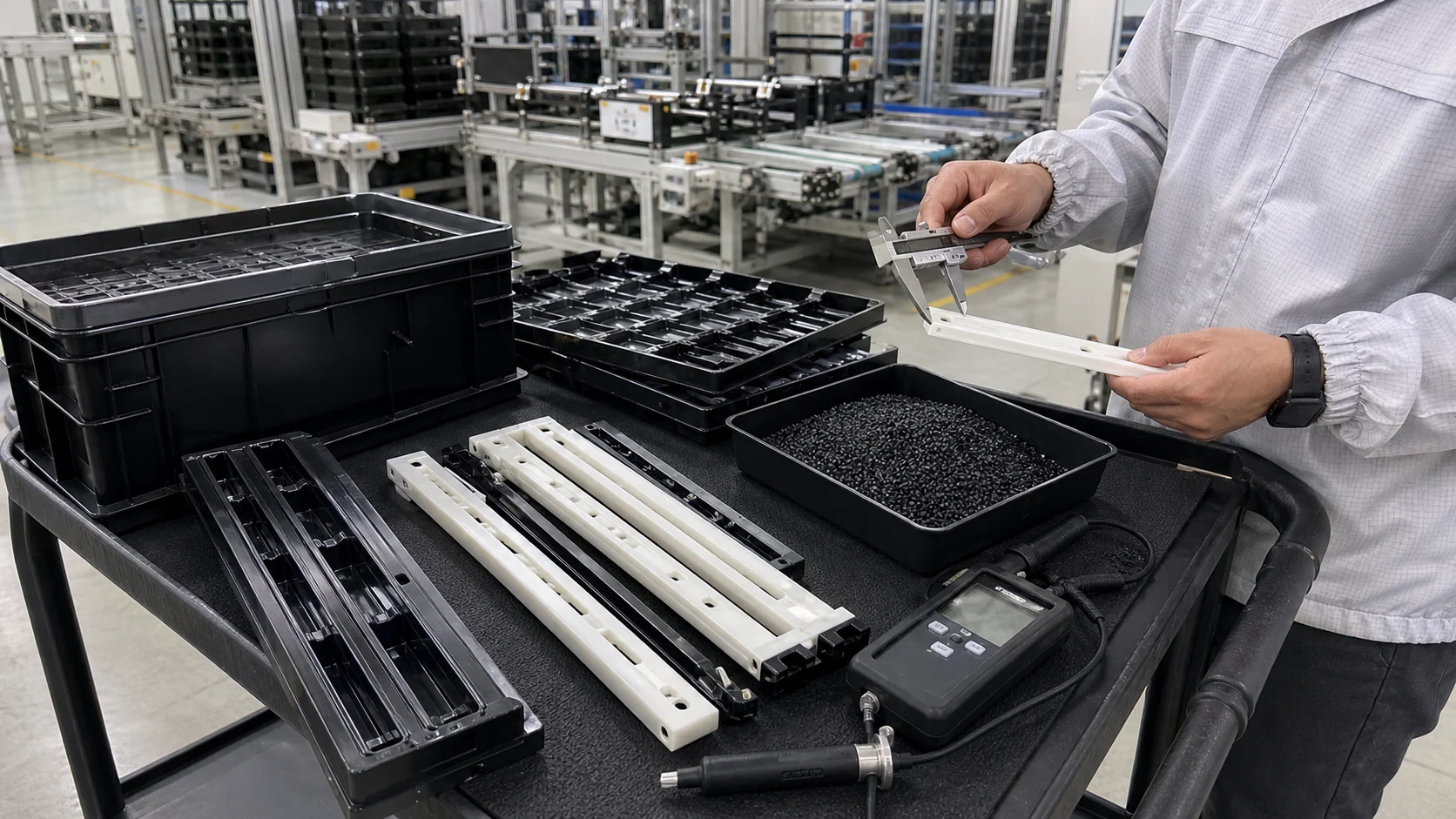
Five-point resistivity measurements on a four-cavity tray with 1.8 mm wall thickness are shown below.
| Measurement location | Surface resistivity |
|---|---|
| Near gate | 1.5 x 10^10 ohm |
| Average of four far corners | 4.2 x 10^9 ohm |
Overall CV was about 28%. The resistivity near the gate was slightly higher by about half a decade, which was acceptable.
Low-humidity and solvent-wipe tests
| Test condition | Result |
|---|---|
| 12% RH for 48 h | Resistivity rose from 3.8 x 10^9 to 8.5 x 10^9 ohm, within the same order of magnitude |
| 50 isopropyl-alcohol wipes | Resistivity rose from 4.1 x 10^9 to 5.6 x 10^9 ohm, drift only 0.15 decades |
Processing tips
| Processing point | Recommendation |
|---|---|
| Barrel temperature | 195-210 C |
| Mold temperature | 70-80 C |
| Injection speed | Medium-low injection speed |
| Gate design | Enlarge gate cross-section to reduce shear that may affect the antistatic phase |
| Mold release | Do not use mold release agents, because they can form an insulating surface film that shields the antistatic effect |
Trade-off and turnaround
This grade provides 10^9-10^11 ohm static-dissipative performance, not conductive performance at 10^3-10^6 ohm. For applications requiring true conductivity, DGK-PP DD2-3A is the better choice. DEYU's philosophy is not to cover every need with one material. Instead, DEYU offers dedicated grades across the entire resistivity spectrum, from 10^2 ohm ultra-conductive to 10^11 ohm antistatic, so customers select precisely what they need and DEYU delivers a matching material.
III. Transparent Discussion of Limitations
DEYU's CNT-compound pellets are mature in performance and process, but no material is perfect. The following points are stated openly, together with how DEYU turns them into advantages.
1. Higher cost than carbon-black solutions
CNT raw material and dispersion processing costs inevitably lead to a higher unit price than traditional carbon-black-filled grades. Industry data confirm that the price premium of advanced CNT and graphene fillers does limit penetration in cost-sensitive applications.
DEYU's turnaround is total-cost-of-ownership optimization: lower loading, longer part life and fewer replacements. The overall economics often beat carbon-black solutions. DEYU also supports small-batch orders starting from 5 kg, allowing customers to qualify the material at the R&D validation stage with low initial investment.
2. Stringent dispersion process requirements
Uniform CNT dispersion directly determines resistivity consistency, requiring much more sophisticated equipment and process control than carbon black. Strong van der Waals forces between CNTs make agglomeration a persistent challenge. Conventional technologies often cannot achieve uniform dispersion even at moderate loadings.
This requirement is precisely DEYU's technological moat. With over 30 years of modification experience, proprietary dispersion processes and production validation across eight extrusion lines, DEYU ensures stable batch-to-batch CV values. DEYU also provides on-site technical support. Engineers can visit customer plants to fine-tune injection molding parameters, helping achieve first-trial success from material to production line.
3. Predominantly black; light-color customization has limits
CNTs are black by nature, so achieving light-colored formulations while maintaining conductivity presents extra challenges in color matching and performance balance.
DEYU has built know-how in colored conductive plastics. For example, light-gray conductive ABS samples can achieve a color difference Delta E below 0.8, with no significant fluctuation in conductivity due to pigment addition. Customization lead time is approximately 10-15 working days, which is acceptable for many industrial projects.
IV. Why Choose DEYU plastics
What worries engineers most when selecting modified plastics? Standard off-the-shelf grades always seem to fall short: conductivity too low, too brittle, insufficient heat resistance or wrong color. Blending in-house may not be realistic because there is no equipment or data. Turning to large custom compounders can also be difficult because of high MOQs, long lead times and limited interest in small-batch requests.
DEYU plastics operates on a different logic.
| DEYU capability | Practical value for customers |
|---|---|
| In-house CNT development | Core dispersion technology is owned internally, not dependent on external masterbatches, making quality fully controllable |
| Broad polymer coverage | Full portfolio across POM, PP, PE, PA, ABS, PC and more |
| Proven real-world cases | Suzhou automation POM rails, Shenzhen medical PP ultra-conductive parts and East China SMT antistatic PP trays are all in volume production |
| On-site technical support | Engineers visit the shop floor to optimize molding parameters, providing one-stop service from material to production |
| Small-batch flexibility | Orders can start at 5 kg, with 3-5 day rapid sampling for R&D validation and volume ramp-up |
DEYU plastics, Yuyao Deyu Plastic Technology Co., Ltd., is located at No. 83 Shunyu Road, Yangming Science and Technology Industrial Park, Yuyao, Zhejiang, China. The company has more than 30 years of modified plastics R&D experience and provides conductive, antistatic and CNT-compound pellets as well as custom performance solutions.
Performance data in this article are based on DEYU internal tests and joint customer validations. Actual values may vary with sample thickness, molding conditions and application environment. Customers are advised to conduct in-house or on-line validation under their specific operating conditions.