
Transparent Anti-Static Plastics for Machine Observation Windows: Balancing Clarity, Dust Control and Impact Resistance
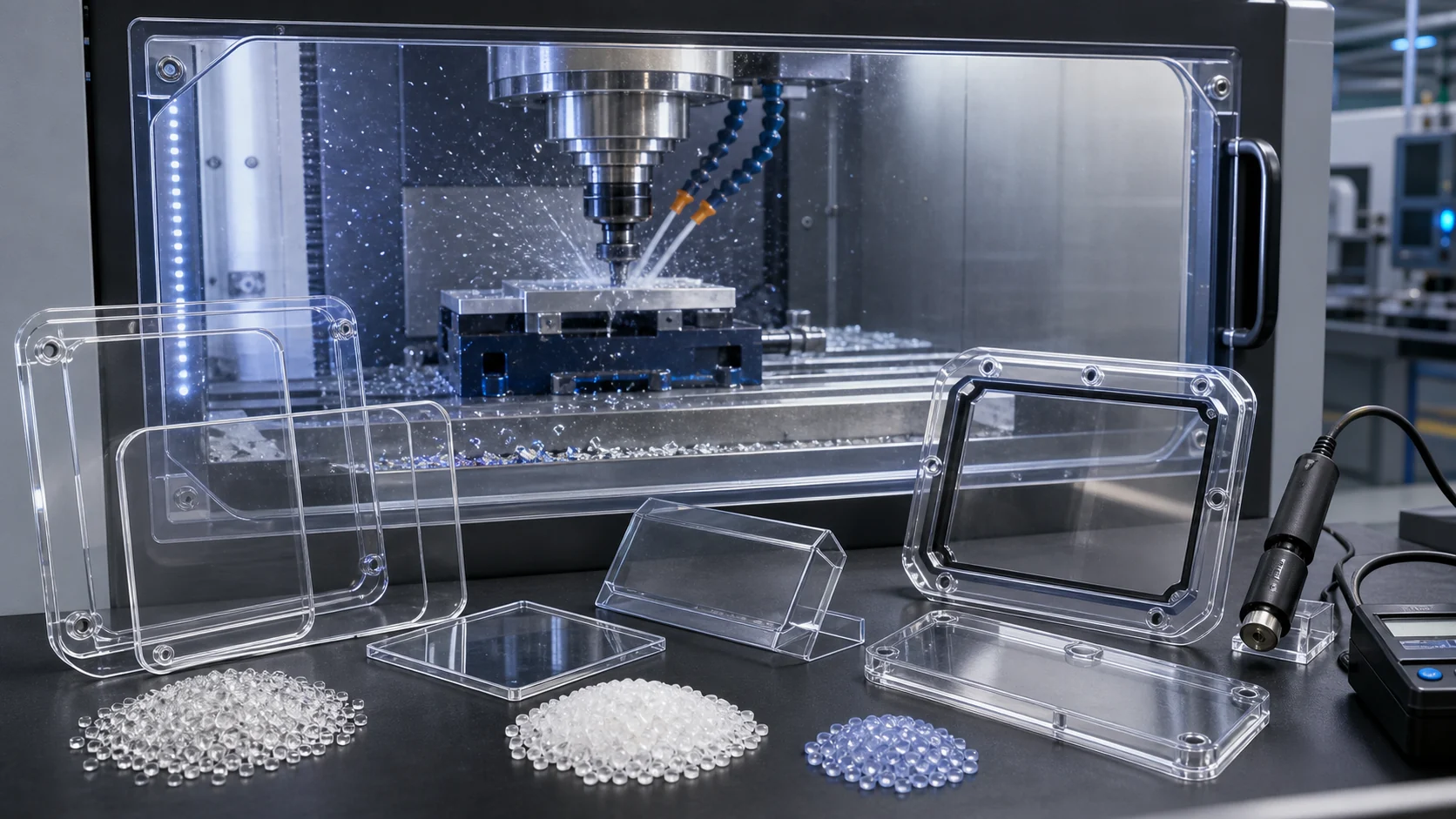
This page is for equipment manufacturers, machinery engineers and material buyers who need transparent observation windows, inspection covers or visible guards that stay clear during production. It explains how transparent anti-static plastics reduce dust and chip adhesion while balancing clarity, impact resistance, molding stability and part-level validation.
Buyer and engineer FAQ
Questions engineers often ask about this material route
Where can modified plastic with a antistatic plastic requirement be used?
Typical fields include clear covers, electronic packaging, dust-control parts, trays and clean-area components. For this article, DEYU would first confirm the working environment, wall thickness, expected lifetime and whether DGK-ABS KJD890TM Transparent Antistatic ABS, DGK-PMMA KJD890TM High-Transparency Antistatic PMMA matches the part geometry or needs formulation adjustment.
What are the main performance indicators for the "antistatic plastic" target?
Focus on stable surface resistance, dust attraction, transparency or color, humidity sensitivity and long-term antistatic decay. Buyers should ask for data on molded parts, not only pellet data, because gate position, filler orientation and thickness can change the final value.
What should engineers watch during injection molding or processing?
Avoid over-drying antistatic systems, confirm resistance after conditioning and after part cleaning. Start from the base-resin processing window, then adjust by molded-part resistance, appearance and mechanical data.
What details help DEYU recommend DGK-ABS KJD890TM Transparent Antistatic ABS, DGK-PMMA KJD890TM High-Transparency Antistatic PMMA more accurately?
Send the current resin or grade, drawing or photo, wall thickness, annual quantity, target standard, failure mode and required color. If a reference grade already passed one test but failed in production, include both data sets.
For a precise recommendation, share the part drawing, base resin, target performance, processing method and test standard with DEYU.
This page is for equipment manufacturers, machinery engineers and material buyers who need transparent observation windows, inspection covers or visible guards that stay clear during production. It explains how transparent anti-static plastics reduce dust and chip adhesion while balancing clarity, impact resistance, molding stability and part-level validation.
DGK-ABS KJD890TM Transparent Antistatic ABS and DGK-PMMA KJD890TM High-Transparency Antistatic PMMA. Use the ABS route when molded transparent covers need balanced toughness and processability, and compare the PMMA route when higher optical clarity is the priority.
1. Background / Problem
Machine observation windows and transparent guards are usually selected first for visibility. Operators need to see cutting fluid, chips, workpiece position, sensors, lamps or inspection marks through the cover. In actual production, visibility alone is not enough. Ordinary transparent plastics may attract dust, powder, fine chips or plastic debris because static charge builds up on the surface.
When the window becomes contaminated, the equipment may still run, but the user experience and inspection accuracy become worse. Operators clean the window more often, the part may scratch during wiping, and small particles can stay near the inspection area. In electronic, optical, packaging or automated equipment, this static-related contamination can also increase the risk of misreading, rework or unstable appearance.
The common engineering question is therefore not simply which transparent plastic is clearer. The better question is which transparent plastic can keep enough optical clarity while reducing static charge, keeping impact strength, and staying stable after molding and cleaning.
2. Why Transparent Anti-Static Plastics Are Difficult
Transparent anti-static plastics are harder to formulate than black conductive plastics. The anti-static system must work without destroying light transmission, haze, surface appearance or molded-part toughness.
If the anti-static route is too weak, dust still adheres after molding. If the route is too aggressive, the material may become hazy, yellowish, brittle or unstable in processing. If the additive migrates to the surface, the first test may pass but the effect may change after cleaning, heating or long-term use.
The difficulty becomes more obvious in real observation-window parts. Large flat areas, ribs, screw bosses, thick-to-thin transitions and long flow lengths can produce different cooling and orientation conditions. A standard test plaque may show acceptable resistance, while the finished cover still has local dust adhesion, haze marks or cracking near fasteners.
3. DEYU Material Selection Direction
DEYU evaluates transparent anti-static observation-window materials from four directions: optical clarity, electrostatic control, mechanical reliability and finished-part validation.
For optical clarity, the target is not only high light transmittance. Haze, yellow tone, flow marks, weld lines and scratch sensitivity also matter because operators judge the machine status through the molded window.
For electrostatic control, most transparent anti-static projects are not trying to create a highly conductive window. They usually need a static-control range that reduces dust and chip adhesion without creating unnecessary electrical or mechanical risk.
For mechanical reliability, the base resin matters. ABS can offer a practical balance of molding, toughness and cost. PMMA can offer higher transparency when impact demand is moderate. PC may be evaluated when impact resistance and safety guarding are more important, but the anti-static route and optical target must be confirmed by the actual part.
For finished-part validation, DEYU recommends testing both standard plaques and molded windows. Resistance, haze, impact risk, screw-boss cracking, cleaning behavior and dust pickup should all be checked on the customer part.
4. Material Route Comparison
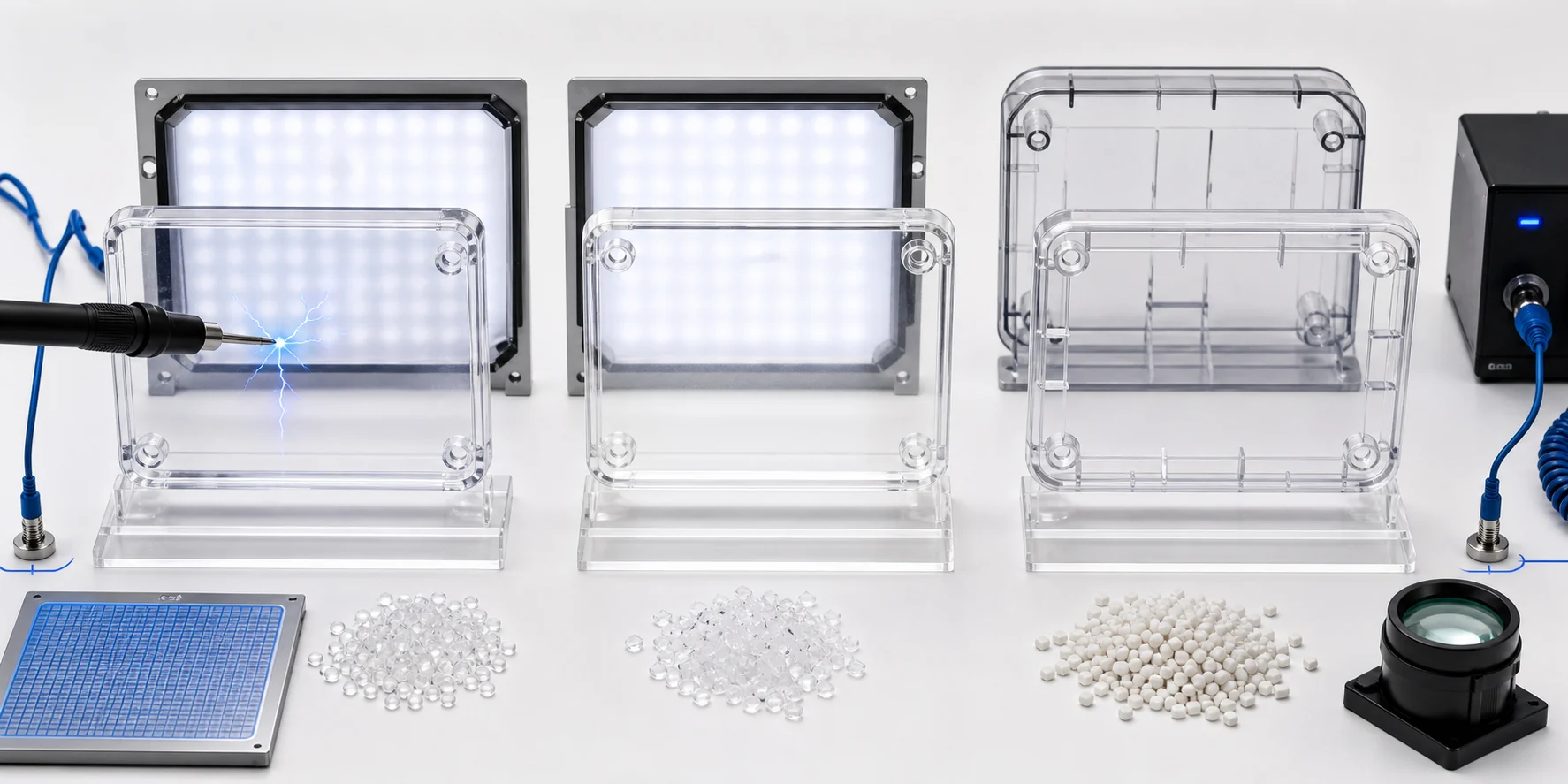
The suitable transparent anti-static route depends on the part size, impact requirement, cleaning frequency, transparency target and molding process.
| Route | Typical Advantage | Main Limit | Suitable Direction |
|---|---|---|---|
| Transparent anti-static ABS | Balanced toughness, molding stability and practical cost | Lower clarity than PMMA; needs haze control | Observation windows, inspection covers, electronic equipment covers |
| Transparent anti-static PMMA | High transparency and clean appearance | Lower impact resistance than PC; notch sensitivity must be considered | Display windows, clean covers, panels where clarity is the priority |
| Transparent anti-static PC | Higher impact and guard-related potential | More difficult anti-static and optical balance; grade must be validated | Safety viewing panels and impact-sensitive covers |
| Coating or surface treatment | Can be applied to existing transparent parts | Wear, cleaning and long-term stability must be verified | Short-life or low-load windows |
| Ordinary transparent resin | Best baseline clarity and simple processing | Static charge may attract dust and chips | Only suitable when static contamination is not a problem |
For machine observation windows, a successful material is rarely selected by transparency alone. The resin route should be chosen by the combined requirement for visibility, dust control, impact resistance, cleaning and assembly.
5. Reference Product Data
Existing DEYU product pages should be used as the first reference when a grade has already been defined. The table below summarizes the transparent anti-static directions most relevant to this application.
| Item | DGK-ABS KJD890TM | DGK-PMMA KJD890TM |
|---|---|---|
| Base resin | ABS | PMMA |
| Material direction | Transparent permanent anti-static ABS | High-transparency anti-static PMMA |
| Surface resistance | 10^9-10^10 ohm | 10^9-10^10 ohm |
| Light transmittance | Above 85% | Above 90% |
| Processing | Injection molding / extrusion | Injection molding / extrusion |
| Typical applications | Transparent anti-static covers, observation windows, electronic protective parts | Clear covers, communication equipment, electronic panels, display or observation windows |
| Selection note | Balanced route for visible molded covers needing toughness and ESD control | Higher-clarity route when optical appearance is the main priority |
These values are product-page reference data, not a universal guarantee for every window structure. Final resistance, haze, impact behavior and cleaning durability should be verified on the customer's molded part.
6. Application Validation Scenario
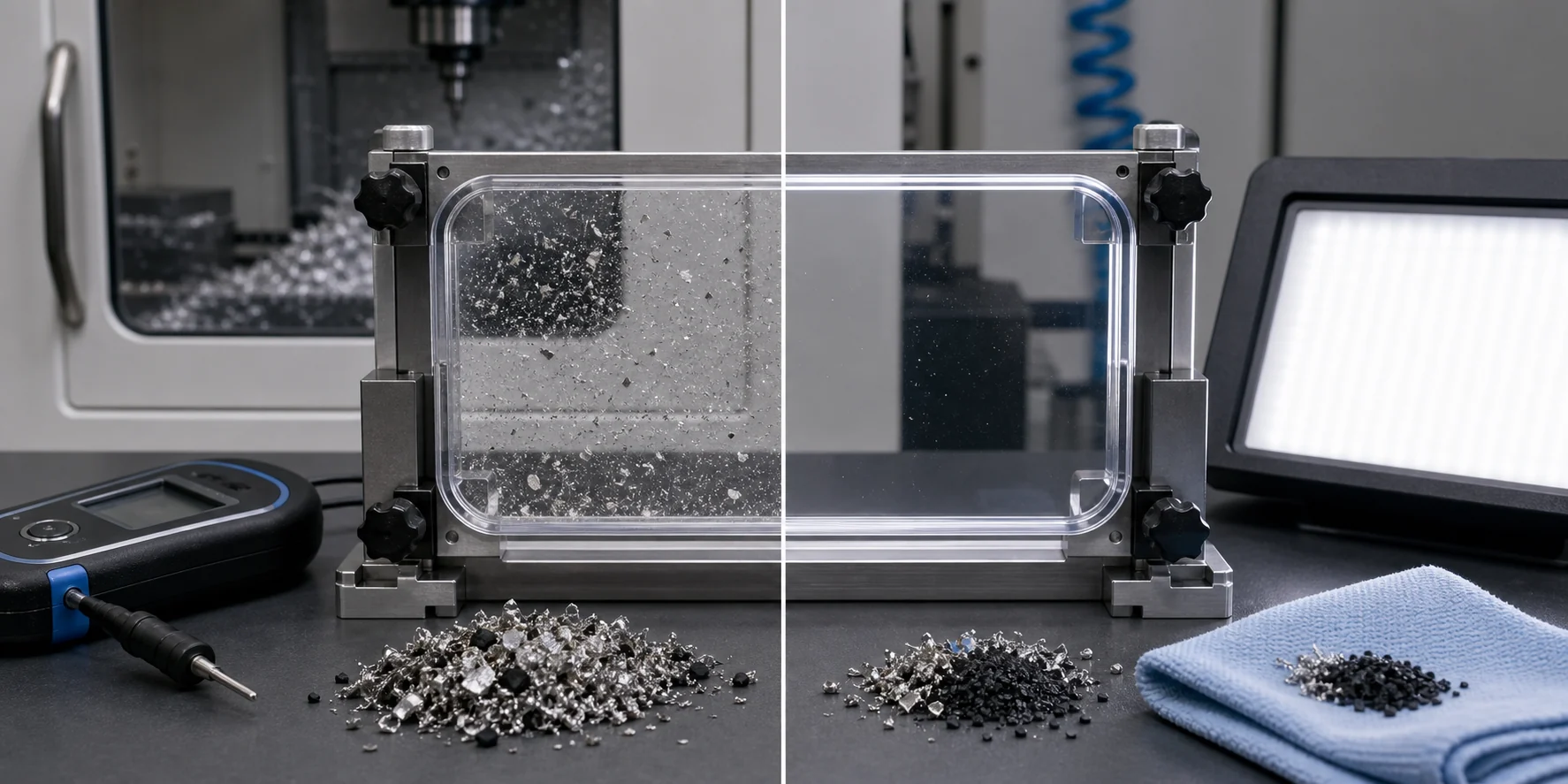
A machine builder currently uses an ordinary transparent plastic window on automated equipment. The part provides acceptable visibility after molding, but during operation dust and fine chips adhere to the surface. Operators wipe the window frequently. After repeated cleaning, fine scratches become visible and the inspection area looks cloudy.
The project goal is to reduce dust and chip adhesion without making the window visibly darker, brittle or difficult to mold. The buyer also wants the same part to fit the existing assembly frame and screw positions.
DEYU would normally recommend a small-batch validation process. First, confirm the base resin direction: ABS, PMMA or PC. Second, define the target optical requirement and acceptable resistance range. Third, mold both standard plaques and finished observation windows. Fourth, test resistance at several areas of the molded window, including the center area, corners, flow end, screw boss area and wiped surface. Fifth, check visibility, haze, scratching, cracking and cleaning behavior after trial use.
7. Validation Data Structure
| Validation Item | Why It Matters | Suggested Observation |
|---|---|---|
| Light transmittance | Determines whether the operator can inspect through the window | Compare plaque and finished window |
| Haze | Directly affects visual clarity | Check flat area, weld line and flow end |
| Surface resistance | Indicates static-control capability | Test multiple positions after molding |
| Dust or chip adhesion | Confirms whether the material solves the real problem | Compare ordinary transparent resin and anti-static resin |
| Impact and cracking | Important for covers fixed by screws or clips | Check screw bosses, corners and drop or vibration risk |
| Cleaning resistance | Observation windows are wiped repeatedly | Test after dry cloth, water or approved cleaner |
| Dimensional stability | The window must fit the existing frame | Check warpage, shrinkage and assembly gap |
| Surface appearance | Visible parts cannot show severe marks | Inspect flow marks, silver streaks, bubbles and scratches |
| Production scrap rate | Material must fit the customer's molding process | Record short shot, haze, deformation and cracking |
8. Result Interpretation
The result should not be judged by a single resistance number. A transparent anti-static plastic may pass a plaque test but fail on a large molded window because the flow path, gate design, cooling rate or cleaning method changes the final performance.
A practical result interpretation should include optical performance, static-control performance and production stability at the same time. If the part becomes clear but still attracts dust, the anti-static route is insufficient. If the resistance is acceptable but haze rises too much, the optical target is not met. If both values pass but screw bosses crack or the window warps, the material still needs adjustment.
For this reason, DEYU treats transparent anti-static observation windows as a part-level validation project, not only as a datasheet selection.
9. Suitable Applications
Transparent anti-static plastic compounds can be considered for machine observation windows, inspection covers, safety viewing panels, electronic equipment covers, transparent ESD guards, automated-line dust-control covers, optical inspection covers, communication equipment windows and clear molded parts that require lower dust attraction.
For very high-impact safety guards, PC-based or laminated structures may need further evaluation. For very high optical clarity, PMMA may be the first route to compare. For balanced molded covers where impact, cost and processing matter together, transparent anti-static ABS is often a practical starting point.
10. What Buyers Should Provide
To select the right material, buyers should provide the drawing or part size, wall thickness, gate position if known, current resin, target transparency or haze requirement, target resistance range, cleaning method, working temperature, impact or safety requirement, monthly usage, color requirement and current defect photos.
Samples of the existing window are also useful. They help compare dust adhesion, scratch marks, haze and assembly stress before selecting a new transparent anti-static compound.
11. Conclusion
Transparent anti-static plastics for machine observation windows must balance several requirements at once. The material needs enough clarity for visual inspection, enough static control to reduce dust and chip adhesion, enough toughness for assembly and use, and enough processing stability for repeatable molding.
DGK-ABS KJD890TM and DGK-PMMA KJD890TM provide two relevant DEYU reference directions: transparent anti-static ABS with 10^9-10^10 ohm resistance and above 85% light transmittance, and high-transparency anti-static PMMA with 10^9-10^10 ohm resistance and above 90% light transmittance. The final choice should be confirmed through molded-part testing, not only by a material datasheet.