
Leitfähiges ABS für Gerätegehäuse und Montagevorrichtungen
Leitfähiges ABS verbindet dauerhafte ESD-Kontrolle mit Schlagzähigkeit, Maßstabilität und effizienter Spritzgießverarbeitung von ABS-Teilen.
FAQ für Einkauf und Ingenieure
Häufige Ingenieurfragen zu dieser Materialroute
Kann leitfähiges ABS für Gehäuse und Montagevorrichtungen eingesetzt werden?
Ja. Dieselbe ABS-Basis kann statisch ableitend oder leitfähig formuliert werden. Zielwiderstand, Wanddicke, Schlaganforderung und Oberfläche müssen jedoch am Formteil bestätigt werden.
Welches DEYU-Produkt passt am besten zu diesem Artikel?
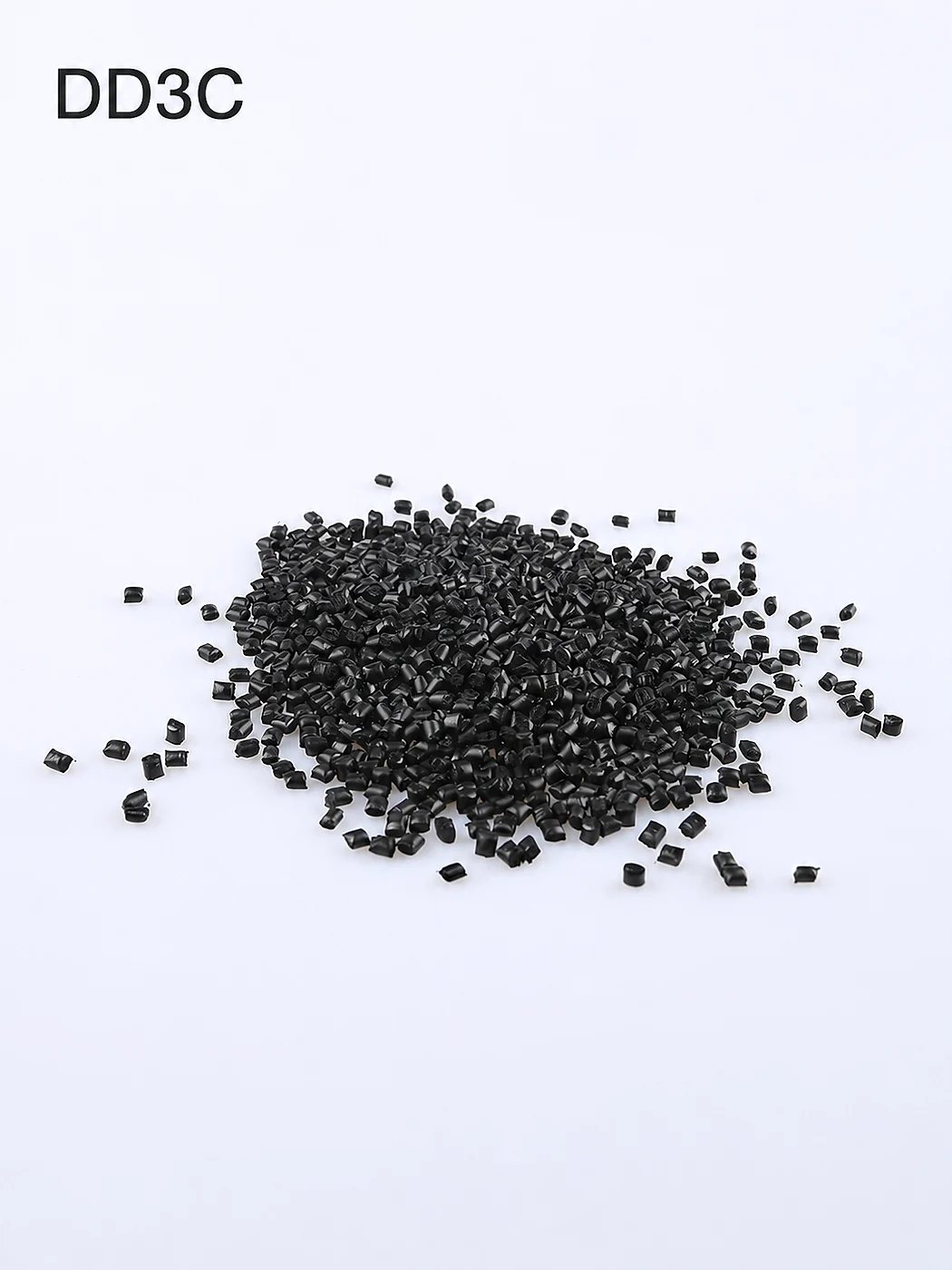
Die nächstliegende Standardreferenz ist DGK-ABS DD3C graphite conductive ABS. Bei anderer Widerstandsspanne, höherer Zähigkeit, Flammschutz oder Optik passt DEYU die Rezeptur an.
Welche Daten sollten vor Serienproduktion geprüft werden?
Anfangs-Oberflächenwiderstand, Streuung innerhalb und zwischen Teilen, Widerstand nach Reinigung, Fall- oder Schlagtest, Verzug, Schwindungsstabilität und Ausschussquote.
Warum wird das Formteil und nicht nur das Granulat validiert?
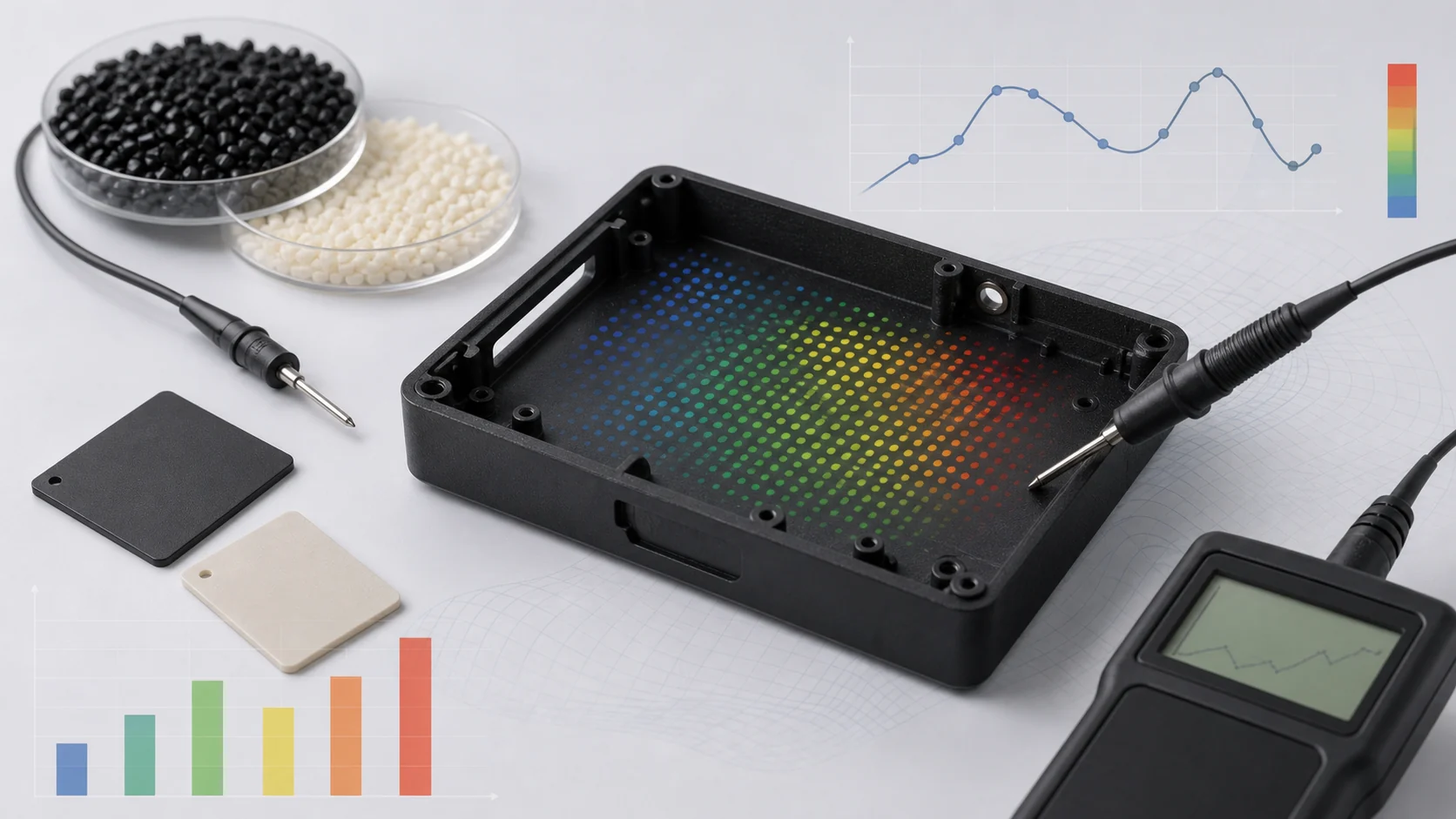
Leitfähige Füllstoffe orientieren sich im Fluss. Anschnitt, Rippen, Dome, Wanddicke und Parameter verändern den Messwert, daher muss die Freigabe an realen Gehäusen oder Vorrichtungen erfolgen.
Hintergrund: Warum leitfähiges ABS für Gehäuse und Vorrichtungen eingesetzt wird
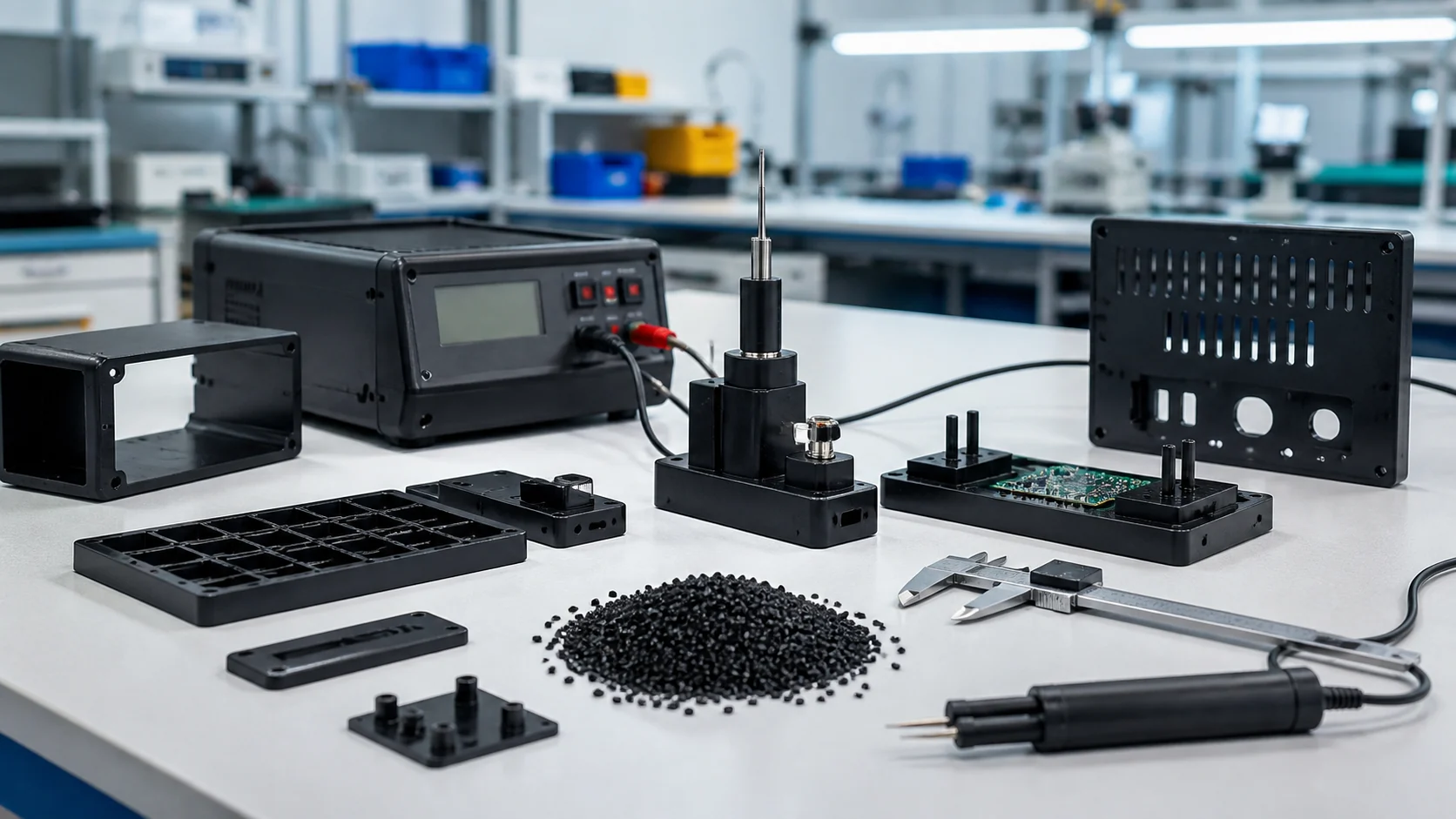
Gerätegehäuse und Montagevorrichtungen müssen Elektronik schützen, elektrostatische Ladung kontrollieren, enge Maße halten und in Serie gut spritzgießbar bleiben. Standard-ABS wird wegen Schlagzähigkeit, Steifigkeit, Oberfläche und Kosten genutzt, ist aber ohne Modifikation isolierend mit Volumenwiderständen um 10^15-10^16 Ohm-cm. DEYU klärt zuerst, ob 10^6-10^9 Ohm oder ein Bereich unter 10^6 Ohm nötig ist.
Technische Schwierigkeit: Widerstand, Optik und Zähigkeit gemeinsam steuern
Die Aufgabe besteht nicht nur darin, ABS schwarz und leitfähig zu machen. Ein praxistaugliches Material muss Widerstand nach Formen, Reinigung und Handling halten und Agglomerate, Fließmarken, Risse und Verzug vermeiden. Kohlenstoffpulver, Ruß, Kohlefaser und Hybridsysteme beeinflussen Widerstand, Optik, Schlagzähigkeit und Fließverhalten unterschiedlich.
DEYU Materialrichtung
DEYU empfiehlt für ABS-Gehäuse und Montagevorrichtungen meist Kohlenstoffpulver, Ruß oder Hybridsysteme. Als nächstliegende Standardreferenz kann DEYU mit DGK-ABS DD3C graphite conductive ABS pellets beginnen und die Rezeptur anpassen, wenn ein anderes Widerstandsfenster, höhere Fallfestigkeit, UL94-Richtung oder kontrolliertere Oberfläche benötigt wird.
Referenzdaten zum Produkt
Die folgenden Daten behalten die technische Logik des Ausgangsartikels bei. Endwerte müssen mit realer Geometrie, Werkzeug, Anschnitt und Konditionierung bestätigt werden.
| Classification | Surface Resistivity | Typical Application |
|---|---|---|
| Conductive | < 10^6 ohm | EMI shielding, explosive environments, high-sensitivity grounding |
| Static Dissipative | 10^6-10^9 ohm | Standard ESD-safe housings, fixtures, enclosures |
| Anti-static | 10^9-10^12 ohm | Low-risk packaging, non-critical covers |
| Requirement | Why It Matters | Typical Specification |
|---|---|---|
| Impact resistance | Protects internal components; withstands handling | Izod notched impact >= 0.5 J/cm |
| Stiffness / flexural modulus | Maintains structural integrity under load | Flexural modulus >= 1600 MPa |
| Dimensional stability | Ensures proper fit and component alignment | Low warpage, consistent shrinkage |
| Tensile strength | Withstands assembly and service loads | Tensile strength >= 28 MPa |
| Heat deflection temperature | Survives operating and soldering temperatures | HDT >= 85 C (264 psi) |
| Filler System | Conductivity | Surface Quality | Recommended For |
|---|---|---|---|
| Carbon powder | Good (10^6-10^9 ohm) | Excellent (smooth finish) | Visible housings, precision fixtures |
| Carbon black | Good (10^4-10^6 ohm) | Good | General ESD housings, enclosures |
| Carbon fibers | High (10^3-10^5 ohm) | Moderate (surface texture) | High-conductivity, structural applications |
| Hybrid systems | Excellent (tailored) | Good | Demanding applications requiring specific resistivity |
| Property | Unit | Test Method | DEYU Conductive ABS (Carbon Powder) | DEYU Conductive ABS (Carbon Black) | DEYU Conductive ABS (Hybrid) |
|---|---|---|---|---|---|
| Filler system | System | Reference | Carbon powder | Carbon black | Carbon powder + CNT |
| Surface resistivity | ohm/sq | ASTM D257 | 10^6-10^9 | 10^4-10^6 | 10^5-10^7 |
| Volume resistivity | ohm-cm | ASTM D257 | 10^6-10^9 | 10^4-10^5 | 10^4-10^6 |
| Static decay (15% RH) | seconds | Mil-B-81705-B | < 0.1 | < 0.1 | < 0.1 |
| Density | g/cm3 | ASTM D792 | 1.03 | 1.05-1.10 | 1.04-1.08 |
| Tensile strength | MPa | ASTM D638 | 28 | 30-40 | 35-45 |
| Flexural strength | MPa | ASTM D790 | 50 | 55-70 | 60-75 |
| Flexural modulus | MPa | ASTM D790 | 1931 | 2000-2800 | 2200-3000 |
| Izod impact (notched) | J/cm | ASTM D256 | 0.53 | 0.4-0.6 | 0.5-0.7 |
| HDT (264 psi) | C | ASTM D648 | 85 | 80-90 | 85-95 |
| UL94 rating | Rating | UL94 | HB | HB / V-0 | V-0 |
| Typical applications | Application | Reference | Visible housings, precision fixtures | General ESD enclosures, trays | High-performance housings, ATEX components |
| Parameter | Recommendation |
|---|---|
| Drying temperature | 80-90 C |
| Drying time | 2-4 hours |
| Moisture content target | < 0.1% |
| Parameter | Recommended Range |
|---|---|
| Cylinder temperature | 210-240 C |
| Mold temperature | 40-60 C |
| Injection speed | Medium |
| Injection pressure | 60-100 MPa |
| Back pressure | Low-Medium |
| Screw speed | 40-60 rpm |
| Parameter | Original Material | DEYU Conductive ABS Grade |
|---|---|---|
| Filler system | Carbon black | Carbon powder + impact modifier |
| Target resistivity | 10^6-10^9 ohm | 10^6-10^8 ohm |
| Trial quantity (housings) | 100 | 100 |
| Target monthly production | 1,000 units | 1,000 units |
| Parameter | Original Material | DEYU Conductive ABS Grade |
|---|---|---|
| Electrical Performance | Category | Category |
| Surface resistivity (initial, avg) | 5x10^8 ohm | 3x10^7 ohm |
| Resistivity - part-to-part variation | ±2 orders | ±0.3 orders |
| Resistivity - within-part variation | ±1.5 orders | ±0.2 orders |
| Resistivity after 50 IPA cycles | 8x10^10 ohm | 5x10^7 ohm |
| Mechanical Performance | Category | Category |
| Izod impact strength (notched) | 0.35 J/cm | 0.55 J/cm |
| Drop test pass rate (1m) | 75% | 98% |
| Surface Quality | Category | Category |
| Filler agglomerates | Visible | None |
| Flow marks | Present | None |
| Surface gloss uniformity | Poor | Excellent |
| Dimensional Stability | Category | Category |
| Warpage (flatness deviation) | 0.25 mm | 0.08 mm |
| Shrinkage consistency | ±0.2% | ±0.08% |
| Processing | Category | Category |
| Molding scrap rate | 12% | 4% |
| Overall defect rate | 18% | 5% |
Verarbeitungshinweise
Leitfähiges ABS kann meist auf Standard-Spritzgießmaschinen verarbeitet werden. Trocknung, Schmelzetemperatur, Werkzeugtemperatur und Scherung bleiben wichtig, weil Feuchte und zu hohe Scherung Oberfläche und Stabilität beeinträchtigen.
Kundenszenario für Fehlersuche und Validierung
Ein Kunde plante ein Tischgehäuse für elektronische Prüfgeräte mit Oberflächenwiderstand unter 10^9 Ohm nach ANSI/ESD S20.20. Das ursprüngliche Material schwankte von 10^7 bis 10^10 Ohm, zeigte Agglomerate, Fließmarken, Risse und Verzug. DEYU passte Füllstoffsystem und Schlagzähpaket an und verglich 100 Teile.
Geeignete Anwendungen
Elektronische Prüfgerätegehäuse, Instrumentengehäuse, Telekommunikationshardware, Steuerboxen, Automobilelektronik, PCB-Montagevorrichtungen, Fertigungslinienlehren, Sensorgehäuse, Robotik, Transfertrays, ESD-Verpackungen, Organizer, Halterungen, Prototypen und Werkstattwerkzeuge.
Welche Informationen Käufer vor Rezepturbestätigung liefern sollten
Teilezeichnung oder 3D-Modell, elektrische Zielvorgabe, ESD-Standard, mechanische Anforderungen, Oberflächenanforderung, Einsatztemperatur, chemische Belastung, Maßtoleranzen, Verarbeitungsverfahren, Flammschutzziel, Produktionsmenge, regulatorische Anforderungen, aktuelles Material und Fehlerbild.
Fazit
Leitfähiges ABS ist sinnvoll, wenn strukturelle ABS-Eigenschaften und dauerhafte ESD-Kontrolle in einem Formteil benötigt werden. Im Validierungsszenario reduzierte die DEYU-Richtung die Streuung zwischen Teilen auf ±0.3 Größenordnungen, innerhalb des Teils auf ±0.2, erhöhte die Falltest-Bestehensrate auf 98%, senkte Verzug und reduzierte Gesamtausschuss von 18% auf 5%.