
Conductive ABS for Equipment Housings and Assembly Fixtures
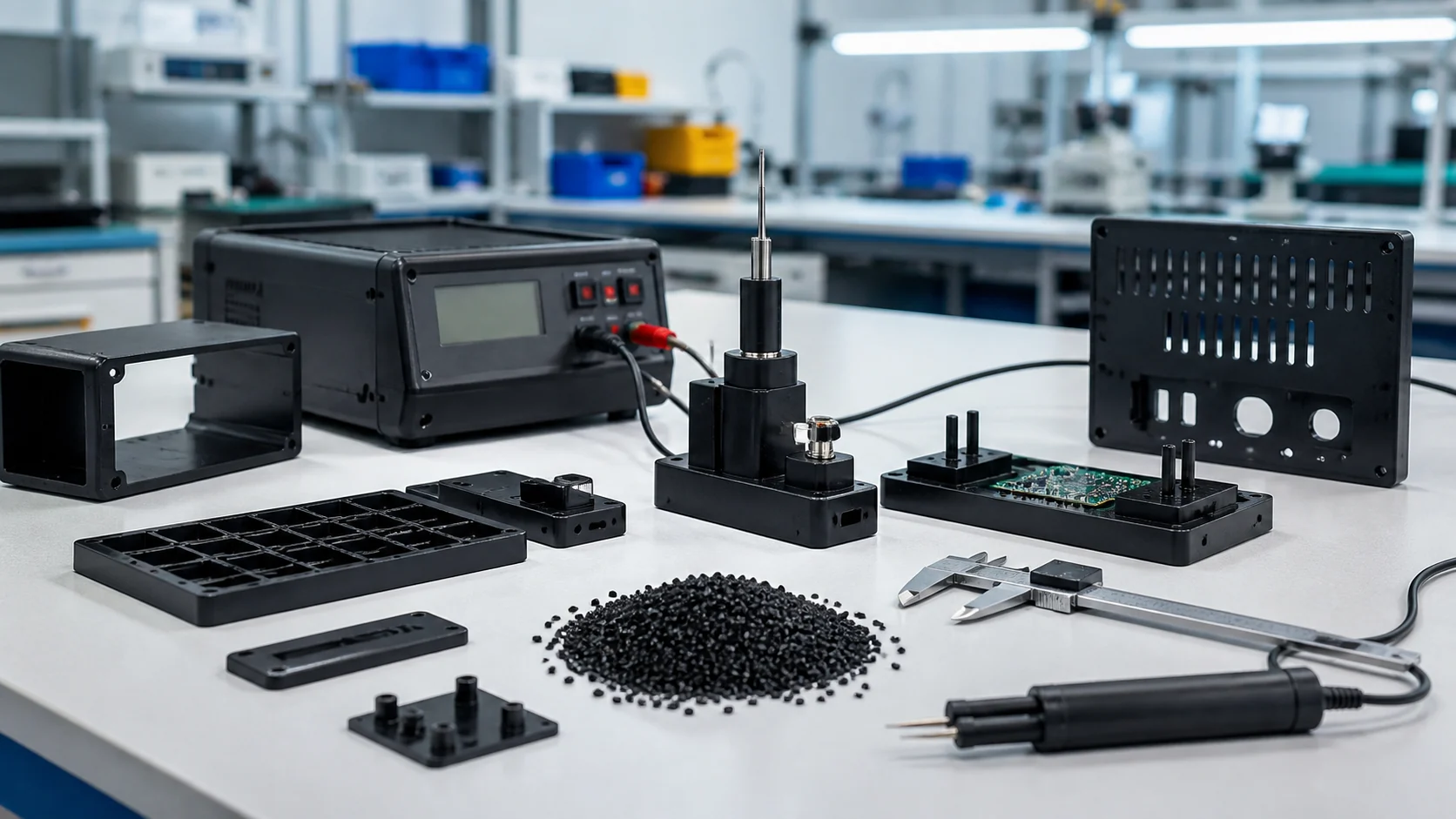
Conductive ABS helps equipment housings and assembly fixtures combine permanent ESD control with the toughness, dimensional stability and injection molding efficiency expected from ABS parts.
Buyer and engineer FAQ
Questions engineers often ask about this material route
Can conductive ABS be used for both equipment housings and assembly fixtures?
Yes. The same ABS base can be formulated for static-dissipative or conductive ranges, but the target resistance, wall thickness, impact requirement and surface finish should be confirmed on the molded part instead of only on pellets.
Which DEYU product is the closest match for this article?
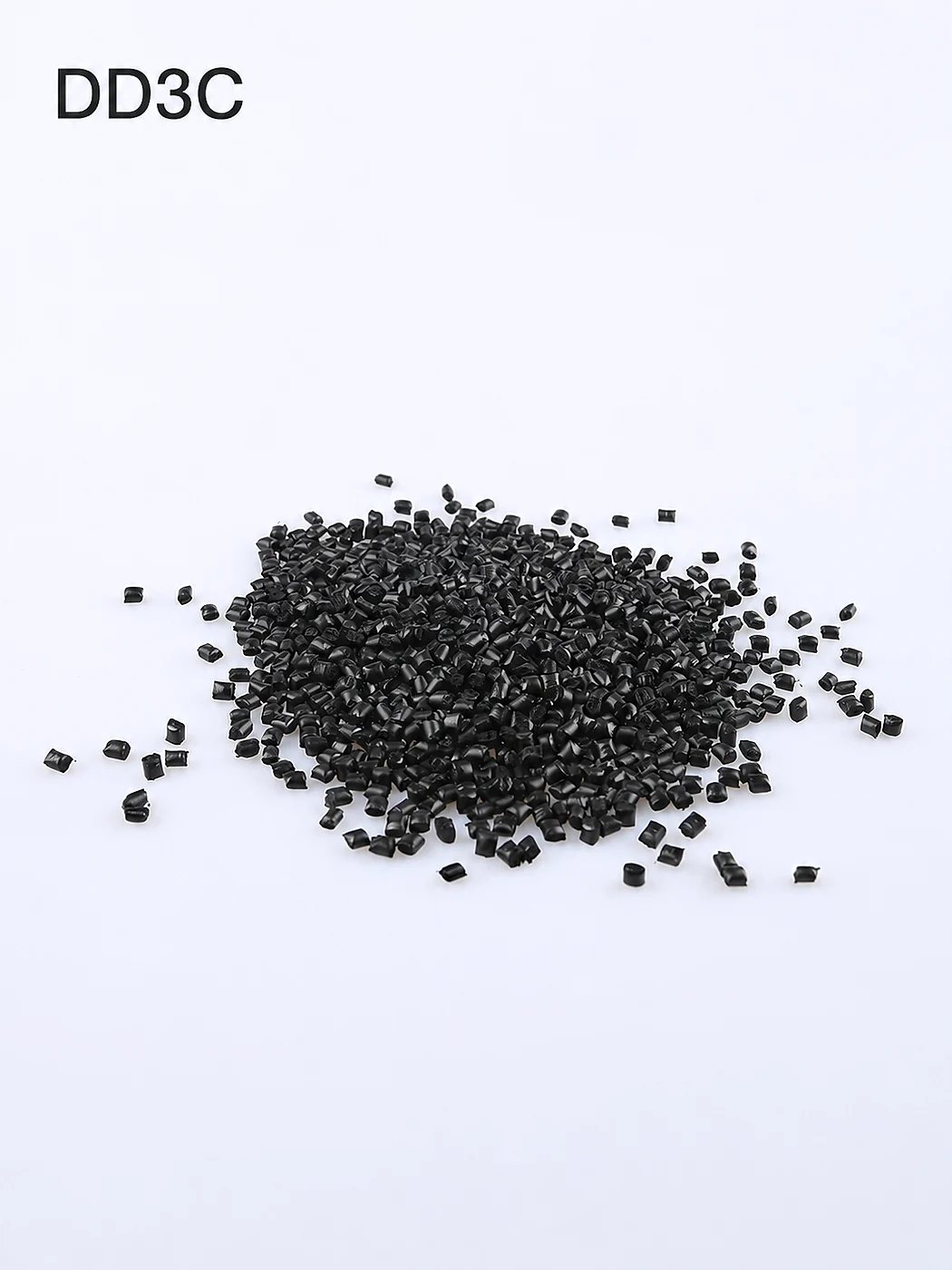
The closest standard reference is DGK-ABS DD3C graphite conductive ABS. If the project needs a different resistance range, higher toughness, flame retardancy or surface appearance, DEYU can adjust the formulation instead of creating a new product page.
What data should buyers check before mass production?
Check initial surface resistivity, within-part and part-to-part variation, resistance after cleaning cycles, drop or impact test results, warpage, shrinkage consistency and molding scrap rate.
Why does this article include molded-part validation rather than only pellet data?
Conductive fillers orient during flow. Gate position, ribs, bosses, wall thickness and processing settings can change the measured surface resistance, so final approval should be based on actual housings or fixtures.
Background: Why conductive ABS is used in housings and fixtures
Equipment housings and assembly fixtures are often expected to protect electronics, control electrostatic charge, keep tight assembly dimensions and remain easy to mold in production. Standard ABS is widely used for housings because it balances toughness, rigidity, surface finish and cost, but unmodified ABS is electrically insulating, with volume resistivity often around 10^15-10^16 ohm-cm.
When electronic test equipment, PCB assembly aids, component transfer trays or semiconductor handling fixtures operate in ESD-sensitive environments, the material must provide a controlled path for charge dissipation. Conductive ABS solves this by adding permanent conductive fillers while retaining the familiar processing window of ABS.
For projects in this category, DEYU first confirms whether the part needs a static-dissipative range of 10^6-10^9 ohm or a more conductive range below 10^6 ohm. Visible instrument housings often prioritize smooth surface and toughness, while assembly fixtures may prioritize dimensional stability and resistance uniformity.
Technical difficulty: resistance, appearance and toughness must move together
The main challenge is not simply making ABS black and conductive. A practical housing or fixture grade must hold resistance after molding, cleaning and handling while avoiding filler agglomerates, flow marks, cracking and warpage.
Carbon powder, carbon black, carbon fiber and hybrid systems can all reduce resistivity, but they affect appearance, impact strength and flow differently. Higher filler loading may reduce resistance, yet it can also increase brittleness or make the surface rough.
Conductive performance must also be measured on the final part. Conductive fillers orient along the melt flow, and gate position, wall thickness, ribs, bosses and weld lines can change the measured value. A pellet data sheet is useful for screening, but the housing or fixture itself must be tested before approval.
DEYU material direction
DEYU generally recommends carbon powder, carbon black or hybrid conductive systems for ABS housings and assembly fixtures. Carbon powder grades are often preferred when the part has visible surfaces or needs a smoother finish. Carbon black grades can be cost-effective for general ESD housings and trays. Hybrid systems are used when the project needs a tailored balance of resistance, toughness and flame retardancy.
For the closest standard internal reference, DEYU can start from DGK-ABS DD3C graphite conductive ABS pellets and then adjust the formulation if the housing needs a different resistance window, higher drop resistance, a specific UL94 direction or a more controlled molded surface.
The practical target is permanent conductivity, stable surface resistivity, consistent molded-part dimensions, acceptable machinability, impact strength, and compliance support such as RoHS, REACH or UL94 when required.
Reference product data
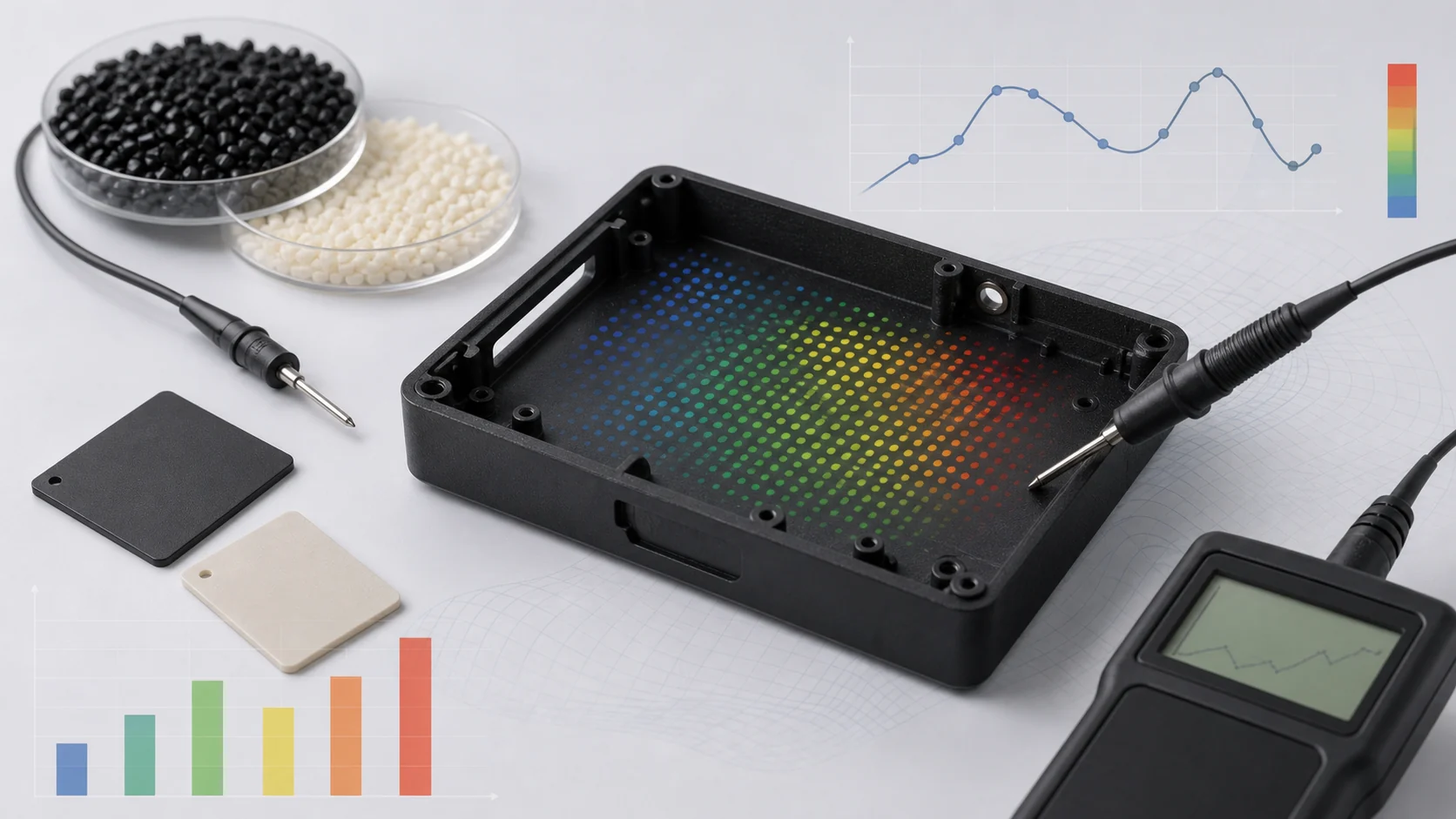
The following reference data keeps the original engineering logic of the source article. Final values must be verified with the actual part geometry, mold, gate location and conditioning method.
| Classification | Surface Resistivity | Typical Application |
|---|---|---|
| Conductive | < 10^6 ohm | EMI shielding, explosive environments, high-sensitivity grounding |
| Static Dissipative | 10^6-10^9 ohm | Standard ESD-safe housings, fixtures, enclosures |
| Anti-static | 10^9-10^12 ohm | Low-risk packaging, non-critical covers |
| Requirement | Why It Matters | Typical Specification |
|---|---|---|
| Impact resistance | Protects internal components; withstands handling | Izod notched impact >= 0.5 J/cm |
| Stiffness / flexural modulus | Maintains structural integrity under load | Flexural modulus >= 1600 MPa |
| Dimensional stability | Ensures proper fit and component alignment | Low warpage, consistent shrinkage |
| Tensile strength | Withstands assembly and service loads | Tensile strength >= 28 MPa |
| Heat deflection temperature | Survives operating and soldering temperatures | HDT >= 85 C (264 psi) |
| Filler System | Conductivity | Surface Quality | Recommended For |
|---|---|---|---|
| Carbon powder | Good (10^6-10^9 ohm) | Excellent (smooth finish) | Visible housings, precision fixtures |
| Carbon black | Good (10^4-10^6 ohm) | Good | General ESD housings, enclosures |
| Carbon fibers | High (10^3-10^5 ohm) | Moderate (surface texture) | High-conductivity, structural applications |
| Hybrid systems | Excellent (tailored) | Good | Demanding applications requiring specific resistivity |
| Property | Unit | Test Method | DEYU Conductive ABS (Carbon Powder) | DEYU Conductive ABS (Carbon Black) | DEYU Conductive ABS (Hybrid) |
|---|---|---|---|---|---|
| Filler system | System | Reference | Carbon powder | Carbon black | Carbon powder + CNT |
| Surface resistivity | ohm/sq | ASTM D257 | 10^6-10^9 | 10^4-10^6 | 10^5-10^7 |
| Volume resistivity | ohm-cm | ASTM D257 | 10^6-10^9 | 10^4-10^5 | 10^4-10^6 |
| Static decay (15% RH) | seconds | Mil-B-81705-B | < 0.1 | < 0.1 | < 0.1 |
| Density | g/cm3 | ASTM D792 | 1.03 | 1.05-1.10 | 1.04-1.08 |
| Tensile strength | MPa | ASTM D638 | 28 | 30-40 | 35-45 |
| Flexural strength | MPa | ASTM D790 | 50 | 55-70 | 60-75 |
| Flexural modulus | MPa | ASTM D790 | 1931 | 2000-2800 | 2200-3000 |
| Izod impact (notched) | J/cm | ASTM D256 | 0.53 | 0.4-0.6 | 0.5-0.7 |
| HDT (264 psi) | C | ASTM D648 | 85 | 80-90 | 85-95 |
| UL94 rating | Rating | UL94 | HB | HB / V-0 | V-0 |
| Typical applications | Application | Reference | Visible housings, precision fixtures | General ESD enclosures, trays | High-performance housings, ATEX components |
| Parameter | Recommendation |
|---|---|
| Drying temperature | 80-90 C |
| Drying time | 2-4 hours |
| Moisture content target | < 0.1% |
| Parameter | Recommended Range |
|---|---|
| Cylinder temperature | 210-240 C |
| Mold temperature | 40-60 C |
| Injection speed | Medium |
| Injection pressure | 60-100 MPa |
| Back pressure | Low-Medium |
| Screw speed | 40-60 rpm |
| Parameter | Original Material | DEYU Conductive ABS Grade |
|---|---|---|
| Filler system | Carbon black | Carbon powder + impact modifier |
| Target resistivity | 10^6-10^9 ohm | 10^6-10^8 ohm |
| Trial quantity (housings) | 100 | 100 |
| Target monthly production | 1,000 units | 1,000 units |
| Parameter | Original Material | DEYU Conductive ABS Grade |
|---|---|---|
| Electrical Performance | Category | Category |
| Surface resistivity (initial, avg) | 5x10^8 ohm | 3x10^7 ohm |
| Resistivity - part-to-part variation | ±2 orders | ±0.3 orders |
| Resistivity - within-part variation | ±1.5 orders | ±0.2 orders |
| Resistivity after 50 IPA cycles | 8x10^10 ohm | 5x10^7 ohm |
| Mechanical Performance | Category | Category |
| Izod impact strength (notched) | 0.35 J/cm | 0.55 J/cm |
| Drop test pass rate (1m) | 75% | 98% |
| Surface Quality | Category | Category |
| Filler agglomerates | Visible | None |
| Flow marks | Present | None |
| Surface gloss uniformity | Poor | Excellent |
| Dimensional Stability | Category | Category |
| Warpage (flatness deviation) | 0.25 mm | 0.08 mm |
| Shrinkage consistency | ±0.2% | ±0.08% |
| Processing | Category | Category |
| Molding scrap rate | 12% | 4% |
| Overall defect rate | 18% | 5% |
Processing guidelines
Conductive ABS can usually run on standard injection molding equipment. Drying, melt temperature, mold temperature and shear control remain important because moisture and excessive shear can hurt surface quality or cause unstable performance.
A practical trial should use several stabilization shots before formal testing. The first molded samples may not represent the final dispersion and thermal condition. DEYU normally recommends evaluating resistance after the process stabilizes, then checking appearance, impact and dimensional results together.
Customer debugging and validation scenario
A customer planned a benchtop electronic test equipment housing. The part required surface resistivity below 10^9 ohm under an ANSI/ESD S20.20 control concept, good drop resistance, dimensional stability and a clean visible surface.
The original conductive ABS showed unstable resistance from 10^7 to 10^10 ohm, visible filler agglomerates, flow marks, cracking after drop testing and excessive warpage. The root causes were poor filler dispersion, inadequate impact modification and a non-optimized molding window.
DEYU adjusted the conductive filler system and impact package, then used a 100-piece trial to compare the original material with a conductive ABS grade tuned for the housing.
Suitable applications
Typical applications include electronic test equipment housings, instrument enclosures, telecommunications hardware, control boxes, junction boxes, automotive electronics housings, PCB assembly fixtures, disk-drive fixtures, production-line jigs, sensor housings, robotics components, transfer trays, packaging components, static-dissipative organizers, brackets, mounts, prototypes and workshop tooling.
What buyers should provide before formulation confirmation
Useful inputs include the part drawing or 3D model, target electrical specification, ESD standard, mechanical requirement, surface-quality requirement, service temperature range, chemical exposure, dimensional tolerance, processing method, flame-retardancy target, production volume, regulatory requirement, current material and failure mode.
Conclusion
Conductive ABS is useful when a project needs structural ABS performance and permanent ESD control in the same molded part. The key is not only the pellet resistivity; the final decision should be based on molded housings or fixtures, including resistance uniformity, impact strength, surface quality, warpage and scrap rate.
In the validation scenario, the DEYU direction reduced part-to-part resistance variation to ±0.3 orders, within-part variation to ±0.2 orders, improved drop-test pass rate to 98%, reduced warpage and lowered overall defects from 18% to 5%.