
UV-beständiges PC/ABS für Leuchtengehäuse, Blenden und Exterieurleisten im Automobil
Automobilteile um Leuchten, Blenden, Parksensor-Abdeckungen und Heckleisten stehen jahrelang in direkter Sonne. Dieser Leitfaden überträgt UV-beständiges PC/ABS auf Automotive-Bauteile mit Stabilisatoraufbau, vollständigen Tabellen, Prozessfenstern und Alterungsdaten für Parkplatzbewitterung.
FAQ zu Automotive-UV-PC/ABS
UV-beständiges PC/ABS für Leuchtengehäuse, Blenden und Exterieurleisten im Automobil
Warum PC/ABS um Automobilleuchten statt nur ABS?
PC/ABS bietet höhere Schlagzähigkeit, Wärmeformbeständigkeit und Dimensionsstabilität und behält zugleich Verarbeitbarkeit und Oberfläche von ABS.
Gibt es eine exakte Produktseite DGK-PC/ABS UV?
Die Type DGK-PC/ABS UV ist nicht als eigene Produktseite veröffentlicht; deshalb verlinkt der Artikel auf das nächstliegende vorhandene Produkt DGK-PC/ABS T85.
Welche Validierung zählt bei Parkplatzbewitterung?
QUV, Feuchtwärme, Temperaturzyklen, Farbänderung, Glanzerhalt, Schlagzähigkeitserhalt und Dimensionsprüfung am Formteil.
Kann dieselbe PC/ABS-UV-Route für Front- und Heckleuchtenteile genutzt werden?
Sie kann für Gehäuse, Blenden, Halter und Abdeckungen geprüft werden, aber jedes Teil braucht Wanddicken-, Farb-, Brand-, Wärme- und Montagevalidierung.
Automotive-Exterieurteile verändern die UV-Frage
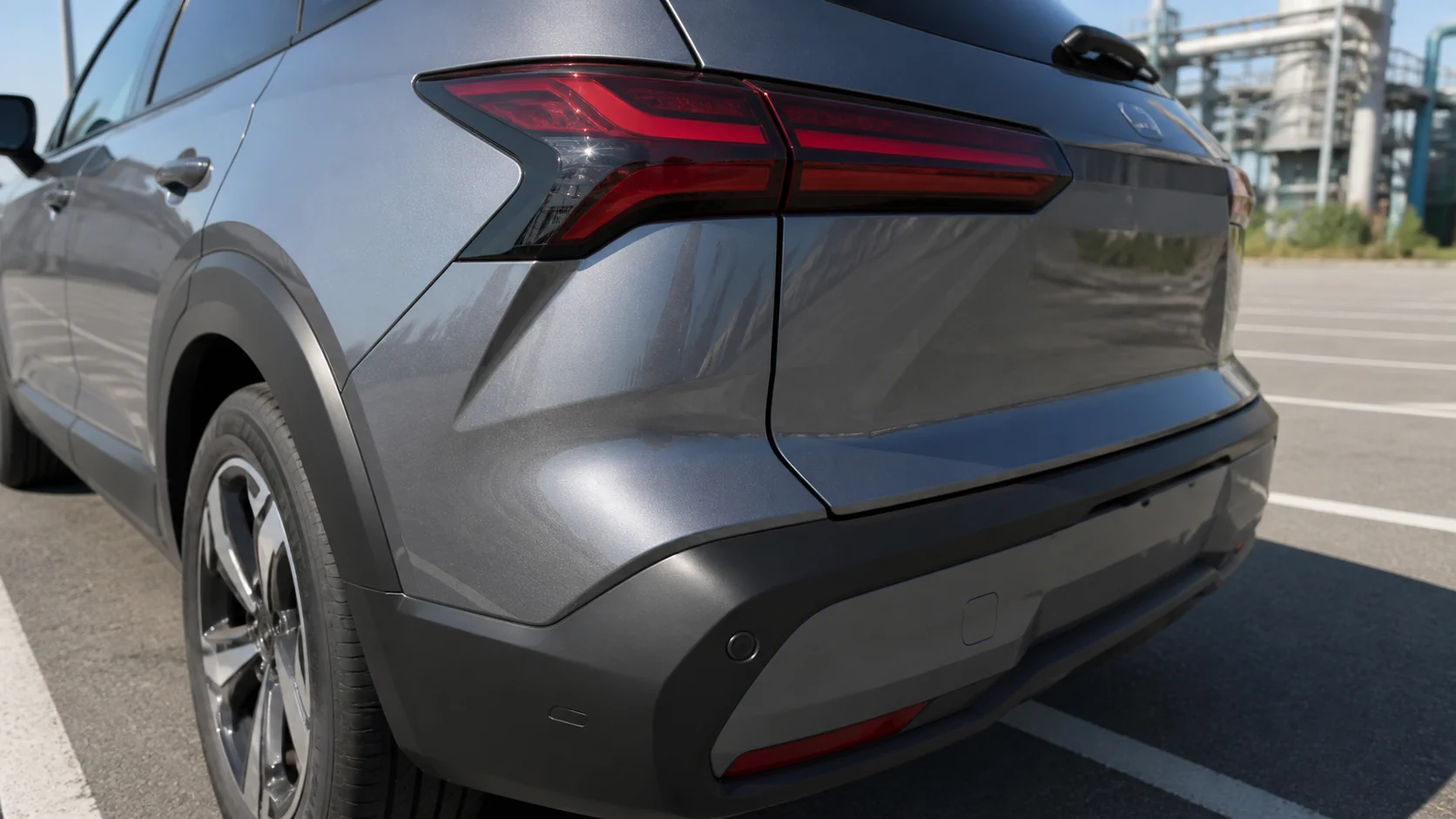
Die Ausgangsunterlage beschreibt UV-beständiges PC/ABS für Außenabdeckungen und Paneele. In dieser neuen Lösung wird dieselbe Materiallogik auf Automotive-Exterieurteile übertragen: Rückleuchtengehäuse, Leuchtenblenden, Heckleisten, Parksensor-Abdeckungen und kleine Außenhalter in offenen Parkbereichen.
Das sind keine Prüfstandteile. Es sind Spritzgussteile rund um Leuchten, Stoßfänger und Außenpaneele, bei denen Sonne, Wärmestau, Feuchte, Waschchemikalien, Vibration und lokale Montagespannung zusammenwirken.
Warum PC/ABS im Leuchtenumfeld eingesetzt wird
Polycarbonat liefert Schlagzähigkeit, Wärmeformbeständigkeit und Dimensionsstabilität. ABS liefert Verarbeitbarkeit, Oberfläche und Kostenausgleich. PC/ABS verbindet diese Stärken für Exterieur-Spritzgussteile, die mehr Zähigkeit und Wärmebeständigkeit brauchen als ABS allein.
Die Schwierigkeit liegt in den PC- und ABS-Phasen. UV-Strahlung, Feuchte und thermische Oxidation greifen den Blend über verschiedene Mechanismen an. DEYU bewertet das Stabilisierungssystem deshalb als komplette Architektur, nicht als Einzeladditiv.
Alterungsmechanismen bei Parkplatzbewitterung
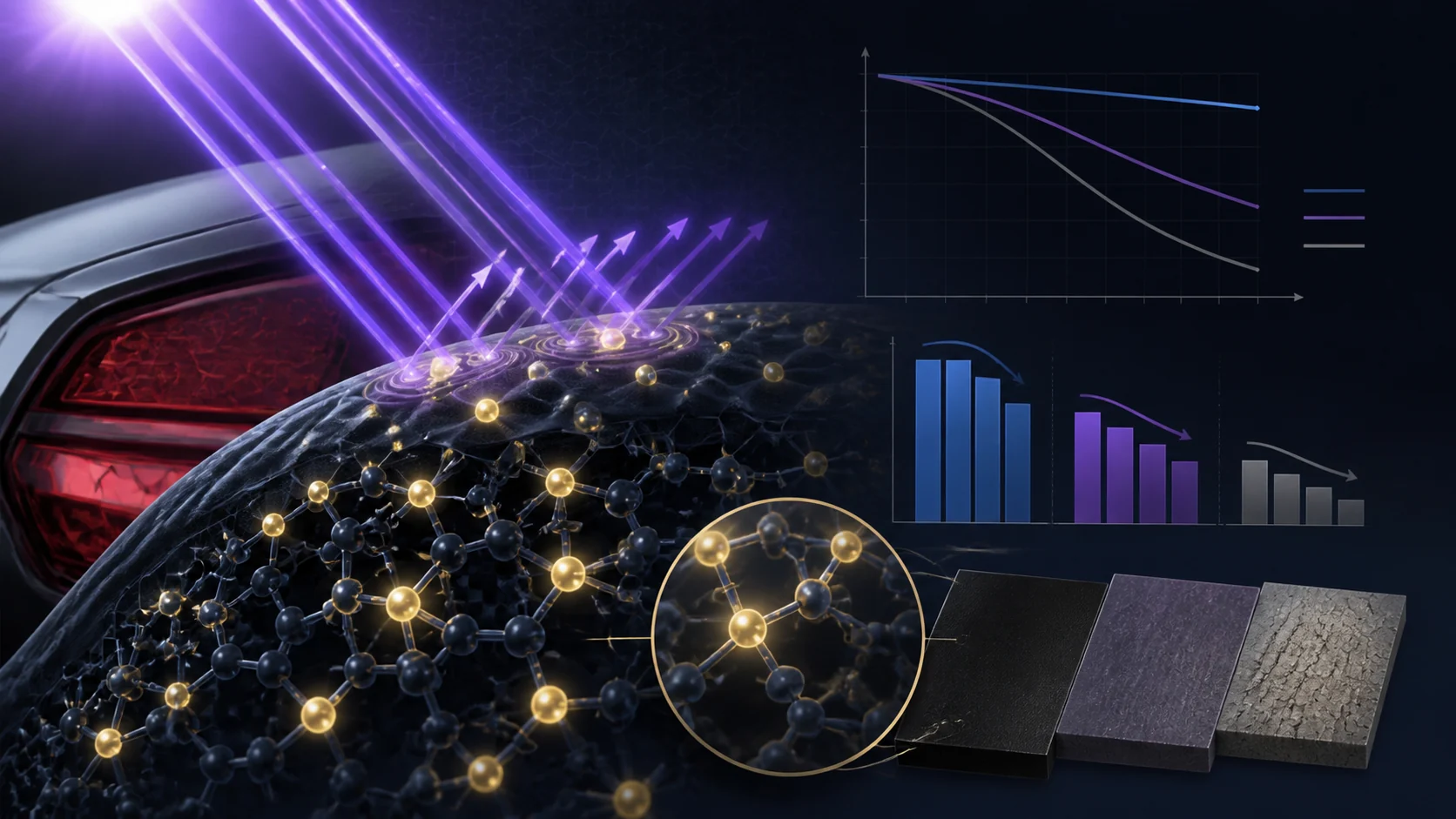
UV-Photooxidation kann Molekülketten spalten und Vergilbung oder Kreidung verursachen. Hydrolyse reduziert die PC-Molekülmasse in feuchten Klimazonen. Thermische Oxidation wird durch Wärmestau an Leuchten, dunklen Exterieurleisten und sonnigen Parkplätzen beschleunigt.
DEYU-Materialrichtung und nächstliegender vorhandener Produktlink
Als öffentliche Produktreferenz ist die nächstliegende vorhandene DEYU-PC/ABS-Seite DGK-PC/ABS T85. Die Type DGK-PC/ABS UV wird als projektspezifische UV-stabilisierte Route auf Basis der PC/ABS-Technologie behandelt, nicht als neu angelegte Produktseite.
Eine typische Automotive-PC/ABS-UV-Route nutzt Hydroxyphenyl-Triazin-UVA, PC-kompatibles HALS, primäre und sekundäre Antioxidantien sowie Hydrolysestabilisierung bei hoher Feuchte. Zielwerte sind ΔE <3,0 nach 2000 h QUV, Schlagzähigkeitserhalt >80% und Glanzerhalt >70%.
Vollständige technische Tabellendaten aus dem Materialbrief
| Stabilizer Type | Function | PC/ABS Compatibility Issue |
|---|---|---|
| UV Absorbers | Photon interception | Must be selected for effectiveness in both phases |
| HALS | Radical scavenging | Some HALS accelerate PC hydrolysis; selection is critical |
| Antioxidants | Thermal protection | Primary + secondary antioxidants required |
| Hydrolysis Stabilizers | Moisture protection | Essential for PC-containing blends in humid climates |
| Property | Pure PC | Pure ABS | PC/ABS Alloy |
|---|---|---|---|
| Impact Resistance | Excellent | Good | Excellent |
| Heat Deflection Temperature | 125–135°C | 80–98°C | 110–120°C |
| UV Resistance | Moderate (needs stabilization) | Poor | Good (with stabilization) |
| Hydrolysis Resistance | Moderate | Good | Moderate (with stabilization) |
| Processability | Moderate | Excellent | Excellent |
| Surface Finish | Excellent | Excellent | Excellent |
| Dimensional Stability | Excellent | Good | Excellent |
| Cost | Higher | Lower | Moderate |
| Property | Typical Value | Test Method |
|---|---|---|
| Density | 1.12–1.15 g/cm³ | ISO 1183 |
| Melt Flow Rate (260°C/5kg) | 15–30 g/10min | ISO 1133 |
| Tensile Strength | 50–60 MPa | ISO 527 |
| Flexural Modulus | 2000–2300 MPa | ISO 178 |
| Notched Impact (23°C) | 40–55 kJ/m² | ISO 180 |
| Heat Deflection Temperature (1.8MPa) | 110–120°C | ISO 75 |
| UV Resistance (ΔE after 2000h QUV) | <3.0 | ASTM G154 |
| Flame Rating | V-0 or HB (depending on grade) | UL94 |
| Gloss (60°) | 80–90 | ASTM D523 |
| Component | Typical Loading | Function | Selection Rationale |
|---|---|---|---|
| UV Absorber (Hydroxyphenyl Triazine) | 0.3–0.5% | Photon interception | Best results for reducing degradation and yellowing |
| PC-Compatible HALS (Tertiary Amine or Oligomeric) | 0.2–0.4% | Radical scavenging | Does not accelerate PC hydrolysis |
| Primary Antioxidant | 0.1–0.2% | Thermal stability | Processing and long-term protection |
| Secondary Antioxidant | 0.05–0.1% | Hydroperoxide decomposition | Synergistic with primary AO |
| Carbodiimide Hydrolysis Stabilizer | 0.2–0.5% | Hydrolysis protection | Essential for PC-containing blends in humid climates |
| Property | Standard PC/ABS | UV-Stabilized PC/ABS | Premium UV PC/ABS |
|---|---|---|---|
| Base Resin | PC + ABS | PC + ABS | PC + ABS |
| UV Stabilization | None or minimal | UVA + PC-compatible HALS | HPT UVA + oligomeric HALS + hydrolysis |
| Density (g/cm³) | 1.12–1.15 | 1.12–1.15 | 1.12–1.15 |
| MFR (260°C/5kg) | 20–30 g/10min | 15–30 g/10min | 15–25 g/10min |
| Tensile Strength (MPa) | 50–60 | 50–60 | 50–60 |
| Flexural Modulus (MPa) | 2000–2300 | 2000–2300 | 2000–2300 |
| Notched Impact (kJ/m²) | 40–55 | 40–55 | 40–55 |
| HDT (°C, 1.8MPa) | 110–120 | 110–120 | 110–120 |
| ΔE after 2000h QUV | >5.0 | <3.0 | <2.0 |
| Impact Retention after UV | <50% | >80% | >85% |
| Gloss Retention after UV | <50% | >70% | >80% |
| Hydrolysis Resistance | Poor | Moderate | Good |
| Service Life (Automotive exterior) | <1 year | 5–7 years | 7–10 years |
| Flame Rating | HB or V-0 | HB or V-0 | V-0 |
| Relative Cost | 1.0x | 1.15–1.25x | 1.30–1.40x |
| UVA Type | ΔE (2000h QUV) | Yellowing Index | Relative Cost |
|---|---|---|---|
| None | >8.0 | High | Lowest |
| Benzotriazole | 3.0–4.0 | Moderate | Moderate |
| Cyanoacrylate | 3.5–4.5 | Moderate | Moderate |
| Hydroxyphenyl Triazine | 1.5–2.5 | Low | Higher |
| Parameter | Typical Range | Notes |
|---|---|---|
| Drying Temperature | 100–110°C | 2–4 hours |
| Drying Time | 2–4 hours | Moisture content <0.02% |
| Melt Temperature | 240–270°C | Depends on PC/ABS ratio |
| Mold Temperature | 60–100°C | Higher for gloss, lower for cycle time |
| Injection Pressure | 80–120 MPa | As required for part geometry |
| Screw Speed | 50–100 rpm | Moderate to avoid shear degradation |
| Residence Time | <8 minutes | Minimize to preserve stabilizers |
Automotive-Fall: Rückleuchtenblende und Parksensor-Abdeckung
Ein Kunde für Exterieurteile einer Heckbaugruppe meldete Vergilbung, Glanzverlust und lokale Risse an Clips nach Feldeinsatz. Die Teile saßen an Rückleuchte und Heckstoßfänger, daher musste die Validierung Parkplatz-UV, Wärme, Feuchte und Montagespannung abbilden.
DEYU behandelte dies als Formulierungs- und Validierungsproblem. Das Ausgangspaket stützte sich auf einen einfachen Benzotriazol-UVA und hatte zu wenig Radikalfänger-, Hydrolyse- und Antioxidantien-Schutz. Die korrigierte Route nutzte HPT-UVA, PC-kompatibles HALS, Carbodiimidstabilisator und ein vollständiges Antioxidantienpaket.
| Observation | Root Cause |
|---|---|
| Yellowing | Single benzotriazole UVA was insufficient; no HALS for radical scavenging |
| Impact loss | Chain scission from UV and hydrolysis; no hydrolysis protection |
| Surface degradation | Photo-oxidation eroded the surface layer |
| Cracking | Molecular weight reduction from UV + hydrolysis; no antioxidant protection |
| Warpage | Dimensional change from hydrolysis and thermal cycling |
| Issue | Corrective Action |
|---|---|
| Insufficient UV protection | Switch to hydroxyphenyl triazine UVA (0.4%) |
| No HALS protection | Add PC-compatible HALS (tertiary amine, 0.3%) |
| No hydrolysis protection | Add carbodiimide hydrolysis stabilizer (0.3%) |
| No antioxidant protection | Add primary antioxidant (0.15%) + secondary antioxidant (0.08%) |
| Validation gap | Add combined UV + thermal aging + damp heat testing to qualification |
| Metric | Original Formulation | Corrected Formulation | Acceptance |
|---|---|---|---|
| ΔE after 2000h QUV | 4.8 | 1.8 | <3.0 |
| ΔE field, 18 months | 5.2 | 1.5 | <3.0 |
| Impact Retention (2000h QUV) | 42% | 88% | >80% |
| Impact Retention (field, 18 months) | 38% | 85% | >80% |
| Gloss Retention (field, 18 months) | 45% | 82% | >70% |
| Hydrolysis Resistance (85°C/85% RH/1000h) | Poor | Pass | Pass |
| Surface Cracking | Present | None | None |
| Dimensional Change | >1.5% | <0.5% | <0.5% |
| Field Pass Rate (24 months) | 72% | 99% | >97% |
Validierungsdaten und Auswahlcheckliste
Die korrigierte Formulierung senkte die QUV-Farbänderung von 4,8 auf 1,8, erhöhte den Schlagzähigkeitserhalt von 42% auf 88%, beseitigte sichtbare Risse und verbesserte die Feldfreigabe nach 24 Monaten auf 99%.
| Parameter | Test Method | Typical Acceptance | UV-Resistant PC/ABS Performance |
|---|---|---|---|
| Color Change (ΔE) after 2000h QUV | ASTM G154 | <3.0 | <3.0 |
| Impact Retention after 2000h QUV | ISO 180 | >80% | >80% |
| Tensile Retention after 2000h QUV | ISO 527 | >85% | >85% |
| Gloss Retention after 2000h QUV | ASTM D523 | >70% | >70% |
| Hydrolysis Resistance (85°C/85% RH/1000h) | IEC 60068-2-78 | No cracking | Pass |
| Surface Cracking | Visual (10x) | None | None |
| Dimensional Stability | After conditioning | <0.5% | <0.5% |
| Flame Rating | UL94 | As specified | V-0 or HB |
| Processing Stability (MFR change) | ISO 1133 | <15% | <15% |
| Application Requirement | Recommended Grade |
|---|---|
| Automotive lamp bezels and exterior covers | UV-stabilized PC/ABS with HPT UVA + PC-compatible HALS |
| Automotive lamp housings with flame requirement | V-0 UV-resistant PC/ABS |
| High-impact bumper-adjacent exterior trim | UV-resistant PC/ABS with impact modification |
| Humid-climate exterior automotive parts | UV-resistant PC/ABS + hydrolysis stabilizer |
| Cost-sensitive exterior trim | UV-stabilized PC/ABS with optimized package |
| Factor | Check |
|---|---|
| UVA type | Hydroxyphenyl triazine preferred over benzotriazole |
| HALS type | PC-compatible (tertiary amine or oligomeric) only |
| Hydrolysis stabilizer | Essential for humid climates |
| Antioxidants | Primary + secondary required |
| Processing | Melt temperature ≤270°C; moisture <0.02% |
| Validation | UV + thermal aging + damp heat combined |
| Application | Recommended Grade | Key Requirement |
|---|---|---|
| Automotive taillight housings | UV PC/ABS + hydrolysis | UV resistance, impact, dimensional stability |
| Parking-sensor covers | UV PC/ABS | UV resistance, weathering, appearance |
| Sun-exposed exterior brackets | UV PC/ABS | UV resistance, thermal cycling |
| Exterior electronic module covers | UV PC/ABS | UV resistance, impact, flame retardancy |
| Rear bumper lamp-adjacent covers | UV PC/ABS | UV resistance, moisture resistance |
| Lamp bezels and decorative covers | UV PC/ABS | UV resistance, appearance, gloss retention |
| EV exterior charging-port covers | UV PC/ABS | UV resistance, impact, weathering |
| Automotive exterior control-module covers | UV PC/ABS | UV resistance, dimensional stability |
| Exposure Severity | Recommended PC/ABS Approach |
|---|---|
| Mild (temperate, partial shade) | Standard UV-stabilized PC/ABS |
| Moderate (full sun, regular cycling) | HPT UVA + PC-compatible HALS |
| Severe (subtropical, high UV + humidity) | HPT UVA + HALS + hydrolysis stabilizer |
| Extreme (tropical, high UV + heat + humidity) | Premium package with full stabilizers |
| Processing Parameter | Recommended Value | Why It Matters |
|---|---|---|
| Drying | 100–110°C, 2–4 hours, <0.02% moisture | Moisture hydrolyzes PC and degrades stabilizers |
| Melt Temperature | 240–270°C (lower is better) | Higher temperatures degrade stabilizers |
| Residence Time | <8 minutes | Prolonged heat exposure degrades stabilizers |
| Screw Speed | 50–100 rpm | High speeds generate shear heat |
| Regrind | ≤20% or avoid for critical parts | Regrind has degraded stabilizer content |
| Factor | Recommendation |
|---|---|
| UV Absorber | Hydroxyphenyl triazine type provides best protection |
| HALS | PC-compatible only (tertiary amine or oligomeric) |
| Hydrolysis Stabilizer | Essential for humid climates |
| Antioxidants | Primary + secondary required |
| UV resistance target | 5–10 years for most automotive exterior applications |
| Impact retention | >80% after 2000h QUV |
| Color stability | ΔE <3.0 after 2000h QUV |
Verarbeitungshinweise für Automotive-Spritzgussteile
UV-beständiges PC/ABS sollte bei 100-110°C für 2-4 Stunden getrocknet werden, um Feuchte <0,02% zu halten. Die Schmelzetemperatur liegt meist bei 240-270°C, Verweilzeit <8 Minuten und moderate Schneckendrehzahl. Rezyklat sollte bei kritischen Exterieurteilen begrenzt werden.
Fazit
UV-beständiges PC/ABS kann eine sinnvolle Materialroute für Leuchtengehäuse, Blenden, Parksensor-Abdeckungen und Exterieurleisten sein, wenn das Stabilisierungssystem PC- und ABS-Phase abdeckt und kombinierte Alterung bestätigt wird.
Für Automotive-Exterieurteile empfiehlt DEYU, UV-Alterung, Feuchtwärme, Temperaturzyklen, Farbänderung, Glanz, Schlagzähigkeit, falls nötig Flammschutz und Dimensionsstabilität am Formteil zu bestätigen.