
UV-Resistant PC/ABS for Automotive Lamp Housings, Bezels and Exterior Trim
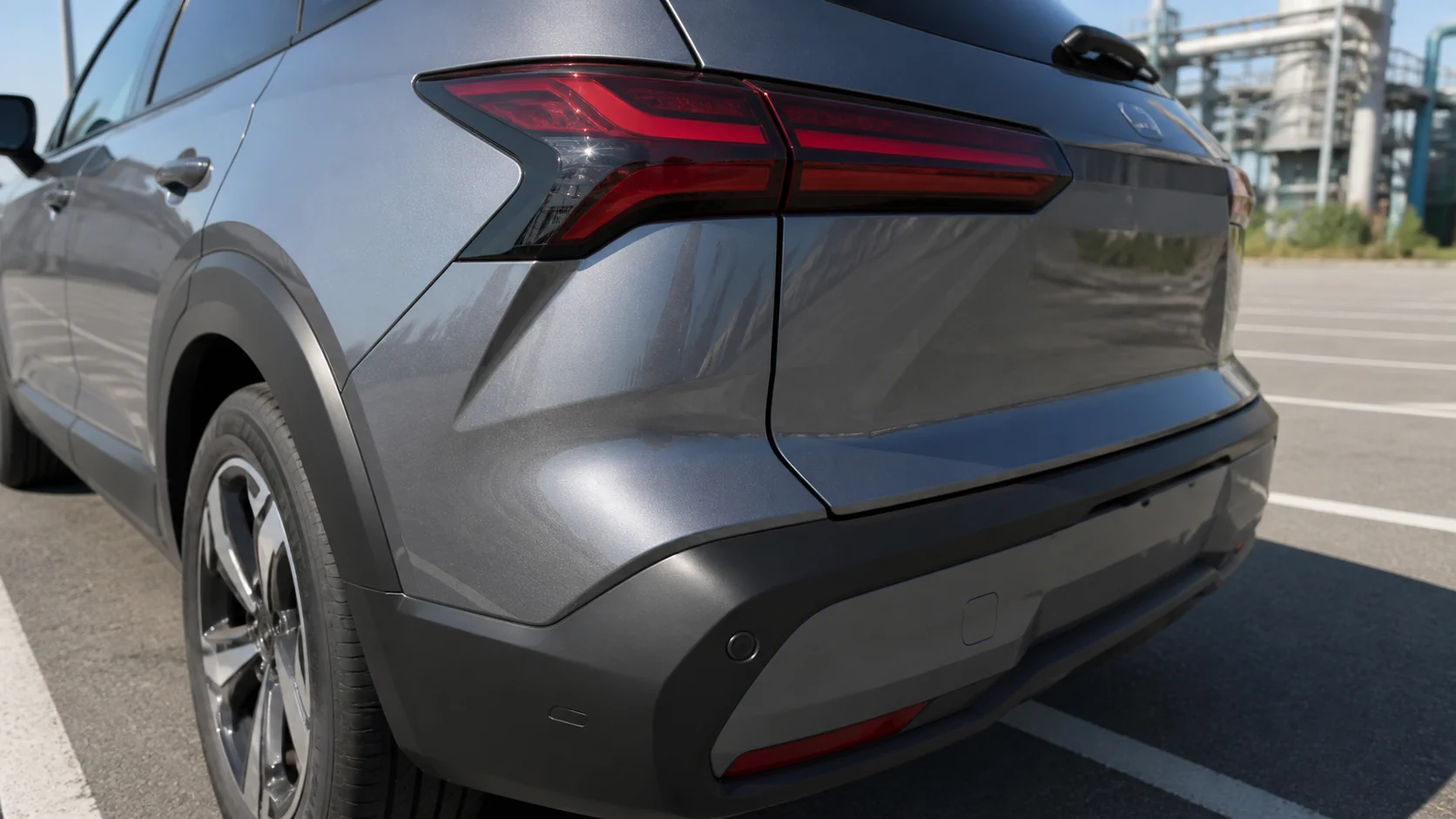
Automotive exterior plastics around taillights, lamp bezels, parking-sensor covers and rear trim stay in direct sun for years. This guide adapts UV-resistant PC/ABS alloy selection to car-part validation, with stabilizer architecture, full property tables, processing windows and field-aging data for parking-lot exposure.
Automotive UV PC/ABS FAQ
UV-Resistant PC/ABS for Automotive Lamp Housings, Bezels and Exterior Trim
Why use PC/ABS around automotive lamps instead of ABS alone?
PC/ABS gives better impact resistance, heat deflection temperature and dimensional stability while retaining the processing and surface finish advantages of ABS. For lamp-adjacent trim, that balance is usually more important than low cost alone.
Is there an exact DGK-PC/ABS UV product page?
The exact DGK-PC/ABS UV article grade is not listed as a public product page, so this article links to the closest existing PC/ABS alloy product, DGK-PC/ABS T85, and treats the UV version as a project-specific formulation route.
What validation matters most for parking-lot exposure?
Use combined QUV aging, damp heat, thermal cycling, color change, gloss retention, impact retention and part-level dimensional checks. Parking-lot parts see sunlight, heat, humidity and intermittent mechanical load together.
Can the same PC/ABS UV route be used for headlamp and taillight parts?
It can be screened for lamp housings, bezels, brackets and covers, but each part still needs wall-thickness, color, flame rating, heat and assembly validation before mass production.
Automotive exterior parts change the UV-resistance question
The source material describes UV-resistant PC/ABS for outdoor covers and panels. For this new solution, the same material logic is applied to automotive exterior parts: taillight housings, lamp bezels, rear trim, parking-sensor covers and small exterior brackets that stay in open parking areas.
These parts are not test-bench parts. They are molded parts assembled around lamps, bumpers and exterior panels, where sunlight, heat soak, humidity, washing chemicals, vibration and local assembly stress act together. The material must protect appearance and impact strength at the same time.
Why PC/ABS is used for lamp-adjacent exterior components
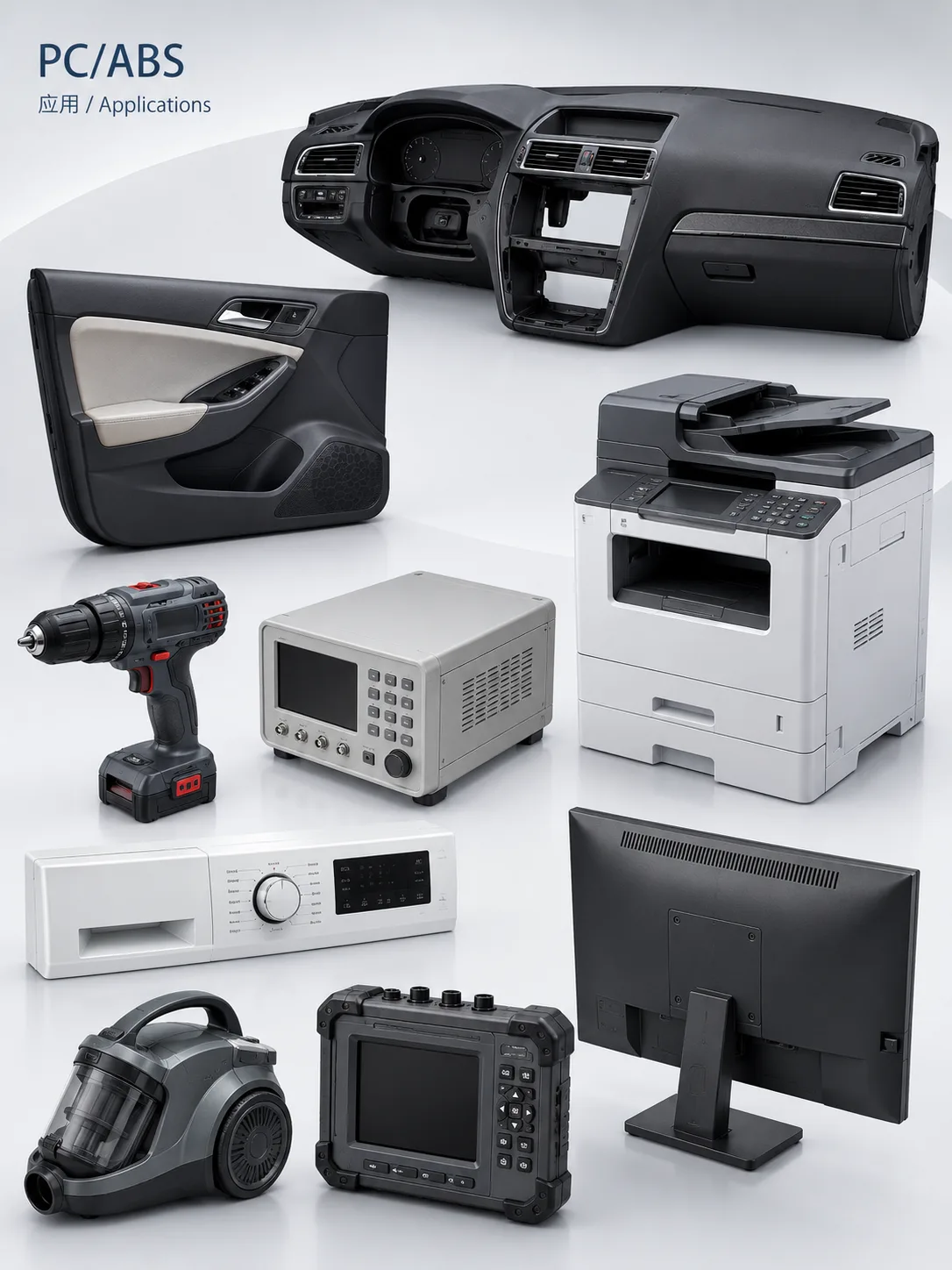
Polycarbonate gives impact strength, heat resistance and dimensional stability. ABS gives processability, surface finish and cost balance. PC/ABS alloy combines these strengths, making it a strong candidate for molded automotive exterior parts that need better toughness and heat resistance than ABS alone.
The challenge is that PC/ABS contains both PC and ABS phases. UV radiation, moisture and thermal oxidation can attack the blend through different mechanisms. A UV package that works in one phase may not be enough for the full alloy, especially when the part must keep color, gloss and impact after outdoor exposure.
Degradation mechanisms in automotive parking-lot exposure
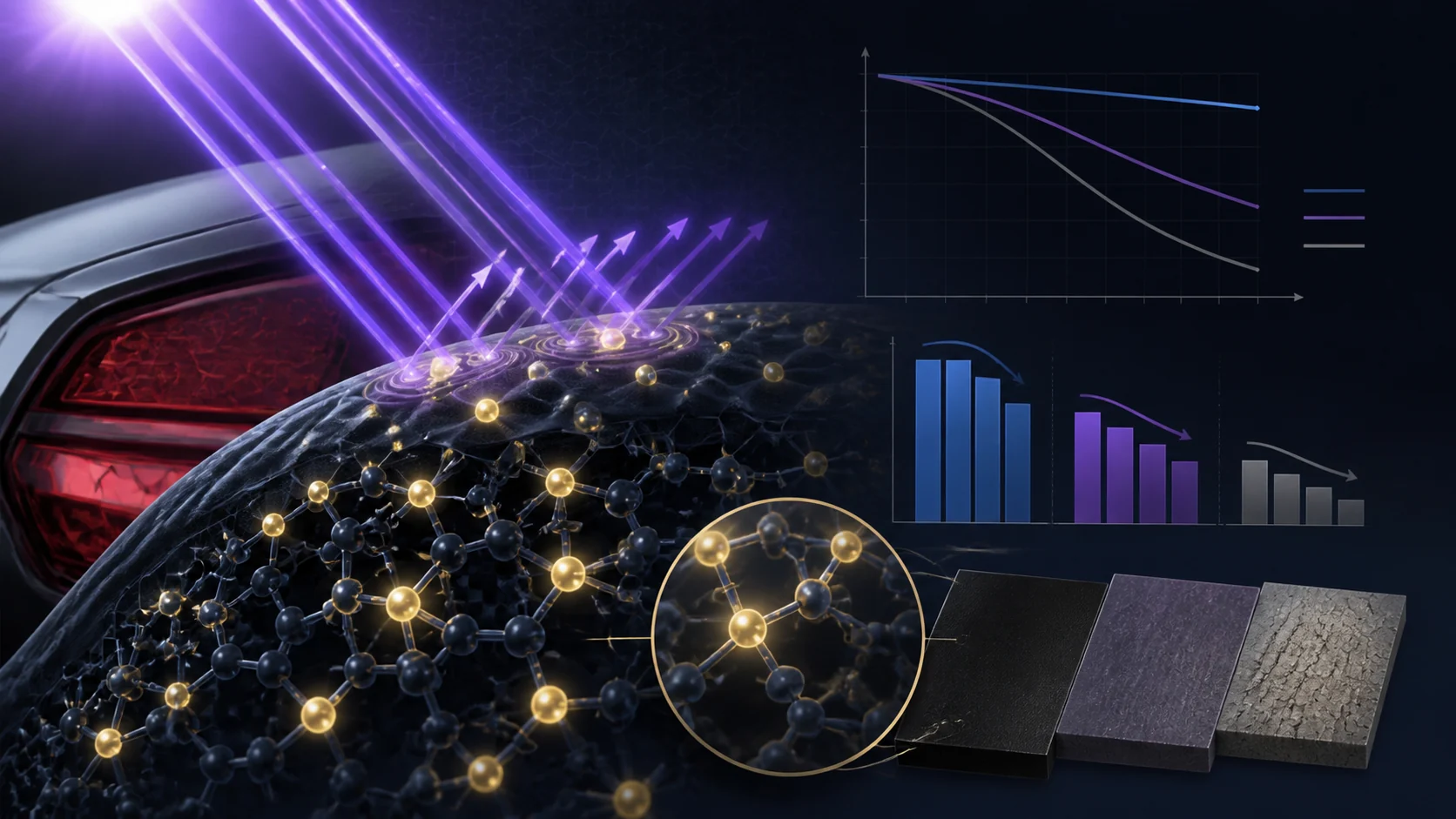
UV photo-oxidation can break molecular chains and drive yellowing or surface chalking. Hydrolysis can reduce PC molecular weight in humid climates. Thermal oxidation is accelerated by heat soak near lamps, dark exterior trim and sunlit parking areas. Because these mechanisms interact, DEYU evaluates the stabilizer system as a complete architecture, not as a single additive.
DEYU material direction and closest existing product link
For a public product reference, the closest existing DEYU PC/ABS alloy page is DGK-PC/ABS T85 PC/ABS Alloy. The article grade DGK-PC/ABS UV is treated as a UV-stabilized project route based on PC/ABS alloy technology, not as a newly created product page.
A typical automotive PC/ABS UV route uses hydroxyphenyl triazine UV absorber, PC-compatible HALS, primary and secondary antioxidants, and hydrolysis stabilization where humidity is severe. The goal is to keep ΔE below 3.0 after 2000 h QUV, impact retention above 80%, and gloss retention above 70%.
Full technical table data from the material brief
| Stabilizer Type | Function | PC/ABS Compatibility Issue |
|---|---|---|
| UV Absorbers | Photon interception | Must be selected for effectiveness in both phases |
| HALS | Radical scavenging | Some HALS accelerate PC hydrolysis; selection is critical |
| Antioxidants | Thermal protection | Primary + secondary antioxidants required |
| Hydrolysis Stabilizers | Moisture protection | Essential for PC-containing blends in humid climates |
| Property | Pure PC | Pure ABS | PC/ABS Alloy |
|---|---|---|---|
| Impact Resistance | Excellent | Good | Excellent |
| Heat Deflection Temperature | 125–135°C | 80–98°C | 110–120°C |
| UV Resistance | Moderate (needs stabilization) | Poor | Good (with stabilization) |
| Hydrolysis Resistance | Moderate | Good | Moderate (with stabilization) |
| Processability | Moderate | Excellent | Excellent |
| Surface Finish | Excellent | Excellent | Excellent |
| Dimensional Stability | Excellent | Good | Excellent |
| Cost | Higher | Lower | Moderate |
| Property | Typical Value | Test Method |
|---|---|---|
| Density | 1.12–1.15 g/cm³ | ISO 1183 |
| Melt Flow Rate (260°C/5kg) | 15–30 g/10min | ISO 1133 |
| Tensile Strength | 50–60 MPa | ISO 527 |
| Flexural Modulus | 2000–2300 MPa | ISO 178 |
| Notched Impact (23°C) | 40–55 kJ/m² | ISO 180 |
| Heat Deflection Temperature (1.8MPa) | 110–120°C | ISO 75 |
| UV Resistance (ΔE after 2000h QUV) | <3.0 | ASTM G154 |
| Flame Rating | V-0 or HB (depending on grade) | UL94 |
| Gloss (60°) | 80–90 | ASTM D523 |
| Component | Typical Loading | Function | Selection Rationale |
|---|---|---|---|
| UV Absorber (Hydroxyphenyl Triazine) | 0.3–0.5% | Photon interception | Best results for reducing degradation and yellowing |
| PC-Compatible HALS (Tertiary Amine or Oligomeric) | 0.2–0.4% | Radical scavenging | Does not accelerate PC hydrolysis |
| Primary Antioxidant | 0.1–0.2% | Thermal stability | Processing and long-term protection |
| Secondary Antioxidant | 0.05–0.1% | Hydroperoxide decomposition | Synergistic with primary AO |
| Carbodiimide Hydrolysis Stabilizer | 0.2–0.5% | Hydrolysis protection | Essential for PC-containing blends in humid climates |
| Property | Standard PC/ABS | UV-Stabilized PC/ABS | Premium UV PC/ABS |
|---|---|---|---|
| Base Resin | PC + ABS | PC + ABS | PC + ABS |
| UV Stabilization | None or minimal | UVA + PC-compatible HALS | HPT UVA + oligomeric HALS + hydrolysis |
| Density (g/cm³) | 1.12–1.15 | 1.12–1.15 | 1.12–1.15 |
| MFR (260°C/5kg) | 20–30 g/10min | 15–30 g/10min | 15–25 g/10min |
| Tensile Strength (MPa) | 50–60 | 50–60 | 50–60 |
| Flexural Modulus (MPa) | 2000–2300 | 2000–2300 | 2000–2300 |
| Notched Impact (kJ/m²) | 40–55 | 40–55 | 40–55 |
| HDT (°C, 1.8MPa) | 110–120 | 110–120 | 110–120 |
| ΔE after 2000h QUV | >5.0 | <3.0 | <2.0 |
| Impact Retention after UV | <50% | >80% | >85% |
| Gloss Retention after UV | <50% | >70% | >80% |
| Hydrolysis Resistance | Poor | Moderate | Good |
| Service Life (Automotive exterior) | <1 year | 5–7 years | 7–10 years |
| Flame Rating | HB or V-0 | HB or V-0 | V-0 |
| Relative Cost | 1.0x | 1.15–1.25x | 1.30–1.40x |
| UVA Type | ΔE (2000h QUV) | Yellowing Index | Relative Cost |
|---|---|---|---|
| None | >8.0 | High | Lowest |
| Benzotriazole | 3.0–4.0 | Moderate | Moderate |
| Cyanoacrylate | 3.5–4.5 | Moderate | Moderate |
| Hydroxyphenyl Triazine | 1.5–2.5 | Low | Higher |
| Parameter | Typical Range | Notes |
|---|---|---|
| Drying Temperature | 100–110°C | 2–4 hours |
| Drying Time | 2–4 hours | Moisture content <0.02% |
| Melt Temperature | 240–270°C | Depends on PC/ABS ratio |
| Mold Temperature | 60–100°C | Higher for gloss, lower for cycle time |
| Injection Pressure | 80–120 MPa | As required for part geometry |
| Screw Speed | 50–100 rpm | Moderate to avoid shear degradation |
| Residence Time | <8 minutes | Minimize to preserve stabilizers |
Automotive case: taillight bezel and rear parking-sensor cover
A customer making exterior molded parts for a vehicle rear assembly reported yellowing, gloss loss and local cracking around clips after field exposure. The parts were installed around the taillight and rear bumper area, so the validation condition had to represent parking-lot UV, heat, humidity and assembly stress rather than only laboratory plaque aging.
DEYU reviewed the failure as a formulation-and-validation problem. The original package relied on a basic benzotriazole UV absorber and did not include enough radical scavenging, hydrolysis protection or antioxidant support. The corrected route used HPT UVA, PC-compatible HALS, carbodiimide hydrolysis stabilizer and a complete antioxidant system.
| Observation | Root Cause |
|---|---|
| Yellowing | Single benzotriazole UVA was insufficient; no HALS for radical scavenging |
| Impact loss | Chain scission from UV and hydrolysis; no hydrolysis protection |
| Surface degradation | Photo-oxidation eroded the surface layer |
| Cracking | Molecular weight reduction from UV + hydrolysis; no antioxidant protection |
| Warpage | Dimensional change from hydrolysis and thermal cycling |
| Issue | Corrective Action |
|---|---|
| Insufficient UV protection | Switch to hydroxyphenyl triazine UVA (0.4%) |
| No HALS protection | Add PC-compatible HALS (tertiary amine, 0.3%) |
| No hydrolysis protection | Add carbodiimide hydrolysis stabilizer (0.3%) |
| No antioxidant protection | Add primary antioxidant (0.15%) + secondary antioxidant (0.08%) |
| Validation gap | Add combined UV + thermal aging + damp heat testing to qualification |
| Metric | Original Formulation | Corrected Formulation | Acceptance |
|---|---|---|---|
| ΔE after 2000h QUV | 4.8 | 1.8 | <3.0 |
| ΔE field, 18 months | 5.2 | 1.5 | <3.0 |
| Impact Retention (2000h QUV) | 42% | 88% | >80% |
| Impact Retention (field, 18 months) | 38% | 85% | >80% |
| Gloss Retention (field, 18 months) | 45% | 82% | >70% |
| Hydrolysis Resistance (85°C/85% RH/1000h) | Poor | Pass | Pass |
| Surface Cracking | Present | None | None |
| Dimensional Change | >1.5% | <0.5% | <0.5% |
| Field Pass Rate (24 months) | 72% | 99% | >97% |
Validation data and selection checklist
The corrected formulation reduced QUV color change from 4.8 to 1.8, raised impact retention from 42% to 88%, eliminated visible cracking and improved the field pass rate to 99% after 24 months. The same data logic should be applied to headlamp bezels, taillight housings, parking-sensor covers and other exterior trim.
| Parameter | Test Method | Typical Acceptance | UV-Resistant PC/ABS Performance |
|---|---|---|---|
| Color Change (ΔE) after 2000h QUV | ASTM G154 | <3.0 | <3.0 |
| Impact Retention after 2000h QUV | ISO 180 | >80% | >80% |
| Tensile Retention after 2000h QUV | ISO 527 | >85% | >85% |
| Gloss Retention after 2000h QUV | ASTM D523 | >70% | >70% |
| Hydrolysis Resistance (85°C/85% RH/1000h) | IEC 60068-2-78 | No cracking | Pass |
| Surface Cracking | Visual (10x) | None | None |
| Dimensional Stability | After conditioning | <0.5% | <0.5% |
| Flame Rating | UL94 | As specified | V-0 or HB |
| Processing Stability (MFR change) | ISO 1133 | <15% | <15% |
| Application Requirement | Recommended Grade |
|---|---|
| Automotive lamp bezels and exterior covers | UV-stabilized PC/ABS with HPT UVA + PC-compatible HALS |
| Automotive lamp housings with flame requirement | V-0 UV-resistant PC/ABS |
| High-impact bumper-adjacent exterior trim | UV-resistant PC/ABS with impact modification |
| Humid-climate exterior automotive parts | UV-resistant PC/ABS + hydrolysis stabilizer |
| Cost-sensitive exterior trim | UV-stabilized PC/ABS with optimized package |
| Factor | Check |
|---|---|
| UVA type | Hydroxyphenyl triazine preferred over benzotriazole |
| HALS type | PC-compatible (tertiary amine or oligomeric) only |
| Hydrolysis stabilizer | Essential for humid climates |
| Antioxidants | Primary + secondary required |
| Processing | Melt temperature ≤270°C; moisture <0.02% |
| Validation | UV + thermal aging + damp heat combined |
| Application | Recommended Grade | Key Requirement |
|---|---|---|
| Automotive taillight housings | UV PC/ABS + hydrolysis | UV resistance, impact, dimensional stability |
| Parking-sensor covers | UV PC/ABS | UV resistance, weathering, appearance |
| Sun-exposed exterior brackets | UV PC/ABS | UV resistance, thermal cycling |
| Exterior electronic module covers | UV PC/ABS | UV resistance, impact, flame retardancy |
| Rear bumper lamp-adjacent covers | UV PC/ABS | UV resistance, moisture resistance |
| Lamp bezels and decorative covers | UV PC/ABS | UV resistance, appearance, gloss retention |
| EV exterior charging-port covers | UV PC/ABS | UV resistance, impact, weathering |
| Automotive exterior control-module covers | UV PC/ABS | UV resistance, dimensional stability |
| Exposure Severity | Recommended PC/ABS Approach |
|---|---|
| Mild (temperate, partial shade) | Standard UV-stabilized PC/ABS |
| Moderate (full sun, regular cycling) | HPT UVA + PC-compatible HALS |
| Severe (subtropical, high UV + humidity) | HPT UVA + HALS + hydrolysis stabilizer |
| Extreme (tropical, high UV + heat + humidity) | Premium package with full stabilizers |
| Processing Parameter | Recommended Value | Why It Matters |
|---|---|---|
| Drying | 100–110°C, 2–4 hours, <0.02% moisture | Moisture hydrolyzes PC and degrades stabilizers |
| Melt Temperature | 240–270°C (lower is better) | Higher temperatures degrade stabilizers |
| Residence Time | <8 minutes | Prolonged heat exposure degrades stabilizers |
| Screw Speed | 50–100 rpm | High speeds generate shear heat |
| Regrind | ≤20% or avoid for critical parts | Regrind has degraded stabilizer content |
| Factor | Recommendation |
|---|---|
| UV Absorber | Hydroxyphenyl triazine type provides best protection |
| HALS | PC-compatible only (tertiary amine or oligomeric) |
| Hydrolysis Stabilizer | Essential for humid climates |
| Antioxidants | Primary + secondary required |
| UV resistance target | 5–10 years for most automotive exterior applications |
| Impact retention | >80% after 2000h QUV |
| Color stability | ΔE <3.0 after 2000h QUV |
Processing considerations for automotive molded parts
UV-resistant PC/ABS should be dried at 100-110°C for 2-4 hours to keep moisture below 0.02%. Melt temperature should normally stay within 240-270°C, residence time below 8 minutes and screw speed in a moderate range. Regrind should be limited for critical exterior parts because stabilizer content has already been partially consumed.
Conclusion
UV-resistant PC/ABS can be a practical material route for automotive lamp housings, bezels, parking-sensor covers and exterior trim when the stabilizer system is selected for both PC and ABS phases and validated by combined aging tests.
For automotive exterior parts, DEYU recommends confirming UV aging, damp heat, thermal cycling, color change, gloss retention, impact retention, flame rating if required, and dimensional stability on molded geometry before mass production.