
Antistatic PP Yarn Production and Applications: Engineering Practice with DGK‑PP DD4‑5A
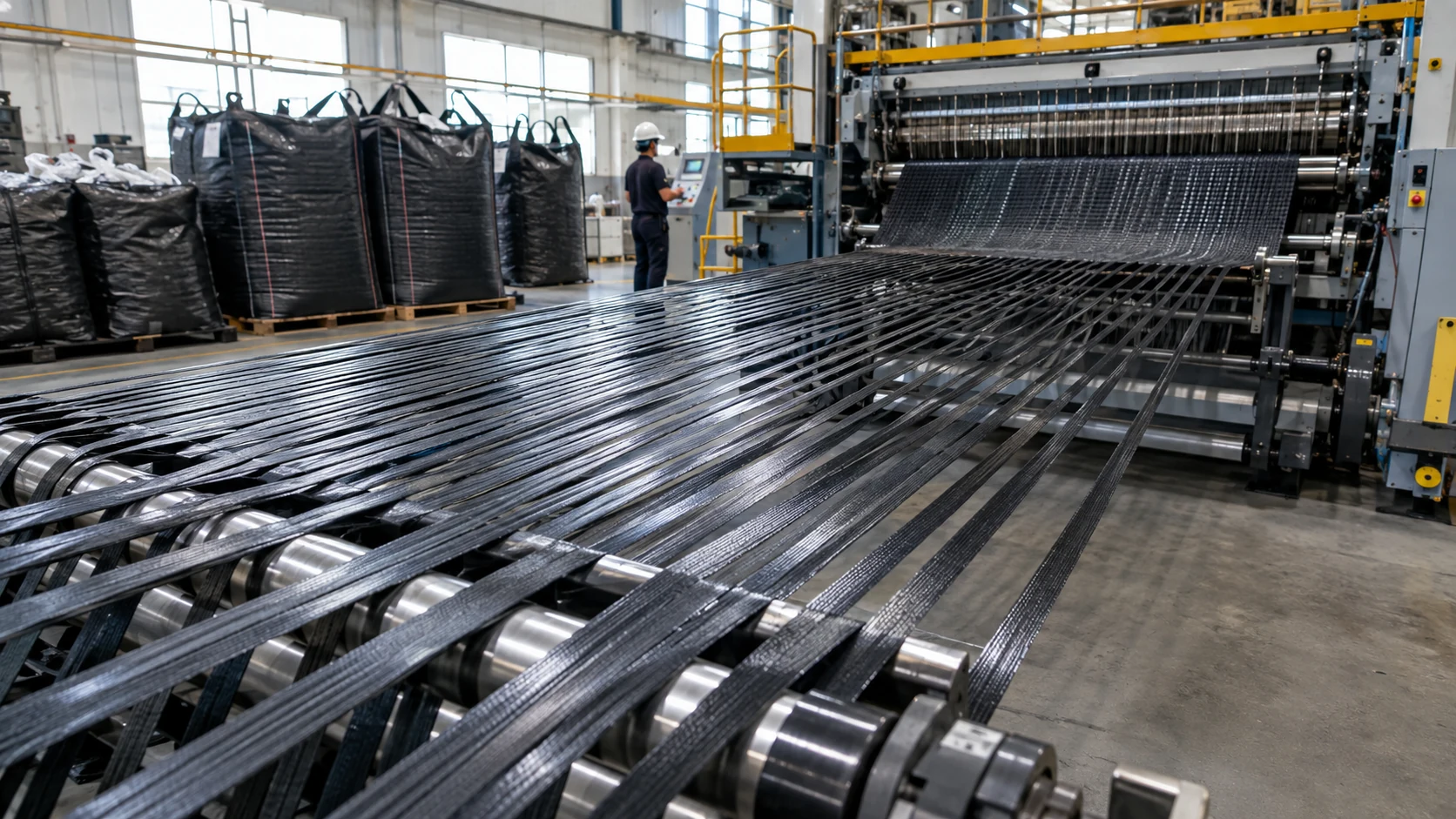
Conductive PP yarn is more difficult to stabilize than an injection-molded part because drawing reorients the polymer and conductive network. This guide follows the complete route from compound and melt flow through draw ratio, blend dilution, three-layer coextrusion, FIBC verification and production troubleshooting.
Buyer and engineer FAQ
Questions engineers often ask about this material route
Why can PP yarn resistance rise after drawing?
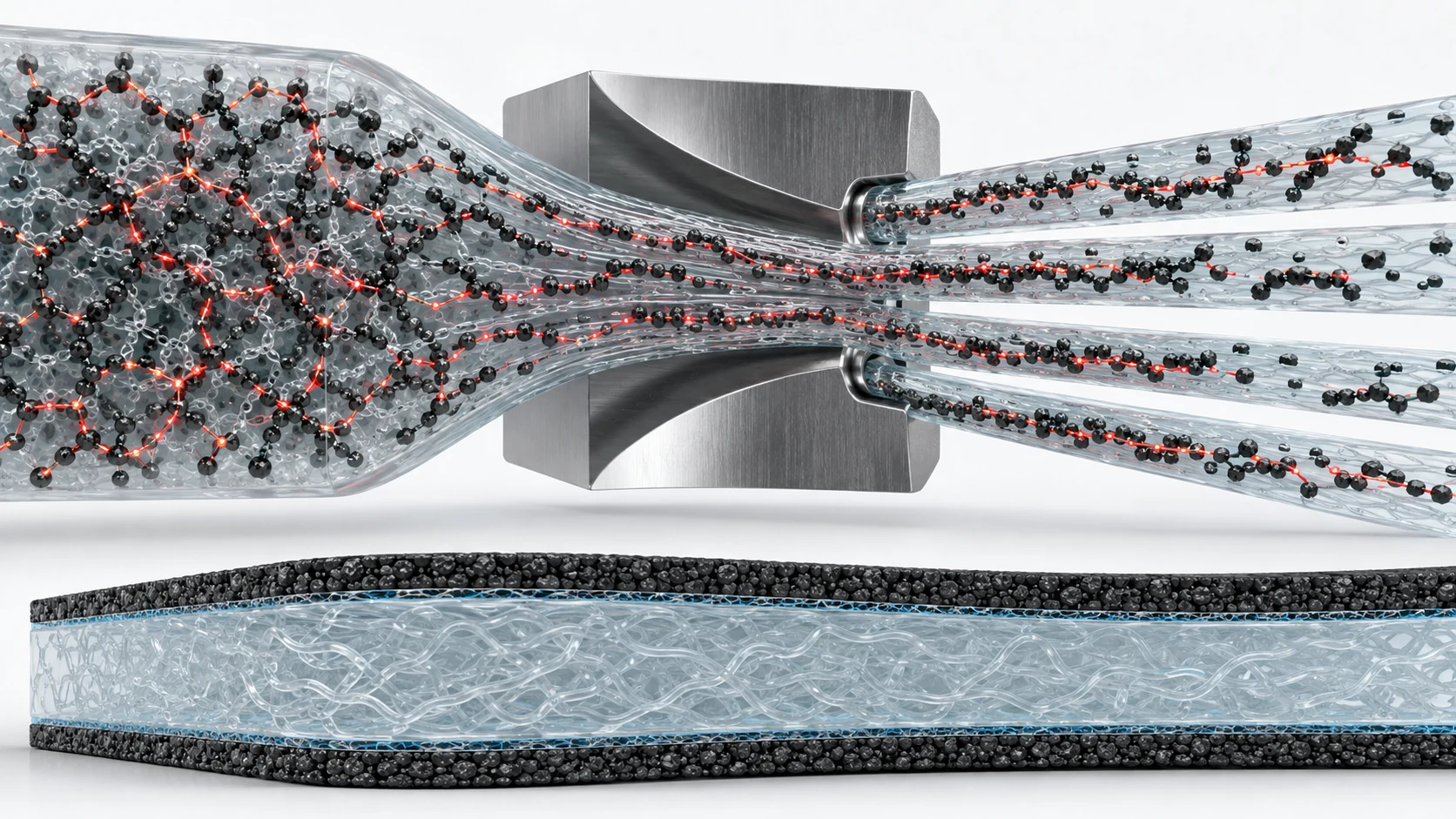
Drawing aligns the polymer chains and moves conductive particles apart or into the draw direction. Contact density and transverse paths can fall, so the finished filament must be tested rather than inferred from pellet or undrawn-strip data.
Is 7:3 or 8:2 blending a universal resistance formula?
No. Those ratios are project trial points. The result depends on the virgin PP grade, carbon network, draw ratio, mixing accuracy, temperature, filament dimensions and test fixture, so a ratio ladder must be validated on the customer's line.
Which standard should be used for conductive PP tape and FIBC testing?
ASTM D257 is intended for insulating materials and excludes moderately conductive materials; ASTM D4496 can be relevant in its stated range. Type C FIBC acceptance should follow IEC 61340-4-4 on the complete grounded bag, while ESD packaging classification is covered by IEC 61340-5-3.
How does three-layer coextrusion reduce cost?
A thin conductive outer skin provides the electrical function while high-strength virgin PP forms most of the core. The quoted 20-30% skin and 30-50% saving are project references and must be recalculated from layer stability, adhesion, scrap and local material prices.
1. Industry Challenge: The Conductive-Yarn Spinning Dilemma
In conductive flexible intermediate bulk containers, antistatic woven bags and conductive yarn, adding conductivity to PP filament is more difficult than adding it to an injection-molded part. High-temperature extrusion and drawing reconstruct the conductive network. Mechanical strength and conductivity can move in opposite directions, leaving a narrow process window.
The first traditional problem is filament breakage caused by poor filler dispersion. If conductive carbon black is not dispersed sufficiently in PP, agglomerates create screen blockage or hard specks at the die. The tape or filament then breaks repeatedly during drawing and line efficiency falls.
The second problem is resistance drift after stretching. The melt or undrawn strand may contain a relatively isotropic conductive network. Drawing aligns the polymer chains and shifts the conductive phase, opening some contacts. Resistance can rise by one or two orders of magnitude and leave the target range. A related extrusion grade, DGK-PP DD3R1, provides a useful project reference: a low-resistance starting compound can produce a 10^4-10^5 ohm finished-filament result after drawing. This is a separate grade example, not a guaranteed conversion rule for DD4-5A.
The third problem is the cost-performance tradeoff. Conductive PP compound costs more than virgin PP. Using conductive compound through the entire filament raises material cost, while excessive dilution can push the blend below its percolation threshold and make resistance unstable.
DEYU's DGK-PP DD4-5A project direction is therefore intended as a complete pellet-to-yarn engineering route: melt flow can be adjusted for the line, blend ratio can be screened for the required resistance, and a three-layer structure can reduce conductive-material consumption. The exact DD4-5A project grade does not currently have a public website page. The closest published product is DGK-PP DD4-5A-JC, which is linked for reference without creating a new product.
2. From Pellets to Yarn: Core Process Variables
2.1 Baseline Properties and Adjustable Melt Flow
The DD4-5 designation refers to a project resistance range around 10^4-10^5 ohm on the supplier's defined reference specimen. A pellet or plaque result is only a starting point because surface resistance depends on specimen shape, electrode geometry, conditioning and voltage. Finished tape, yarn and woven fabric must be tested in their actual form.
Project reference properties for DGK-PP DD4-5A are density 0.965 g/cm3, tensile strength 21.8 MPa, elongation at break 90%, MFR 7 g/10 min at 230 C/2.16 kg, Izod notched impact 35 kJ/m2 and heat-deflection temperature 105 C. These values must be confirmed against the current batch TDS because the public website product is the related DD4-5A-JC rather than the exact yarn project formulation.
An MFR of 7 g/10 min is a medium-flow starting point for many tape lines. Customer equipment differs in screw design, round or flat die geometry and draw ratio. Some lines need more flow to reduce head pressure, while others need lower flow for melt strength. DEYU can adjust the homopolymer/copolymer balance and additive package; related projects have moved MFR toward 14-15 g/10 min for fine-denier or lower-pressure processing while retaining the agreed electrical target.
2.2 Resistance-Network Reconstruction During Drawing
Conductive PP filament does not have one immutable resistance value. Before drawing, contacts are distributed more isotropically and resistance can be lower. After drawing, the network becomes oriented, contact gaps grow and transverse connectivity can weaken. The final result may remain conductive at 10^4-10^5 ohm or move into a higher dissipative range after dilution.
The finished resistance is therefore jointly controlled by the initial compound, draw ratio, die and filament geometry, cooling history and blend. A higher draw ratio often raises resistance, but the relationship is nonlinear. DEYU's technical workflow starts from the customer's draw-ratio range and finished-item target, then selects or adjusts the starting formulation to compensate for orientation.
2.3 Conditioning and Extrusion Temperature
PP itself absorbs little moisture, but carbon-black surface area, additives, storage condensation and contamination can introduce surface moisture. A project starting condition is 90 C for 4-5 hours using controlled hot-air or dehumidifying drying. The line should confirm that drying improves bubbles, silver streaks and break rate without causing pellet sticking or unnecessary energy use.
A starting extrusion window is 210-225 C, adjusted for machine and filament type. If temperature is too low, viscosity and head pressure rise; if it is too high, PP and heat-sensitive additives can degrade and residence-time risk increases. The correct window is established from pressure, torque, output, filament appearance, MFR retention and electrical data.
3. Blend Control: Multiple Resistance Levels from One Project Compound
The project DD4-5A direction starts around 10^4-10^5 ohm on the defined reference specimen, but not every application needs that low a value. Blending it with high-tensile, high-elongation virgin PP can move the finished yarn toward a static-dissipative range while restoring drawability.
The relationship follows percolation behavior rather than a linear mixing rule. Above the threshold, enough conductive paths remain; near or below it, resistance rises sharply and becomes sensitive to small composition or process changes. In one DEYU trial system, a 70:30 DD4-5A-to-virgin-PP blend produced a finished reference around 10^7 ohm, while an 80:20 blend produced about 10^6 ohm. These are line-specific trial points, not universal values.
Virgin PP also compensates part of the toughness loss that conductive filling can cause during drawing. With a DD4-5A project elongation reference of 90%, blending with a high-elongation PP can improve finished-yarn mechanical margin. One compound, several validated ratios and several resistance bands can reduce inventory, but only after a ratio ladder is qualified on the production line.
DGK-PP KJD789R-A1 provides a separate permanent-antistatic PP benchmark. An East China SMT tray project measured resistance variation between gate and remote corners, low-humidity drift and alcohol-wipe retention. Those injection-molded tray data demonstrate the behavior of another antistatic PP route; they do not predict the resistance of drawn DD4-5A yarn and are retained only as a comparison point.
4. Three-Layer Coextrusion: A Structured Cost Route
4.1 Layer Design
For high-volume antistatic woven-bag tape and conductive FIBC yarn, three-layer coextrusion can turn a technically feasible compound into an economical construction. A typical structure uses a conductive or dissipative PP outer skin, a tie interface where required, and a high-strength PP core.
The outer layer uses DD4-5A project compound or its validated blend to provide the electrical function. The core uses high-tensile, high-elongation virgin PP for load carrying. The interface and coextrusion settings must prevent delamination during drawing, weaving, flexing and bag manufacture.
4.2 Quantifying the Cost Advantage
In a project structure where the conductive functional layer represents about 20-30% of total material, conductive-compound use can fall by roughly 70-80% compared with a fully conductive monolayer. The stronger virgin-PP core can also improve break load and elongation compared with a monolayer made entirely from conductive compound.
This concept has been evaluated for conductive or dissipative FIBC flat tape and antistatic woven bags. Project estimates cite 30-50% material-cost reduction, but the realized saving depends on layer-ratio stability, tie resin, edge trim, startup scrap, line output, bag design and local prices. Type C and Type D FIBC also use different electrostatic-control principles, so the complete bag must be designed and qualified for its declared type.
4.3 Selection Logic
If the finished tape must remain at or below 10^5 ohm under the agreed fixture, direct extrusion of the project compound is the first trial. If 10^6-10^7 ohm is acceptable and cost reduction is important, an 80:20 or 70:30 blend ladder can be evaluated. If annual demand exceeds about 500 tonnes and a stable coextrusion line is available, the project can compare equipment modification, layer control, scrap and material saving. An outer-layer share at or below 25% is a useful calculation point, not an automatic payback guarantee.
5. Customer Validation Cases and Test Methods
Case 1: East China Antistatic Woven-Bag Plant
An anonymized plant producing about 2,000 tonnes per year of antistatic woven bags for electronic-component packaging previously compounded another conductive PP masterbatch. Carbon-black dispersion caused frequent breaks, hard specks and fabric resistance ranging from 10^7 to 10^11 ohm on one roll. The reported incoming-product pass rate was 82%.
After adopting the DD4-5A project route, DEYU reviewed a 65 mm single-screw line and an 8.5x draw ratio. The project MFR was moved from 7 toward 9 g/10 min, and conditioning changed from 80 C for 2 hours to 90 C for 4 hours.
The plant's quality team recorded head, middle and tail specimens over three 24-hour batches. Its historical record called the method ASTM D257 with 23 +/- 2 C, 50 +/- 5% RH, 100 V and 60 seconds. ASTM D257 is officially intended for insulating materials and excludes moderately conductive materials, so the production report should identify the actual electrodes and fixture and use ASTM D4496 or another appropriate method where its resistance range applies.
The project report recorded average breaks falling from 42 per 24 hours to no more than one, no visible hard specks under the stated inspection, and a finished 70:30 blend near 10^7 ohm with within-batch CV no more than 15%. The reported pass rate rose from 82% to 98.5%, followed by about 12 tonnes per month of supply as of August 2026. These commercial and test figures should be supported by the signed customer report before external certification claims are made.
Case 2: South China Type C Conductive FIBC Plant
A Type C FIBC exporter needed the complete bag to comply with IEC 61340-4-4. Type C FIBC uses conductive fabric or a conductive yarn grid and must be grounded. The 2018 edition permits a maximum resistance to ground of 100 Mohm for the relevant Type C requirement. The previous all-conductive flat-tape route put material cost above 35% of total cost.
The three-layer project used a 25% outer conductive layer made from an 80:20 DD4-5A/virgin-PP blend, a 70% high-tensile PP core and a 5% tie layer. Finished-tape resistance was reported at 10^6-10^7 ohm. Complete-bag resistance from locations including lifting loops to the grounding point measured 2 x 10^7-5 x 10^7 ohm, below 10^8 ohm in the project test.
A reported break load of at least 350 N/50 mm and elongation of at least 25% must be tied to a defined specimen: 50 mm is typically a strip or fabric width rather than one fine filament. The bag's mechanical qualification, safety factor, cyclic lifting and electrostatic type qualification remain governed by the customer's FIBC test plan. The project reported about 40% material-cost reduction and about 8 tonnes per month of DD4-5A use.
RoHS, REACH and SGS statements must be attached to a current declaration or report covering the supplied formulation and date. A statement that a report number is available on request is not a substitute for checking formulation identity, restricted-substance scope and report validity.
Case 3: North China Conductive-Yarn Plant
A conductive-yarn producer used imported compound for fine-denier yarn at no more than 50 D and wanted to reduce an 8-12 week lead time and high purchase cost. DEYU adjusted the DD4-5A project MFR from 7 to 14 g/10 min at 230 C/2.16 kg to reduce pack pressure and extend spinneret-pack service life while holding the agreed starting electrical range.
A 48-hour trial recorded stable pack pressure without screen blockage or filament breaks. The reported 50D/24f yarn measured 5 x 10^4-8 x 10^4 ohm with tensile strength at least 4.5 cN/dtex. After ten AATCC 61 cycles, resistance increased by less than 0.5 order of magnitude. The producer reportedly converted two lines, used about 5 tonnes per month and reduced imported-material purchasing by 60%. Test edition, wash procedure, electrode spacing and yarn conditioning should accompany the report.
6. Extrusion and Drawing Troubleshooting
| Symptom | Possible cause | Troubleshooting step | Verification |
|---|---|---|---|
| High break frequency, above project limit | Moisture/condensation, excessive temperature, poor dispersion or worn screw | Confirm conditioning; reduce melt setpoint by 5 C; inspect screen and screw | Compare MFR, pressure trend, break count and microscopy |
| Finished resistance above target | Excessive draw ratio, blend error or network separation | Reduce draw ratio by 5%; reweigh 70:30 or 80:20 blend; assess die temperature | Segment finished tape and test with a defined fixture |
| Hard specks or black points | Residue, agglomeration or raw-material contamination | Purge with virgin PP for 10-15 min; inspect screen mesh and material segregation | Visual inspection plus agreed magnification |
| Large batch-to-batch resistance spread | Conditioning, mixing or barrel-temperature variation | Standardize conditioning; extend dry mixing; check zone stability | Test at least five defined specimens per batch and calculate CV |
7. Process and Standards Quick Reference
| Stage | Project starting point | Engineering note |
|---|---|---|
| Conditioning | 90 C for 4-5 h | Confirm benefit because PP is low-absorption; control condensation and additive moisture |
| Extrusion | 210-225 C | Adjust by pressure, residence time, yarn form and degradation evidence |
| DD4-5A reference resistance | 10^4-10^5 ohm | Supplier-defined specimen; exact project grade has no public product page |
| Undrawn low-resistance reference | About 10^3 ohm in a DD3R1-related example | Separate-grade example, not a fixed DD4-5A conversion |
| Drawn filament | 10^4-10^5 ohm project range | Depends on draw ratio, orientation, geometry and fixture |
| 70:30 DD4-5A/virgin PP | About 10^7 ohm in one trial | Dissipative project point; validate a ratio ladder |
| 80:20 DD4-5A/virgin PP | About 10^6 ohm in one trial | Lower dissipative project point; not universal |
| Coextruded functional skin | 20-30% | Remaining structure mainly high-strength PP core and required interface |
| Material-cost reduction | 30-50% project estimate | Recalculate from price, scrap, output and layer stability |
| Moderately conductive material test | ASTM D4496 where applicable | ASTM D257 explicitly excludes moderately conductive materials |
| Type C FIBC | IEC 61340-4-4:2018 | Qualify the complete grounded bag; maximum grounding resistance revised to 100 Mohm |
| ESD protective packaging | IEC 61340-5-3:2022 | Packaging-property classification; IEC 61340-5-1 is the ESD control-program standard |
| Restricted substances | Current RoHS/REACH evidence | Confirm formulation, scope, report number and validity |
8. Summary
The engineering value of DGK-PP DD4-5A for antistatic PP yarn is not limited to a conductive pellet. It is a controllable route from compound to finished filament. Melt flow can be adjusted to the screw, die, filament form and draw ratio; related projects have moved MFR from 7 toward 14-15 g/10 min.
Resistance can be tuned through a validated 70:30 or 80:20 blend ladder, moving one project compound from a 10^4-10^5 ohm starting range toward 10^6-10^7 ohm finished results. Three-layer coextrusion confines the functional compound to a 20-30% skin and uses ordinary high-strength PP in the core, creating a project opportunity for 30-50% material-cost reduction.
The three anonymized cases cover a 72-hour woven-bag trial, a grounded Type C FIBC project and a 48-hour fine-denier yarn trial. Their reported break rate, resistance and cost results are useful engineering references, but release decisions require the signed source reports, current compliance documents, defined electrode fixture and complete-bag or finished-yarn qualification.