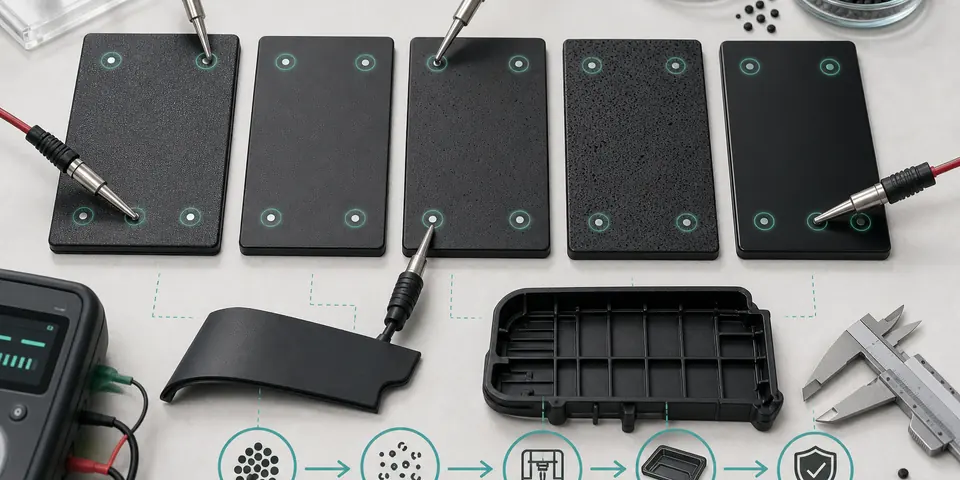
Carbon Black Conductive Plastics: Advantages, Limits and Application Selection
This page is for buyers, product engineers and material engineers who are comparing carbon black conductive plastics with conductive routes such as graphite, carbon fiber, carbon nanotube or metal fiber. It explains the mechanism, performance boundary, application selection logic and validation method for carbon black modified plastic compounds.
Buyer and engineer FAQ
Questions engineers often ask about this material route
Where can ABS / PA / PE / POM / PP with a conductive plastic requirement be used?
Typical fields include ESD trays, electronic housings, fixtures, EMI parts and antistatic logistics parts. For this article, DEYU would first confirm the working environment, wall thickness, expected lifetime and whether Conductive Plastics, DGK-PP DD2-3A Conductive PP matches the part geometry or needs formulation adjustment.
What are the main performance indicators for the "conductive plastic" target on ABS / PA / PE / POM / PP?
Focus on surface resistance, volume resistance, dispersion uniformity, impact strength and molding stability. Buyers should ask for data on molded parts, not only pellet data, because gate position, filler orientation and thickness can change the final value.
What should engineers watch during injection molding or processing?
For ABS / PA / PE / POM / PP, a practical starting window is 210-245°C melt / 50-80°C mold. Avoid excessive filler loading, control weld lines and verify resistance on the molded part. Final parameters should follow part thickness, gate design and the actual machine.
What details help DEYU recommend Conductive Plastics, DGK-PP DD2-3A Conductive PP more accurately?
Send the current resin or grade, drawing or photo, wall thickness, annual quantity, target standard, failure mode and required color. If a reference grade already passed one test but failed in production, include both data sets.
For a precise recommendation, share the part drawing, base resin, target performance, processing method and test standard with DEYU.
This page is for buyers, product engineers and material engineers who are comparing carbon black conductive plastics with conductive routes such as graphite, carbon fiber, carbon nanotube or metal fiber. It explains the mechanism, performance boundary, application selection logic and validation method for carbon black modified plastic compounds.
Conductive Plastics and DGK-PP DD2-3A Conductive PP. Use the product category page for resin-route selection and the DGK-PP DD2-3A page when the project needs a low-resistance conductive PP direction around 10^2-10^3 ohm.
1. Background / Problem
In many industrial parts, ordinary plastic is not enough because the finished product must control static electricity or provide a stable conductive path. Typical applications include ESD trays, electronic packaging, battery-related components, conductive structural parts, automotive auxiliary parts and industrial housings.
Buyers often ask whether carbon black conductive plastic can replace carbon fiber, graphite or metal-filled material. Carbon black is one of the most widely used conductive modification routes for plastics and can be applied to PP, PE, ABS, PA, POM, PC and other resin systems.
Compared with some high-cost conductive fillers, carbon black usually offers a practical balance between conductivity, processing feasibility and cost control. The limitation is that it is not suitable for every application. Final performance depends on resin type, carbon black structure, filler loading, dispersion quality, melt flow, part thickness, injection conditions and the post-molding test method.
The correct engineering question is not simply whether carbon black is conductive. The better question is which conductivity range is required, and whether the carbon black route can maintain that range after molding, assembly and actual use.
2. Technical Difficulty / Why It Happens
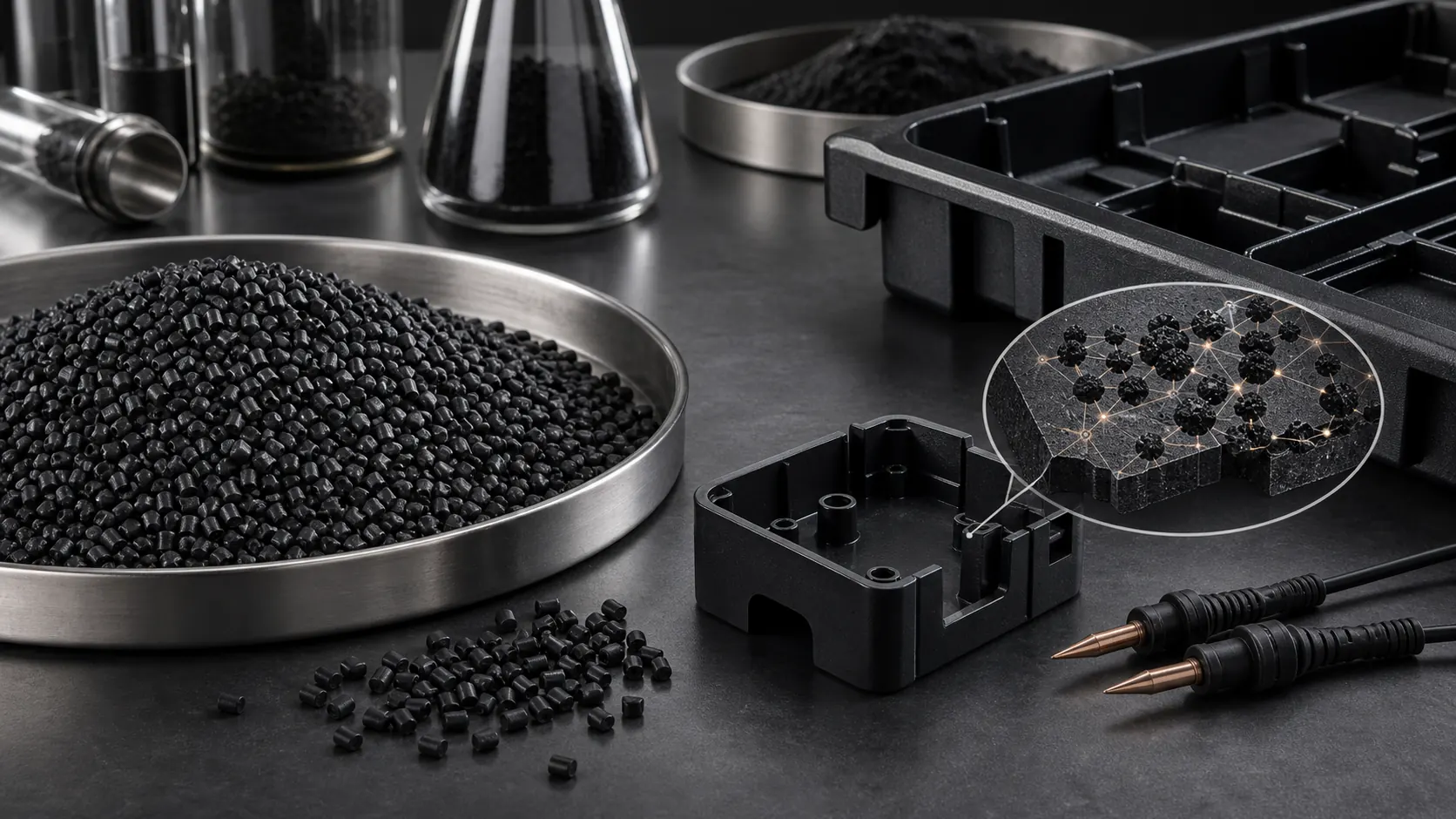
Carbon black conductive plastic works by forming a conductive network inside the polymer matrix. When filler content reaches a certain level, conductive particles contact or approach each other closely enough to allow charge transfer. This point is often described as the percolation threshold.
The main difficulty is that the conductive network is sensitive to both formulation and processing.
2.1 Conductivity Is Not Linear
Adding more carbon black does not always produce a smooth and predictable conductivity improvement. Before the percolation threshold, resistance may remain very high. Once the threshold is reached, resistance can drop sharply. After that, further filler addition may improve conductivity, but it may also reduce mechanical strength, impact performance, surface quality or flowability.
Conductive plastics therefore cannot be selected only by filler percentage.
2.2 Dispersion Strongly Affects Resistance Stability
If carbon black is poorly dispersed, some areas of the molded part may be conductive while other areas remain less conductive. Test results may vary between the sprue area, flow end, thin-wall area and rib area.
For customers, this may appear as unstable surface resistance after injection molding, different resistance results between samples from the same batch, weak conductivity at thin-wall or long-flow sections, black specks, poor surface appearance, local brittleness or higher scrap rate after switching from ordinary resin to a conductive compound.
2.3 Conductive Performance May Conflict with Mechanical Properties
Carbon black usually increases stiffness but may reduce elongation and impact strength when the loading level becomes high. For applications that require impact resistance, snap-fit performance or repeated assembly, the formulation must balance electrical performance and mechanical reliability.
A conductive PP tray may focus more on surface resistance and dimensional stability, while a conductive ABS housing may need better surface appearance and impact resistance. A conductive PA or POM part may require wear resistance and mechanical strength in addition to conductivity.
3. DEYU Material Direction
DEYU usually evaluates carbon black conductive plastic compounds from four directions.
The first direction is the target resistance range. The material route is different for anti-static, static dissipative and conductive requirements. A target such as 10^3-10^5 ohm, 10^5-10^7 ohm or 10^6-10^9 ohm should be defined together with the test method.
The second direction is base resin selection. PP, PE, ABS, PA and POM have different processing behavior and application boundaries. DEYU may recommend a resin system based on stiffness, impact strength, chemical resistance, dimensional stability, temperature requirement and cost target.
The third direction is dispersion and processing balance. Carbon black type, feeding method, compounding temperature and screw configuration influence the final conductive network. DEYU can support small-batch validation before mass production.
The fourth direction is part-level verification. Conductivity should not only be tested on standard specimens. Finished parts should also be tested at key positions, especially thin-wall areas, ribs, corners, assembly surfaces and areas far from the gate.
Carbon black conductive compounds are commonly considered when the buyer needs black conductive plastic pellets with stable processability and a practical cost-performance balance. If the application requires very high strength, lower filler loading, light color or reduced black appearance limitation, carbon fiber, carbon nanotube or hybrid conductive systems may need to be evaluated.
4. Carbon Black Conductive Route: Advantages and Limits
Carbon black conductive plastics are often selected because the route is mature, widely applicable and suitable for many injection molding or extrusion applications.
Typical advantages include compatibility with PP, PE, ABS, PA, POM and other resin systems, adjustable anti-static, static dissipative or conductive ranges depending on formulation, suitability for black conductive pellets and black molded parts, generally better cost control than some advanced conductive filler systems, and practical use in trays, housings, packaging, industrial parts and functional components.
The route also has clear engineering boundaries. Carbon black normally produces black or dark-colored materials, may reduce impact strength and elongation at high filler levels, may lower melt flow and make thin-wall molding more difficult, may cause resistance drift if dispersion or molding conditions are unstable, may affect surface gloss, and may not be suitable for light-colored or transparent conductive material.
For this reason, buyers should avoid selecting carbon black conductive plastic only by price or one resistance value. Part structure, wall thickness, process window and final inspection method are equally important.
5. Reference Product Data
The following table is a selection direction for carbon black conductive plastic compound development. It is not a universal datasheet. Final values should be confirmed by DEYU internal testing and customer part-level validation before use in a formal specification.
| Item | Selection Direction |
|---|---|
| Product direction | DGK carbon black conductive plastic compound |
| Base resin | PP / PE / ABS / PA / POM, selected according to application |
| Modification route | Carbon black conductive modification; hybrid conductive route can be evaluated if needed |
| Processing method | Injection molding or extrusion, depending on grade design |
| Color | Black or dark color |
| Density | Project-specific value to be confirmed by test |
| MFR / melt flow rate | Project-specific value to be confirmed by resin and part structure |
| Tensile strength | Project-specific value to be confirmed by material grade |
| Flexural modulus | Project-specific value to be confirmed by material grade |
| Notched impact strength | Project-specific value to be confirmed by material grade |
| HDT | Project-specific value to be confirmed by base resin |
| Surface resistance | Selected according to target range, commonly discussed from 10^3-10^9 ohm for static-control applications |
| Volume resistance | Confirm when through-thickness or structural conduction is required |
| Flame retardancy | Optional; depends on formulation and resin system |
| Typical applications | ESD trays, conductive packaging, electronic holders, industrial housings, conductive structural parts |
Existing DEYU product data should be used where a grade is already defined. For example, the conductive plastics platform covers PP / PE / ABS / PA / POM and application-specific engineering plastics. DGK-PP DD2-3A is a conductive PP direction with 10^2-10^3 ohm performance positioning, while other resin-specific grades should be checked on their own product pages before quotation or sampling.
6. Material Route Selection Matrix
| Application requirement | Carbon black route suitability | Engineering comment |
|---|---|---|
| Black conductive plastic parts | High | Carbon black is suitable when black appearance is acceptable. |
| ESD tray or turnover box | High | PP or PE conductive compound is often considered. |
| Electronic packaging | Medium to High | Resistance range and cleanliness requirement should be confirmed. |
| Light-colored conductive plastic | Low | Carbon black is usually not suitable for light color. |
| Transparent conductive plastic | Low | Other anti-static or conductive systems should be evaluated. |
| High mechanical strength conductive part | Medium | Carbon fiber or hybrid route may be more suitable in some cases. |
| Thin-wall injection molding | Medium | Flowability and resistance at the flow end must be tested. |
| High-gloss visible housing | Medium to Low | Surface appearance should be validated by molded part trial. |
| Wear-resistant conductive part | Medium | POM, PA or hybrid modification route may be needed. |
| Low-cost conductive component | Medium to High | Carbon black route may offer practical cost control, depending on target resistance. |
7. Real Customer Application Case
This case is based on a real customer scenario from DEYU's internal project records. It can be used when a buyer wants to evaluate carbon black conductive plastic for an injection-molded ESD tray or electronic component holder.
A customer currently uses ordinary PP or ABS for a molded tray. The part has acceptable dimensions and molding cycle, but the final product needs controlled resistance to reduce static-related risk during handling. The buyer considers switching to carbon black conductive plastic pellets.
The engineering team needs to verify whether the conductive compound can meet the target resistance range without causing excessive molding scrap, warpage, brittleness or assembly problems.
DEYU may recommend a small-batch validation process: confirm base resin, confirm target resistance range and test method, mold standard test specimens and finished parts, test resistance at multiple positions of the finished part, record molding scrap rate and dimensional change, and adjust carbon black loading, flowability or toughening direction if necessary.
8. Validation Data Table
The table below is a customer internal trial structure. Values should be replaced by actual DEYU or customer trial data for each project.
| Validation item | Initial trial direction | Trial observation method | Result interpretation |
|---|---|---|---|
| Trial quantity | Set by project risk and part size | Small-batch molding trial | Quantity should be enough to observe resistance fluctuation and molding stability. |
| Monthly production estimate | Customer input required | Buyer production planning | Helps decide whether formulation should prioritize cost, cycle time or stability. |
| Target surface resistance | Defined by application, often within a 10^3-10^9 ohm static-control range | Tested on molded part surface | Must match customer test standard and application requirement. |
| Resistance drift after molding | Compare positions and batches | Gate area, flow end, ribs and assembly surface | Large drift may indicate dispersion, gate design or process sensitivity. |
| Molding scrap rate | Customer trial record | Injection molding trial | High scrap may relate to flowability, warpage, short shot or surface defect. |
| Assembly scrap rate | Customer trial record | Assembly-line observation | Important for snap-fit parts, trays with ribs or housings. |
| Defect rate | Visual and dimensional inspection | Molded part inspection | Defects may include black specks, flow marks, brittleness or deformation. |
| Dimensional stability | Customer tolerance requirement | CMM or fixture inspection | Conductive filler may change shrinkage behavior. |
| Impact or drop performance | Part-level requirement | Drop or impact trial | Required when the product is handled frequently. |
| Pass rate | Combined electrical and mechanical evaluation | Final trial review | Should be judged by resistance and production stability together. |
9. Result Interpretation
Carbon black conductive plastic should not be judged by one resistance value only. A single specimen may pass, but the finished part may still fail because of molding conditions, flow length, wall thickness or local filler distribution.
Standard test bars help compare tensile strength, flexural modulus, impact strength and HDT. They are useful for basic material screening, but they do not fully represent finished part behavior.
Finished parts should be tested at several positions. The gate area, flow end, rib area, corner area and assembly surface may show different resistance values. If resistance drift is large, formulation or molding process adjustment is required.
A conductive plastic compound must also fit the customer production line. If the material reaches the target resistance but causes high scrap rate, unstable dimensions or assembly cracking, it may not be suitable for mass production without further optimization.
10. Suitable Applications
Carbon black conductive plastic compounds are suitable for applications where black appearance is acceptable and conductivity needs to be controlled within a defined range.
Typical applications include ESD trays and turnover boxes, electronic component holders, conductive packaging parts, industrial plastic housings, battery-related auxiliary components, conductive PP or PE sheets, black conductive ABS molded parts, anti-static or conductive logistics parts, plastic parts requiring static discharge control and functional injection-molded components.
For applications requiring light color, transparency, high surface gloss or very high mechanical strength, buyers may need to compare carbon black with other modification routes.
11. What Buyers Should Provide
| Buyer input | Why it matters |
|---|---|
| Base resin requirement | PP, PE, ABS, PA, POM and other resins have different processing and performance boundaries. |
| Target resistance range | The formulation changes significantly between anti-static, dissipative and conductive requirements. |
| Test method | Surface resistance, volume resistance and test environment should be clarified. |
| Drawing or part size | Wall thickness, flow length and ribs affect conductivity stability. |
| Processing method | Injection molding, extrusion or sheet extrusion may require different flow properties. |
| Current defect data | Warpage, short shot, brittleness or unstable resistance helps identify the adjustment direction. |
| Mechanical requirement | Tensile strength, impact strength, stiffness and assembly strength influence formulation design. |
| Flame-retardant requirement | Conductive and flame-retardant systems may need balanced formulation. |
| Monthly usage | Helps evaluate cost target, production stability and supply planning. |
| Color and appearance requirement | Carbon black normally means black or dark appearance. |
Conclusion
Carbon black conductive plastic is a practical and widely used route for producing conductive or static-control polymer compounds. It is especially suitable for black conductive PP, PE, ABS, PA and POM materials used in trays, packaging, industrial housings and functional molded parts.
Its main advantage is the balance between conductivity, processability and cost control. Its main limitation is that the conductive network is sensitive to formulation, dispersion and molding conditions. High filler loading may also influence impact strength, flowability and surface appearance.
For buyers, the key is to define the target resistance range, base resin, part structure and validation method before selecting the material. A good conductive compound should be verified not only by standard specimen data, but also by molded part resistance, production scrap rate, dimensional stability and assembly performance.
DEYU can support carbon black conductive plastic compound development and small-batch validation for PP, PE, ABS, PA, POM and related modified plastic systems. Final formulation and published data should be confirmed by internal testing and customer part-level validation.