
Conductive ABS for Equipment Housings: Appearance, Toughness and ESD Control
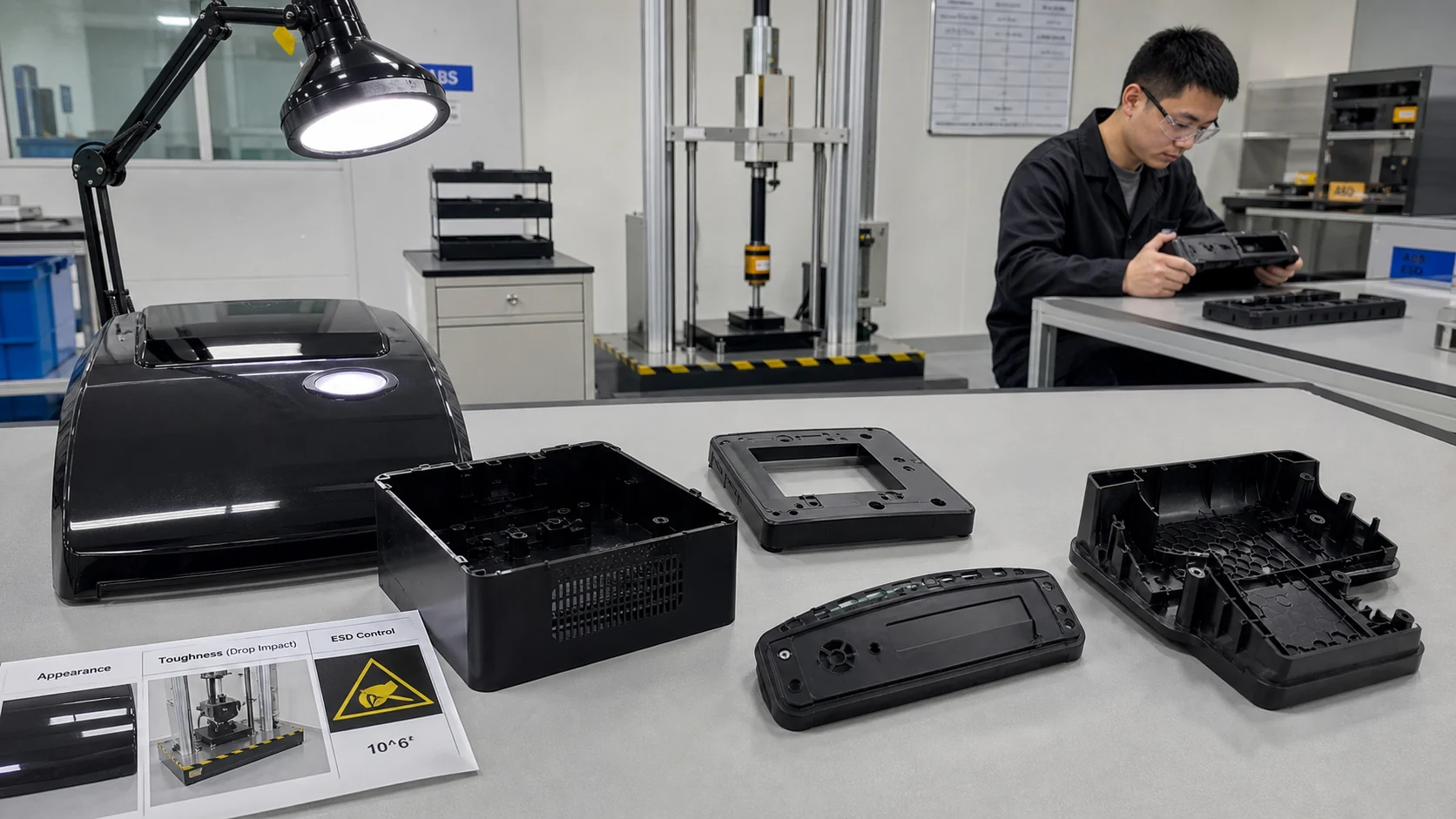
Equipment housings need more than a low resistance number. Visible ABS enclosures must keep surface quality, survive handling and still provide permanent, humidity-independent ESD control.
Housing material FAQ
Conductive ABS for Equipment Housings: Appearance, Toughness and ESD Control
Why can conductive ABS be harder to use in visible housings?
Conductive fillers can change gloss, surface texture, filler orientation and toughness. The grade must be validated on the molded housing, not only as pellets.
Which resistance range should an equipment housing use?
It depends on the ESD program. Conductive targets are often below 10^6 Ω, dissipative targets are 10^6-10^9 Ω and antistatic targets are usually 10^9-10^12 Ω.
When should CF15L be considered instead of KJD678R-BZ?
Use CF15L when rigidity, load bearing or dimensional stability is more important than maximum toughness. For general covers, KJD678R-BZ is usually the first direction.
What data should be checked before production?
Measure resistance at multiple housing locations, gloss or appearance, Izod/Charpy impact, drop or shipping performance, scrap rate and field dust/ESD return rate.
Background and Problem
Acrylonitrile butadiene styrene, or ABS, is one of the most common engineering thermoplastics for equipment housings, enclosures and structural components. It is chosen for good impact resistance, excellent surface finish, dimensional stability, plating capability and moderate cost. Printer and copier covers, instrument bezels, business-machine enclosures and many electronic housings still rely on ABS because it balances appearance and processing better than many alternatives.
The market pressure is also real. The global ABS market was about 10.69 million tons in 2025, and anti-static ABS resin was valued at about USD 1.19 billion in 2024, with growth driven by electronics and automotive demand. For buyers, this means ESD grades are no longer niche; they are part of everyday housing material selection.
The problem is that standard ABS is an excellent insulator, often above 10^14 Ω·cm. In electronics manufacturing or office equipment, static charge on a housing attracts dust, contaminates optics and internal electronics, and can create ESD damage risk. The engineering task is a triple balance: appearance, toughness and ESD control.
| Requirement | Why it matters |
|---|---|
| Appearance | Visible housings need surface quality, gloss and color consistency for brand perception and product quality. |
| Toughness | Housings must withstand drops, impact and handling without cracking. |
| ESD control | Housings must protect internal electronics from static damage and reduce dust attraction. |
Why the Triple Balance Is Difficult
Appearance challenge
For visible housings, surface quality is non-negotiable. Conductive fillers may reduce gloss, create surface roughness or cause silver streaking if the filler is poorly dispersed or oriented badly during molding. Good compounding must keep carbon black, graphite or carbon fiber uniformly distributed.
| Filler type | Surface-quality impact | Mitigation |
|---|---|---|
| Carbon black | Can cause roughness if poorly dispersed | Optimized compounding and fine dispersion |
| Graphite | Plate-like particles can affect gloss | Controlled particle size and loading |
| Carbon fiber | May create texture or silver streaking | Processing and fiber-orientation control |
Toughness challenge
ABS is also valued for impact resistance. Conductive fillers, especially at high loading, can reduce ductility and create stress-concentration points. Low filler loading usually has minor impact, moderate loading brings visible toughness loss, and high loading can make the molded housing brittle.
| Filler loading | Impact on toughness | Mechanism |
|---|---|---|
| Low (<8 wt%) | Minimal reduction | Filler particles act as limited stress concentrators |
| Moderate (8-15 wt%) | Moderate reduction | More stress concentration and lower ductility |
| High (>15 wt%) | Significant reduction | Brittle behavior and crack propagation |
ESD control challenge
The resistance target must match the ESD program. Conductive grades are typically below 10^6 Ω·cm, dissipative grades are around 10^6-10^9 Ω·cm, and antistatic grades are often 10^9-10^12 Ω·cm. Housing materials should use permanent conductive networks rather than humidity-dependent migratory additives when long-term stability is required.
| Category | Surface resistivity | Typical housing application |
|---|---|---|
| Conductive | <10^6 Ω·cm | High-sensitivity electronics, semiconductor equipment |
| Dissipative | 10^6-10^9 Ω·cm | General electronics housings, office equipment |
| Antistatic | 10^9-10^12 Ω·cm | Low-level static control, consumer electronics |
Processing consideration
Processing then determines whether the compound works in the real part. ABS and fillers must be dried, melt temperature must avoid surface defects and unstable filler dispersion, mold temperature affects gloss and orientation, and gate placement can change both resistance and appearance across the housing.
DEYU Material Direction
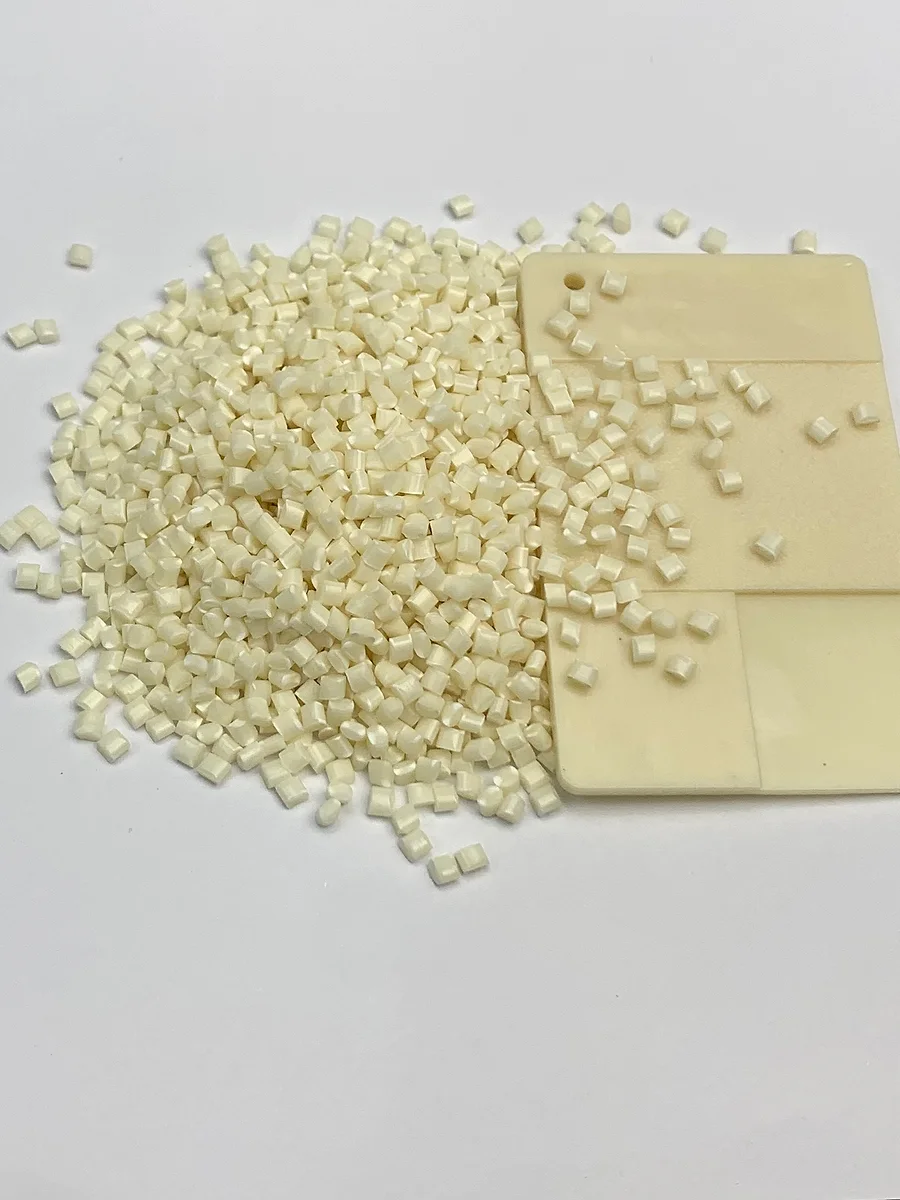
DEYU uses three conductive ABS platforms for equipment housings. DGK-ABS KJD678R-BZ is a carbon-black conductive ABS direction for general covers and housings where appearance, ESD and moderate toughness must be balanced.
DGK-ABS DD3C is a graphite-filled conductive ABS compound that provides stable 10^3-10^4 Ω·cm resistance with good mechanical properties and surface quality for drive housings, fax-machine parts, cassette housings and similar electronic enclosures.
For higher rigidity, DGK-ABS CF15L uses 15% carbon fiber reinforcement. It is designed for structural electronic housings, load-bearing enclosures, precision equipment housings and automation components that need stiffness, strength and ESD protection together.
Reference Product Data
| Property | Test method | DGK-ABS KJD678R-BZ (carbon black) | DGK-ABS DD3C (graphite) | DGK-ABS CF15L (carbon fiber) |
|---|---|---|---|---|
| Base resin | - | ABS | ABS | ABS |
| Filler type | - | Carbon black | Graphite | Carbon fiber (15%) |
| Processing | - | Injection molding | Injection molding | Injection molding |
| Color | - | Black | Black | Black |
| Flexural strength | GB/T9341-2008 | - | 34 MPa | >=138 MPa |
| Flexural modulus | GB/T9341-2008 | 2000-2500 MPa | 1600 MPa | >=8160 MPa |
| Tensile strength | GB/T1040-2006 | 35-45 MPa | 19 MPa | >=97.6 MPa |
| Elongation at break | GB/T1040-2006 | - | 17% | >=5.5% |
| Notched impact | ASTM D256 | 80-150 J/m | 8 kJ/m² | >=6 kJ/m² Charpy |
| HDT | GB/T1633-2000 | 85-95°C | 84°C | >=92°C @ 1.8 MPa |
| Surface resistivity | GB/T1401-2002 / ASTM D257 | 10^4-10^6 Ω·sq | 10^3-10^4 Ω·cm | <=10^4 Ω·cm |
| MFR | GB/T3682-2000 | - | 6 g/10 min | <=18 g/10 min |
| Drying | - | 80-90°C, 3-4 h | 90°C, 3-4 h | 80-100°C, 3-4 h |
| Melt temperature | - | 220-240°C | 225-235°C | 230-260°C |
| Mold temperature | - | 50-70°C | 50-80°C | 60-90°C |
| Housing suitability | - | Good appearance, good toughness, excellent ESD | Good appearance, moderate toughness, excellent ESD | Good appearance with processing, moderate toughness, excellent ESD |
| Typical applications | - | General electronics housings and covers | Drives, fax machines, VCR cassettes | Structural housings, precision enclosures |
Values are typical ranges, not guaranteed minimums or maximums.
Customer Debugging and Validation Scenario
An office equipment manufacturer producing printer and copier covers used standard ABS. During assembly and field use, static charge attracted dust to optics and electronics, creating performance issues and returns. At the same time, housings cracked during shipping and handling at about 4%.
The manufacturer evaluated DGK-ABS KJD678R-BZ in 1,000 molded housings while tracking surface resistivity, static charge after handling, dust adhesion, Izod impact, crack rate, gloss, molding scrap and assembly pass rate.
| Parameter | Detail |
|---|---|
| Trial quantity | 1,000 housings |
| Monthly volume | 50,000 housings |
| Material | DGK-ABS KJD678R-BZ |
| Processing | Injection molding |
| Drying | 3-4 h at 80-90°C |
| Melt temperature | 220-240°C |
| Mold temperature | 50-70°C |
| Target resistance | <10^6 Ω·sq |
| Test method | GB/T1401-2002 / ASTM D257 |
Validation data
| Metric | Standard ABS control | DEYU DGK-ABS KJD678R-BZ |
|---|---|---|
| Surface resistivity | >10^14 Ω·sq | 10^4-10^5 Ω·sq |
| Static charge after handling | 2,000-5,000 V | <100 V |
| Dust on housing surface | Significant accumulation | Minimal, visually clean |
| Izod notched impact | 200-300 J/m | 80-150 J/m |
| Housing crack rate | 4% | 1.5% |
| Dust/ESD field returns | 3.5% | <0.5% |
| Surface gloss 60° | 85-90 | 75-80 |
| Molding scrap rate | 2.5% | 3.2% |
| Assembly pass rate | 94% | 98% |
Direction after trial
The trial showed the material did not simply chase conductivity. It reduced surface resistivity from more than 10^14 Ω·sq to 10^4-10^5 Ω·sq, reduced static charge to below 100 V, cut dust/ESD-related field returns from 3.5% to below 0.5%, and lowered housing crack rate from 4% to 1.5%. Gloss dropped from 85-90 to 75-80, still acceptable for the black housing line.
Two refinement points remained: KJD678R-BZ required 3-4 h drying at 80-90°C, and molding scrap rose slightly from 2.5% to 3.2%. DEYU therefore recommended process-window optimization and evaluating pre-dried supply options for stable mass production.
Achieving the Triple Balance
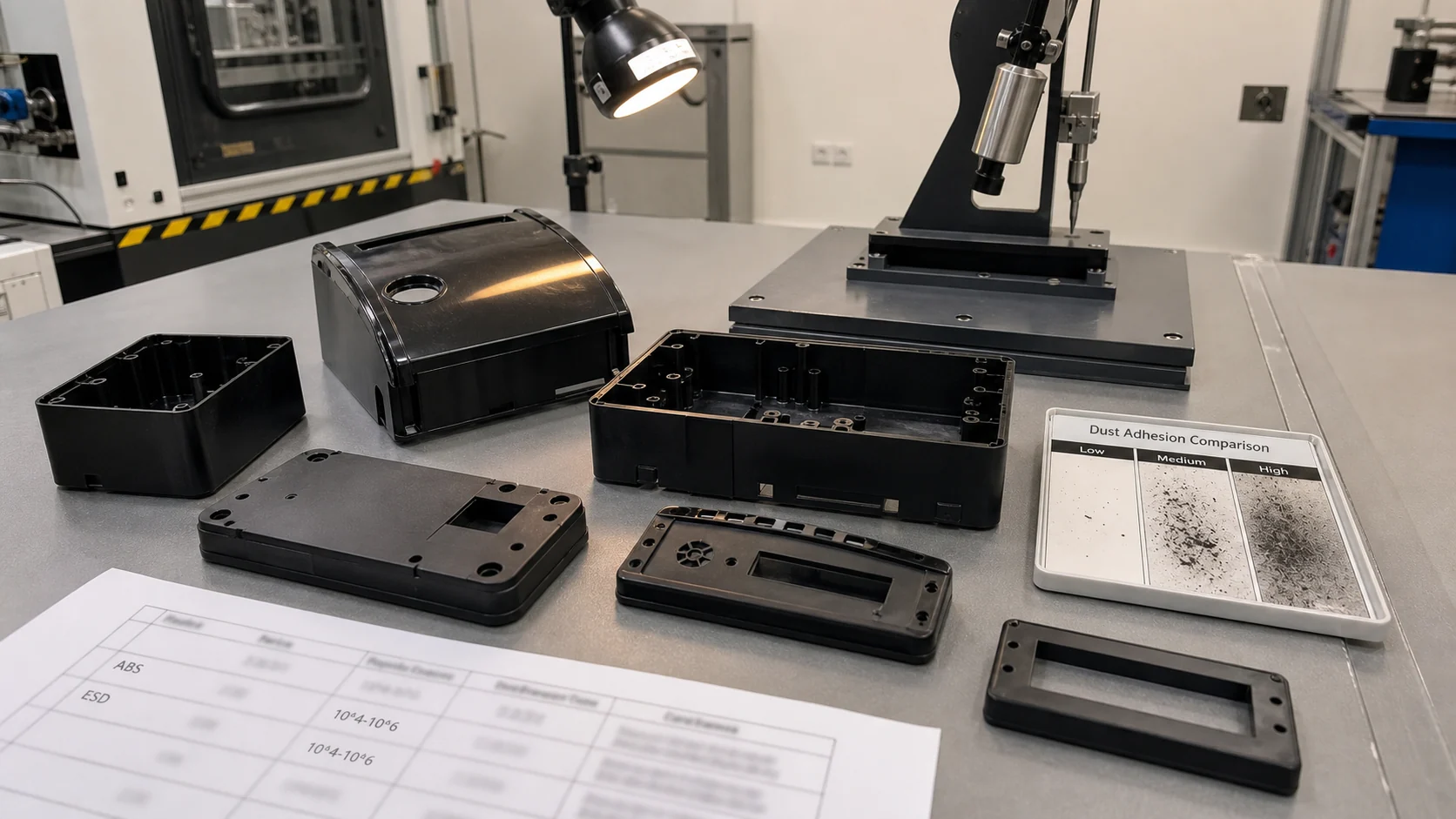
For appearance-critical housings, use carbon black or graphite with optimized dispersion, dry correctly, keep moderate melt temperature, adjust mold temperature, avoid visible gate marks and use texture when it helps hide minor filler effects.
| Consideration | Recommendation |
|---|---|
| Filler selection | Carbon black or graphite with optimized dispersion |
| Processing | Proper drying, moderate melt temperature and optimal mold temperature |
| Gate design | Avoid visible gate marks; consider multiple gates for uniform fill |
| Surface treatment | Textured surfaces can mask minor filler effects |
For toughness-critical housings, avoid excessive filler loading, add generous radii, keep wall thickness uniform and consider impact-modified grades when drop or shipping abuse is severe.
| Consideration | Recommendation |
|---|---|
| Filler selection | Lower filler loading or impact-modified grades |
| Part design | Avoid sharp corners; use generous radii |
| Wall thickness | Maintain uniform thickness to avoid stress concentration |
| Impact modifier | Consider grades with impact modifier packages |
For ESD-critical housings, define whether the requirement is conductive or dissipative, use ANSI/ESD STM11.11 or ASTM D257 consistently, measure multiple housing locations and choose permanent conductive fillers rather than migratory additives.
| Consideration | Recommendation |
|---|---|
| Resistivity target | Specify conductive (<10^6) or dissipative (10^6-10^9) based on ESD program |
| Test method | Use ANSI/ESD STM11.11 or ASTM D257 consistently |
| Measurement locations | Measure multiple locations because resistance varies across the part |
| Permanence | Choose permanent conductive fillers, not migratory additives |
Suitable Applications
| Application | Recommended grade | Key requirements |
|---|---|---|
| Printer and copier covers | DGK-ABS KJD678R-BZ | Appearance + ESD + moderate toughness |
| Business machine enclosures | DGK-ABS KJD678R-BZ | Dimensional stability + ESD + surface quality |
| Instrument panel bezels | KJD678R-BZ or DD3C | Appearance + ESD |
| Floppy disk drive housings | DGK-ABS DD3C | Stable ESD + good mechanicals |
| Fax machine components | DGK-ABS DD3C | ESD + processability |
| VCR cassette housings | DGK-ABS DD3C | ESD + surface quality |
| Structural electronics housings | DGK-ABS CF15L | Rigidity + strength + ESD |
| Precision equipment enclosures | DGK-ABS CF15L | Dimensional stability + load-bearing + ESD |
| Test and measurement housings | DGK-ABS KJD678R-BZ | ESD + appearance + toughness |
| Automation equipment enclosures | DGK-ABS CF15L | Structural integrity + ESD |
What Buyers Should Provide
Buyers should provide part drawings, target resistance range, gloss or texture requirements, drop or impact criteria, load conditions, working temperature, chemical/UV/cleaning exposure, molding method, flame-retardant requirements, current failure mode, production volume and regulatory requirements such as RoHS or REACH.
| Information needed | Why it matters |
|---|---|
| Part drawing / 3D model | Identifies wall thickness, corners and gate locations |
| Target resistance | Defines conductive, dissipative or antistatic requirement |
| Appearance requirement | Gloss, color and texture affect filler selection |
| Impact requirement | Drop, handling and shipping define toughness needs |
| Load requirement | Load-bearing parts may need CF15L |
| Operating temperature | Affects HDT requirement |
| Environmental exposure | Chemicals, UV and cleaning agents affect stabilizers |
| Processing method | Injection molding is primary for grade selection |
| Flame retardancy | UL94 V-0/V-1/V-2/HB requires FR design if needed |
| Current failure mode | ESD issues, cracking or surface defects guide diagnosis |
| Production volume | Determines commercial and custom formulation feasibility |
| Regulatory requirements | RoHS and REACH affect compliance verification |
Conclusion
Conductive ABS compounds for equipment housings must balance appearance, toughness and ESD control. A material that only gives a low resistance value is not enough if it creates visible surface defects or brittle housings.
DEYU's recommended directions are KJD678R-BZ for general housings, DD3C for stable graphite conductivity, and CF15L for structural housings requiring rigidity and strength. The office equipment validation showed reduced static, lower dust-related returns, acceptable surface quality and a housing crack rate reduction from 4% to 1.5%.
| Dimension | Requirement | How DEYU delivers |
|---|---|---|
| Appearance | Good surface quality, gloss and color consistency | Optimized filler dispersion and particle-size control |
| Toughness | Sufficient impact resistance for handling and shipping | Optimized filler loading and impact modifier options |
| ESD control | Permanent humidity-independent static protection | Permanent conductive fillers: carbon black, graphite and carbon fiber |