
Conductive Plastics: Functions, Technical Routes, and a Professional Purchasing Guide for Industrial Applications
Conductive plastics provide controlled electrical performance for ESD protection, dust reduction, powder handling, grounding design and lightweight industrial components while keeping the processability and design freedom of thermoplastics.
Buyer and engineer FAQ
Questions engineers often ask about this material route
Where can modified plastic with a conductive plastic requirement be used?
Typical fields include ESD trays, electronic housings, fixtures, EMI parts and antistatic logistics parts. For this article, DEYU would first confirm the working environment, wall thickness, expected lifetime and whether conductive plastics compound platform, DGK-ABS DD3C graphite conductive ABS matches the part geometry or needs formulation adjustment.
What are the main performance indicators for the "conductive plastic" target?
Focus on surface resistance, volume resistance, dispersion uniformity, impact strength and molding stability. Buyers should ask for data on molded parts, not only pellet data, because gate position, filler orientation and thickness can change the final value.
What should engineers watch during injection molding or processing?
Avoid excessive filler loading, control weld lines and verify resistance on the molded part. Start from the base-resin processing window, then adjust by molded-part resistance, appearance and mechanical data.
What details help DEYU recommend conductive plastics compound platform, DGK-ABS DD3C graphite conductive ABS more accurately?
Send the current resin or grade, drawing or photo, wall thickness, annual quantity, target standard, failure mode and required color. If a reference grade already passed one test but failed in production, include both data sets.
For a precise recommendation, share the part drawing, base resin, target performance, processing method and test standard with DEYU.
Short Answer
Conductive plastics are not only used to “make plastic conduct electricity.” In industrial applications, conductive plastics are used to control static electricity, reduce dust adhesion, improve ESD safety, stabilize powder flow, reduce part sticking, support grounding design, protect electronic components, and replace metal in selected lightweight components.
A professional purchasing decision should not start with the question: “Can this plastic be conductive?” It should start with:
What resistance range is required? Is the target anti-static, static-dissipative, conductive, or high-conductive? What base resin is needed: PP, ABS, PC, PA, POM, PC/ABS, PE, PPS, or TPU? Is the part used for ESD protection, mechanical equipment, powder handling, electrical housing, roller, tray, gear, or fixture? Does the product require black color, light color, transparency, flame retardancy, wear resistance, UV resistance, low temperature resistance, or high strength? What testing method will be used: surface resistance, volume resistance, or real-part validation?
Yuyao Deyu DEYU plastics develops DGK conductive plastic compounds based on actual application requirements rather than only providing a single “conductive plastic material.” The formulation can be adjusted according to resistance target, resin system, processing method, mechanical performance, color, cost, and customer validation standard.
For material matching, DEYU can start from the broad conductive plastics compound platform or from application grades such as DGK-ABS DD3C graphite conductive ABS, then adjust resistance, resin, impact strength, flowability, color and processing window around the final molded part.
Introduction: Why Conductive Plastics Are Becoming More Important
Traditional plastics are usually insulating materials. This is useful in many applications, but in some industrial products, insulation becomes a problem.
Static electricity may cause dust attraction, powder sticking, film adhesion, unstable feeding, ESD risk, sensor errors, operator discomfort, and production interruption. In mechanical equipment, static charge may also increase dust accumulation and affect long-term stability. In electronic packaging, uncontrolled static discharge may damage sensitive components. In powder handling systems, static accumulation may disturb powder flow or increase cleaning frequency.
Metal can conduct electricity, but metal is heavy, may corrode, may require machining, may increase noise, and is not always suitable for complex molded structures.
Conductive plastics provide a middle solution. They retain many advantages of thermoplastics while adding controlled electrical performance.
Key advantages include:
lighter weight than metal; injection molding or extrusion processability; lower corrosion risk; integrated part design; controlled electrical resistance; ESD protection; dust reduction; possible wear-resistant or flame-retardant combination; customized resin systems for different working conditions.
The real value of conductive plastics is not simply electrical conductivity. It is the ability to combine electrical function with mechanical, processing, and application requirements.
1. What Are Conductive Plastics?
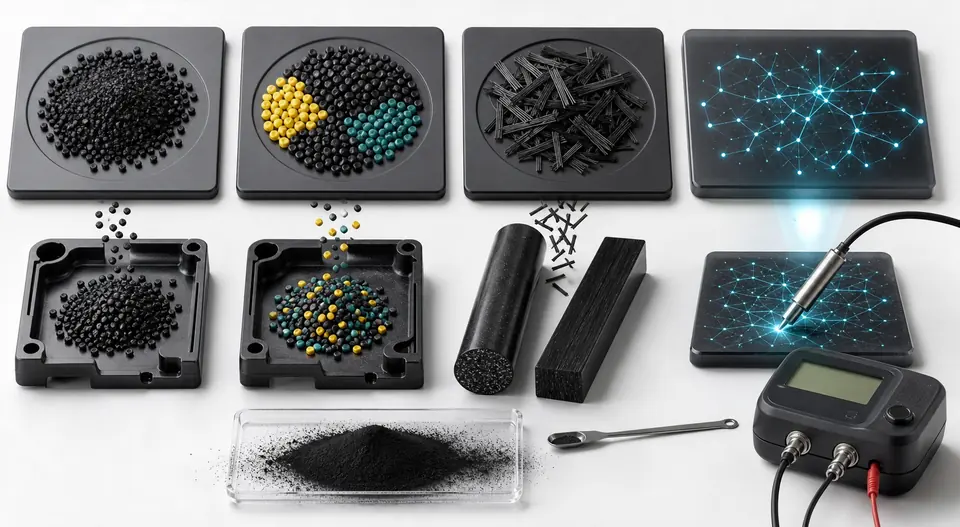
Conductive plastics are modified polymer materials with conductive fillers, conductive networks, or functional additives inside the resin system.
Common product forms include:
conductive compound; conductive thermoplastic compound; conductive plastic compound; conductive pellets; conductive granules; conductive masterbatch; custom conductive modified plastic.
Common base resins include:
PP; ABS; PC; PC/ABS; PA6; PA66; POM; PE; PBT; PPS; TPU; TPE; high-performance engineering plastics.
Common conductive routes include:
conductive carbon black; high-efficiency conductive carbon systems; carbon nanotubes; carbon fiber; graphite or graphene-related systems; metal fiber or metal-based systems; conductive masterbatch; permanent anti-static systems; hybrid conductive networks.
Different routes give different resistance levels, colors, mechanical properties, surface quality, cost, and processing behavior.
2. Conductive, Static-Dissipative, and Anti-Static: Do Not Mix Them Up
Many buyers use “conductive,” “anti-static,” and “ESD” interchangeably. In material selection, they should be distinguished.
| Level | Typical Surface Resistance Direction | Main Function | Typical Application |
|---|---|---|---|
| Anti-static | 10⁹–10¹² Ω | Reduce static accumulation and dust attraction | Covers, boxes, packaging parts |
| Static-dissipative | 10⁶–10⁹ Ω | Controlled discharge of static electricity | ESD trays, fixtures, electronic handling |
| Conductive | 10³–10⁶ Ω | Faster charge transfer | Powder equipment, industrial trays, rollers |
| High-conductive | 10²–10³ Ω direction | Strong conductive pathway | Special grounding-related industrial parts |
The lower the resistance target, the more difficult the formulation usually becomes. Very low resistance may require higher conductive filler loading or a more efficient conductive network. This may affect toughness, flowability, surface quality, color, dimensional stability, and cost.
Professional purchasing should not simply choose the lowest resistance. The correct choice is the resistance range that solves the application problem while maintaining the necessary product performance.
3. Main Functions of Conductive Plastics
3.1 ESD Protection
In electronic assembly, component storage, semiconductor packaging, and precision equipment, conductive or static-dissipative plastics can help control electrostatic discharge.
Typical parts:
ESD trays; electronic component boxes; transport carriers; fixtures; assembly jigs; IC handling parts; cleanroom plastic components.
Selection focus:
surface resistance stability; volume resistance if required; cleanliness; dust control; impact strength; dimensional stability; long-term resistance consistency.
3.2 Dust Reduction
When ordinary plastic surfaces accumulate static charge, dust is easily attracted. Conductive or anti-static materials can reduce dust adhesion and cleaning frequency.
Typical parts:
industrial covers; air outlet covers; display covers; equipment housings; packaging trays; automation covers.
Selection focus:
anti-static or static-dissipative target; color; surface appearance; UV resistance if used outdoors; impact retention.
3.3 Powder Handling and Powder Release
Powder handling is one of the strongest application areas for conductive plastics. Ordinary insulating plastics may cause powder adhesion, flow interruption, and cleaning difficulty.
Typical parts:
powder transfer components; hopper liners; powder covers; feeding trays; powder equipment guards; industrial dust collection parts.
Selection focus:
conductive resistance level; surface smoothness; wear resistance; chemical resistance; cleaning method; black color acceptance; impact strength.
3.4 Mechanical Equipment Stability
In conveyor systems, textile machinery, packaging equipment, and automation lines, conductive plastics can reduce static-related sticking, sensor errors, dust accumulation, and unstable feeding.
Typical parts:
guide rails; rollers; sliders; gears; bushings; trays; mechanical guards; automation fixtures.
Selection focus:
conductivity plus wear resistance; low friction; dimensional stability; noise reduction; mold shrinkage control; mechanical strength.
3.5 Metal Replacement in Selected Parts
Conductive plastics can replace metal in some parts where electrical function, light weight, corrosion resistance, molding flexibility, and lower noise are required.
Typical parts:
conductive brackets; rollers; equipment covers; POM conductive gears; PA66 conductive structural parts; PP conductive trays; PPS conductive high-temperature parts.
Selection focus:
load condition; stiffness; creep resistance; wear behavior; temperature; resistance target; grounding design.
4. Technical Route 1: Conductive Carbon Black
Conductive carbon black is one of the most mature and cost-effective conductive routes.
Advantages
stable conductivity when dispersed properly; good cost-performance balance; suitable for many resins; mature compounding process; effective for black industrial parts; can achieve static-dissipative and conductive ranges.
Limitations
usually black; high addition may reduce impact strength; flowability may decrease; surface smoothness may be affected; dispersion strongly affects resistance stability.
Suitable Materials
conductive PP compound; conductive ABS compound; conductive POM compound; conductive PE compound; conductive PC/ABS compound; selected conductive nylon compounds.
Purchasing Advice
Choose this route when the product accepts black color and needs stable conductivity with reasonable cost.
5. Technical Route 2: Conductive Masterbatch
Conductive masterbatch is a concentrated conductive additive system designed for easier feeding, better dispersion, and adjustable resistance.
Advantages
better processing convenience; less powder handling in production; more stable feeding; easier small-batch trial; adjustable dosage; suitable for custom compound development; good for fast resistance tuning.
Limitations
carrier compatibility must be matched; too much masterbatch may affect mechanical properties; different base resins need different masterbatch systems; real-part testing is still necessary.
Suitable Materials
conductive PP compound; conductive ABS compound; conductive PE compound; conductive POM compound; conductive PA compound; custom conductive thermoplastic compounds.
DEYU Application Logic
DEYU uses conductive masterbatch routes when the customer needs flexible adjustment, small-batch validation, or customized conductive compounds. This is especially useful for PP, ABS, POM, PA, and PE systems where resistance targets and mechanical requirements vary by application.
6. Technical Route 3: Carbon Nanotube Conductive Network
Carbon nanotubes can form conductive networks at relatively low addition levels because of their high aspect ratio.
Advantages
lower addition level in selected systems; better mechanical retention than high-loading carbon black in some cases; suitable for thin-wall parts; stable static-dissipative performance when well dispersed; useful for high-end ESD applications.
Limitations
higher cost; difficult dispersion; dark color direction; resistance may vary with flow orientation; requires strict compounding control.
Suitable Applications
high-end ESD trays; thin-wall electronic parts; PC/ABS housings; PA and POM precision parts; parts requiring better toughness retention.
Purchasing Advice
Choose this route when ordinary carbon black affects mechanical properties too much or when lower filler loading is required.
7. Technical Route 4: Carbon Fiber Reinforced Conductive Plastics
Carbon fiber provides both conductivity and reinforcement. It is suitable when conductivity must coexist with stiffness, strength, dimensional stability, and heat resistance.
Advantages
conductivity plus reinforcement; higher stiffness; lower shrinkage; better dimensional stability; suitable for structural parts; useful for metal replacement.
Limitations
usually black or dark; higher cost; risk of brittleness; fiber orientation affects resistance; surface may become rough; mating surface wear must be evaluated.
Suitable Materials
carbon fiber reinforced PA66; carbon fiber reinforced PA6; carbon fiber reinforced POM; carbon fiber reinforced PP; carbon fiber reinforced PC; PPS conductive reinforced compounds.
Purchasing Advice
Choose this route when the part needs conductivity and rigidity at the same time, such as brackets, supports, mechanical components, rollers, structural trays, or precision equipment parts.
8. Technical Route 5: Hybrid Conductive + Functional Modification
Many real applications require conductivity plus another function.
Common combinations include:
conductive + wear resistant; conductive + flame retardant; conductive + UV resistant; conductive + low friction; conductive + high impact; conductive + glass fiber reinforcement; conductive + carbon fiber reinforcement; conductive + low warpage; conductive + cold resistant.
Examples:
conductive POM + PTFE for low-friction gears; conductive PA66 + glass fiber for structural ESD parts; conductive PP + flame retardant for electrical trays; conductive ABS + impact modifier for powder equipment covers; conductive PC/ABS + flame retardant for electronic housings; conductive nylon + carbon fiber for mechanical components.
This is where customized formulation becomes important. A ready-made conductive material may not solve the real part problem if wear, impact, flame retardancy, shrinkage, or color is ignored.
9. Professional Purchasing Guide: How to Choose Conductive Plastics
Step 1: Define the Real Problem
Before asking for conductive plastic, define the failure:
dust adhesion; ESD warning; powder sticking; film sticking; feeding instability; sensor error; metal replacement; wear powder accumulation; static shock; grounding requirement.
Different problems require different resistance levels.
Step 2: Define the Resistance Target
Ask clearly:
surface resistance or volume resistance? target 10⁹–10¹² Ω, 10⁶–10⁹ Ω, 10³–10⁶ Ω, or 10²–10³ Ω? test on standard specimen or real molded part? test before or after aging? test at what humidity and temperature?
A material that is 10⁶ Ω on a test bar may not be the same on a thin-wall real part. Resistance can be affected by part thickness, gate position, filler orientation, humidity, and testing method.
Step 3: Choose the Base Resin
Common choices:
PP for low cost, chemical resistance, trays, covers, and packaging parts; ABS for appearance housings and equipment covers; PC/ABS for electrical housings, impact and flame-retardant balance; PA6 / PA66 for structural mechanical parts and reinforced ESD components; POM for gears, sliders, bushings, and low-friction moving parts; PE for packaging and chemical-resistant parts; PPS for high-temperature conductive components; TPU for flexible conductive rollers or sleeves.
Step 4: Confirm Color Requirement
Color strongly affects route selection.
Black conductive materials are easier to develop with carbon black or carbon fiber. Light-colored anti-static materials usually need permanent anti-static systems. Transparent conductive materials are much more difficult and require special routes. Colored conductive materials need careful pigment and resistance balance.
Do not ask for low resistance and bright color at the same time without validating feasibility.
Step 5: Confirm Mechanical and Processing Requirements
Conductive fillers may affect:
impact strength; elongation; flowability; surface quality; warpage; shrinkage; weld line strength; mold wear; fiber orientation; brittleness.
A professional purchase specification should include both electrical and mechanical targets.
Step 6: Confirm Additional Functions
Check whether the product also needs:
flame retardancy; wear resistance; low friction; UV resistance; low-temperature toughness; high rigidity; impact resistance; food contact or cleanroom requirements; chemical resistance.
The earlier these requirements are confirmed, the fewer trial errors will occur.
10. Purchasing Specification Template
A professional inquiry for conductive plastics can be written like this:
We need a conductive thermoplastic compound for injection molding. Base resin: PP / ABS / PC/ABS / PA66 / POM. Application: ESD tray / powder equipment cover / mechanical roller / electronic housing / gear / fixture. Target surface resistance: 10⁶–10⁸ Ω / 10³–10⁵ Ω / other range. Color: black / gray / custom color. Part thickness: ____ mm. Processing method: injection molding / extrusion. Mechanical requirements: impact strength, stiffness, wear resistance, or low friction. Additional requirements: flame retardancy, UV resistance, anti-static, low warpage, or low-temperature toughness. Testing method: standard specimen or final part. Current problem: dust adhesion / sticking / ESD warning / cracking / warpage / poor flow.
This type of inquiry allows material suppliers to select the correct conductive route instead of simply quoting a generic conductive material.
11. Customer Case 1: Conductive PP Tray for Packaging Equipment
Original Situation
A packaging equipment customer used ordinary PP trays to transfer lightweight plastic caps. The trays were low-cost and easy to mold, but caps often stuck to the tray surface because of static electricity.
Main problems:
caps did not release smoothly; feeding rhythm became unstable; manual correction was required; dust adhesion increased; production speed could not reach target.
Original Data
| Item | Original PP Tray |
|---|---|
| Surface resistance | >10¹³ Ω |
| Cap release abnormality | 12–18 times/hour |
| Dust adhesion after 8 hours | 3.8 g/m² |
| Production speed | 84–88% of target |
| Rejection due to feeding issue | 3.4% |
| Tray warpage | Acceptable but unstable |
DEYU Improvement Plan
DEYU recommended a DGK conductive PP compound based on a conductive masterbatch route.
The formulation direction included:
conductive PP network; surface resistance target around 10⁵–10⁶ Ω; injection flowability retention; impact balance at tray corners; warpage control; stable release surface.
Debugging Process
First Trial
Surface resistance reached the target direction, but slight warpage appeared after molding.
Adjustment:
optimized PP base resin; adjusted conductive masterbatch dosage; improved cooling balance; reduced local conductive filler concentration.
Second Trial
Warpage improved, but tray corner impact was slightly low.
Adjustment:
added impact balance modifier; adjusted mold temperature; optimized filler dispersion; recommended holding pressure adjustment.
Final Trial
The tray achieved stable cap release and reduced static-related feeding problems.
Final Result
| Item | Original PP | DEYU Conductive PP Tray Material |
|---|---|---|
| Surface resistance | >10¹³ Ω | 10⁵–10⁶ Ω |
| Cap release abnormality | 12–18 times/hour | 1–3 times/hour |
| Dust adhesion after 8 hours | 3.8 g/m² | 0.9 g/m² |
| Production speed | 84–88% of target | 97–99% of target |
| Rejection due to feeding issue | 3.4% | 0.6% |
| Tray warpage | Acceptable but unstable | Stable after process adjustment |
Case Conclusion
The customer did not need a general anti-static PP. Because cap sticking directly affected feeding speed, a conductive PP compound gave better release stability and reduced production interruption.
12. Customer Case 2: Conductive POM Gear for Mechanical Equipment
Original Situation
A mechanical equipment customer used ordinary POM gears. The gears had low friction and good wear behavior, but after long operation, static charge and wear powder accumulated around the gear housing.
Main problems:
wear powder adhesion; static accumulation; gear noise increase; sensor contamination; unstable long-term operation.
Original Data
| Item | Original POM Gear |
|---|---|
| Surface resistance | >10¹³ Ω |
| Gear noise after 100 hours | 62 dB |
| Tooth wear after 200 hours | 0.12 mm |
| Wear powder accumulation | Medium to high |
| Transmission abnormality | 4 times / 200 hours |
| Assembly pass rate | 92% |
DEYU Improvement Plan
DEYU recommended a DGK conductive wear-resistant POM compound.
The formulation direction included:
conductive network for static dissipation; POM dimensional stability; PTFE-assisted low-friction system; wear-resistant additive balance; molding shrinkage control.
Debugging Process
First Trial
Conductivity improved, but gear noise did not decrease enough.
Adjustment:
improved PTFE balance; optimized surface smoothness; adjusted mold temperature.
Second Trial
Noise improved, but tooth wear needed further reduction.
Adjustment:
introduced hybrid wear-resistant additive; controlled conductive filler dispersion; optimized cooling and holding pressure.
Final Trial
The gear achieved better static dissipation, lower wear powder accumulation, and improved operation stability.
Final Result
| Item | Original POM | DEYU Conductive Wear-Resistant POM |
|---|---|---|
| Surface resistance | >10¹³ Ω | 10⁶–10⁷ Ω |
| Gear noise after 100 hours | 62 dB | 56 dB |
| Tooth wear after 200 hours | 0.12 mm | 0.05 mm |
| Wear powder accumulation | Medium to high | Low |
| Transmission abnormality | 4 times / 200 hours | 0–1 time / 200 hours |
| Assembly pass rate | 92% | 98% |
Case Conclusion
For moving parts, conductive plastic must often be developed together with wear resistance and dimensional stability. A simple conductive filler addition would not be enough.
13. Customer Case 3: Conductive ABS Cover for Powder Handling Equipment
Original Situation
A powder handling equipment customer used ordinary ABS covers. ABS provided good appearance and molding performance, but powder strongly adhered to the cover surface after continuous operation.
Main problems:
powder adhesion; cleaning difficulty; powder contamination risk; static accumulation; manual cleaning time too long.
Original Data
| Item | Original ABS Cover |
|---|---|
| Surface resistance | 10¹³ Ω direction |
| Notched impact strength | 18 kJ/m² |
| Powder adhesion after 4 hours | 6.2 g/m² |
| Manual cleaning time | 22 minutes/shift |
| Surface appearance | Good gloss |
| Powder contamination risk | High |
DEYU Improvement Plan
DEYU recommended a DGK conductive ABS compound.
The formulation direction included:
conductive carbon network; surface resistance target around 10⁵–10⁶ Ω; impact retention; surface appearance balance; powder release improvement; stable injection molding.
Debugging Process
First Trial
Surface resistance reached the conductive range, but the surface became slightly rough.
Adjustment:
optimized conductive filler dispersion; changed masterbatch carrier compatibility; adjusted injection temperature and screw speed.
Second Trial
Surface quality improved, but impact strength was slightly below expectation.
Adjustment:
added impact balance modifier; reduced filler agglomeration; optimized drying and molding conditions.
Final Trial
The cover achieved conductive performance with acceptable appearance and impact strength.
Final Result
| Item | Original ABS | DEYU Conductive ABS Compound |
|---|---|---|
| Surface resistance | 10¹³ Ω direction | 10⁵–10⁶ Ω |
| Notched impact strength | 18 kJ/m² | 16.5 kJ/m² |
| Powder adhesion after 4 hours | 6.2 g/m² | 1.4 g/m² |
| Manual cleaning time | 22 minutes/shift | 7 minutes/shift |
| Surface appearance | Good gloss | Slight matte, acceptable |
| Powder contamination risk | High | Reduced |
Case Conclusion
The customer did not need a metal cover. Conductive ABS reduced powder adhesion and cleaning time while keeping the processing advantages of ABS.
14. Customer Case 4: Static-Dissipative PC/ABS Fixture for Electronic Assembly
Original Situation
An electronics customer used ordinary PC/ABS fixtures in an automated assembly line. The fixtures had good strength and dimensional stability, but the surface resistance was too high, creating ESD warning events near electronic modules.
Main problems:
ESD warning events; dust adhesion; static charge accumulation; fixture positioning variation after long use; customer concern about electronic component safety.
Original Data
| Item | Original PC/ABS Fixture |
|---|---|
| Surface resistance | 10¹²–10¹³ Ω |
| Dimensional change after 500 cycles | 0.18 mm |
| ESD warning events | 9 times/week |
| Dust adhesion | Medium |
| Fixture service cycle | 4 weeks |
| Impact performance | Good |
DEYU Improvement Plan
DEYU recommended a DGK static-dissipative PC/ABS compound instead of a very low-resistance conductive grade.
The formulation direction included:
surface resistance target around 10⁷–10⁸ Ω; impact retention; dimensional stability; low dust adhesion; stable injection molding; controlled discharge rather than excessive conductivity.
Debugging Process
First Trial
Resistance met the target, but slight shrinkage difference appeared.
Adjustment:
modified PC/ABS ratio; optimized conductive additive dispersion; adjusted mold temperature and holding pressure.
Second Trial
Dimensional stability improved, but impact retention needed confirmation.
Adjustment:
balanced impact modifier; tested after temperature cycling; validated fixture positioning repeatability.
Final Trial
The fixture met both ESD and mechanical positioning requirements.
Final Result
| Item | Original PC/ABS | DEYU Static-Dissipative PC/ABS |
|---|---|---|
| Surface resistance | 10¹²–10¹³ Ω | 10⁷–10⁸ Ω |
| Dimensional change after 500 cycles | 0.18 mm | 0.09 mm |
| ESD warning events | 9 times/week | 0–1 time/week |
| Dust adhesion | Medium | Low |
| Fixture service cycle | 4 weeks | 6–8 weeks |
| Impact performance | Good | Good, within requirement |
Case Conclusion
For electronic assembly fixtures, the right solution was not the lowest resistance. A static-dissipative PC/ABS compound provided controlled discharge while maintaining dimensional accuracy and impact performance.
15. Customer Case 5: Conductive PA66 Reinforced Component for Textile Machinery
Original Situation
A textile machinery customer used reinforced PA66 parts in a yarn guiding mechanism. The material had good strength, but static charge accumulated during high-speed operation.
Main problems:
fiber dust accumulation; yarn sticking; unstable tension; occasional yarn breakage; frequent cleaning.
Original Data
| Item | Original Reinforced PA66 |
|---|---|
| Surface resistance | 10¹²–10¹³ Ω |
| Tensile strength | 118 MPa |
| Flexural modulus | 4,200 MPa |
| Notched impact strength | 7.5 kJ/m² |
| Yarn breakage frequency | 5–8 times / 10,000 m |
| Cleaning interval | Every 6 hours |
DEYU Improvement Plan
DEYU recommended a DGK conductive reinforced PA66 compound.
The formulation direction included:
conductive network for static dissipation; reinforcement system for stiffness retention; toughness balance; wear-resistant surface adjustment; smooth yarn-contact surface.
Debugging Process
First Trial
Surface resistance dropped to around 10⁸ Ω, but impact strength decreased more than expected.
Adjustment:
reduced conductive filler concentration; introduced nylon-specific toughness balance; optimized moisture conditioning before testing.
Second Trial
Mechanical performance improved, but the yarn contact surface needed better smoothness.
Adjustment:
adjusted lubricant and dispersion system; controlled fiber exposure; changed injection temperature profile.
Final Trial
The material achieved static-dissipative performance while maintaining structural strength and surface quality.
Final Result
| Item | Original PA66 | DEYU Conductive Reinforced PA66 |
|---|---|---|
| Surface resistance | 10¹²–10¹³ Ω | 10⁶–10⁷ Ω |
| Tensile strength | 118 MPa | 112 MPa |
| Flexural modulus | 4,200 MPa | 4,350 MPa |
| Notched impact strength | 7.5 kJ/m² | 7.1 kJ/m² |
| Yarn breakage frequency | 5–8 times / 10,000 m | 1–2 times / 10,000 m |
| Cleaning interval | Every 6 hours | Every 12–16 hours |
Case Conclusion
For textile machinery, conductivity alone was not enough. The final material had to balance conductivity, stiffness, toughness, surface smoothness, and wear behavior.
16. How DEYU plastics Supports Conductive Plastic Selection
Yuyao Deyu DEYU plastics provides customized conductive plastic compounds and conductive masterbatch solutions.
Solution Directions
DEYU can support:
DGK conductive PP compound; DGK conductive ABS compound; DGK conductive PC compound; DGK conductive PC/ABS compound; DGK conductive PA6 compound; DGK conductive PA66 compound; DGK conductive POM compound; DGK conductive PE compound; DGK conductive PPS compound; DGK conductive TPU compound; DGK conductive masterbatch series; conductive + wear-resistant materials; conductive + flame-retardant materials; conductive + UV-resistant materials; conductive + carbon fiber reinforced materials; conductive + low-warpage materials; conductive + high-impact materials.
Customizable Factors
DEYU can adjust:
surface resistance range; volume resistance range; base resin; conductive filler system; conductive masterbatch dosage; carbon black network; carbon fiber content; carbon nanotube route; impact strength; flexural modulus; wear resistance; friction coefficient; flowability; shrinkage and warpage; flame retardancy; UV resistance; color; surface appearance; cost target.
Information DEYU Recommends Buyers Provide
To select a suitable conductive plastic compound, DEYU recommends providing:
application scenario; current material; target resin; current resistance; target resistance range; surface or volume resistance test method; part thickness; part drawing or sample; processing method; color requirement; mechanical requirements; flame retardancy requirement; wear or low-friction requirement; UV or low-temperature requirement; current failure mode; customer acceptance standard.
Conclusion
Conductive plastics are functional engineering materials used to solve real industrial problems: static accumulation, ESD risk, dust adhesion, powder sticking, unstable feeding, wear powder accumulation, and the need for lightweight conductive parts.
The key to purchasing conductive plastics is not choosing the lowest resistance. The key is selecting the correct resistance range, base resin, conductive route, mechanical balance, processing method, and validation standard.
Conductive carbon black is suitable for cost-effective black conductive materials. Conductive masterbatch is useful for adjustable and customized conductive compounds. Carbon nanotubes may be used when lower filler loading or better mechanical retention is needed. Carbon fiber reinforced conductive plastics are suitable when conductivity and rigidity must coexist. Hybrid conductive systems are necessary when conductivity must be combined with wear resistance, flame retardancy, UV resistance, impact strength, or low warpage.
Yuyao Deyu DEYU plastics provides DGK conductive plastic compounds and conductive masterbatch solutions for PP, ABS, PC, PC/ABS, PA6, PA66, POM, PE, PPS, TPU, and other resin systems. Instead of only supplying a generic conductive plastic, DEYU focuses on matching the resistance target, material route, part structure, and actual working condition, so that the final compound can meet both electrical and mechanical requirements.