
Conductive PP Compound for Molded Industrial Parts: Selection and Validation Guide
Polypropylene (PP) is one of the most widely used thermoplastics in industrial applications. With a density of just 0.90–0.91 g/cm³, it is the lightest of the common plastics, offering excellent chemical resistance, good processability, and low cost. However, standard PP has surface resistivity above 10¹⁶ Ω, making it highly susceptible to electrostatic charge accumulation — a serious risk for electronics handling, cleanroom environments, and industrial operations where static discharge can damage components or attract dust.
Buyer and engineer FAQ
Questions engineers often ask about this material route
Where can PP with a conductive plastic requirement be used?
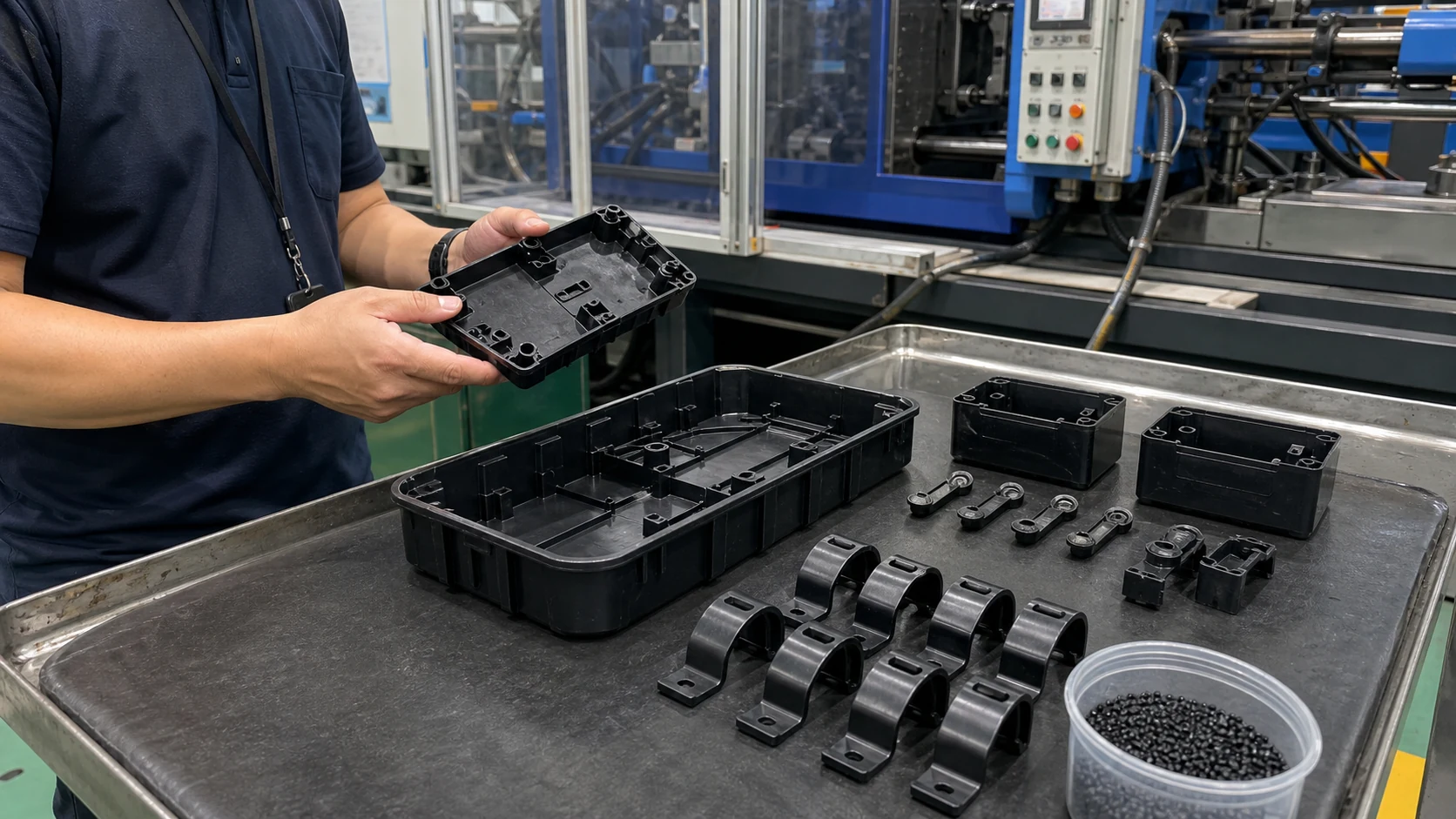
Typical fields include ESD trays, electronic housings, fixtures, EMI parts and antistatic logistics parts. For this article, DEYU would first confirm the working environment, wall thickness, expected lifetime and whether DGK-PP DD2-3A conductive PP, DGK-PP DD4-5A-JC flame-retardant conductive PP matches the part geometry or needs formulation adjustment.
What are the main performance indicators for the "conductive plastic" target on PP?
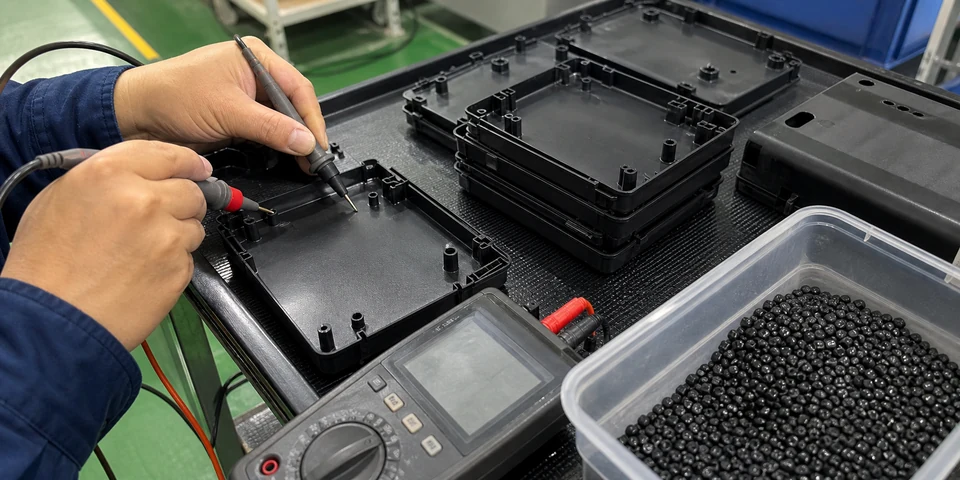
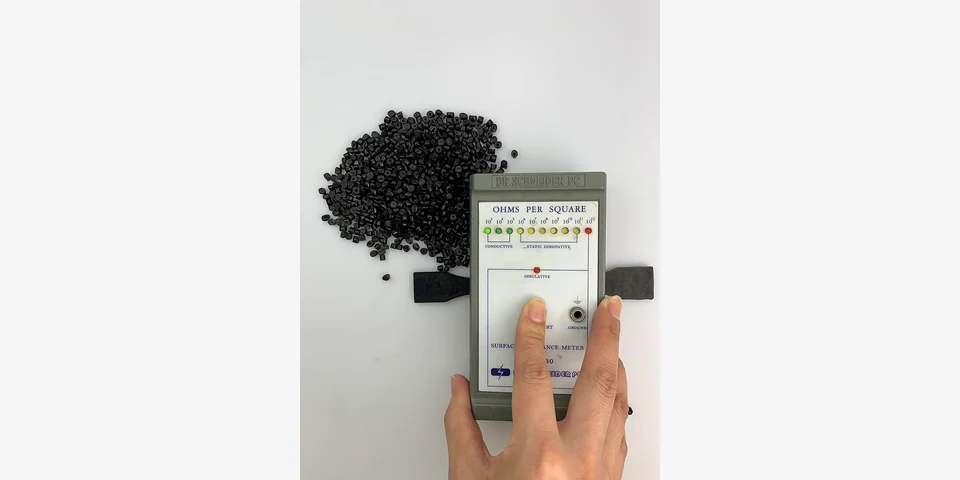
Focus on surface resistance, volume resistance, dispersion uniformity, impact strength and molding stability. Buyers should ask for data on molded parts, not only pellet data, because gate position, filler orientation and thickness can change the final value.
What should engineers watch during injection molding or processing?
For PP, a practical starting window is 190-230°C melt / 30-60°C mold. Avoid excessive filler loading, control weld lines and verify resistance on the molded part. Final parameters should follow part thickness, gate design and the actual machine.
What details help DEYU recommend DGK-PP DD2-3A conductive PP, DGK-PP DD4-5A-JC flame-retardant conductive PP more accurately?
Send the current resin or grade, drawing or photo, wall thickness, annual quantity, target standard, failure mode and required color. If a reference grade already passed one test but failed in production, include both data sets.
For a precise recommendation, share the part drawing, base resin, target performance, processing method and test standard with DEYU.
Background / Problem
Polypropylene (PP) is one of the most widely used thermoplastics in industrial applications. With a density of just 0.90–0.91 g/cm³, it is the lightest of the common plastics, offering excellent chemical resistance, good processability, and low cost. However, standard PP has surface resistivity above 10¹⁶ Ω, making it highly susceptible to electrostatic charge accumulation — a serious risk for electronics handling, cleanroom environments, and industrial operations where static discharge can damage components or attract dust.
Related DEYU plastics material references for this selection topic: DGK-PP DD2-3A conductive PP and DGK-PP DD4-5A-JC flame-retardant conductive PP.
The challenge: Adding conductive fillers to PP transforms it from an insulator into a material that can dissipate static charge, but the choice of filler — carbon black, carbon fiber, carbon nanotubes (CNT), or hybrid systems — fundamentally changes the material's mechanical properties, surface quality, processing behavior, and cost.
Industrial applications for conductive PP include:
ESD trays, containers and storage boxes for electronic components
Protective housings for sensitive equipment
Handling equipment and production aids
Chemical-resistant components requiring static dissipation
Automotive interior anti-static parts
Instrument housings and anti-static work surfaces
The cost of poor selection: A conductive PP compound that fails in production leads to scrap, rework, delayed delivery, and field failures. Understanding the selection logic and validation process is essential for reliable industrial performance.
Technical Difficulty / Why Conductive PP Requires Careful Selection
1. The Percolation Threshold — The Critical Concept
Conductive fillers in PP form a physical network of particles that carries electrical charge. The percolation threshold is the minimum filler concentration at which this network becomes continuous. Below this threshold, the material remains insulative. At the threshold, resistivity drops dramatically. Above it, resistivity plateaus.
For carbon black in PP, the percolation threshold typically ranges from 10–20 wt%, depending on the carbon black grade and dispersion quality. CNT-based compounds achieve percolation at much lower loadings — typically 0.1–1 wt% — because of the extremely high aspect ratio of nanotubes.
The implication: Loading must be high enough to exceed the percolation threshold for stable conductivity, but low enough to preserve mechanical properties and processability.
2. Filler Selection — The Three Primary Routes
| Route | Filler | Typical Resistivity | Key Advantage | Key Limitation |
|---|---|---|---|---|
| Carbon Black | CB aggregates | 10⁴–10⁶ Ω·cm | Low cost, proven technology | Higher loading reduces impact and flow |
| Carbon Fiber | CF fibers | 10²–10⁴ Ω·cm | Mechanical reinforcement + conductivity | Higher cost; anisotropic properties |
| CNT | Carbon nanotubes | 10²–10⁶ Ω·cm | Property preservation; low loading | Higher cost; dispersion critical |
| Permanent Anti-Static | Polymer alloy | 10⁹–10¹¹ Ω·cm | Colorable; humidity-independent | Higher resistivity range only |
3. Processing Sensitivity — The Hidden Variable
Conductive PP compounds are more sensitive to processing conditions than unfilled PP. Small variations in melt temperature, injection speed, or mold temperature can cause resistivity to drift out of specification.
Key processing factors:
| Factor | Effect | Recommended Approach |
|---|---|---|
| Melt temperature | Affects filler dispersion and network formation | Stay within recommended range |
| Injection speed | Affects filler orientation and anisotropy | Optimize for part geometry |
| Mold temperature | Affects crystallization and skin-core structure | Set for optimal crystallinity |
| Shear rate | Can break filler networks or cause orientation | Avoid excessive shear |
For carbon black-filled PP, mold temperature must sometimes be limited to prevent filler migration to the surface. For CNT-based compounds, higher mold temperatures are possible because CNT does not migrate to the surface — enabling optimal polymer crystallization.
4. Filler Orientation and Anisotropy
During injection molding, fibrous fillers (carbon fiber, CNT) align with the flow direction, creating anisotropic conductivity — higher along the flow direction, lower across it. This means that resistivity can vary significantly between flow and transverse directions on the same part. Part geometry, gate location, and flow path design must account for this anisotropy.
5. Weld Line Sensitivity
Weld lines (where two flow fronts meet) are critical failure points for conductive PP. Filler concentration naturally drops at weld lines, creating localized high-resistivity zones. This must be addressed through gate placement, processing optimization, or hybrid filler systems that perform better at weld lines.
DEYU Material Direction — DGK-PP Series
DEYU offers a comprehensive range of conductive PP compounds under the DGK-PP series, covering multiple filler routes and resistivity targets across PP, PE, PVC, PA, POM, ABS, and TPV base materials.
DGK-PP KJD789R1 — Permanent Anti-Static PP
| Property | Value | Test Method |
|---|---|---|
| Base Resin | PP (copolymer) | — |
| Technology | Permanent anti-static polymer alloy | — |
| Density | 0.93 g/cm³ | GB/T 1033 |
| MFR (230°C/2.16kg) | 7 g/10min | GB/T 3682 |
| Tensile Strength | 17 MPa | GB/T 1040 |
| Flexural Modulus | 1,790 MPa | GB/T 9341 |
| Notched Charpy Impact | 6.5 kJ/m² | GB/T 1043.1 |
| Unnotched Charpy Impact | 40 kJ/m² | GB/T 1043.1 |
| HDT (A method) | 93°C | GB/T 1633 |
| Surface Resistivity | 10⁹–10¹¹ Ω·cm | GB/T 1410 |
| Flammability | HB | GB/T 2408 |
| Color | Natural (colorable) | — |
| Processing | Injection molding | — |
Key Features: Humidity-independent performance — the anti-static component is anchored within the polymer matrix and does not migrate or wash out. Surface resistivity remains stable through multiple alcohol wipes. Available in natural state for custom color matching.
DGK-PP DD4-5 — High-Impact Conductive PP
| Property | Value | Test Method |
|---|---|---|
| Base Resin | PP (modified) | — |
| Technology | Carbon black conductive | — |
| Density | 0.965 g/cm³ | — |
| MFR | 7 g/10min | — |
| Tensile Strength | 21.8 MPa | — |
| Elongation at Break | 90% | — |
| Izod Notched Impact | 35 kJ/m² | — |
| HDT | 105°C | — |
| Surface Resistivity | 10⁴–10⁵ Ω·cm | — |
| Processing | Injection molding | — |
Key Features: High impact resistance (35 kJ/m² Izod) with elongation at break of 90% — significantly higher than typical carbon black-filled PP. Stable surface conductivity for ESD protection while retaining PP's chemical resistance and processability. Suitable for thin-wall and complex geometry molding.
DGK-PP DD2-3A — CNT-Based Conductive PP
| Property | Value | Test Method |
|---|---|---|
| Base Resin | PP | — |
| Technology | Carbon nanotube composite | — |
| Surface Resistivity | 10²–10⁴ Ω | GB/T 1410 |
| Tensile Strength | Contact DEYU for data | GB/T 1040 |
| Processing | Injection molding | — |
| Applications | Medical device components, precision parts | — |
Key Features: CNT-based conductive network at very low loading, preserving PP's mechanical properties and surface quality. Validated in medical device applications.
DGK-PP DDL28 — Ultra-Conductive PP (Super Conductive)
| Property | Value | Test Method |
|---|---|---|
| Base Resin | PP | — |
| Technology | Ultra-conductive hybrid | — |
| Volume Resistivity | 0.04–0.05 Ω·cm | — |
| Density | ~0.90 g/cm³ | — |
| Processing | Compression molding, extrusion | — |
Key Features: Volume resistivity 0.04–0.05 Ω·cm — thousands of times lower than traditional carbon black-filled PP (10²–10³ Ω·cm). Retains PP's low density (~0.90 g/cm³) — significantly lighter than graphite (1.8–2.0 g/cm³) and metals (2.7–8.0 g/cm³). Suitable for fuel cell and flow battery electrode plates.
Customer Debugging / Validation Scenario
Context: An electronics manufacturer was producing ESD trays for semiconductor handling using a carbon black-filled PP compound. The target surface resistivity was 10⁶–10⁸ Ω/sq. The material passed incoming inspection, but production showed inconsistent resistivity — values ranging from 10⁶ Ω/sq near the gate to >10⁹ Ω/sq at weld lines and end-of-fill locations.
Problem analysis: Three issues were identified:
| Issue | Root Cause | Impact |
|---|---|---|
| Resistivity at weld lines | Carbon black concentration dropped below percolation threshold at flow front coalescence | 12% reject rate |
| Resistivity variation | Loading at percolation threshold; processing variations caused network disruption | Inconsistent ESD performance |
| Surface quality | Carbon black agglomerates created rough surface | Aesthetic rejections |
Trial structure:
| Parameter | Value |
|---|---|
| Trial Quantity | 1,000 trays (5 molding cycles) |
| Monthly Production | 200,000 trays |
| Target Surface Resistivity | 10⁶–10⁸ Ω/sq |
DEYU interventions:
Material change — Switched from standard carbon black PP to DGK-PP DD4-5 with optimized carbon black loading and impact modification
Hybrid option — Evaluated DGK-PP DD2-3A (CNT-based) for property preservation
Process optimization — Adjusted melt temperature and injection speed based on DEYU processing recommendations
Validation Data Table (customer internal trial structure):
| Parameter | Existing Material (CB-PP) | DGK-PP DD4-5 | DGK-PP DD2-3A (CNT) | Target |
|---|---|---|---|---|
| Surface Resistivity Range (Ω/sq) | 10⁶–10⁹ | 10⁵–10⁶ | 10⁴–10⁵ | 10⁶–10⁸ |
| Resistivity at Weld Line (Ω/sq) | 8×10⁹ | 6×10⁶ | 4×10⁵ | <10⁸ |
| Resistivity Variation (max/min) | 1,000:1 | 20:1 | 8:1 | <10:1 |
| Impact Strength (kJ/m²) | 3.5 | 35 (Izod) | ~25 | >10 |
| Molding Scrap Rate | 12% | 4.5% | 3% | <5% |
| Surface Quality | Rough | Good | Excellent | Acceptable |
| Material Cost ($/kg) | $4.50 | $5.20 | $7.80 | — |
Result Interpretation:
Existing material: The standard carbon black PP was at the percolation threshold. Processing variations caused the network to break and reform, resulting in inconsistent resistivity. Weld lines showed the highest resistivity — 1,000× higher than the gate area — causing the 12% reject rate.
DGK-PP DD4-5: The optimized carbon black formulation with impact modification delivered stable resistivity across the part, including at weld lines. The high impact strength (35 kJ/m² Izod) and 90% elongation at break provided durability for handling applications. Scrap rate dropped from 12% to 4.5%.
DGK-PP DD2-3A (CNT): The CNT-based compound provided the best resistivity stability and surface quality, with the lowest variation and excellent surface appearance. However, material cost was significantly higher.
DEYU plastics' contribution: DEYU provided a systematic comparison of three conductive routes, enabling the customer to select the optimal balance of performance and cost for their specific application.
Next steps: Full production validation of selected grade. DEYU can provide ongoing technical support and in-process resistivity monitoring protocols.
Suitable Applications — DGK-PP Grades by Application
| Application | Recommended Grade | Rationale |
|---|---|---|
| SMT trays, IC trays | DGK-PP KJD789R1 | Anti-static, colorable, humidity-independent |
| ESD trays, industrial containers | DGK-PP DD4-5 | High impact, stable conductivity |
| Electronic housings | DGK-PP DD4-5 or DD2-3A | Conductivity + mechanical properties |
| Medical device components | DGK-PP DD2-3A | Property preservation, validated |
| Battery electrode plates | DGK-PP DDL28 | Ultra-conductive, lightweight |
| Fuel cell bipolar plates | DGK-PP DDL28 | Ultra-conductive, chemical resistance |
| Cleanroom fixtures | DGK-PP KJD789R1 | Low particle generation, colorable |
| Automotive interior ESD parts | DGK-PP KJD789R1 or DD4-5 | Lightweight, durable |
| Anti-static work surfaces | DGK-PP KJD789R1 | Permanent anti-static, colorable |
What Buyers Should Provide for Selection
To receive a precise conductive PP grade recommendation, buyers should provide:
Target resistivity — surface or volume resistivity range (Ω/sq or Ω·cm) with test standard
Application description — what is the part and what does it do?
Part drawing — geometry, wall thickness, gate location, weld line locations
Processing method — injection molding, extrusion, compression molding
Mechanical requirements — impact strength, tensile strength, flexural modulus
Thermal requirements — continuous use temperature, peak temperature
Surface appearance requirements — gloss, texture, color requirements
Environmental conditions — temperature range, chemical exposure, humidity
Production volume — annual or monthly quantity
Cost constraints — target material cost per kilogram or per part
DEYU can support with:
Grade selection based on application requirements
Processing window recommendations for stable resistivity
Small-batch validation (25–100 kg) with full testing
Technical support during molding trials
In-process quality monitoring protocols
Conclusion
Selecting and validating a conductive PP compound for industrial molded parts requires a systematic approach that balances electrical performance, mechanical properties, processing behavior, and cost.
Key takeaways:
The percolation threshold is critical — loading must exceed the percolation threshold for stable conductivity, but excessive loading degrades mechanical properties and processability
Different filler routes serve different applications — carbon black for cost-effective ESD; CNT for property preservation and surface quality; ultra-conductive grades for electrode applications
Processing conditions affect resistivity — melt temperature, injection speed, and mold temperature all influence filler network formation and final resistivity
Weld lines are the critical failure point — resistivity at weld lines can be 1–3 orders higher than surrounding material; address through gate placement and filler selection
Validation must be part-specific — standard test bars do not predict production part performance; validate in the actual production mold
DEYU offers a complete range of conductive PP compounds through the DGK-PP series — from permanent anti-static (KJD789R1) and high-impact conductive (DD4-5) to CNT-based (DD2-3A) and ultra-conductive (DDL28) grades — with the technical expertise to guide selection, optimize processing, and validate performance in production.