
Conductive TPU Cast Film: Processing Guide, Material Selection and Application Validation
TPU, or thermoplastic polyurethane, is widely used in films, tubes, cable jackets, footwear materials, protective films, elastic sheets and flexible functional materials because it combines flexibility, abrasion resistance, elasticity and thermoplastic processability.
Buyer and engineer FAQ
Questions engineers often ask about this material route
Where can TPU with a conductive plastic requirement be used?
Typical fields include ESD trays, electronic housings, fixtures, EMI parts and antistatic logistics parts. For this article, DEYU would first confirm the working environment, wall thickness, expected lifetime and whether DGK-TPU DD3-4ML Conductive TPU, Conductive Plastics matches the part geometry or needs formulation adjustment.
What are the main performance indicators for the "conductive plastic" target on TPU?
Focus on surface resistance, volume resistance, dispersion uniformity, impact strength and molding stability. Buyers should ask for data on molded parts, not only pellet data, because gate position, filler orientation and thickness can change the final value.
What should engineers watch during injection molding or processing?
For TPU, a practical starting window is 180-220°C melt / 20-50°C mold, dry before molding. Avoid excessive filler loading, control weld lines and verify resistance on the molded part. Final parameters should follow part thickness, gate design and the actual machine.
What details help DEYU recommend DGK-TPU DD3-4ML Conductive TPU, Conductive Plastics more accurately?
Send the current resin or grade, drawing or photo, wall thickness, annual quantity, target standard, failure mode and required color. If a reference grade already passed one test but failed in production, include both data sets.
For a precise recommendation, share the part drawing, base resin, target performance, processing method and test standard with DEYU.
1. Background / Problem
TPU, or thermoplastic polyurethane, is widely used in films, tubes, cable jackets, footwear materials, protective films, elastic sheets and flexible functional materials because it combines flexibility, abrasion resistance, elasticity and thermoplastic processability.
DGK-TPU DD3-4ML Conductive TPU and Conductive Plastics. Use the TPU grade as a flexible conductive reference and compare the broader conductive plastics category when the project needs a different base resin or resistance range.
DGK-TPU DD3-4ML Conductive TPU and Conductive Plastics are useful reference pages when a project needs a flexible conductive thermoplastic route. The existing DGK-TPU DD3-4ML data identifies a TPU compound with 10^4-10^6 ohm resistance, 66 R hardness, good wear resistance and elasticity. For cast film, the same electrical direction should still be validated on film thickness, winding and surface quality before mass production.
When TPU film is used for electronic packaging, ESD protection, flexible conductive layers, dust-control covers, anti-static industrial films, sensor auxiliary layers or protective films, ordinary insulating TPU may not meet the functional requirement. Buyers therefore search for conductive TPU compound, conductive TPU pellets, anti-static TPU film material or ESD TPU film.
The difficulty is not simply adding conductive filler into TPU. The conductive network must remain stable while the film keeps flexibility, smooth surface, stable thickness, low migration tendency and continuous winding performance. If the material is selected only by a resistance number, the production line may still see fish eyes, gels, black specks, uneven thickness, resistance drift, edge curl, whitening after stretch or roll blocking.
2. Basic Process Logic of Conductive TPU Cast Film
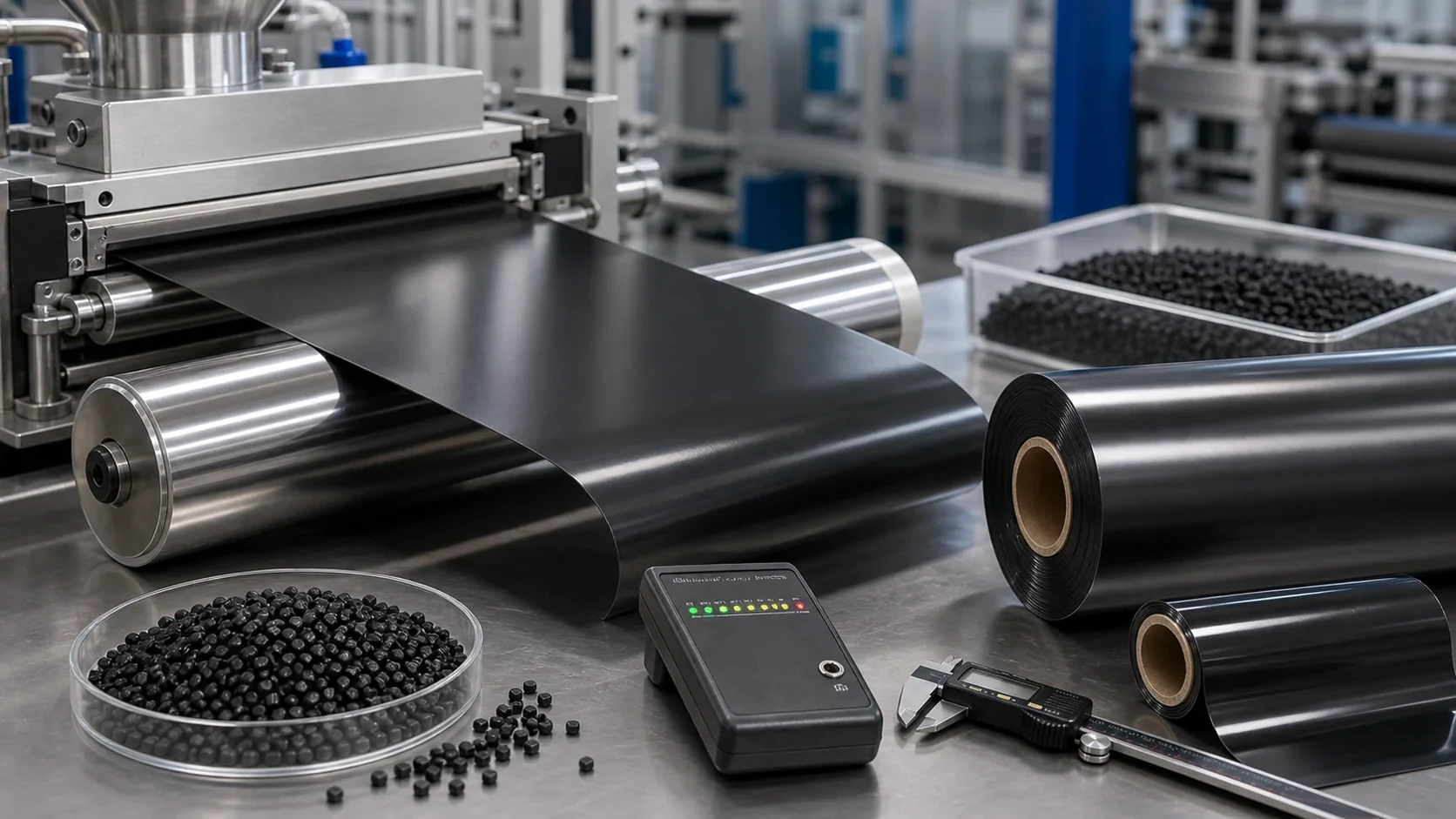
Conductive TPU cast film is usually produced through cast extrusion. The typical process is conductive TPU pellets, drying, extrusion plasticizing, melt filtration, T-die, chill roll casting, thickness control, traction, winding, then resistance and surface inspection.
TPU is moisture-sensitive. Before cast film extrusion, drying should be controlled carefully. Reference drying directions often fall around 80-100 °C for 3-5 hours, but the final setting must follow TPU type, moisture level, equipment and material validation. Poor drying can lead to bubbles, silver streaks, haze spots, melt fluctuation and unstable surface quality.
During extrusion, the material needs enough plasticizing and dispersion without degrading the TPU or conductive system. A practical reference window may place feeding, compression, metering and die zones in a gradually rising range around 150-205 °C, but this must be confirmed on the customer line. Melt temperature, screw design, filtration and residence time influence both film surface and resistance stability.
The T-die and chill roll affect film flatness, thickness and resistance uniformity. Reference validation thicknesses may include 0.05 mm, 0.08 mm, 0.10 mm and 0.20 mm, while wider development windows can extend from thin films to thicker elastic sheets. Each thickness should be tested separately because a material that passes at 0.20 mm may not hold the same resistance at 0.05 mm.
3. How to Select Conductive TPU
Conductive TPU selection should follow the real application logic: target resistance, film thickness, flexibility, conductive system, surface requirement, cast-film process and final application validation.
The first decision is whether the film needs anti-static, static dissipative or conductive behavior. If the purpose is dust reduction or static control in packaging, a dissipative range may be enough. If the film is used as a flexible conductive layer, grounding strip or functional current path, lower and more stable resistance must be validated.
The second decision is the TPU base. Polyether TPU is often considered when hydrolysis resistance, humid environments and low-temperature flexibility matter. Polyester TPU may be considered when abrasion resistance and mechanical strength are more important. Special modified TPU can be developed when the project also requires flame retardancy, transparency, low migration, high wear resistance or low-temperature flexibility.
Hardness also matters. A soft TPU film may feel flexible but can create blocking, stretching deformation or winding issues. A harder TPU may support better handling but can reduce bending feel or lamination performance. The existing DGK-TPU DD3-4ML reference hardness of 66 R is a useful flexible TPU direction, but film-level testing is still required.
4. Key Selection Factors
4.1 Resistance Range
Conductive TPU, anti-static TPU and ESD TPU are often used as search terms, but they do not mean the same thing. Buyers should define target surface resistance, volume resistance if needed, test voltage, sample conditioning, humidity and measurement position.
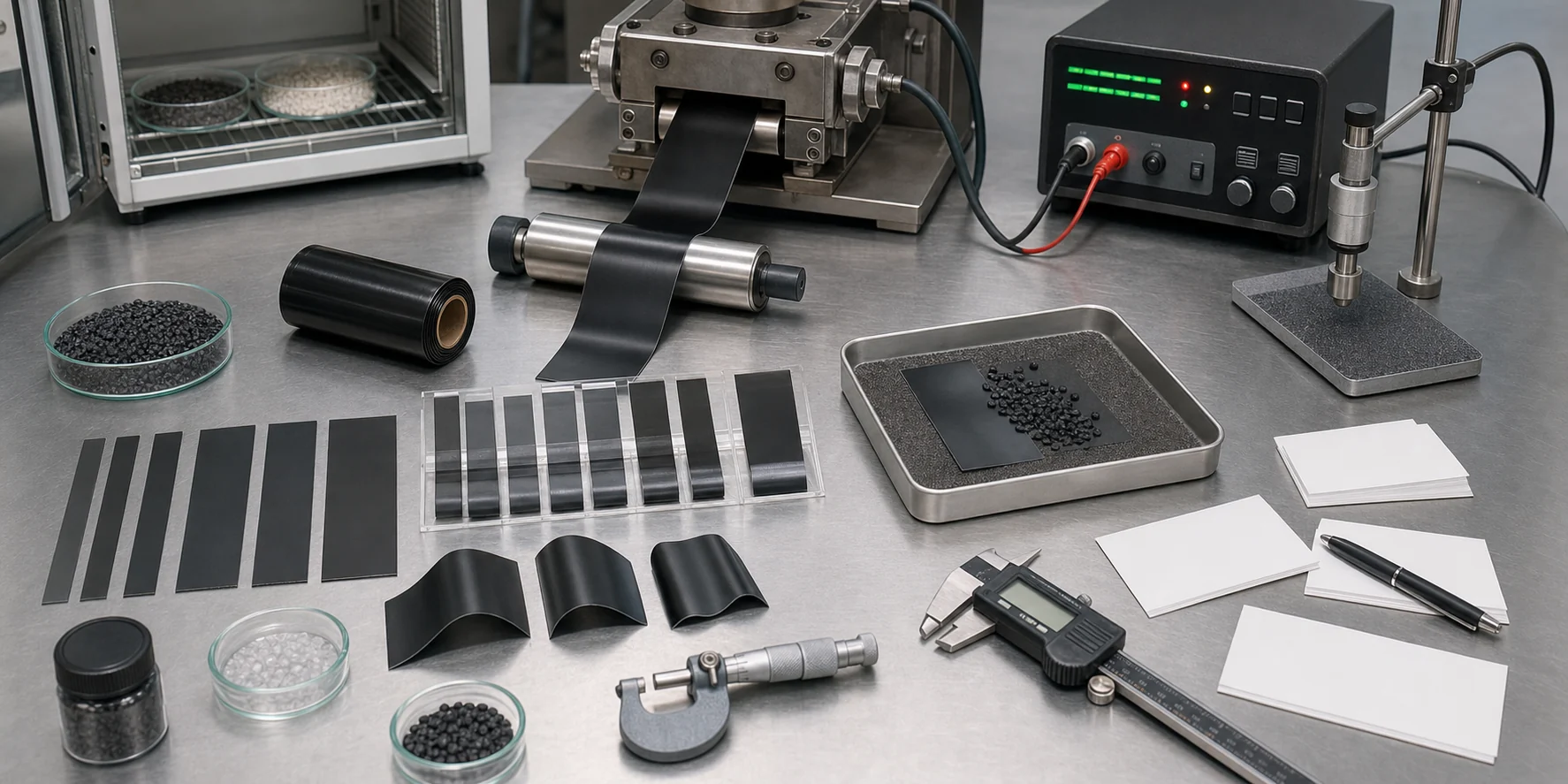
For film, resistance should be measured at multiple points: machine direction, transverse direction, center, edge, inner winding layer, outer winding layer and after storage. A single value on a pellet plaque is not enough.
4.2 Conductive System
Common conductive systems for TPU film include conductive carbon black, carbon nanotubes, graphite, graphene direction, short carbon fiber and hybrid systems.
Carbon black is often practical for black conductive film and cost control, but loading level may affect flexibility and surface smoothness. CNT or hybrid systems may support lower loading or better network efficiency, but dispersion, cost and resistance uniformity must be validated. Ionic anti-static systems may be used for light-color or transparent anti-static directions, but migration, humidity dependence and long-term stability need special attention.
4.3 Surface Quality
Conductive filler makes film surface control more difficult. The line should inspect fish eyes, gels, rough particles, black specks, flow marks, transverse lines, thickness variation and roll flatness. These issues are controlled through pellet dispersion, drying, melt filtration, die maintenance and casting conditions together.
4.4 Flexibility and Winding
Increasing conductive filler may reduce resistance but also change elasticity, elongation, tear strength and hand feel. For flexible conductive film, the goal is not the lowest possible resistance. The film must still pass bending, stretching, abrasion, winding and lamination checks.
5. DEYU Material Direction
DEYU evaluates conductive TPU cast film projects by combining compound data with film-line validation.
| Evaluation Point | DEYU Direction |
|---|---|
| Base resin | Polyester TPU, polyether TPU or customized TPU system |
| Conductive target | Anti-static, static dissipative, conductive or customized resistance range |
| Conductive route | Carbon black, CNT, graphite, hybrid conductive system or low-migration anti-static route |
| Hardness | Flexible TPU direction such as 85A-95A, adjusted by film requirement |
| Processing | Cast film extrusion, sheet extrusion or extrusion validation |
| Surface quality | Fish eye, gel, black speck, roughness and haze inspection |
| Film behavior | Thickness stability, edge curl, stretching whitening, roll blocking and winding flatness |
| Validation | Pellet test, film test, roll test and customer application trial |
DEYU can use existing conductive TPU experience as a starting point, then adjust base TPU, filler dispersion, flowability, hardness and conductive route according to film thickness and customer line conditions.
6. Reference Product Data and Film Selection Direction
The table below separates confirmed existing product direction from film-development validation items. Final film values should be confirmed by DEYU internal testing and customer cast-film trials.
| Item | Reference Direction |
|---|---|
| Existing reference grade | DGK-TPU DD3-4ML conductive TPU compound |
| Base resin | TPU |
| Existing electrical direction | 10^4-10^6 ohm reference resistance direction from product page |
| Existing hardness direction | 66 R |
| Existing processing direction | Injection molding / extrusion |
| Existing application direction | Wear-resistant soft conductive parts, sealing strips and electronic sleeves |
| Cast film development route | Conductive TPU compound adjusted for film extrusion and winding |
| Film thickness validation | Typical trial points such as 0.05 mm, 0.08 mm, 0.10 mm and 0.20 mm |
| Surface quality inspection | Fish eyes, gels, black specks, rough particles, haze and thickness variation |
| Film-level resistance test | Multiple positions, MD/TD direction, roll layers and storage condition |
| Publication note | Film-specific values should be confirmed by internal and customer line validation before publication as guaranteed data. |
7. Conductive TPU Cast Film Selection Matrix
| Application Requirement | Recommended Direction | Key Validation Items |
|---|---|---|
| Electronic packaging anti-static film | Anti-static TPU or ESD TPU | Surface resistance, migration, cleanliness and winding |
| Flexible conductive film | Conductive TPU | Resistance stability after bending and stretching |
| Dust-control cover film | Anti-static or dissipative TPU | Dust adhesion, cleaning frequency and abrasion |
| Industrial protective film | Polyester conductive TPU direction | Abrasion, tensile behavior and surface quality |
| Elastic film in humid environment | Polyether anti-static TPU direction | Hydrolysis resistance, humidity effect and flexibility |
| Black functional conductive film | Carbon-based conductive TPU | Blackness, smoothness and resistance uniformity |
| Light-color anti-static film | Low-migration anti-static TPU direction | Transparency, haze, migration and long-term stability |
8. Application Validation Scenario
The following scenario is an anonymized validation structure for a customer making flexible electronic packaging protective film. It should be treated as an engineering validation format, not as guaranteed public data.
| Validation Item | Original Direction | Conductive TPU Trial Direction | Engineering Interpretation |
|---|---|---|---|
| Film application | Ordinary TPU cast film | Conductive or dissipative TPU cast film | The target is static control while keeping TPU flexibility. |
| Film thickness | 0.08-0.12 mm project direction | Same thickness range for direct comparison | Thickness affects both resistance and winding behavior. |
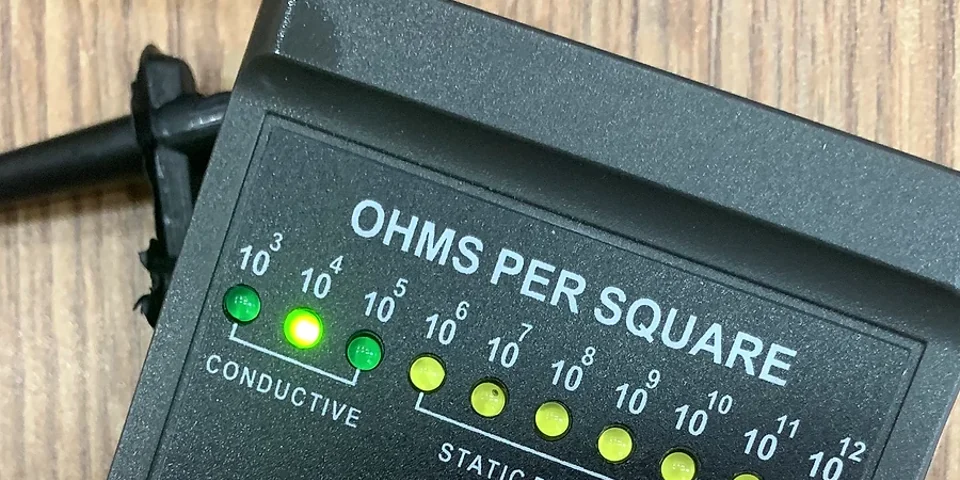
| Surface resistance | Insulating TPU baseline | 10^3-10^5 ohm or adjusted dissipative range according to requirement | The final range should match the application, not only the lowest number. |
| Dust or chip adhesion | Customer baseline | Reduced after resistance control | Dust-control effect must be checked on film surface after winding. |
| Thickness variation | Customer baseline | Controlled by cast-film window | Stable extrusion, die condition and chill roll settings matter. |
| Winding wrinkles | Customer baseline | Reduced through hardness and surface adjustment | Flexibility and blocking behavior must be balanced. |
| Surface contamination | Customer baseline | Checked by visual and cleanliness inspection | Gels, specks and migration can affect electronic packaging. |
| Final pass decision | Visual inspection mainly | Resistance, surface, winding and application trial | Conductive TPU film needs both electrical and process approval. |
9. How to Validate Conductive TPU Cast Film
A practical validation plan should include pellet testing, film testing and customer line testing.
Pellet testing checks moisture, hardness, melt flow direction, dispersion and baseline resistance. Film testing checks surface resistance, volume resistance if required, tensile behavior, elongation, tear strength, thickness, haze, roughness and surface defects. Roll testing checks inner and outer layers, resistance after storage, blocking, wrinkles and edge curl. Application testing checks packaging, lamination, flexing, cleaning frequency, dust adhesion and final handling.
For conductive TPU film, the final decision should come from the customer’s cast-film line and real application condition. A material that passes a molded plaque or thick sheet test may still fail a thin film line because of surface quality, filtration, winding or resistance variation.
10. What Buyers Should Provide
| Buyer Input | Why It Matters |
|---|---|
| Target application | Packaging film, conductive layer, dust-control cover and industrial protective film need different TPU routes. |
| Target resistance range | Anti-static, dissipative and conductive formulations are different. |
| Film thickness | 0.05 mm and 0.20 mm have different resistance and process challenges. |
| Color requirement | Black conductive, transparent anti-static and light-color anti-static routes are different. |
| Required hardness | Hardness affects flexibility, stretching, winding and lamination feel. |
| Processing method | Cast film, blown film, calendering and sheet extrusion need different melt behavior. |
| Surface requirement | Gel, haze spot, black speck and roughness tolerance should be defined. |
| Migration requirement | Electronic packaging and clean environments need low-migration validation. |
| Current defect data | Dust adhesion, resistance drift, thickness variation, wrinkles and scrap rate guide the adjustment. |
| Monthly usage | Helps evaluate formula cost, batch stability and supply planning. |
11. Conclusion
Conductive TPU can be developed for flexible conductive film, anti-static film, ESD protective film, dust-control covers and industrial protective layers. The key is not simply making TPU black or adding conductive filler. The material must balance conductive network stability, flexibility, surface quality, thickness control, low migration tendency and winding performance.
Selection should start with the target resistance range, then move to TPU type, hardness, conductive system, film thickness, surface requirement and validation method. Standard specimen data are only the first screening step. The final judgment should come from cast-film line trials, roll behavior, dust-adhesion testing and end-use validation.
DEYU can support conductive TPU, anti-static TPU and dissipative TPU compound development, using DGK-TPU DD3-4ML and related conductive plastic experience as reference directions before customer film-line validation.