
Extrusion Conductive PP for Anti-Static Packaging: Sheet, Turnover Box and ABA Co-Extrusion Guide
Extrusion-grade conductive PP packaging must keep stable ESD discharge, smooth sheet appearance and enough impact strength after stretching through the die. This guide explains material choice, ABA co-extrusion and a real turnover-box case.
Buyer and process engineer FAQ
Extrusion Conductive PP for Anti-Static Packaging: Sheet, Turnover Box and ABA Co-Extrusion Guide
Can DGK-PP DD3R1 be used for extruded anti-static packaging?
Yes. It is positioned for extrusion and injection conductive PP applications such as hollow sheet, turnover boxes, trays and carrier tape, but the final resistance must be checked on the real extruded part.
Why does conductive PP extrusion show resistance fluctuation?
Extrusion stretches the melt and can orient conductive carbon black along the flow direction. If the conductive network is pulled apart, transverse resistance rises and batch variation becomes larger.
Should buyers use single-layer extrusion or ABA co-extrusion?
Single-layer extrusion is simpler and suitable for early trials or uniform ESD requirements. ABA co-extrusion is better for cost optimization because conductive PP is used mainly on the surface layers.
Which product page is linked if DGK-PP DD3R1 is not listed?
The exact DD3R1 page does not exist on the site, so the closest existing reference is DGK-PP DD4-5A-JC conductive PP. DEYU can adjust the formula for packaging extrusion requirements.
Market demand for conductive PP anti-static packaging
As electronic components move toward higher integration and higher sensitivity, electrostatic discharge is a larger source of hidden product failure. In electronics manufacturing and assembly, static-related failures are often treated as a major risk item, and anti-static packaging becomes part of the whole product protection chain rather than only an accessory.
Polypropylene is attractive for packaging because it is light, chemically resistant and cost efficient. Standard PP is an excellent insulator with very high volume resistivity, so it must be modified with conductive carbon black or other conductive fillers when trays, turnover boxes, hollow sheets and carrier tapes need permanent ESD control.
The source grade in this article is DGK-PP DD3R1, an extrusion-grade conductive PP direction for anti-static packaging. Because the site does not currently have an exact DGK-PP DD3R1 product page, the single body internal link uses the closest existing conductive PP reference: DGK-PP DD4-5A-JC conductive PP pellets.
Extrusion challenges: percolation network and surface quality
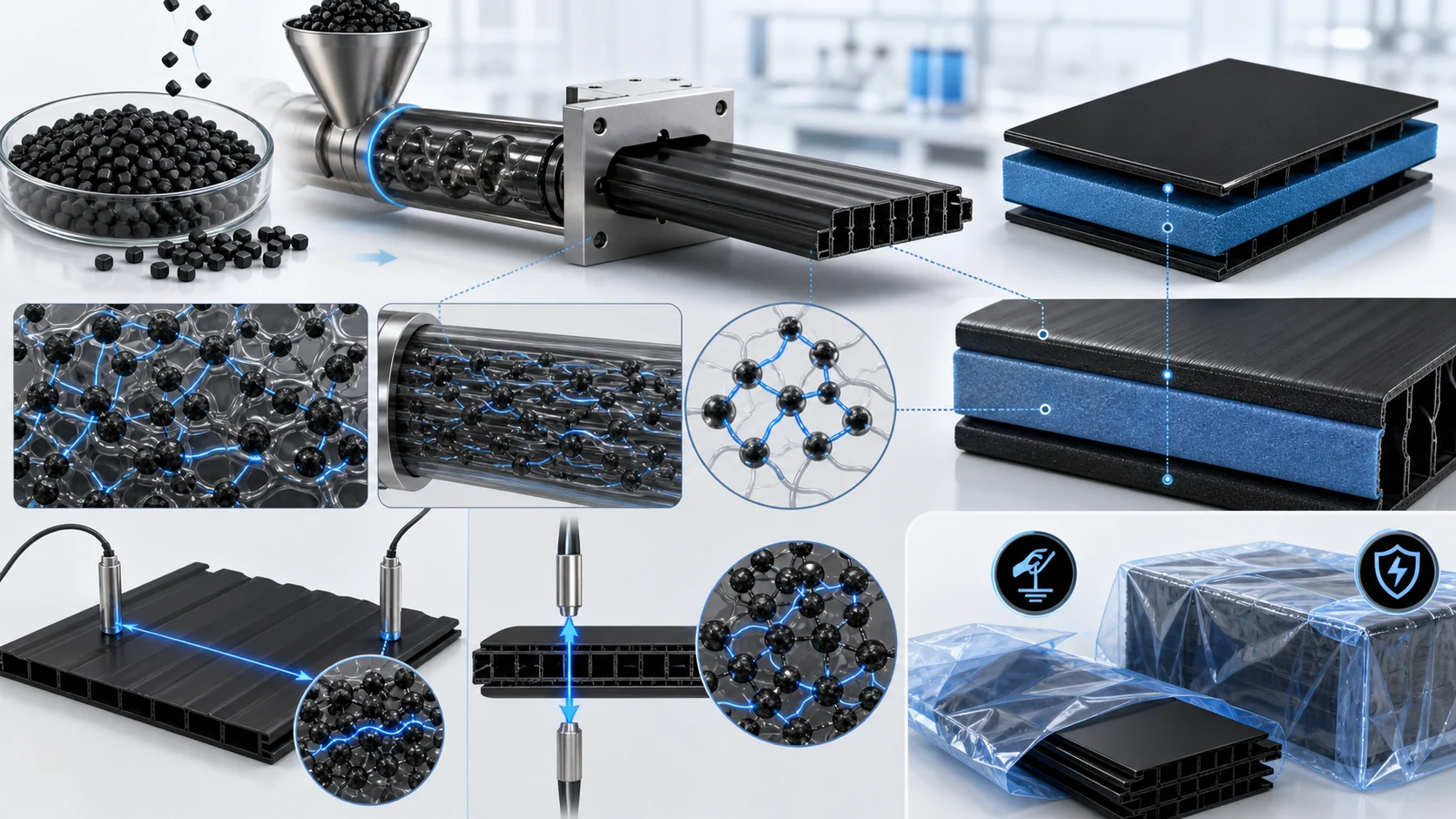
Conductive plastics rely on a percolation network formed by conductive fillers. During extrusion, the melt is stretched strongly at the die. Fillers can orient along the flow direction, and the conductive network can be partially broken. The practical symptom is anisotropic resistance: longitudinal resistance may pass while transverse resistance rises.
Dispersion is just as important. If conductive filler is not dispersed well, extruded sheet can show pitting, small crystal-like points or rough surface defects. For carrier tape, trays and packaging surfaces that touch electronic parts, these defects can directly cause rejection.
DGK-PP DD3R1 was designed around these extrusion risks by combining conductive carbon black dispersion control with PP matrix modification. The goal is not only a low resistance value on pellets, but stable resistance and clean appearance after sheet extrusion and stretching.
Material solution: DGK-PP DD3R1 conductive PP
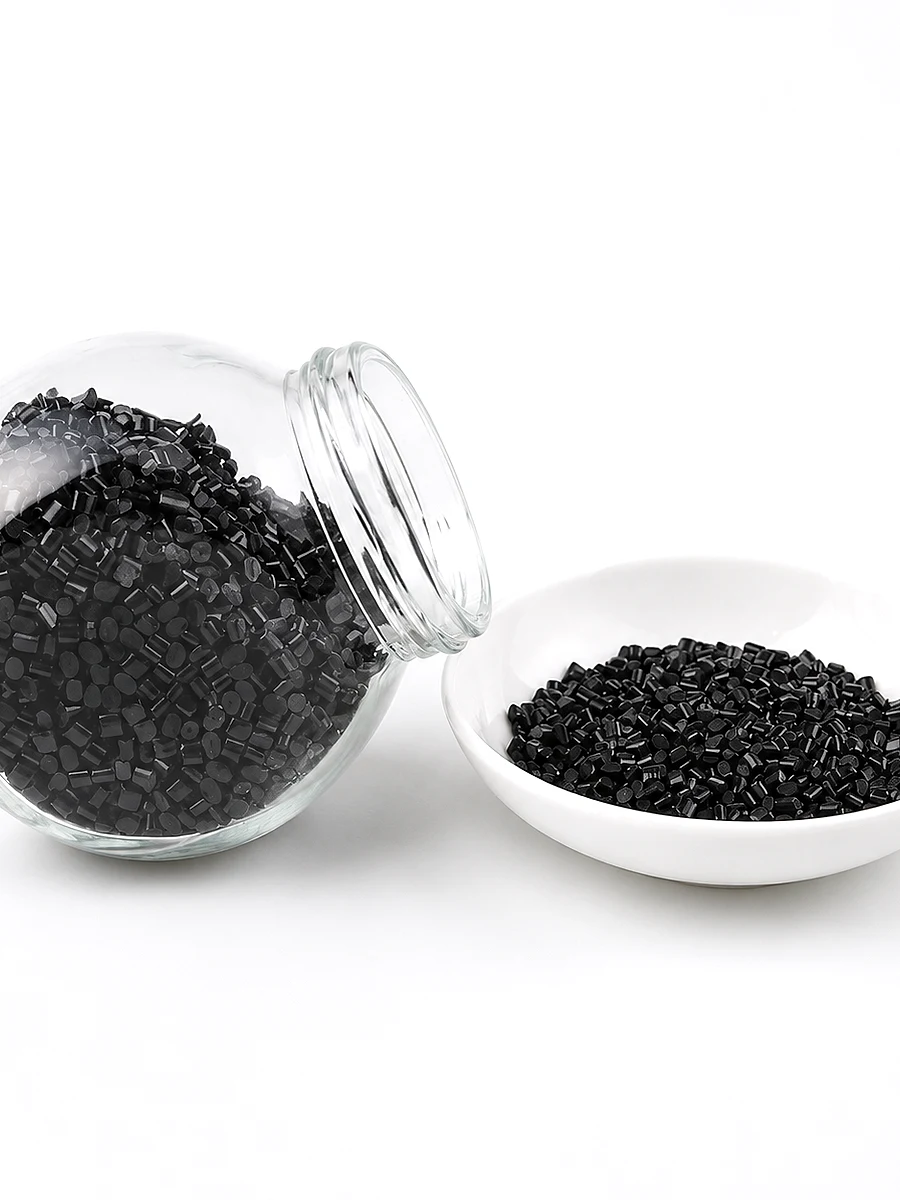
DGK-PP DD3R1 is a black conductive PP compound developed for extrusion and injection processing. It uses a high-rigidity PP base modified with high-purity conductive carbon black, targeting durable ESD behavior and balanced mechanical performance.
The 10^5 ohm surface resistance places the material in a controlled static-dissipative to conductive packaging range for safe discharge. The melt flow rate of 3.5 g/10 min fits extrusion processing better than a high-flow injection-only grade. Tensile strength of 21 MPa and elongation of 60% help packaging products survive handling, stacking and turnover use.
| Property | Test Data | Unit |
|---|---|---|
| Surface resistance | 10^5 | ohm |
| Tensile strength | 21 | MPa |
| Elongation at break | 60 | % |
| Flexural strength | 28.2 | MPa |
| Flexural modulus | 968.1 | MPa |
| Charpy notched impact strength at 23 C | 17.8 | kJ/m2 |
| Izod notched impact strength at 23 C | 19 | kJ/m2 |
| Melt flow rate at 230 C / 2.16 kg | 3.5 | g/10 min |
| Heat deflection temperature at 0.45 MPa | 81 | C |
| Density | 1.046 | g/cm3 |
| Flammability | HB (UL-94) | Rating |
Process route: single-layer extrusion and ABA co-extrusion
Single-layer extrusion uses conductive PP through the whole wall. It is simple, easy to trial and suitable when every part of the sheet must have similar conductivity or when output volume is not very large.
Three-layer ABA co-extrusion uses conductive PP on the A surface layers and a high-tensile PP in the B core layer. This keeps the ESD function at the surface while the core supplies mechanical support. In larger production, only using conductive material in the surface layers can reduce material cost by about 20-30%.
ABA production must match screw speed, heating profile, layer flow and haul-off ratio. If layer viscosity and flow rate are not balanced, the sheet may show layer instability, delamination or uneven thickness.
| Route | Material Structure | Advantages | Limitations |
|---|---|---|---|
| Single-layer extrusion | All layers use conductive PP | Simple process, low equipment requirement, uniform ESD behavior | Higher material cost because the full wall uses conductive modified PP |
| ABA three-layer co-extrusion | A layers use conductive PP; B layer uses high-tensile PP | Conductive surface, stronger structure, about 20-30% material cost reduction | Requires layer-flow matching and stable co-extrusion setup |
| Layer | Recommended Material | Function |
|---|---|---|
| A skin layer | DGK-PP DD3R1 conductive PP or the closest existing conductive PP direction | Provides anti-static surface function and controlled ESD discharge |
| B core layer | High tensile PP tape yarn grade such as HP500N or similar material | Provides stiffness, tensile strength, impact support and cost control |
| A skin layer | DGK-PP DD3R1 conductive PP or the closest existing conductive PP direction | Keeps both sides ESD-safe for trays, boxes and hollow sheets |
Customer case: anti-static turnover box for electronic components
A manufacturer in East China supplied ESD turnover boxes for SMT use in semiconductor packaging plants. The previous imported conductive PP had high cost and long lead time. The customer needed surface resistance around 10^4-10^5 ohm, good impact resistance for repeated drop and stacking, and a smooth surface without pitting so precision components would not be scratched.
The customer selected DGK-PP DD3R1 and used single-layer extrusion to produce hollow-sheet turnover boxes. Under the initial process of 80 C drying for 3 hours and 190-200 C extrusion, the sheet showed light surface pitting and resistance fluctuated between 10^5 and 10^6 ohm. Some batches moved outside the specification.
DEYU and the customer adjusted drying, barrel temperature, die temperature and haul-off matching. After drying at 90 C for 4-5 hours, raising barrel temperature to 210-225 C, setting the die near 80 C and controlling stretch ratio around 3-5 times, resistance stabilized around 10^5 ohm and surface pitting was removed.
The appearance acceptance rate increased from 82% to more than 98%. The box passed repeated drop testing without cracking after 10 drops from 1.5 m. Compared with the imported material, material cost fell by about 25% and delivery cycle shortened from 6 weeks to 2 weeks.
| Parameter | Initial Setting | Optimized Setting | Reason |
|---|---|---|---|
| Drying temperature | 80 C | 90 C | Higher drying temperature removes moisture more completely |
| Drying time | 3 hours | 4-5 hours | Longer drying reduces crystal points and surface pitting |
| Barrel extrusion temperature | 190-200 C | 210-225 C | Higher melt temperature improves flow and filler dispersion |
| Die temperature | 70 C | 80 C | Higher die temperature improves surface gloss and appearance |
| Item | Before Optimization | After Optimization |
|---|---|---|
| Surface resistance | 10^5-10^6 ohm fluctuation with some batches outside target | Stable around 10^5 ohm |
| Batch-to-batch resistance variation | Unstable and difficult to approve | Within +/-0.5 order of magnitude |
| Surface pitting | Visible pitting and small points | Resolved after drying and temperature adjustment |
| Appearance acceptance rate | 82% | Above 98% |
| Drop-test result | Not stable for repeated turnover use | No cracking after 10 drops from 1.5 m |
| Material cost versus imported conductive PP | Imported baseline | About 25% lower |
| Delivery cycle | 6 weeks | 2 weeks |
Process summary for extrusion production
For conductive PP extrusion, drying should not be treated as a minor step. Moisture can create bubbles, pitting and unstable appearance. A 90 C by 4-5 hour drying window is a practical starting point for DD3R1-type conductive PP.
Extrusion temperature should be high enough for stable melt flow and filler dispersion, but not so aggressive that the conductive system degrades. Screw speed and haul-off speed should be matched to avoid excessive stretching of the conductive network.
Before long shutdown, purge the machine with pure PP instead of leaving conductive PP in the barrel. Conductive carbon black systems can char during long residence time and create black specks in the next production run.
| Process Item | Recommended Setting | Purpose |
|---|---|---|
| Drying | 90 C x 4-5 hours | Remove moisture and avoid pitting or crystal points |
| Barrel temperature | 210-225 C | Balance melt flow and conductive network integrity |
| Die temperature | Around 80 C | Improve sheet surface quality |
| Stretch ratio | Control around 3-5 times | Avoid excessive network breakage and resistance increase |
| Line matching | Match screw speed and haul-off speed | Reduce longitudinal/transverse resistance anisotropy |
| Shutdown | Purge with pure PP before long stop | Prevent conductive carbon black degradation or charring |
Conclusion
Extrusion-grade conductive PP has strong application potential in anti-static packaging. DGK-PP DD3R1 provides stable resistance around 10^5 ohm, usable mechanical strength and an extrusion-friendly flow window for hollow sheets, trays, turnover boxes and carrier tape.
The real production case shows that material selection and process control must work together. Drying, barrel temperature, die temperature and stretch ratio directly affect pitting, resistance fluctuation and final approval. ABA co-extrusion gives a further cost path for larger-volume packaging while keeping ESD function on the surface.