
Black Electrical Housings: Flame-Retardant Conductive PP Validation Guide
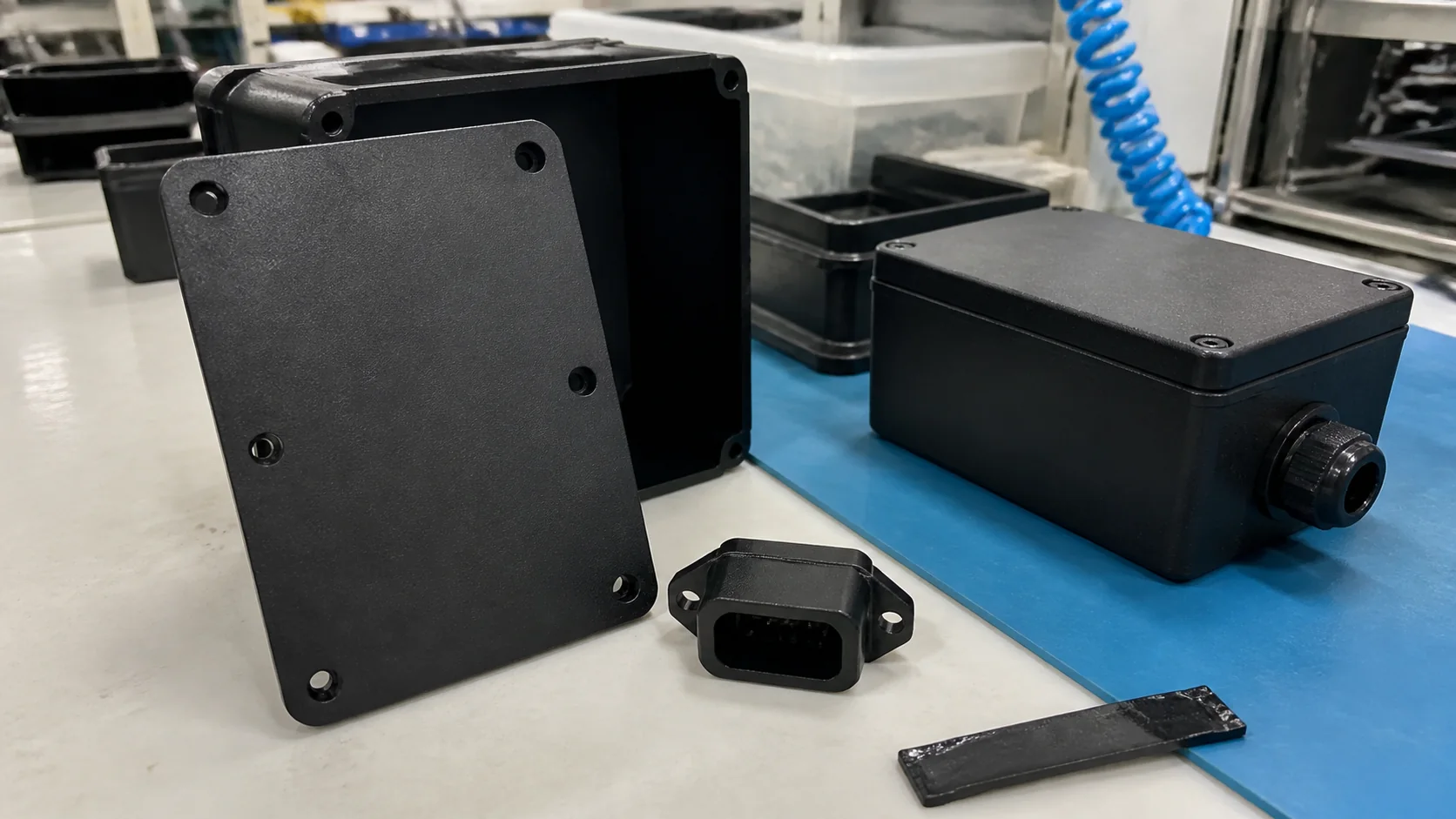
Black electrical housings need a production-grade material decision, not only a formulation discussion. This article focuses on how to validate flame-retardant conductive PP in junction boxes, connector bodies, control housings and ESD covers where UL94 thickness, resistance drift, black surface quality and assembly cracking must be checked together.
Electrical housing material FAQ
Black Electrical Housings: Flame-Retardant Conductive PP Validation Guide
Why should black electrical housings be validated on molded parts?
UL94 bars and flat plaques do not show gate shear, weld lines, ribs, screw bosses or sealing surfaces. A black ESD housing should be checked on the real molded geometry before production approval.
What is the main difference between this article and a formulation guide?
This article is written from the part-validation side: UL94 thickness, resistance mapping, aging drift, white bloom, assembly cracking and production defect rate.
Which resistance range is practical for black ESD housings?
Many housings use 10^6-10^9 ohm surface resistance. Lower resistance can be developed, but it must be balanced with flow, toughness, UL94 thickness and surface quality.
What information should be sent for material screening?
Send the drawing, wall thickness, gate and weld-line plan, UL94 target, resistance range, aging requirement, current defect photos, molding method and expected volume.
Application background: black housings are validated as parts
A black electrical housing is usually judged by more than one line on a data sheet. The material must pass the required UL94 thickness, keep an ESD or conductive resistance range on the molded surface, avoid white blooming on black appearance parts, and survive screw bosses, snap fits, sealing pressure and transport vibration.
That is why this article starts from the part, not from the additive package. Junction boxes, connector housings, control-panel covers, battery module covers and ATEX-related ventilation components all create different risk points: thin walls, weld lines, ribs, flow ends and assembled stress zones.
Production risks that pellet data can miss
Resistance drift, white bloom and assembly cracking
The first production risk is uneven resistance. A plaque can meet 10^6-10^9 ohm while the actual housing measures one or two orders higher near the weld line or far from the gate. Gate shear, filler orientation, wall thickness and local packing pressure all change the conductive path.
The second risk is visible aging. Black conductive PP makes white bloom easy to see, especially when a flame-retardant package migrates after storage, heat exposure or humidity aging. A material that looks acceptable after molding can still fail a customer audit after two or three months.
| Housing area | What can go wrong |
|---|---|
| Gate side | High shear can change filler orientation and create a low or unstable resistance zone |
| Weld line | Two flow fronts can interrupt the conductive path and raise resistance |
| Thin ribs | Lower packing pressure can reduce conductivity and increase burn sensitivity |
| Screw boss | High local stress can cause cracking during assembly |
| Visible black cover | Migrating additives can create white bloom after storage or heat aging |
| Validation item | Why it matters | Typical check |
|---|---|---|
| UL94 at real wall thickness | A V-0 plaque does not prove a thin housing wall | Test 1.5 mm, 2.0 mm or the customer-specified thickness |
| Molded-part resistance map | ESD performance must be uniform across the part | Measure gate, middle, weld line, flow end and cover surface |
| Black surface aging | White bloom is easy to see on black conductive PP | Heat / humidity / storage inspection before approval |
| Assembly toughness | Bosses, clips and covers fail under local stress | Screw torque, snap-fit and drop or vibration review |
| Requirement | Part-level question | Approval evidence |
|---|---|---|
| UL94 V-0 | Does the real wall thickness pass? | Thickness-specific UL94 record |
| ESD / conductive range | Does every critical zone meet the target? | Resistance map with min / max values |
| Low-bloom black appearance | Does the black surface stay clean after aging? | Aged visual sample and photo record |
| RoHS / REACH / halogen-free | Does the compliance route match the market? | Supplier declaration or project document |
| Production stability | Does the trial batch match repeat production? | Scrap, cracking and resistance distribution data |
DEYU validation route for black electrical housings
DEYU's validation route separates four checks: UL94 at the real thickness, surface-resistance mapping on the molded part, black-surface aging with bloom inspection, and mechanical review at bosses, clips and sealing edges. These checks are run together because improving one item can damage another.
For many black electrical housings, the practical screening target is UL94 V-0 at 1.5-3.0 mm, surface resistance around 10^6-10^9 ohm, stable resistance after aging, no visible bloom, tensile strength above 25 MPa and enough impact strength for assembly handling. Lower resistance targets can be developed when the part design and toughness margin allow it.
| Material route | Best fit | Watch point |
|---|---|---|
| DGK-PP DD4-5A-JC reference direction | Black parts needing both conductive PP behavior and UL94 V-0 | Confirm thickness, resistance range and part geometry |
| Custom low-bloom FR conductive PP | Visible electrical covers and junction boxes | Run aging before approving black appearance |
| Higher-flow conductive FR PP | Thin-wall housings and long-flow covers | Confirm resistance at flow end |
| Toughened conductive FR PP | Snap fits, clips and screw bosses | Confirm UL94 does not drop after toughening |
| Decision point | Prefer this direction when... | Risk if skipped |
|---|---|---|
| Resistance target first | The part is mainly ESD-safe housing or cover | Over-conductive grades may add cost and brittleness |
| UL94 thickness first | The customer requires V-0 at 1.5 mm or thinner | A 3.0 mm pass can mislead approval |
| Appearance first | The part is externally visible or audited after storage | Blooming can reject an otherwise functional part |
| Assembly first | Bosses, clips and sealing ribs are critical | A low-resistance material can still crack in use |
Reference product data
For a public product reference, see DGK-PP DD4-5A-JC flame-retardant conductive PP. The table below is used for application screening and still needs molded-part validation.
| Property | Unit | DGK-PP DD4-5A-JC public data | Use in housing validation |
|---|---|---|---|
| Material type | - | Black flame-retardant conductive PP | Reference route for black ESD housings |
| Surface resistance | ohm | 10^3-10^5 | Conductive range; confirm if the project needs dissipative or lower resistance |
| UL94 rating | - | UL-94 V-0 | Reconfirm at customer wall thickness |
| Flexural strength / modulus | MPa | 22 / 1023 | Check ribs, cover stiffness and deformation |
| Tensile strength / elongation | MPa / % | 21.8 / 90 | Useful for boss and clip stress review |
| Izod notched impact | kJ/m2 | 35 | Strong signal for assembly toughness |
| MFI / density / HDT | - | 7 g/10 min / 0.965 g/cm3 / 105 C | Use to set injection and service-temperature review |
Customer case: black junction box approval
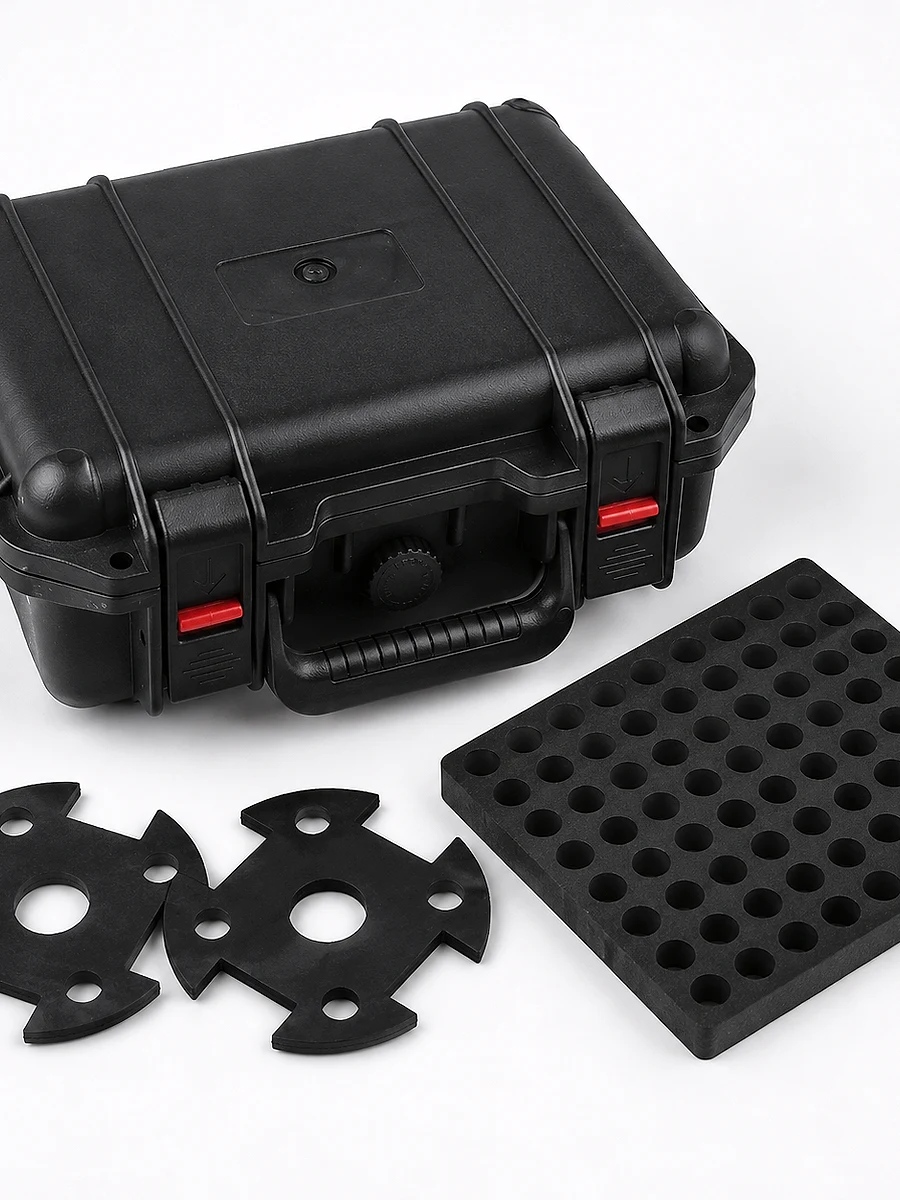
A junction-box supplier came to DEYU with a black PP housing that looked correct at first inspection but failed in storage and assembly. The data sheet claimed V-0 and ESD behavior, yet 1.5 mm sections drifted between V-0 and V-2, molded resistance moved from 10^6 to above 10^10 ohm in some locations, white bloom appeared after several months, and screw bosses cracked during tightening.
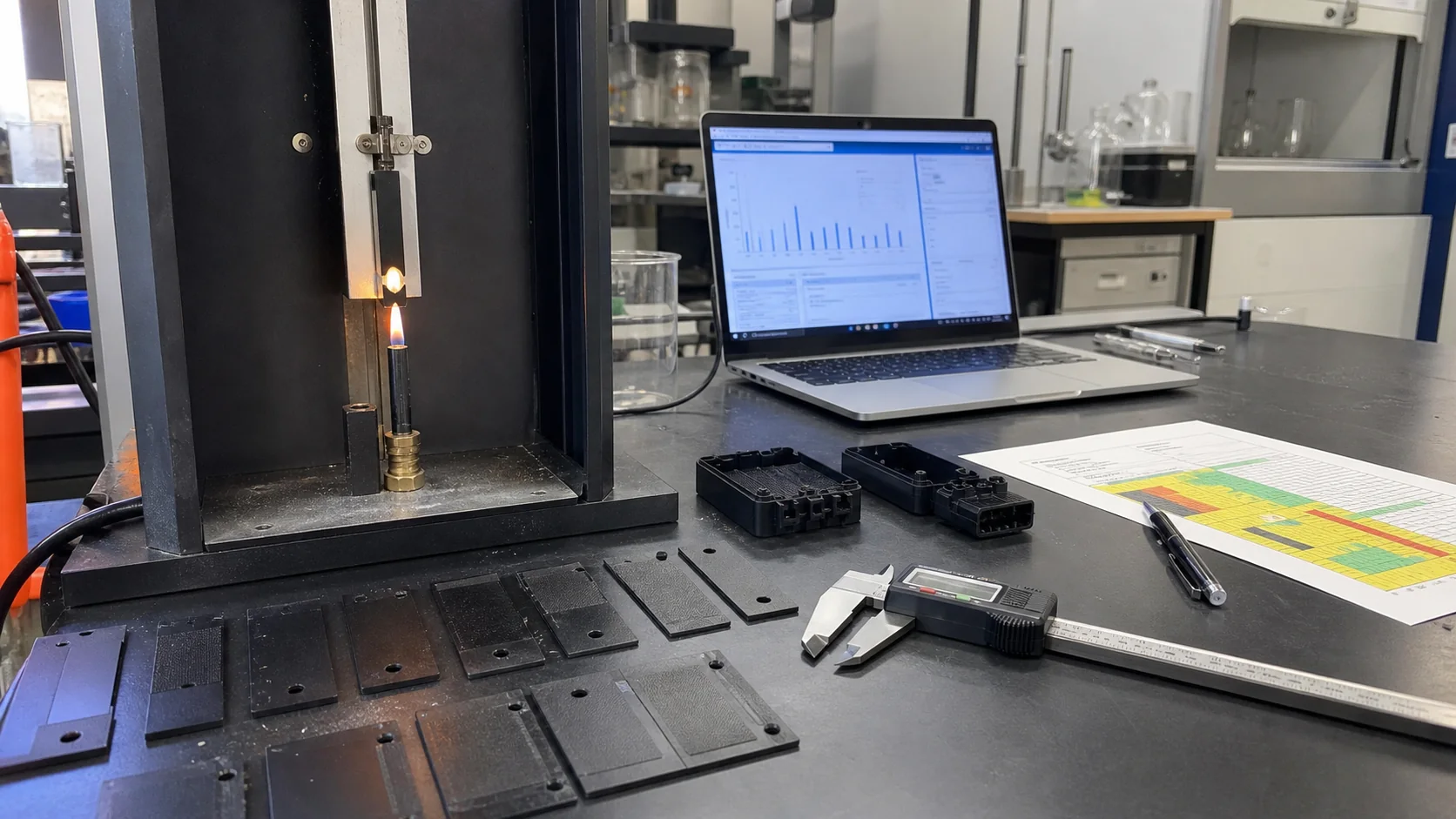
DEYU treated it as a validation failure rather than a simple grade swap. The team mapped resistance at the gate side, flow end, weld line, ribs and cover surface; checked UL94 at 1.5 mm and 3.0 mm; aged black parts before visual inspection; and reviewed the boss geometry against the compound's toughness window.
| Approval item | Original material issue | DEYU validation focus |
|---|---|---|
| UL94 at 1.5 mm | V-0 / V-2 batch variation | Thickness-specific V-0 confirmation |
| Resistance map | 10^6 to above 10^10 ohm by location | Reduce spread across gate, weld line and flow end |
| Black surface | White bloom after 2-3 months | Low-bloom aging check |
| Assembly | Screw boss cracking | Toughness and torque window review |
| Production | High molding scrap | Stable process window and lower defect rate |
| Parameter | Before validation change | After DEYU validation direction |
|---|---|---|
| Surface resistance, average | 5 x 10^8 ohm | 3 x 10^7 ohm |
| Part-location resistance spread | +/-2 orders | +/-0.3 orders |
| Resistance after aging | 8 x 10^10 ohm | 4 x 10^7 ohm |
| UL94 V-0 pass rate at 1.5 mm | 85% | 100% |
| Visible bloom after 3 months | Present on 60% of parts | None |
| Assembly cracking rate | 8% | 1% |
| Molding scrap rate | 14% | 4% |
| Overall defect rate | 20% | 5% |
How to read the validation result
The replacement direction used a compatible low-bloom flame-retardant conductive PP based on the DGK-PP DD4-5A-JC application space. In the trial, the molded parts reached consistent V-0 at 1.5 mm, resistance variation tightened to within about +/-0.3 orders, post-aging resistance stayed in the conductive/ESD range, and visible bloom disappeared from the black surface.
The business result mattered as much as the lab result: assembly cracking fell from 8% to 1%, molding scrap dropped from 14% to 4%, and the overall defect rate moved from 20% to 5%. The material decision was approved because the part passed the use conditions, not because a pellet data sheet looked complete.
Suitable parts and buyer input list
This validation route fits black junction boxes, terminal boxes, sensor covers, connector bodies, switch housings, socket housings, battery module covers, PCB racks, ESD cable covers, industrial ventilation parts and equipment covers used where static discharge and fire safety are reviewed together.
For a fast DEYU evaluation, send the part drawing, nominal and minimum wall thickness, gate position, weld-line location, screw boss and clip details, sealing surfaces, resistance target and method, UL94 rating and thickness, aging condition, surface appearance requirement, current defect photos, molding machine/process and expected annual volume.
Conclusion
| Approval factor | Do not approve only by... | Approve after... |
|---|---|---|
| Fire safety | Generic UL94 plaque | Target wall-thickness UL94 result |
| ESD reliability | One resistance reading | Molded-part resistance map |
| Black appearance | Fresh molded sample | Aged low-bloom visual check |
| Assembly toughness | Tensile data only | Boss, clip and sealing stress review |
The right question for black flame-retardant conductive PP is not only whether the compound can combine UL94 V-0 and conductivity. The better question is whether the molded housing can keep those properties after flow, aging and assembly.
DEYU can support small-batch validation for black electrical housings where low-bloom appearance, stable ESD resistance, UL94 performance and assembly toughness must be proven before mass production.