
Graphite Conductive ABS for Low-Friction ESD Jigs and Anti-Static Covers
Graphite conductive ABS is useful when an ESD jig or anti-static cover must do more than drain charge: it must slide smoothly, avoid scratching delicate components and survive repeated production cycles.
Buyer and engineer FAQ
Questions engineers ask before choosing graphite conductive ABS
When is graphite conductive ABS better than carbon-black conductive ABS?
Choose graphite conductive ABS when the part contacts sensitive components, slides against assemblies, or needs a smoother visible surface. Carbon black can be effective for conductivity, but graphite is often better for low friction and reduced scratching.
Which existing DEYU product should this page link to first?
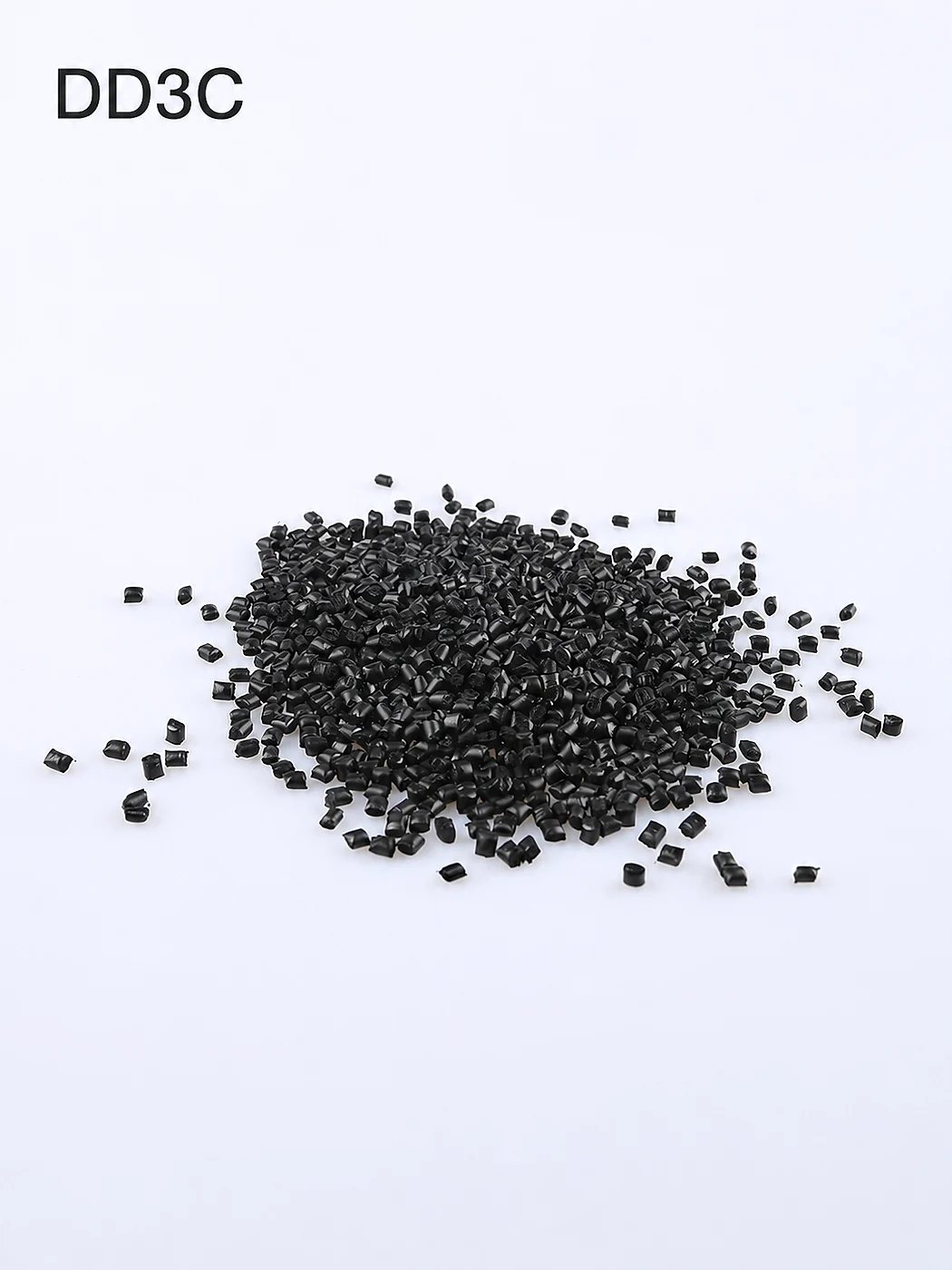
The closest existing product is DGK-ABS DD3C graphite conductive ABS. It is the most relevant starting point; if a project needs a different resistance range or lower friction target, DEYU can adjust the formulation.
What should be validated on real jigs or covers?
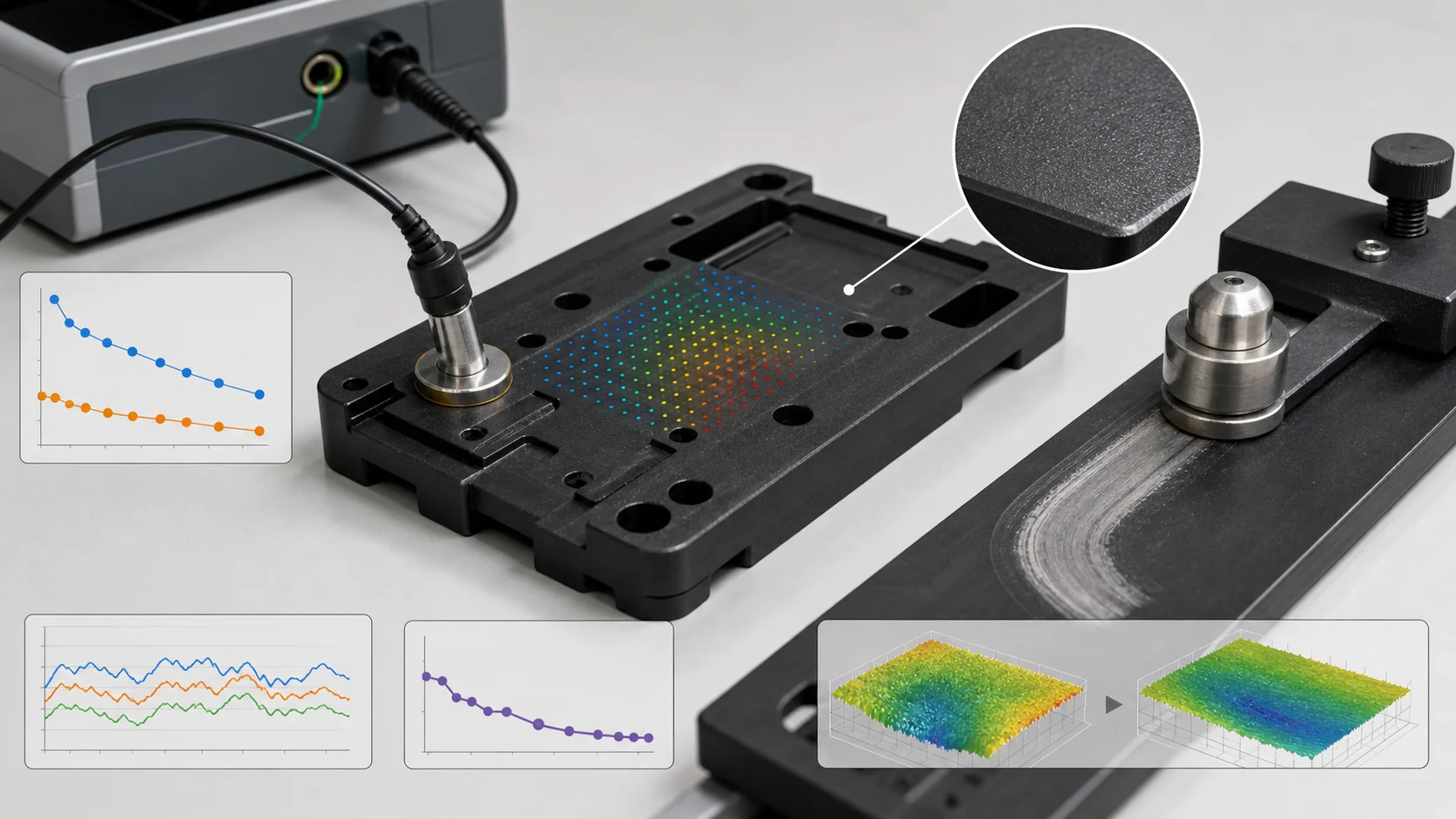
Validate surface resistivity, part-to-part variation, within-part variation, surface roughness, coefficient of friction, wear depth, component scratching, dimensional change after cycles and molding scrap rate.
Can graphite conductive ABS be cleaned with IPA?
It can be formulated for IPA cleaning environments, but the final part should be checked after repeated cleaning cycles. In the validation data, the graphite ABS direction held resistance after 100 IPA cycles much better than the original material.
Why graphite conductive ABS deserves a separate application page
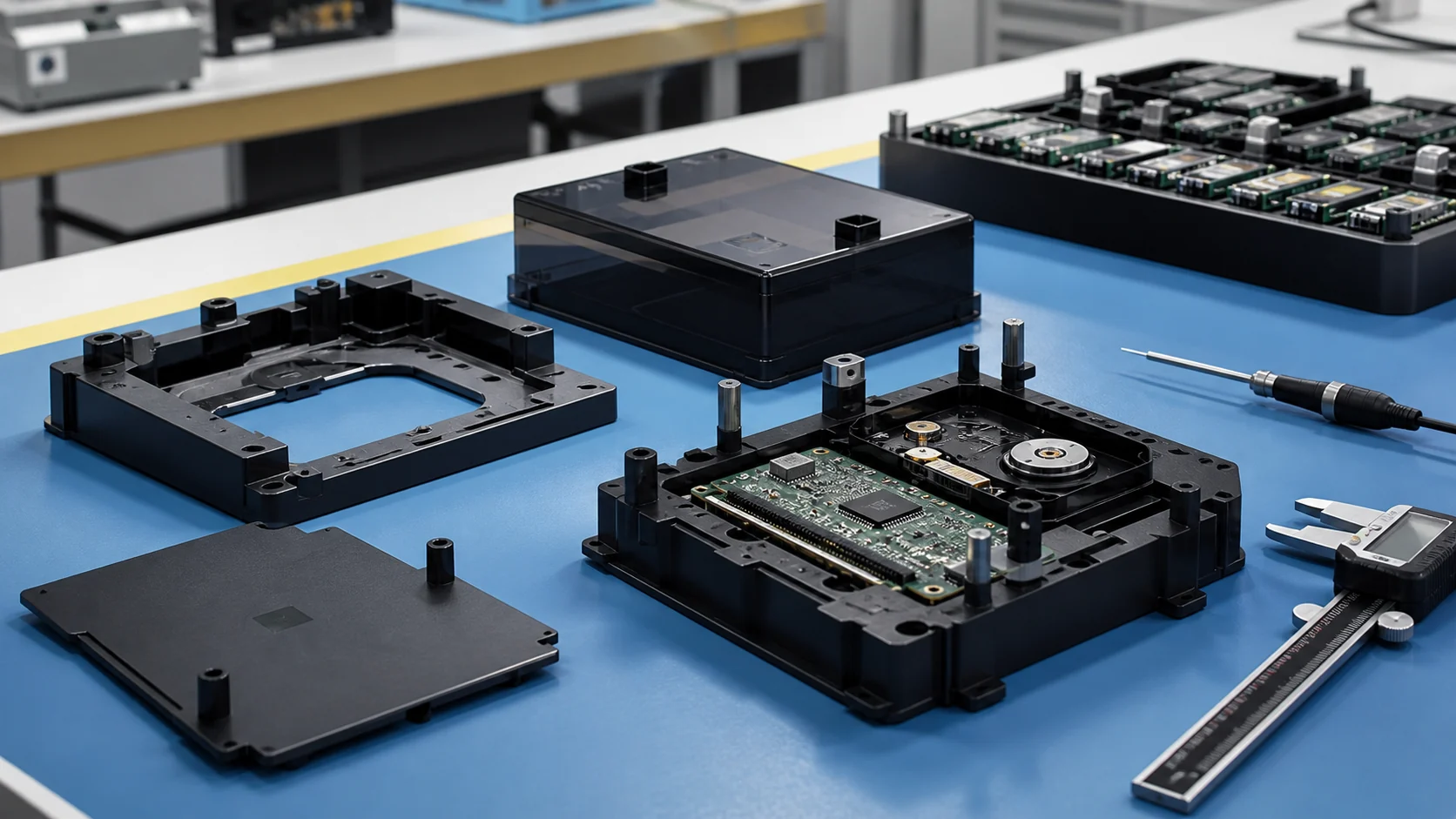
Many conductive ABS articles focus on housings, covers or resistance ranges. This page is narrower: it looks at precision industrial jigs and anti-static covers where the contact surface matters as much as the electrical value. In HDD assembly, PCB handling, semiconductor fixturing and test jigs, the surface that touches a component must drain charge without creating scratches, dust pickup or unstable sliding.
Unmodified ABS remains an electrical insulator, often around 10^15-10^16 ohm-cm in volume resistivity. Conductive fillers create the required discharge path, but the chosen filler also changes surface feel, friction, wear, stiffness and molded-part appearance. That is why graphite conductive ABS is not just another black conductive ABS option.
Graphite versus carbon black in jig surfaces
Carbon black is efficient for conductivity, but it can produce a rougher surface if dispersion or loading is not controlled. Graphite has a platelet structure and natural lubricity, so it can provide a smoother contact surface and lower dynamic friction in sliding jig applications.
For anti-static covers, graphite can help maintain a uniform black appearance with fewer visible agglomerates. For precision jigs, it reduces friction against components and can extend service life. The tradeoff is that each formulation still needs to balance conductivity, impact strength, flow and dimensional stability.
DEYU formulation direction
DEYU positions graphite conductive ABS for jigs, fixtures, anti-static covers and component-handling parts that need permanent non-migrating ESD control. Target surface resistivity can be selected from conductive ranges such as 10^3-10^5 ohm to static-dissipative ranges such as 10^6-10^9 ohm.
For the most relevant existing product reference, start with DGK-ABS DD3C graphite conductive ABS pellets. For precision jigs, DEYU can tune graphite loading, impact modification and flow stability around the real part geometry, tolerance, surface roughness and cleaning protocol.
Reference formulation and validation data
The tables below summarize formulation direction, processing guidance and molded-part validation points for graphite conductive ABS jigs and covers.
| Filler Type | Conductivity Efficiency | Surface Quality | Lubricity | Mechanical Impact |
|---|---|---|---|---|
| Graphite | Good (platelet structure) | Excellent (smooth) | High (self-lubricating) | Moderate stiffness increase |
| Carbon black | Good (high surface area) | Moderate (rougher) | Low | Higher stiffness increase |
| Hybrid (Graphite + CB) | Excellent (synergistic) | Good | Moderate | Balanced |
| Classification | Surface Resistivity | Typical Jig/Cover Application |
|---|---|---|
| Conductive | < 10^6 ohm | Rapid charge dissipation, high-sensitivity component handling |
| Static Dissipative | 10^6-10^9 ohm | Standard ESD-safe jigs, fixtures, covers |
| Anti-static | 10^9-10^11 ohm | Low-risk covers, non-critical applications |
| Requirement | Why It Matters | Typical Specification |
|---|---|---|
| Impact resistance | Withstands handling, drops, and repeated use | Izod notched impact >= 0.5 J/cm |
| Dimensional stability | Maintains precision tolerances for component alignment | Low warpage, consistent shrinkage |
| Wear resistance | Withstands repeated contact with components | Good abrasion resistance |
| Stiffness / flexural modulus | Maintains structural integrity under load | Flexural modulus >= 1600 MPa |
| Heat deflection temperature | Survives soldering and operating temperatures | HDT >= 85 C (264 psi) |
| Grade | Filler System | Surface Resistivity | Key Characteristics | Recommended For |
|---|---|---|---|---|
| DGK-ABS-G1 | Graphite powder | 10^6-10^9 ohm | Smooth surface, good impact | Standard jigs, general covers |
| DGK-ABS-G2 | Graphite + CB hybrid | 10^4-10^6 ohm | High conductivity, balanced properties | High-sensitivity handling, precision jigs |
| DGK-ABS-G3 | Graphite (high loading) | 10^3-10^5 ohm | Excellent conductivity, reduced lubricity | EMI shielding, conductive covers |
| DGK-ABS-GF | Graphite + glass fiber | 10^6-10^8 ohm | High stiffness, excellent dimensional stability | Precision fixtures, load-bearing jigs |
| Property | Unit | Test Method | DEYU Graphite Conductive ABS (DGK-ABS-G1) | DEYU Hybrid Conductive ABS (DGK-ABS-G2) |
|---|---|---|---|---|
| Filler system | System | Reference | Graphite powder | Graphite + carbon black |
| Surface resistivity | ohm | ANSI/ESD STM11.11 | 10^6-10^9 | 10^4-10^6 |
| Volume resistivity | ohm-cm | ASTM D257 | 10^5-10^8 | 10^3-10^5 |
| Density | g/cm3 | ASTM D792 | 1.04-1.08 | 1.05-1.10 |
| MFR (220 C/10kg) | g/10min | ASTM D1238 | 5-15 | 4-10 |
| Tensile strength | MPa | ASTM D638 | 30-38 | 28-35 |
| Flexural strength | MPa | ASTM D790 | 50-60 | 45-55 |
| Flexural modulus | MPa | ASTM D790 | 1800-2400 | 2000-2800 |
| Izod impact (notched) | J/cm | ASTM D256 | 0.5-0.7 | 0.4-0.6 |
| HDT (264 psi) | C | ASTM D648 | 85-90 | 80-85 |
| Surface roughness Ra | micrometer | Profilometer | 0.3-0.6 | 0.5-1.0 |
| Coefficient of friction (dynamic) | Coefficient | ASTM D1894 | 0.25-0.35 | 0.30-0.40 |
| Typical applications | Application | Reference | Jigs, fixtures, anti-static covers | High-conductivity jigs, EMI covers |
| Parameter | Recommendation |
|---|---|
| Drying temperature | 80-90 C |
| Drying time | 2-4 hours |
| Moisture content target | < 0.1% |
| Parameter | Recommended Range |
|---|---|
| Cylinder temperature | 210-240 C |
| Mold temperature | 40-60 C |
| Injection speed | Medium |
| Injection pressure | 60-100 MPa |
| Back pressure | Low-Medium |
| Screw speed | 40-60 rpm |
| Parameter | Original Material (CB-filled ABS) | DEYU Graphite Conductive ABS (DGK-ABS-G1) |
|---|---|---|
| Filler system | Carbon black | Graphite powder |
| Target resistivity | 10^6-10^9 ohm | 10^6-10^9 ohm |
| Trial quantity (jigs) | 50 | 50 |
| Target monthly production | 500 units | 500 units |
| Assembly cycles target | 100,000 cycles | 100,000 cycles |
| Parameter | Original Material | DEYU Graphite Conductive ABS |
|---|---|---|
| Electrical Performance | Category | Category |
| Surface resistivity (initial, avg) | 5x10^8 ohm | 3x10^7 ohm |
| Resistivity - part-to-part variation | ±2 orders | ±0.3 orders |
| Resistivity - within-part variation | ±1.5 orders | ±0.2 orders |
| Resistivity after 100 IPA cleaning cycles | 8x10^10 ohm | 5x10^7 ohm |
| Surface Quality | Category | Category |
| Surface roughness Ra | 1.8 micrometer | 0.4 micrometer |
| Surface roughness Rz | 8.5 micrometer | 2.8 micrometer |
| Visible filler agglomerates | Yes (frequent) | None |
| Friction & Wear | Category | Category |
| Coefficient of friction (dynamic) | 0.45 | 0.28 |
| Wear depth (50,000 cycles) | 0.25 mm | 0.08 mm |
| Component scratching | 12/50 (24%) | 0/50 (0%) |
| Dimensional Stability | Category | Category |
| Dimensional change (100,000 cycles) | 0.08 mm | 0.02 mm |
| Warpage (flatness deviation) | 0.15 mm | 0.06 mm |
| Processing | Category | Category |
| Molding scrap rate | 10% | 4% |
| Overall defect rate | 16% | 5% |
| Service Life | Category | Category |
| Replacement interval | 30,000 cycles | >100,000 cycles |
Processing notes for molded jigs and covers
Graphite conductive ABS should be dried before injection molding. Standard ABS molding equipment is usually sufficient, and clean regrind up to 20% can be considered after confirming resistance and appearance. Graphite fillers may reduce mold wear compared with carbon fiber or glass fiber compounds, but the surface must remain uniform with no visible agglomerates.
Customer validation scenario: HDD assembly jig
A hard disk drive assembly equipment manufacturer was developing precision jigs for read-write head handling. The jig required surface resistivity below 10^9 ohm, smooth surface finish, dimensional stability within ±0.05 mm, low friction and durability beyond 100,000 assembly cycles.
The original carbon-black-filled conductive ABS created a gritty contact surface, high friction, batch resistance variation from 10^7 to 10^10 ohm and visible wear after 30,000 cycles. DEYU identified carbon black surface roughness, poor lubricity and inadequate dispersion as the main causes.
After switching to the graphite conductive ABS direction, surface roughness improved from Ra 1.8 micrometers to 0.4 micrometers, friction dropped from 0.45 to 0.28, component scratching fell from 24% to 0%, and replacement interval increased from 30,000 cycles to more than 100,000 cycles.
Suitable applications
Industrial jigs include PCB assembly jigs, HDD precision fixtures, semiconductor handling fixtures, test and inspection jigs, conveyor guides, positioning fixtures and robotics end-of-arm tooling. Anti-static covers include electronic equipment covers, cleanroom covers, machine guards, instrument enclosures and transport covers. Component-handling uses include IC trays, wafer fixtures, SMD trays and connector covers.
Buyer information needed by DEYU
Provide the drawing or 3D model, critical tolerances, target resistance range, ESD standard, jig or cover application type, roughness limit, gloss target, acceptable surface defects, impact requirement, flexural modulus, wear requirement, coefficient-of-friction target, service temperature, cleanroom class, IPA or other chemical exposure, processing method, production volume, compliance needs, current material and failure mode.
Conclusion
Graphite conductive ABS is a strong material direction when a jig or cover needs ESD safety plus smoother contact, lower friction and longer service life. The important decision is not graphite as a keyword, but validated performance on the real molded part: resistance uniformity, surface roughness, friction, wear depth, component scratching, dimensional drift and molding yield.