
Graphite Conductive ABS vs Carbon-Fiber Conductive ABS: How to Choose
A data-rich material-selection guide for engineers comparing graphite conductive ABS and carbon-fiber conductive ABS. It explains how DGK-ABS DD3C and DGK-ABS CF15L differ in surface resistivity, stiffness, tensile strength, impact behavior, processing window, part cost, weight reduction and validation logic, so the final choice matches the real part rather than the generic label “conductive ABS—
Buyer and engineer FAQ
Questions engineers ask before choosing DD3C or CF15L
When should graphite conductive ABS be chosen instead of carbon-fiber conductive ABS?
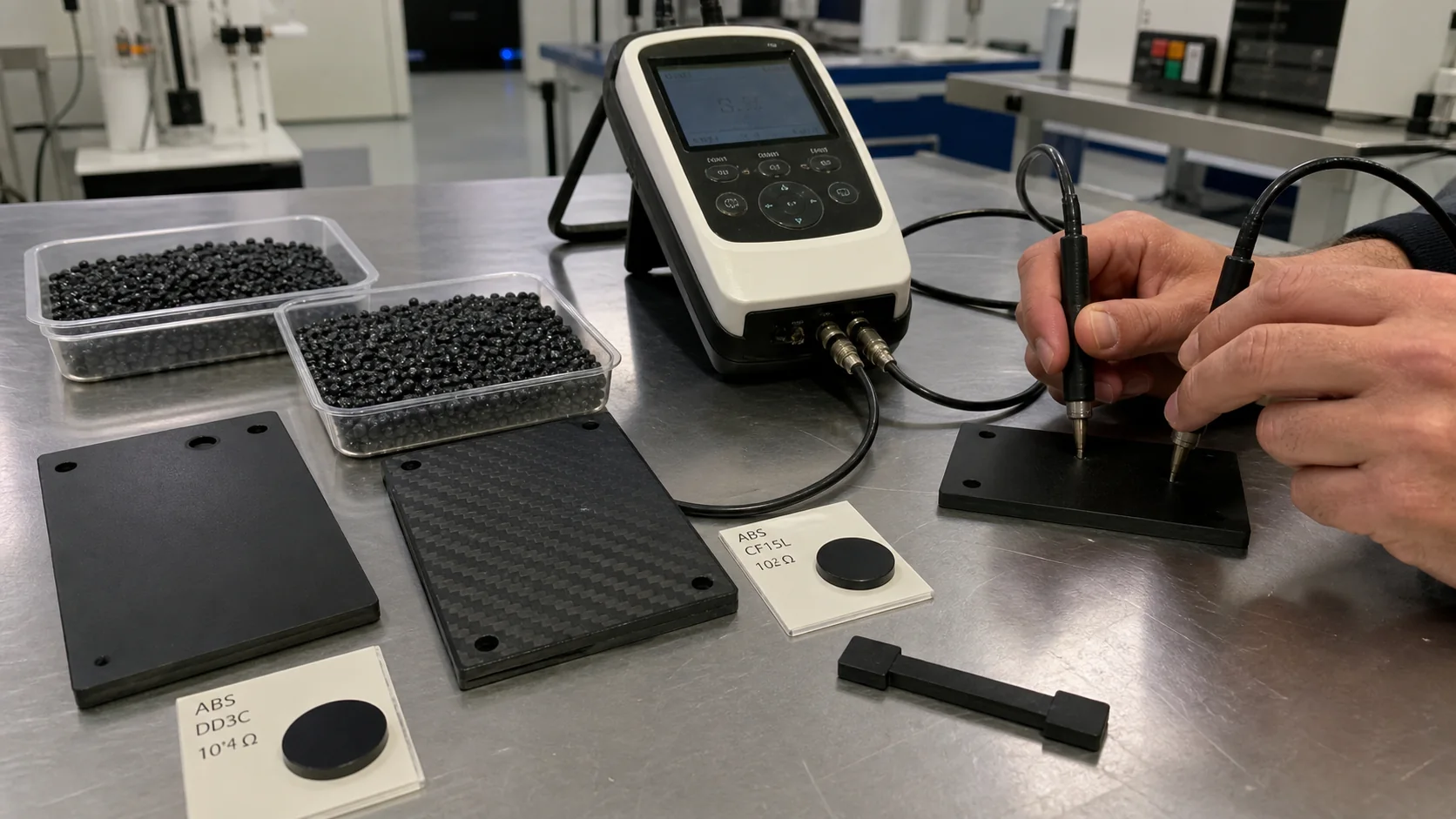
Choose graphite conductive ABS when the part mainly needs stable ESD protection, good surface quality, standard ABS processing and a lower cost structure. DGK-ABS DD3C fits housings, covers and non-load-bearing fixtures where 10³-10Ω·cm is sufficient.
When is carbon-fiber conductive ABS the stronger option?
Use DGK-ABS CF15L when the part also needs high rigidity, load-bearing strength, dimensional stability or metal replacement. Its 15% carbon-fiber reinforcement gives much higher flexural modulus and tensile strength than graphite-filled DD3C.
Do both grades provide permanent conductivity?
Yes. Both grades rely on conductive filler networks inside the ABS matrix, so conductivity is permanent and not dependent on humidity. The final molded-part value still needs verification after processing.
What information helps DEYU choose between DD3C and CF15L?
Send the drawing, wall thickness, target surface resistance, load or deflection limit, processing method, surface-quality requirement, annual quantity and any current failure mode. These details decide whether the material should prioritize cost-effective ESD protection or structural performance.
For a precise recommendation, share the drawing, resistance target, load conditions, process and expected production volume with DEYU.
Background / Problem
Acrylonitrile Butadiene Styrene (ABS) is one of the most versatile engineering thermoplastics, valued for its impact resistance, surface quality, dimensional stability, and ease of processing. However, standard ABS is an excellent electrical insulator—surface resistivity above 10¹Ω·cm makes it unsuitable for applications requiring electrostatic discharge (ESD) control.
To render ABS conductive, two fundamentally different filler approaches are commonly used: graphite and carbon fiber. Both create permanent conductive networks within the ABS matrix, but they deliver vastly different mechanical properties, conductivity characteristics, and application suitability.
The engineering challenge: selecting the right conductive ABS compound for a specific application requires understanding not just the conductivity level, but the full performance profile—stiffness, strength, impact resistance, surface quality, processability, and cost.
DEYU offers two distinct conductive ABS solutions:
| Product | Filler Type | Primary Strength | Target Applications |
|---|---|---|---|
| DGK-ABS DD3C | Graphite | Stable surface resistivity (10³—0Ω·cm) with good mechanical properties | Floppy disk drives, fax machines, VCR cassettes, general electronics housings |
| DGK-ABS CF15L | Carbon fiber (15%) | Exceptional rigidity (≤160 MPa modulus) + high strength (≤7.6 MPa) + conductivity | Precision fixtures, structural housings, load-bearing ESD parts, automation components |
This guide provides a direct comparison of these two materials to help engineers make the right selection for their specific application.
Product Overview
DGK-ABS DD3C —Graphite Conductive ABS
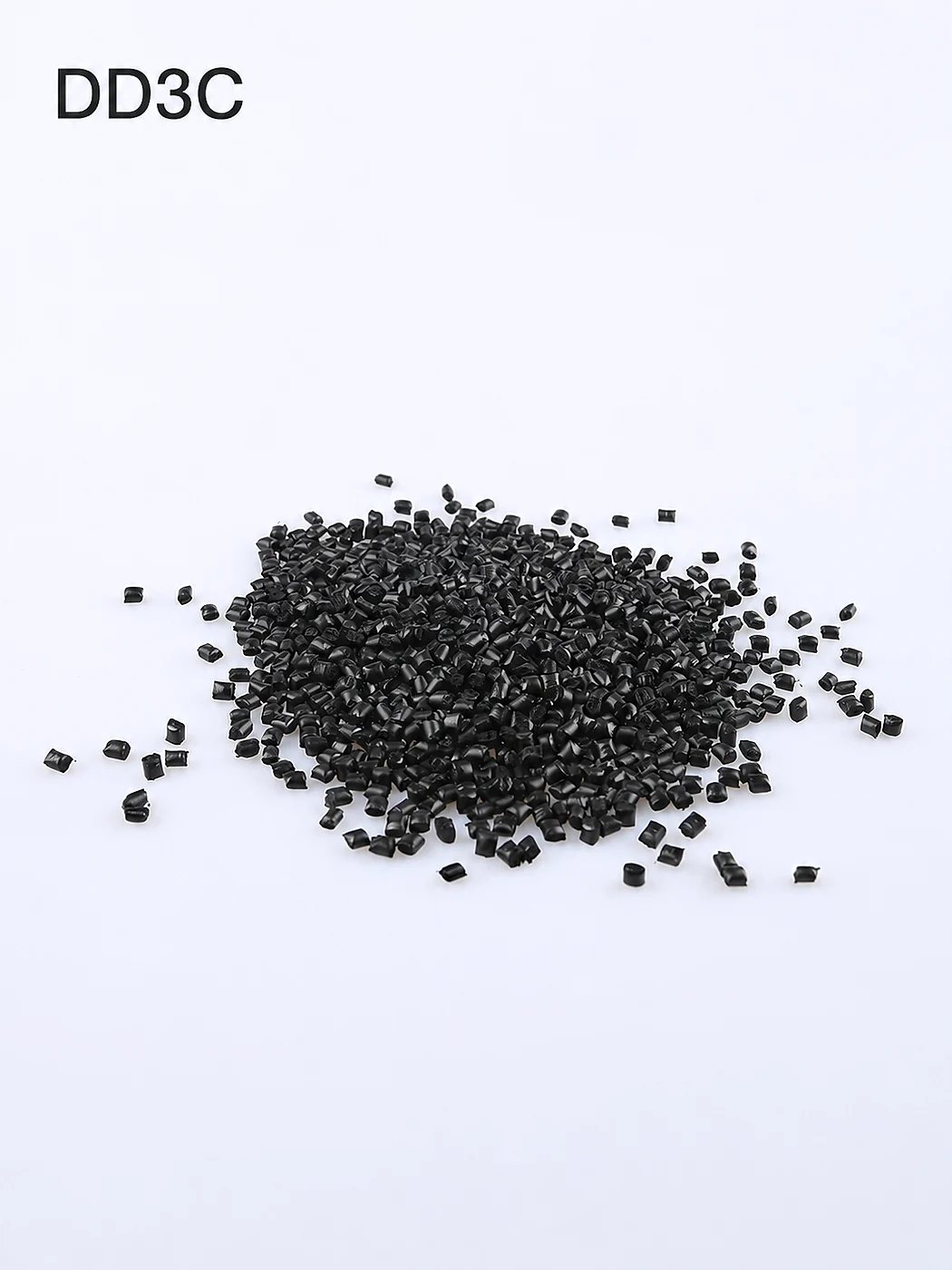
DGK-ABS DD3C is a graphite-filled conductive ABS compound designed for applications requiring stable, permanent surface resistivity in the 10³—0Ω·cm range. The graphite particles form a conductive network through the ABS matrix, providing ESD protection without significantly compromising the mechanical properties of ABS.
Related DEYU grades for this comparison: DGK-ABS DD3C graphite conductive ABS and DGK-ABS CF15L carbon-fiber conductive ABS.
Key features:
Stable surface resistivity: 10³—0Ω·cm
Good mechanical properties for a conductive ABS
Standard ABS processing conditions
Cost-effective for high-volume electronics applications
Black color
Typical applications: Floppy disk drives, fax machines, VCR cassette housings, general electronics enclosures, ESD-safe production fixtures.
DGK-ABS CF15L —Carbon-Fiber Conductive ABS
DGK-ABS CF15L is a 15% carbon-fiber reinforced conductive ABS compound designed for rigid structural parts requiring both exceptional mechanical performance and ESD protection. The carbon fibers serve a dual function: mechanical reinforcement and electrical conductivity.
Key features:
Flexural modulus ≤160 MPa (3—× stiffer than standard ABS)
Tensile strength ≤7.6 MPa (≤× standard ABS)
Surface resistivity ≤0Ω·cm
HDT ≤2°C @ 1.8 MPa
59% lighter than aluminum
Black color
Typical applications: Precision fixtures, automated handling components, structural electronics housings, load-bearing ESD parts, semiconductor equipment components, robotics and automation parts.
Direct Performance Comparison
Mechanical Properties
| Property | DGK-ABS DD3C (Graphite) | DGK-ABS CF15L (Carbon Fiber) | Standard ABS (Reference) |
|---|---|---|---|
| Flexural Modulus | 1600 MPa | ≤160 MPa | ~2200 MPa |
| Bending Strength | 34 MPa | ≤38 MPa | ~60—0 MPa |
| Tensile Strength | 19 MPa | ≤7.6 MPa | ~40—0 MPa |
| Elongation at Break | 17% | ≤.5% | ~50—00% |
| Impact Strength (Izod, notched) | 8 kJ/m² | ≤ kJ/m² (Charpy) | ~200—00 J/m |
| Heat Distortion Temperature | 84°C | ≤2°C @ 1.8 MPa | ~85—5°C |
Interpretation:
Flexural Modulus: DGK-ABS CF15L is 5× stiffer than DGK-ABS DD3C and 3.7× stiffer than standard ABS. For applications requiring dimensional stability under load, CF15L is the clear choice.
Tensile Strength: DGK-ABS CF15L delivers 5× the tensile strength of DGK-ABS DD3C and 2× that of standard ABS. This enables load-bearing applications with thinner wall sections.
Elongation at Break: DGK-ABS DD3C offers 3× the elongation of DGK-ABS CF15L. For applications requiring flexibility or snap-fit assembly, DD3C is more suitable.
Impact Strength: Both materials show reduced impact resistance compared to unfilled ABS—expected for conductive compounds. DD3C offers slightly better impact resistance (8 kJ/m² vs. 6 kJ/m² for CF15L).
Heat Distortion Temperature: CF15L offers higher HDT (92°C @ 1.8 MPa vs. 84°C for DD3C), making it more suitable for elevated-temperature applications.
Electrical Properties
| Property | DGK-ABS DD3C | DGK-ABS CF15L | Standard ABS |
|---|---|---|---|
| Surface Resistivity | 10³—0Ω·cm | ≤0Ω·cm | >10¹Ω·cm |
| Conductivity Category | Conductive | Conductive | Insulative |
| Humidity Dependence | None | None | N/A |
| Permanence | Permanent | Permanent | N/A |
| Conductivity Mechanism | Graphite particle network | Carbon fiber network | —/td> |
Interpretation:
Both materials deliver permanent, humidity-independent conductivity in the conductive range (<10Ω·cm per ANSI/ESD S20.20 standards). DGK-ABS DD3C offers a slightly tighter resistivity range (10³—0Ω·cm), while DGK-ABS CF15L provides ≤0Ω·cm.
The conductivity mechanism differs:
Graphite (DD3C): Plate-like graphite particles form a percolation network through particle-to-particle contact. This provides stable, uniform conductivity.
Carbon fiber (CF15L): High-aspect-ratio carbon fibers create a continuous conductive network through fiber-to-fiber contact. Carbon-fiber composites generally exhibit higher electrical conductivity levels than particulate composites due to fiber orientation effects.
Processing Characteristics
| Aspect | DGK-ABS DD3C | DGK-ABS CF15L |
|---|---|---|
| Drying Temperature | 90°C | 80—00°C |
| Drying Time | 3— hours | 3— hours |
| Melt Temperature | 225—35°C | 230—60°C |
| Mold Temperature | 50—0°C | 60—0°C |
| Flow Characteristics | Good (MFR 6 g/10min) | Moderate (MFR ≤8 g/10min) |
| Fiber Orientation Effect | None | Significant (anisotropic properties) |
| Surface Quality | Good | Good (with proper processing) |
Interpretation:
Processing window: DGK-ABS DD3C offers a slightly wider processing window with lower melt temperatures (225—35°C vs. 230—60°C for CF15L).
Flow characteristics: DD3C shows better flow (MFR 6 g/10min), making it more suitable for complex, thin-wall geometries. CF15L's higher viscosity (MFR ≤8 g/10min) requires higher injection pressures.
Fiber orientation: DGK-ABS CF15L exhibits anisotropic properties due to fiber alignment during flow. Parts will have higher stiffness and strength in the flow direction than in the cross-flow direction. Part design and gate placement must account for this. DGK-ABS DD3C, with its particulate filler, does not exhibit significant anisotropy.
Drying: Both materials require drying—essential for achieving specified mechanical and electrical properties.
Density and Weight
| Property | DGK-ABS DD3C | DGK-ABS CF15L |
|---|---|---|
| Density | Not specified (typical ABS: ~1.05 g/cm³) | 1.096—.10 g/cm³ |
| Weight vs. Aluminum | ~61% lighter | ~59% lighter |
Both materials offer significant weight reduction compared to aluminum (≤0% lighter), making them attractive for applications where weight reduction is a priority.
Cost Considerations
| Aspect | DGK-ABS DD3C | DGK-ABS CF15L |
|---|---|---|
| Filler Cost | Lower (graphite) | Higher (carbon fiber) |
| Compound Cost | Lower | Higher |
| Tooling Cost | Standard | Standard |
| Part Cost | Lower | Higher |
| Value Proposition | Cost-effective ESD protection | High-performance structural + ESD |
Interpretation:
DGK-ABS DD3C offers the lower-cost solution for applications where the primary requirement is stable ESD protection with good mechanical properties. DGK-ABS CF15L commands a premium but delivers exceptional structural performance that can replace metal in many applications—potentially offsetting the higher material cost through weight reduction, design simplification, and elimination of secondary operations.
Selection Decision Framework
When to Choose DGK-ABS DD3C (Graphite)
Choose DGK-ABS DD3C when:
| Criterion | Why |
|---|---|
| Primary requirement is stable ESD protection | DD3C delivers 10³—0Ω·cm resistivity with excellent stability |
| Moderate mechanical properties are sufficient | 1600 MPa modulus, 34 MPa bending strength |
| Good flow is needed for complex geometries | MFR 6 g/10min provides good flow for thin-wall parts |
| Cost is a primary concern | Graphite filler is more cost-effective than carbon fiber |
| Flexibility or snap-fit features are required | 17% elongation at break provides some ductility |
| No fiber orientation effects are desired | Graphite particles do not create anisotropic properties |
| Standard ABS processing is preferred | Lower melt temperature, familiar processing window |
| Application is electronics housings or covers | DD3C is specifically formulated for these applications |
Typical applications:
Floppy disk drive housings
Fax machine components
VCR cassette housings
General electronics enclosures
ESD-safe production fixtures (non-load-bearing)
Business machine covers
When to Choose DGK-ABS CF15L (Carbon Fiber)
Choose DGK-ABS CF15L when:
| Criterion | Why |
|---|---|
| Structural rigidity is critical | ≤160 MPa modulus—× stiffer than DD3C |
| High strength is required | ≤7.6 MPa tensile strength—× stronger than DD3C |
| Load-bearing applications | Exceptional strength and stiffness under load |
| Dimensional stability under load is required | High modulus prevents deflection |
| Heat resistance is important | ≤2°C HDT @ 1.8 MPa |
| Weight reduction vs. metal is a priority | 59% lighter than aluminum |
| Metal replacement is the goal | CF15L can replace aluminum in many fixture applications |
| High-performance applications | Precision fixtures, automation components, semiconductor equipment |
Typical applications:
Precision assembly fixtures
Automated handling components
Structural electronics housings
Load-bearing ESD parts
Semiconductor equipment components
Robotics and automation parts
Test and inspection jigs
PCB handling fixtures
Direct Comparison Matrix
| Consideration | DGK-ABS DD3C (Graphite) | DGK-ABS CF15L (Carbon Fiber) | Recommendation |
|---|---|---|---|
| ESD Protection | 10³—0Ω·cm | ≤0Ω·cm | Both excellent |
| Stiffness | 1600 MPa | ≤160 MPa | CF15L for rigidity |
| Strength | 19 MPa tensile | ≤7.6 MPa tensile | CF15L for load-bearing |
| Flexibility | 17% elongation | 5.5% elongation | DD3C for flexibility |
| Impact Resistance | 8 kJ/m² | 6 kJ/m² (Charpy) | DD3C slightly better |
| Heat Resistance | 84°C | ≤2°C @ 1.8 MPa | CF15L for high-temp |
| Flow/Processability | MFR 6 g/10min | MFR ≤8 g/10min | DD3C easier to process |
| Fiber Orientation | None | Significant | DD3C for isotropic properties |
| Cost | Lower | Higher | DD3C for cost-sensitive |
| Metal Replacement | No | Yes | CF15L for metal replacement |
| Surface Quality | Good | Good (with proper processing) | Both acceptable |
Customer Debugging / Validation Scenario
Validation Scenario: Electronics Manufacturer —Material Selection for Two Applications
Background: An electronics manufacturer had two distinct applications requiring conductive ABS:
Application A: Electronics Housing Covers —The manufacturer needed ESD-safe covers for a consumer electronics device. Requirements: surface resistivity <10Ω·cm, good surface quality for visible parts, moderate mechanical properties, cost-effective for high-volume production, and standard injection molding.
Application B: Precision Assembly Fixtures —The manufacturer needed ESD-safe fixtures for PCB assembly. Requirements: surface resistivity <10Ω·cm, high stiffness to prevent deflection under load, dimensional stability, lightweight for automated handling, and durability.
Material Selection Decision:
| Criterion | Application A (Housing Covers) | Application B (Assembly Fixtures) |
|---|---|---|
| Primary requirement | ESD protection + surface quality | Stiffness + ESD protection |
| Selected material | DGK-ABS DD3C (Graphite) | DGK-ABS CF15L (Carbon Fiber) |
| Rationale | Cost-effective, good surface quality, standard processing | Exceptional rigidity, high strength, lightweight |
Validation Results:
| Metric | Application A: DGK-ABS DD3C | Application B: DGK-ABS CF15L |
|---|---|---|
| Surface resistivity | 10³—0Ω·cm | ≤0Ω·cm |
| Flexural modulus | 1600 MPa | ≤160 MPa |
| Deflection under load | Acceptable | <0.5 mm @ 500 N |
| Surface quality | Good | Good |
| Part weight | Low | 59% lighter than aluminum alternative |
| Molding yield | 96% | 94% |
| Cost per part | Low | Moderate |
Direction After Validation:
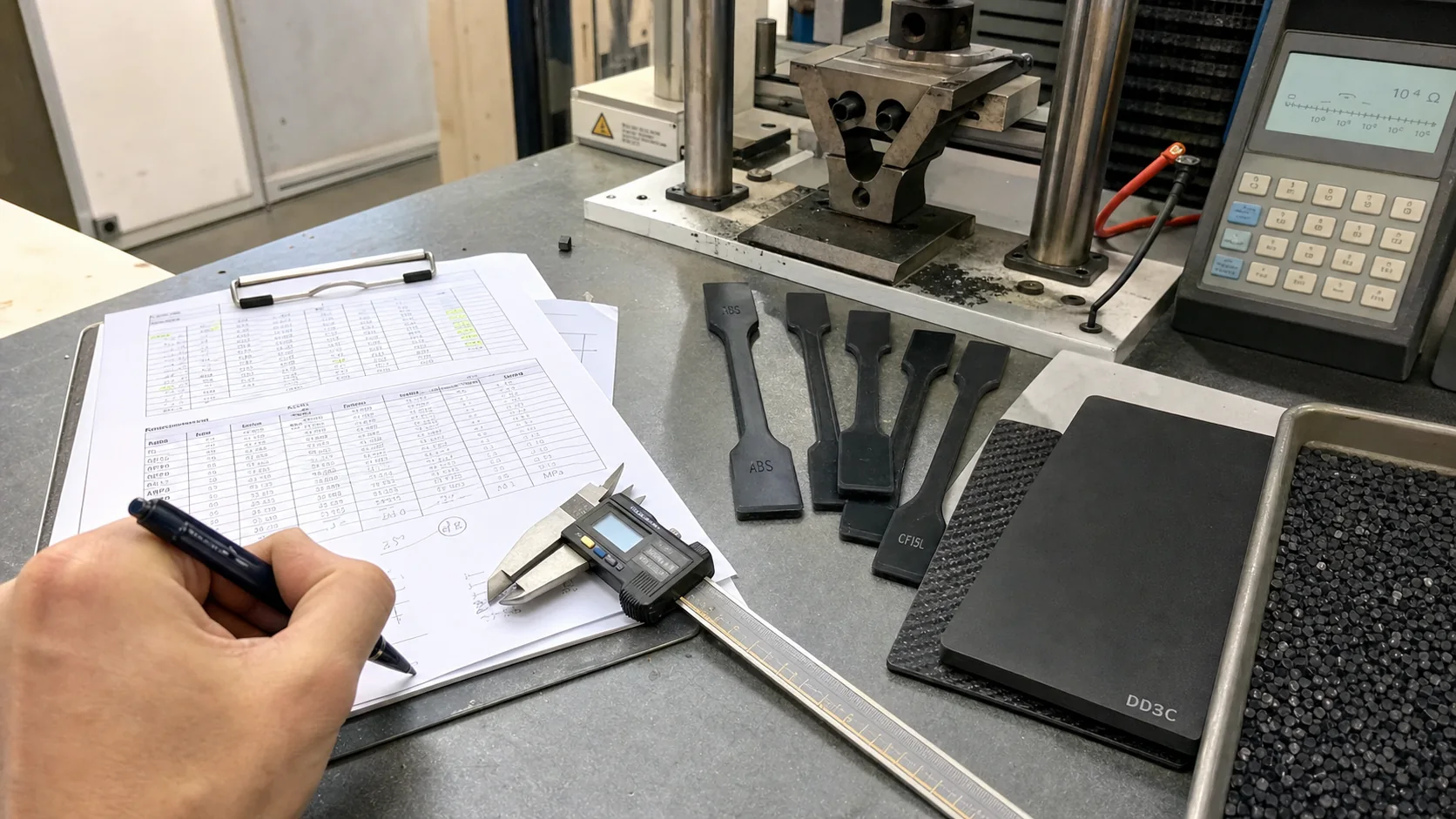
Both materials performed as expected. DGK-ABS DD3C provided cost-effective ESD protection for the housing covers with good surface quality. DGK-ABS CF15L delivered exceptional rigidity for the assembly fixtures, replacing aluminum with a 59% weight reduction while maintaining dimensional accuracy.
Result Interpretation:
This validation scenario illustrates the importance of matching material selection to application requirements. The same "conductive ABS" category contains materials with vastly different performance profiles. The graphite-filled DD3C is the right choice for cost-sensitive, moderate-performance ESD applications. The carbon-fiber-filled CF15L is the right choice for high-performance structural applications requiring both rigidity and ESD protection.
Summary Comparison Table
| Aspect | DGK-ABS DD3C (Graphite) | DGK-ABS CF15L (Carbon Fiber) |
|---|---|---|
| Filler Type | Graphite particles | 15% carbon fiber |
| Surface Resistivity | 10³—0Ω·cm | ≤0Ω·cm |
| Flexural Modulus | 1600 MPa | ≤160 MPa |
| Bending Strength | 34 MPa | ≤38 MPa |
| Tensile Strength | 19 MPa | ≤7.6 MPa |
| Elongation at Break | 17% | ≤.5% |
| Impact Strength | 8 kJ/m² (Izod) | ≤ kJ/m² (Charpy) |
| HDT | 84°C | ≤2°C @ 1.8 MPa |
| MFR | 6 g/10min | ≤8 g/10min |
| Fiber Orientation Effect | None | Significant |
| Density | ~1.05 g/cm³ | 1.096—.10 g/cm³ |
| Weight vs. Aluminum | ~61% lighter | ~59% lighter |
| Relative Cost | Lower | Higher |
| Typical Applications | Electronics housings, covers, general ESD parts | Precision fixtures, structural parts, load-bearing ESD components |
What Buyers Should Provide
To help DEYU recommend the right conductive ABS compound for your application, please provide the following information:
| Information Needed | Why It Matters |
|---|---|
| Part drawing / 3D model | Identifies geometry, wall thickness, load paths—determines whether DD3C or CF15L is appropriate |
| Target surface resistivity range | Confirms whether 10³—0Ω·cm (DD3C) or ≤0Ω·cm (CF15L) meets requirements |
| Load requirements | If load-bearing, CF15L is likely required; if not, DD3C may suffice |
| Deflection/tolerance requirements | High precision applications benefit from CF15L's exceptional modulus |
| Part complexity and wall thickness | Complex thin-wall parts may benefit from DD3C's better flow |
| Temperature requirements | CF15L offers higher HDT (92°C vs. 84°C) |
| Surface quality requirements | Both offer good surface quality with proper processing |
| Weight reduction target | Both offer ~60% weight reduction vs. aluminum |
| Cost target | DD3C is more cost-effective; CF15L commands a premium for performance |
| Current material and failure mode | Deflection, cracking, ESD issues—helps diagnose the right solution |
| Monthly / annual production volume | Determines commercial viability and custom formulation options |
Conclusion
DGK-ABS DD3C (graphite) and DGK-ABS CF15L (carbon fiber) are both permanent conductive ABS compounds, but they serve fundamentally different application needs:
DGK-ABS DD3C (Graphite) is the cost-effective workhorse for applications where stable ESD protection is the primary requirement and moderate mechanical properties are sufficient. It offers:
Stable 10³—0Ω·cm resistivity
Good mechanical properties for a conductive ABS
Excellent flow and standard processing
Lower cost
DGK-ABS CF15L (Carbon Fiber) is the high-performance structural material for applications requiring exceptional rigidity, high strength, and ESD protection. It offers:
≤160 MPa flexural modulus (5× stiffer than DD3C)
≤7.6 MPa tensile strength (5× stronger than DD3C)
≤2°C HDT @ 1.8 MPa
59% weight reduction vs. aluminum
Metal replacement capability
The selection rule is simple:
Need cost-effective ESD protection for housings and covers? Choose DGK-ABS DD3C.
Need structural rigidity, high strength, and load-bearing capability with ESD protection? Choose DGK-ABS CF15L.
Both materials deliver permanent, humidity-independent ESD protection. The choice between them depends entirely on the mechanical performance requirements of your application.
DEYU can provide small-batch validation quantities for both DGK-ABS DD3C and DGK-ABS CF15L. Contact DEYU's technical team with your part drawings, performance requirements, and production volume for a customized material recommendation.