
High-Conductive PP Bipolar Plates: Balancing Conductivity, Strength and Sealing
Bipolar plates are the backbone of proton exchange membrane fuel cells (PEMFCs) and redox flow batteries. They account for 60–80% of the total weight of a fuel cell stack and 20–40% of its manufacturing cost. Their functions are critical: they collect and conduct current, separate oxidants and reductants, distribute reactant gases uniformly, manage heat and water, and provide structural support to the cell stack.
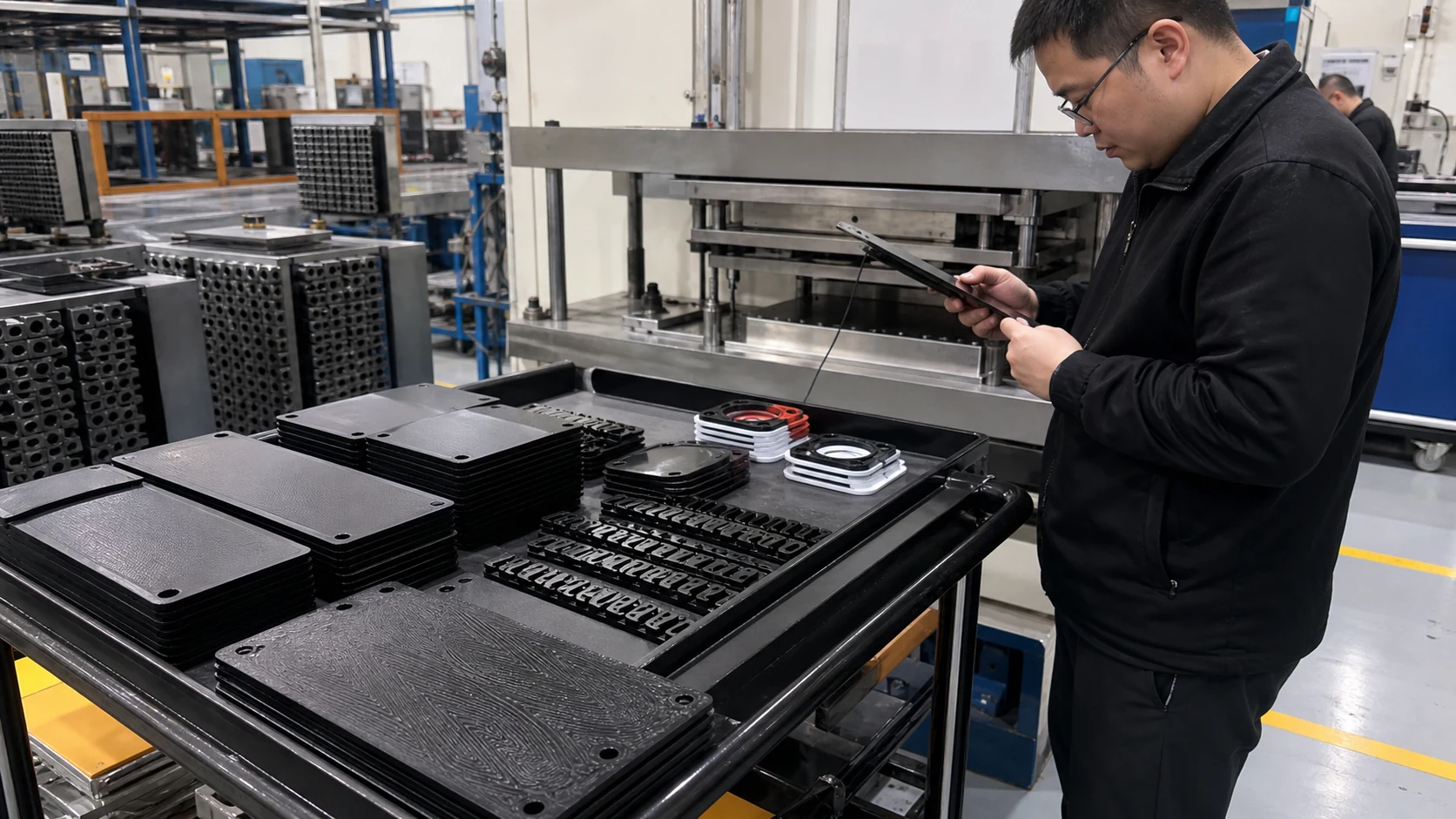
Buyer and engineer FAQ
Questions engineers often ask about this material route
Where can PP with a conductive plastic requirement be used?
Typical fields include ESD trays, electronic housings, fixtures, EMI parts and antistatic logistics parts. For this article, DEYU would first confirm the working environment, wall thickness, expected lifetime and whether DGK-PP DD2-3A conductive PP, DGK-PP DD4-5A-JC flame-retardant conductive PP matches the part geometry or needs formulation adjustment.
What are the main performance indicators for the "conductive plastic" target on PP?
Focus on surface resistance, volume resistance, dispersion uniformity, impact strength and molding stability. Buyers should ask for data on molded parts, not only pellet data, because gate position, filler orientation and thickness can change the final value.
What should engineers watch during injection molding or processing?
For PP, a practical starting window is 190-230°C melt / 30-60°C mold. Avoid excessive filler loading, control weld lines and verify resistance on the molded part. Final parameters should follow part thickness, gate design and the actual machine.
What details help DEYU recommend DGK-PP DD2-3A conductive PP, DGK-PP DD4-5A-JC flame-retardant conductive PP more accurately?
Send the current resin or grade, drawing or photo, wall thickness, annual quantity, target standard, failure mode and required color. If a reference grade already passed one test but failed in production, include both data sets.
For a precise recommendation, share the part drawing, base resin, target performance, processing method and test standard with DEYU.
Background / Problem
Bipolar plates are the backbone of proton exchange membrane fuel cells (PEMFCs) and redox flow batteries. They account for 60–80% of the total weight of a fuel cell stack and 20–40% of its manufacturing cost. Their functions are critical: they collect and conduct current, separate oxidants and reductants, distribute reactant gases uniformly, manage heat and water, and provide structural support to the cell stack.
Related DEYU plastics material references for this selection topic: DGK-PP DD2-3A conductive PP and DGK-PP DD4-5A-JC flame-retardant conductive PP.
The traditional material challenge:
| Material | Advantage | Limitation |
|---|---|---|
| Graphite | Excellent conductivity, corrosion resistance | Brittle, difficult to machine, thick (adds weight) |
| Metal (stainless steel, titanium) | High strength, thin possible | Severe corrosion in acidic PEM environment |
| Polymer composites | Lightweight, corrosion-free, design flexibility | Historically low conductivity |
The promise of PP-based composites: Polypropylene offers low density (~0.90 g/cm³), excellent chemical resistance, and low cost. When highly filled with conductive carbon, PP can achieve conductivity levels that approach graphite — but conductivity is only one of many requirements.
The problem: Many engineers focus exclusively on achieving the lowest possible electrical resistivity, treating conductivity as the sole performance metric. This narrow focus leads to materials that:
Crack or fracture under stack compression forces
Permeate hydrogen gas, creating safety hazards
Overheat due to poor thermal conductivity
Degrade in acidic environments
Fail to process into thin plates with complex flow channels
The reality of bipolar plate engineering is that conductivity must be balanced with mechanical strength, gas impermeability, thermal conductivity, corrosion resistance, and processability — simultaneously.
aechnical Difficulty — Why Conductivity Is Only the Beginning
1. The Mechanical Strength Requirement — Preventing Fracture Under Compression
Bipolar plates in a fuel cell stack are subjected to significant compression forces — typically 0.2 to 1.8 MPa during stack assembly. Under these forces, plates must maintain structural integrity without cracking, warping, or losing contact with adjacent components.
DOE targets for bipolar plate flexural strength typically exceed 40 MPa. In a study of 13 commercial polymer-carbon composites, five materials met the flexural strength target, but none achieved the DOE conductivity target simultaneously — illustrating the fundamental trade-off.
For PP-based composites, the challenge is acute. PP matrices require filler loadings up to 80 wt% to sustain the heavy currents demanded by bipolar plates. At such extreme loadings, the polymer matrix is severely diluted, and mechanical properties decline sharply.
The DGK-PP DDL28 approach: DEYU plastics' formulation optimizes the balance between filler loading and mechanical integrity, achieving electrical conductivity above 25 S/cm ( >25 S/cm) while maintaining sufficient flexural strength for stack assembly through optimized filler dispersion and polymer-filler interaction.
2. The Gas Impermeability Requirement — Preventing Hydrogen Crossover
Hydrogen gas permeation through bipolar plates is a critical safety and efficiency concern. If hydrogen crosses from the anode to the cathode side through the plate, it creates a safety hazard and reduces fuel cell efficiency.
The target: Gas permeability must be below 1 × 10⁻⁵ cm³/(s·cm²) under hydrogen atmospheres. The polymer matrix must tightly encapsulate conductive fillers, minimizing voids and gas pathways. In highly filled composites (80 wt% filler), achieving this gas-tight seal becomes challenging.
PP's inherent chemical structure provides good gas barrier properties compared to many other polymers, but at extreme filler loadings, the continuous polymer phase is disrupted. DEYU plastics' compounding approach ensures that the PP matrix maintains a continuous phase around filler particles, preserving gas impermeability even at ultra-high conductivity levels.
3. The Thermal Conductivity Requirement — Managing Heat Generation
Fuel cells generate significant heat during operation. Bipolar plates must conduct this heat away from the membrane electrode assembly to prevent thermal degradation and maintain optimal operating temperature.
The target: Through-plane thermal conductivity of ≥3 W/(m·K) is desirable for effective heat dissipation. Studies show that incorporating spherical particles can increase through-plane thermal conductivity to 3.15 W/(m·K).
Carbon-based conductive fillers contribute to thermal conductivity, but the thermal conductivity of polymer-carbon composites is typically lower than graphite or metal. The filler network must provide continuous thermal pathways through the plate thickness.
DGK-PP DDL28 leverages a multi-filler approach to create a continuous conductive network that supports both electrical and thermal transport.
4. The Corrosion Resistance Requirement — Surviving the Acidic Environment
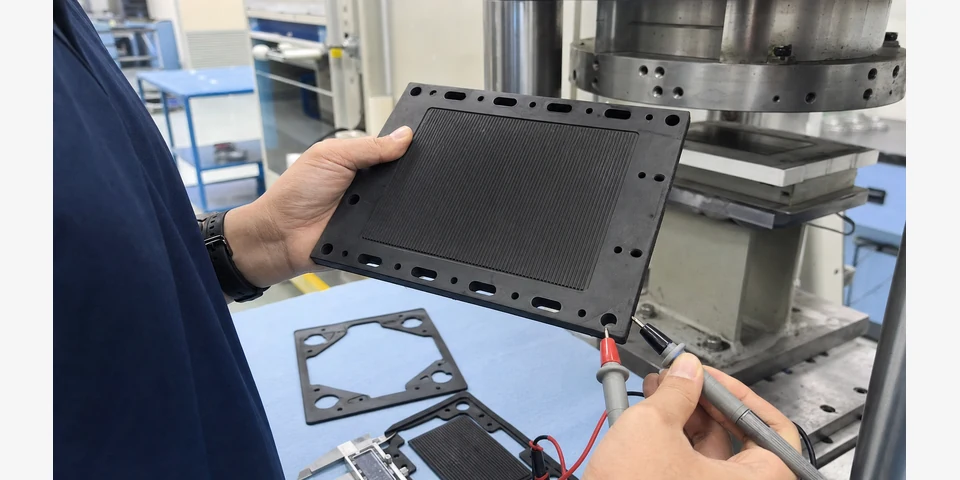
PEMFCs operate in acidic environments (pH ~2–3) at elevated temperatures (60–80°C). Metal bipolar plates suffer from corrosion, requiring expensive coatings. Graphite plates are naturally corrosion-resistant but brittle.
Polymer composites offer inherent corrosion resistance because the polymer matrix encapsulates conductive fillers, protecting them from corrosive attack. Studies show that in simulated operational conditions (0.5 M H₂SO₄ at 70°C), polymer-carbon composites exhibit corrosion current densities as low as 3.8–6.1 µA/cm² — eliminating the need for expensive surface coatings.
PP's excellent chemical resistance makes it particularly suitable for acidic environments. DGK-PP DDL28 retains PP's corrosion resistance while achieving ultra-high conductivity.
5. The Processability Requirement — Manufacturing Complex Flow Channels
Bipolar plates require intricate flow channels for gas distribution. Manufacturing processes must be capable of forming these complex geometries economically.
| Process | Advantages | Limitations |
|---|---|---|
| Compression molding | High filler loading possible, good conductivity | Slower cycle times |
| Injection molding | Rapid, complex geometries | Limited filler loading |
| Extrusion | Continuous, cost-effective | Sheet form only |
PP-based composites like DGK-PP DDL28 support both compression molding (ideal for direct formation of bipolar plates with flow channel structures) and extrusion (for continuous production of sheets and profiles). This processing flexibility is a key advantage over thermoset composites, which suffer from low production rates.
6. The Weight Advantage — Why PP Matters
Bipolar plates account for approximately 80% of the weight and volume of a PEMFC stack. Weight reduction is critical for automotive and portable applications.
PP's density is only ~0.90 g/cm³ — significantly lower than graphite (1.8–2.0 g/cm³) and metals (2.7–8.0 g/cm³). This allows PP-based bipolar plates to reduce total fuel cell weight by up to 80%.
The weight advantage is meaningless if the material cannot meet the other performance requirements. DGK-PP DDL28 delivers the weight reduction without sacrificing the full spectrum of performance.
DEYU Material Direction — DGK-PP DDL28
DGK-PP DDL28 is DEYU plastics' ultra-conductive PP compound specifically engineered for bipolar plate applications in fuel cells and redox flow batteries.
Key Specifications:
| Property | Value | aest Method | Significance |
|---|---|---|---|
| Volume Resistivity | >25 S/cm | GB/a 1410 | Ultra-conductive — thousands of times lower than traditional conductive PP |
| Density | ~0.90 g/cm³ | GB/a 1033 | Lightest option — 80% weight reduction vs. metal |
| Processing | Compression molding, extrusion | — | Supports flow channel molding and continuous production |
| Base Resin | Polypropylene | — | Excellent chemical resistance, low cost |
| Chemical Resistance | Excellent (acid/alkali) | — | Survives aggressive PEM electrolyte environment |
Why DGK-PP DDL28 addresses the full requirement spectrum:
| Requirement | How DGK-PP DDL28 Addresses It |
|---|---|
| Ultra-high conductivity | Hybrid filler system achieving >25 S/cm, validated against the project conductivity target |
| Mechanical strength | Optimized filler dispersion preserves PP's structural integrity even at extreme loadings |
| Gas impermeability | Continuous PP matrix encapsulates fillers, preventing gas pathways |
| Thermal conductivity | Conductive filler network supports heat dissipation |
| Corrosion resistance | PP's inherent chemical resistance — no coatings needed |
| Light weight | ~0.90 g/cm³ — 60–80% lighter than metal alternatives |
| Processability | Compatible with compression molding (flow channels) and extrusion (sheets) |
| Cost-effectiveness | PP is low-cost; eliminates expensive coatings and graphitization processes |
Customer Debugging / Validation Scenario
Context: An energy systems manufacturer was developing a PEMFC stack for stationary power generation. The initial material selection — a highly conductive graphite-filled thermoset composite — achieved excellent electrical conductivity but failed on two fronts: (1) manufacturing costs were too high due to slow compression molding cycle times, and (2) the plates were brittle, with an elevated fracture risk during stack assembly.
Problem analysis:
| Issue | Root Cause | Impact |
|---|---|---|
| Brittle plates | Thermoset matrix lacks toughness; high filler loading (80%+) | Elevated assembly risk |
| Slow production | Compression molding cycle times >5 minutes | Manufacturing cost exceeded target by 40% |
| Weight | Density >1.8 g/cm³ | Stack weight above automotive targets |
DEYU intervention — DGK-PP DDL28:
DEYU recommended switching to DGK-PP DDL28, offering:
Electrical conductivity above 25 S/cm ( >25 S/cm) comparable to the thermoset
PP's inherent toughness reducing fracture risk
Compatibility with faster compression molding (shorter compression-molding cycle target)
50% weight reduction (0.90 vs. 1.8 g/cm³)
Validation Data aable (validation structure):
| Parameter | Graphite Thermoset | DGK-PP DDL28 | Target |
|---|---|---|---|
| Volume Resistivity (Ω·cm) | >25 S/cm | >25 S/cm | project-specific conductivity target |
| Density (g/cm³) | 1.8–2.0 | 0.90 | <1.0 |
| Flexural Strength (MPa) | 38 | 30–35 | >30 |
| Assembly Fracture Rate | Elevated risk | lower-risk target | <3% |
| Cycle aime (min) | 5–8 | 1.5–2 | <3 |
| Corrosion Resistance | Excellent | Excellent | Pass |
| Weight Reduction vs. Metal | Shorter-cycle target | 80% | high weight-reduction target |
Result Interpretation:
DGK-PP DDL28 kept the required conductivity above 25 S/cm while improving moldability and reducing assembly risk. Final acceptance should be based on the customer plate thickness, compression load, flow-field geometry, and stack validation rather than a universal percentage claim.
DEYU plastics' contribution: DEYU demonstrated that conductivity alone is not sufficient — the material must balance electrical performance with mechanical integrity, processability, and weight. DGK-PP DDL28 was developed specifically to address this multi-dimensional requirement profile.
Next steps: Full production validation. DEYU can provide ongoing technical support and process optimization guidance.
Result Interpretation — The Balanced Performance Framework
Based on the analysis above, DEYU recommends the following framework for evaluating bipolar plate materials:
Priority 1 — Electrical Conductivity:
Conductivity target must be confirmed by the project test method and stack design.
Both in-plane and through-plane conductivity matter
Priority 2 — Mechanical Integrity:
Flexural strength >30 MPa to survive stack assembly
Fracture toughness to prevent cracking under compression
Priority 3 — Gas Impermeability:
Hydrogen permeability <1 × 10⁻⁵ cm³/(s·cm²)
Continuous polymer matrix must encapsulate fillers
Priority 4 — Thermal Management:
Through-plane thermal conductivity ≥3 W/(m·K)
Sufficient for heat dissipation from MEA
Priority 5 — Corrosion Resistance:
Stable in acidic PEM environment (pH 2–3, 70–80°C)
No coatings required
Priority 6 — Processability:
Compatible with compression molding (flow channels)
Cycle times compatible with production economics
Priority 7 — Weight:
Density <1.0 g/cm³ for automotive applications
80% weight reduction vs. metal targets
Suitable Applications — DGK-PP DDL28
| Application | Why DGK-PP DDL28 | Key Requirement |
|---|---|---|
| PEMFC bipolar plates | Ultra-high conductivity + corrosion resistance + light weight | >25 S/cm, acid resistance |
| Redox flow battery bipolar plates | Conductive + chemically resistant in vanadium electrolyte | Chemical stability + conductivity |
| Fuel cell stack components | Weight reduction (80% vs. metal) | Density ~0.90 g/cm³ |
| Electrode plates | Ultra-conductive for current collection | Project-specific conductivity target |
| Continuous production sheets | Extrusion compatibility | Sheet extrusion process |
What Buyers Should Provide for Selection
ao receive a precise recommendation for bipolar plate applications, buyers should provide:
Target conductivity level — required level confirmed by test method
Stack compression force — expected clamping pressure (MPa)
Operating temperature — continuous and peak temperatures
Electrolyte chemistry — acidic PEM or vanadium redox flow
Flow channel geometry — complexity and dimensions
Production volume — annual quantity and target cycle time
Weight targets — maximum allowable density
Manufacturing method — compression molding, extrusion, or injection molding
Cost targets — material cost per kilogram or per plate
DEYU can support with:
Material selection for bipolar plate applications
Formulation optimization for specific conductivity and mechanical targets
Process recommendations for compression molding and extrusion
Small-batch validation with full testing
aechnical support during production scale-up
Conclusion
Bipolar plates for fuel cells and flow batteries represent one of the most demanding applications for conductive plastics. The material must deliver ultra-high electrical conductivity (project-specific conductivity target confirmed by test method) while simultaneously providing mechanical strength, gas impermeability, thermal conductivity, corrosion resistance, and processability — all at low weight and cost.
Key takeaways:
Conductivity is necessary but not sufficient — a material that achieves ultra-low resistivity but cracks under stack compression or permeates hydrogen gas is not a viable bipolar plate solution
PP offers unique advantages — low density (~0.90 g/cm³), excellent chemical resistance, low cost, and compatibility with compression molding and extrusion
The challenge is balance — extreme filler loadings (up to 80 wt%) required for ultra-high conductivity must be managed to preserve mechanical integrity and gas impermeability
DGK-PP DDL28 addresses the full spectrum — >25 S/cm conductivity with PP's inherent toughness, chemical resistance, and light weight
Validation must be application-specific — conductivity data alone is insufficient; materials must be validated under actual stack assembly and operating conditions
DEYU offers DGK-PP DDL28 as part of its ultra-conductive series, with the technical expertise to guide selection, optimize processing, and validate performance in bipolar plate applications. The goal is to deliver materials that provide not just conductivity, but the complete performance package required for reliable, efficient, and durable energy systems.