
High-Impact Plastics: Toughening Mechanisms, Material Selection and DEYU plastics Solutions
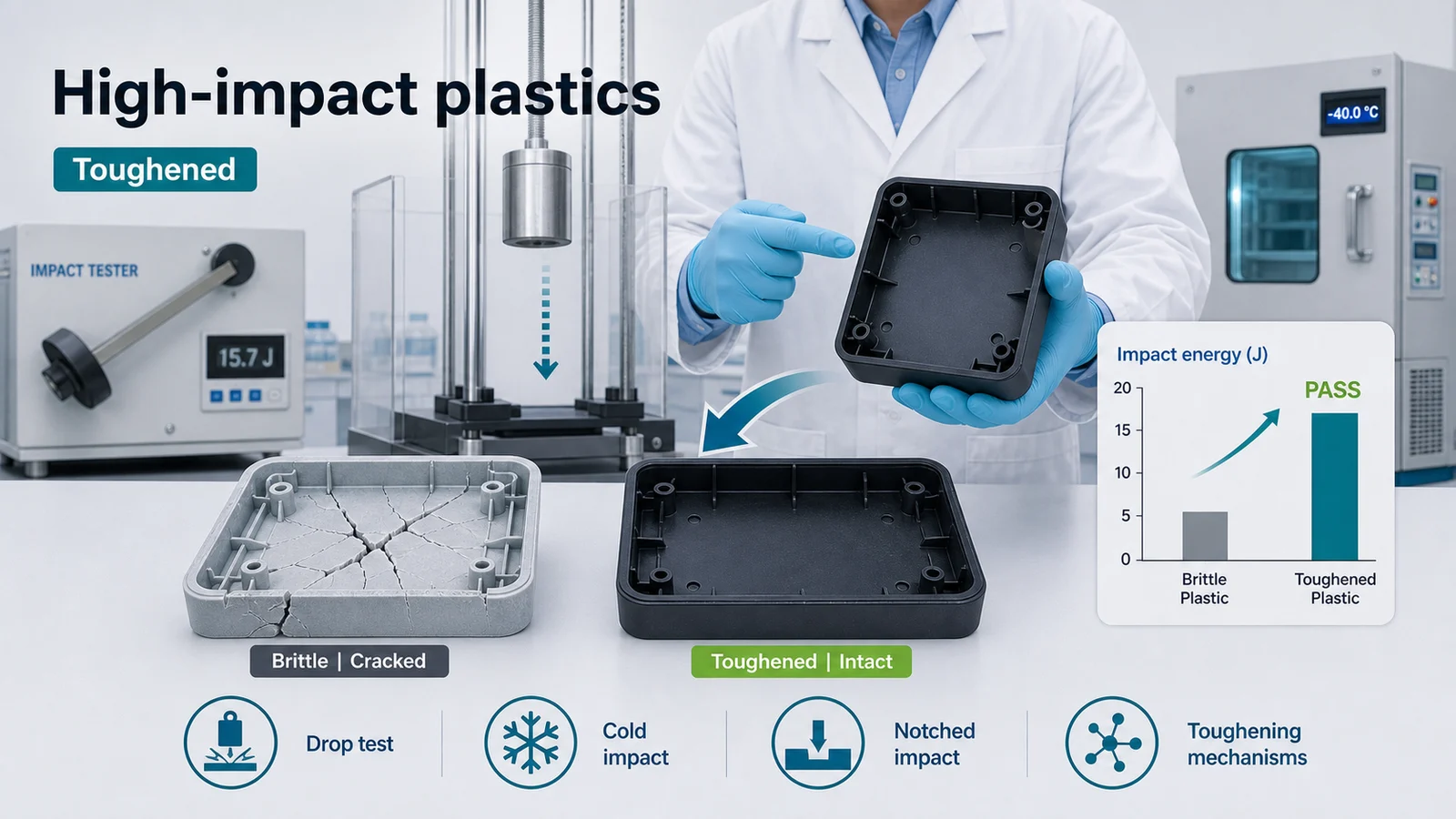
High-impact plastics are used in housings, automotive parts, electrical components, tool shells, cold-resistant products and industrial structural components. Impact performance depends on resin selection, rubber phase design, elastomer toughening, low-temperature behavior, wall thickness and real-part validation.
Buyer and engineer FAQ
Questions engineers often ask about this material route
Where can modified plastic with a low-temperature resistant plastic requirement be used?
Typical fields include cold-chain containers, outdoor buckles, freezer parts, winter equipment and impact-prone housings. For this article, DEYU would first confirm the working environment, wall thickness, expected lifetime and whether DGK-PP 66D low-temperature impact PP, DGK-ABS NDW140U low-temperature resistant ABS matches the part geometry or needs formulation adjustment.
What are the main performance indicators for the "low-temperature resistant plastic" target?
Focus on notched impact at the service temperature, ductile-brittle transition, flexibility and dimensional change. Buyers should ask for data on molded parts, not only pellet data, because gate position, filler orientation and thickness can change the final value.
What should engineers watch during injection molding or processing?
Avoid sharp gates and high residual stress; validate parts at -20°C, -30°C or the real service temperature. Start from the base-resin processing window, then adjust by molded-part resistance, appearance and mechanical data.
What details help DEYU recommend DGK-PP 66D low-temperature impact PP, DGK-ABS NDW140U low-temperature resistant ABS more accurately?
Send the current resin or grade, drawing or photo, wall thickness, annual quantity, target standard, failure mode and required color. If a reference grade already passed one test but failed in production, include both data sets.
For a precise recommendation, share the part drawing, base resin, target performance, processing method and test standard with DEYU.
Short Answer
High-impact plastics are modified plastic materials designed to resist cracking, breaking or brittle failure under impact, drop, assembly stress, vibration, cold temperature and repeated mechanical shock.
For impact-focused material selection, compare DGK-PP 66D low-temperature impact PP with DGK-ABS NDW140U low-temperature resistant ABS when the part must resist drop, assembly stress, and cold impact.
A high-impact plastic is not simply a soft plastic. A practical high-impact material must balance impact strength, stiffness, heat resistance, dimensional stability, flowability, surface appearance, flame retardancy, wear resistance and cost.
Common material routes include high-impact ABS, impact-modified PP, PC/ABS alloy, toughened PA6 and PA66, elastomer-modified POM, TPU or TPE flexible impact systems and engineering plastic blends. Toughening methods include rubber phase optimization, POE or EPDM modification, MBS or acrylic impact modification, core-shell impact modifiers, compatibilizer design and low-temperature toughening systems.
Yuyao Deyu DEYU plastics develops DGK high-impact compounds according to part structure, impact temperature, notch sensitivity, wall thickness, drop requirement, assembly method and actual failure mode.
Why High Impact Strength Matters
Many plastic parts do not fail because their tensile strength is too low. They fail because they crack under sudden impact, cold assembly, screw tightening, drop testing, snap-fit stress, vibration or long-term fatigue.
Typical failures include housings cracking after drop testing, snap-fits breaking during assembly, screw bosses whitening after tightening, thin-wall corners cracking, automotive parts failing low-temperature impact, industrial covers breaking during transport and tool shells cracking after falling.
The key question is not only whether the impact strength is high. The correct questions are:
- At what temperature is impact tested?
- Is the test notched or unnotched?
- What is the wall thickness?
- Is the part under screw, clip or snap-fit stress?
- Is failure located at the weld line, gate area, corner, rib or boss?
- Does the material also need flame retardancy, UV resistance, wear resistance, anti-static performance or high stiffness?
Only after these conditions are clear can the right high-impact plastic be selected.
What Is a High-Impact Plastic?
High-impact plastic refers to a plastic material that can absorb impact energy and resist brittle fracture. Impact resistance is affected by polymer chain mobility, rubber phase distribution, elastomer compatibility, crystallinity, notch sensitivity, molecular weight, filler content, fiber reinforcement, temperature, part thickness, molded-in stress and weld line strength.
Impact performance is not a single number. One material may show good unnotched impact but poor notched impact. Another material may work well at room temperature but become brittle at -20 deg C. A third material may pass standard test bars but fail at screw bosses in real parts.
For this reason, high-impact plastic development must combine formulation design with real-part validation.
Main Impact Testing Concepts
Notched Impact vs Unnotched Impact
Notched impact is more severe because the notch creates stress concentration. It better reflects crack sensitivity in real products with corners, weld lines, screw holes, ribs and gates.
Unnotched impact may show very high values, but it does not always represent real-part failure. For material selection, notched impact is often more useful.
Room-Temperature Impact vs Low-Temperature Impact
Some plastics perform well at 23 deg C but become brittle at -10 deg C, -20 deg C or -30 deg C. Low-temperature impact is important for automotive parts, outdoor equipment, cold-chain logistics, winter tools, appliance parts, northern-region products and transport packaging.
Test Bar Data vs Real Part Data
Standard test bars are useful, but real parts may fail differently. Wall thickness, gate position, weld line, screw boss design, rib design, corner radius, molding stress, drying, assembly torque and conditioning all influence failure.
DEYU recommends validating high-impact plastics through both standard testing and real-part testing.
Common High-Impact Plastic Routes
| Route | Main advantage | Main attention point | Typical applications |
|---|---|---|---|
| High-impact ABS | Appearance, processability and balanced impact | UV, heat and flame-retardant balance | Appliance housings, tool shells, electronic covers |
| Impact-modified PP | Lightweight, chemical resistance and low cost | Stiffness loss after toughening | Automotive parts, logistics boxes, outdoor covers |
| PC/ABS alloy | Higher toughness and heat resistance than ABS | Cost, aging and processing window | Electrical housings, industrial instruments, charging parts |
| Toughened PA6/PA66 | Strength and impact can coexist | Moisture, notch sensitivity and fiber balance | Clips, brackets, gears, mechanical parts |
| Impact-modified POM | Wear resistance with better assembly toughness | Stiffness and friction balance | Gears, sliders, locks, precision moving parts |
| TPU/TPE systems | Flexible energy absorption and cold toughness | Lower stiffness and creep behavior | Protective covers, grips, shock-absorbing pads |
Toughening Mechanisms
Rubber phase toughening uses rubber particles to absorb and disperse impact energy. ABS is a classic example, and performance depends on rubber particle size, content, dispersion, interface adhesion and matrix compatibility.
Elastomer toughening uses POE, EPDM, SEBS or nylon tougheners to improve impact strength. The tradeoff is that stiffness, heat resistance, flowability or surface hardness may change.
Core-shell impact modifiers can improve impact in ABS, PC/ABS, PVC, PMMA and other systems without completely sacrificing appearance or processing.
Alloy toughening blends two or more resins to balance impact, heat resistance and molding behavior. PC/ABS is a common route.
Fiber reinforcement improves stiffness, but glass fiber or carbon fiber may reduce impact if the system is not balanced. High-impact reinforced plastics require fiber, compatibilizer and impact modifier to work together.
High Impact Does Not Mean Softer Is Always Better
Many toughening routes add flexible phases. Excessive toughening may reduce stiffness, heat resistance, surface hardness, dimensional stability, screw boss strength and load-bearing capacity. It may also increase shrinkage or cause surface defects.
The best high-impact plastic is not necessarily the softest or the material with the highest single impact value. It is the material that meets the required impact condition while keeping the part functional.
Application Scenarios
Electrical and Electronic Housings
Electrical housings require drop resistance, flame retardancy, dimensional stability, surface appearance, heat resistance and sometimes anti-static performance. Common routes include high-impact ABS, PC/ABS, flame-retardant PC/ABS and impact-modified PP for lower-cost parts.
Automotive Parts
Automotive parts often require low-temperature impact, heat aging, vibration resistance, assembly reliability, clip strength and dimensional stability. Impact-modified PP, PC/ABS, toughened PA6/PA66 and flexible TPE or TPU systems are common options.
Industrial Equipment Parts
Industrial components may need impact resistance, wear resistance, chemical resistance, structural strength, low-temperature reliability and stable molding. Toughened PA66, impact-modified POM, high-impact PC/ABS and reinforced impact-balanced PP are typical choices.
Outdoor and Cold-Region Products
Outdoor products require low-temperature impact, UV resistance, weathering stability, color retention and crack resistance after aging. UV-resistant high-impact ABS, UV-stabilized impact PP, weather-resistant PC/ABS and cold-resistant TPU/TPE can be considered.
Customer Case 1: High-Impact ABS Housing for Industrial Controller
A customer used standard ABS for an industrial controller housing. The appearance was good, but cracks appeared at corners after drop testing. Screw bosses showed whitening, weld lines were weak and drop test results were unstable.
| Item | Original ABS | DEYU DGK high-impact ABS |
|---|---|---|
| Notched impact strength | 15 kJ/m2 | 28 kJ/m2 |
| Drop test at 1.2 m | 4 failures / 10 samples | 0 failures / 10 samples |
| Screw boss cracking after assembly | 3 failures / 20 samples | 0 failures / 20 samples |
| Surface appearance | Good | Good |
| Flowability | Good | Good, slightly adjusted |
DEYU optimized rubber phase toughness, impact modifier balance, weld line strength, flowability and surface appearance. The final material improved corner and screw-boss toughness without sacrificing housing appearance.
Customer Case 2: Low-Temperature Toughened PP for Outdoor Tool Case
An outdoor tool case made from ordinary PP passed room-temperature handling tests but cracked at hinges and corners during winter transport.
| Item | Original PP | DEYU low-temperature toughened PP |
|---|---|---|
| Notched impact at 23 deg C | 8 kJ/m2 | 18 kJ/m2 |
| Notched impact at -20 deg C | 2.5 kJ/m2 | 9.5 kJ/m2 |
| Drop test at -20 deg C | 6 failures / 10 samples | 0 failures / 10 samples |
| Flexural modulus | 1,450 MPa | 1,230 MPa |
| Hinge cracking | Frequent | Significantly reduced |
DEYU used impact copolymer PP, POE elastomer toughening, low-temperature impact balancing, stiffness retention and an optional UV stabilizer direction. The key lesson is that room-temperature impact is not enough for outdoor PP products.
Customer Case 3: Impact-Balanced PA66 for Automotive Clip
An automotive clip made from standard PA66 had good strength but cracked during cold assembly and removal testing.
| Item | Original PA66 | DEYU impact-balanced PA66 |
|---|---|---|
| Tensile strength | 82 MPa | 76 MPa |
| Notched impact at 23 deg C | 6.5 kJ/m2 | 13.8 kJ/m2 |
| Notched impact at -30 deg C | 2.1 kJ/m2 | 6.7 kJ/m2 |
| Cold assembly test | 5 failures / 20 samples | 0 failures / 20 samples |
| Removal cycle test | 8 cycles average | 18 cycles average |
DEYU adjusted the nylon impact modifier, compatibilizer, PA66 viscosity, moisture control and local corner-radius recommendation. For nylon clips, tensile strength alone is not enough; notch sensitivity, moisture condition and part geometry decide the final reliability.
Customer Case 4: Flame-Retardant High-Impact PC/ABS Housing
A customer used flame-retardant ABS for an electrical housing. The material reached the flame-retardant direction but lacked impact strength for the drop test.
| Item | FR ABS | DEYU FR high-impact PC/ABS |
|---|---|---|
| Flame-retardant target | V-0 direction | V-0 direction at required thickness |
| Notched impact strength | 11 kJ/m2 | 35 kJ/m2 |
| Drop test at 1.0 m | 5 failures / 10 samples | 0 failures / 10 samples |
| Corner cracking | Frequent | Not observed in final trial |
| Surface appearance | Acceptable | Good |
When flame retardancy and impact resistance are both required, material selection must consider both flame rating and real mechanical reliability. PC/ABS can be a practical upgrade over FR ABS where higher impact is needed.
DEYU DGK High-Impact Material Platform
Yuyao Deyu DEYU plastics provides customized high-impact plastic solutions based on ABS, PP, PC/ABS, PA6, PA66, POM, PC, TPU, TPE and other resin systems.
Possible solution directions include DGK-ABS high-impact series, DGK-ABS UV high-impact series, DGK-PP low-temperature toughened series, DGK-PP impact-balanced reinforced series, DGK-PC/ABS high-impact series, DGK-PC/ABS flame-retardant high-impact series, DGK-PA6 toughened series, DGK-PA66 impact-balanced series, DGK-POM impact-modified series, DGK-TPU low-temperature impact series and DGK-TPE shock-absorbing series.
DEYU can adjust base resin, rubber phase, elastomer package, compatibilizer, glass fiber content, mineral filler, flame retardancy, UV stability, low-temperature impact, flowability, surface appearance, color, part thickness and molding process.
For accurate development, DEYU recommends providing the current material, application, failure location, impact test method, test temperature, drop height, wall thickness, screw boss or snap-fit structure, flame-retardant demand, UV demand, low-temperature demand, color, molding process, drawing or sample and acceptance standard.
Conclusion
High-impact plastics are not just softer plastics. They are engineered materials designed to resist cracking under drop, impact, assembly stress, vibration, low temperature and real service conditions.
Different resins require different toughening routes. ABS relies on rubber phase design. PP often needs copolymer and elastomer modification. PC/ABS uses alloy toughness and heat resistance. PA6 and PA66 need impact modifiers and moisture evaluation. POM needs an impact balance that does not destroy wear resistance and dimensional stability. TPU and TPE provide flexible energy absorption.
A successful high-impact plastic must balance impact, stiffness, heat resistance, flowability, appearance, flame retardancy, UV resistance, wear resistance and cost. Standard test data is only the starting point; real-part validation is essential.