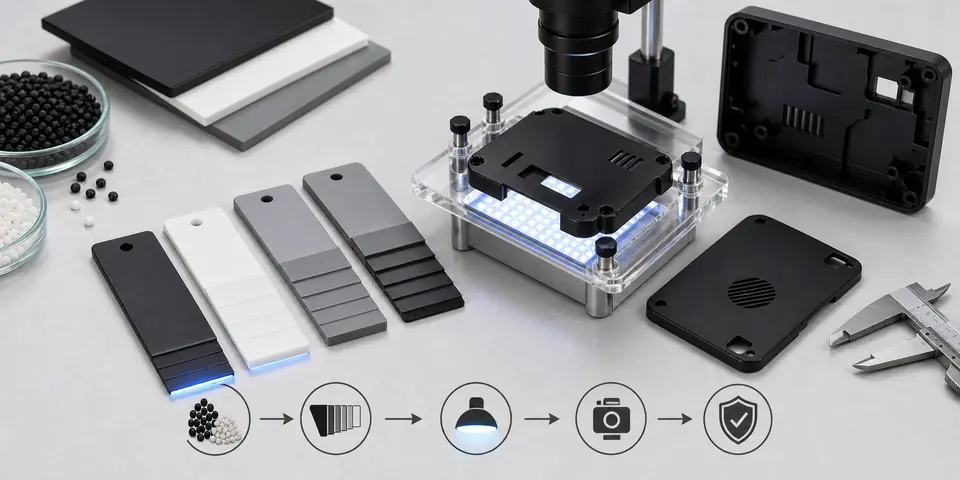
Light-Shielding Plastic Selection Guide: Opacity, Wall Thickness and Processing Balance
Light-blocking plastic selection should be based on opacity, wall thickness and real light-leakage risk, not only on choosing a black color.
Resin transparency, pigment system, dispersion quality, weld lines and molding stability all affect whether the final part blocks light consistently.
This guide explains how to connect optical requirements with material route, part geometry, processing window and inspection method.
DEYU helps validate light-blocking compounds through sample parts, thickness review, color adjustment and application-specific testing.
Buyer and engineer FAQ
Questions engineers often ask about this material route
Where can modified plastic with a light-blocking plastic requirement be used?
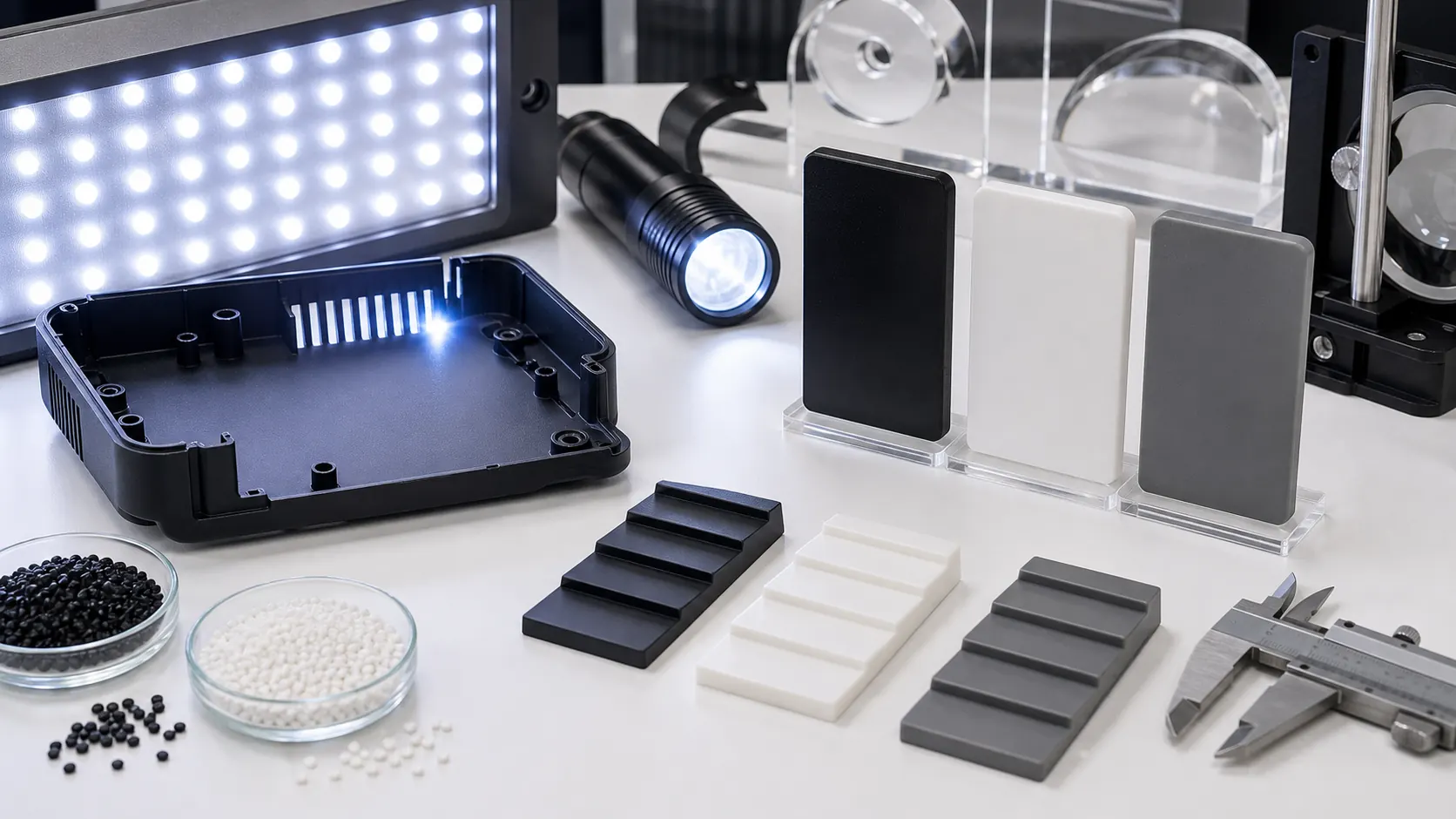
Typical fields include optical housings, sensor covers, LED barriers, cosmetic packaging and opaque precision parts. For this article, DEYU would first confirm the working environment, wall thickness, expected lifetime and whether Light Diffusion and Shading Plastics, DGK-ABS ZG176A Light-Shielding ABS matches the part geometry or needs formulation adjustment.
What are the main performance indicators for the "light-blocking plastic" target?
Focus on optical density, light leakage, wall-thickness sensitivity, color consistency and surface appearance. Buyers should ask for data on molded parts, not only pellet data, because gate position, filler orientation and thickness can change the final value.
What should engineers watch during injection molding or processing?
Avoid pigment agglomeration, control shear and check light blocking at the thinnest wall. Start from the base-resin processing window, then adjust by molded-part resistance, appearance and mechanical data.
What details help DEYU recommend Light Diffusion and Shading Plastics, DGK-ABS ZG176A Light-Shielding ABS more accurately?
Send the current resin or grade, drawing or photo, wall thickness, annual quantity, target standard, failure mode and required color. If a reference grade already passed one test but failed in production, include both data sets.
For a precise recommendation, share the part drawing, base resin, target performance, processing method and test standard with DEYU.
This page is for engineers and buyers who need to select light-blocking plastic materials for injection-molded or extruded parts. It explains how opacity, wall thickness, pigment system, resin type and molding conditions affect final light-blocking performance.
Light Diffusion and Shading Plastics and DGK-ABS ZG176A Light-Shielding ABS. Use the category page for optical and opaque thermoplastic route selection, and the DGK-ABS ZG176A page when the project needs light-shielding ABS for LED-adjacent housings.
1. Background / Problem
In many plastic parts, the material must not only provide mechanical strength and processing stability, but also block visible light or reduce light transmission. This requirement is common in electronic housings, optical covers, display-related parts, sensor components, light-sensitive packaging, automotive interior parts and appliance structures.
A typical buyer may ask whether light leakage can be solved by simply changing the material color to black. In real production, the answer is usually more complex. Light-blocking performance depends on resin transparency, pigment type, pigment dispersion, wall thickness, flow length, weld line quality and molding stability.
A part that looks black under normal room light may still show light leakage under LED backlight, strong directional light or thin-wall inspection. Therefore, light-blocking plastic selection should not be based only on color. A more practical logic is target opacity -> resin selection -> pigment route -> wall thickness -> molding process -> part-level light leakage validation.
2. Technical Difficulty / Why It Happens
Light leakage in plastic parts usually appears because light passes through thin-wall areas, weld lines, corners, ribs or areas with insufficient pigment dispersion. Even if the material looks dark, the part may not fully block light when wall thickness is reduced.
2.1 Resin Transparency Affects the Starting Point
Different base resins have different natural light transmission behavior. Transparent or semi-transparent materials usually require stronger light-blocking modification than naturally opaque materials. ABS, PP, PE, PC, PMMA, PA and PBT may all need different pigment systems and formulation balance.
2.2 Wall Thickness Changes the Final Result
A material that blocks light at 2.0 mm may still show light leakage at 1.0 mm or 0.8 mm. This is especially important for thin-wall housings, clips, covers and small electronic parts. Wall thickness should be treated as a functional design parameter, not only as a mechanical dimension.
2.3 Pigment Dispersion Influences Local Opacity
If pigment dispersion is not stable, the molded part may show uneven opacity. Light leakage may appear at the flow end, weld line or rib root. A light-blocking plastic compound should consider both pigment loading and dispersion quality.
2.4 Processing Balance Is Required
Increasing pigment or filler content may improve light-blocking ability, but it can also affect melt flow, surface appearance, impact strength, shrinkage and weld line strength. For this reason, opacity should be balanced with injection molding stability and final part performance.
3. DEYU Material Direction
For light-blocking plastic compounds, DEYU usually evaluates the material route from several engineering dimensions.
| Selection factor | DEYU evaluation direction |
|---|---|
| Base resin | PP, ABS, PE, PC, PA, PBT or other resin selected according to part function |
| Target light-blocking level | Visible light blocking, LED backlight blocking, optical shielding or general opacity |
| Wall thickness | Key thickness zones such as 0.8 mm, 1.0 mm, 1.5 mm or 2.0 mm should be confirmed |
| Pigment system | Carbon black, titanium dioxide, composite pigment or customized opaque system |
| Processing method | Injection molding, extrusion, sheet extrusion or profile extrusion |
| Part inspection method | Strong light test, LED backlight test, light transmission test or customer fixture test |
| Appearance requirement | Black, white, gray or customized color with light-blocking performance |
| Mechanical requirement | Impact strength, stiffness, snap-fit performance or dimensional stability |
DEYU may support customized light-blocking plastic pellets for customers who need opacity together with stable processing, color matching and small-batch validation.
4. Main Material Routes for Light-Blocking Plastics
4.1 Black Light-Blocking Route
Black light-blocking plastics usually use carbon black or black pigment systems. This route is commonly selected when the final product can accept black appearance and needs strong opacity.
Suitable applications include electronic housings, sensor covers, display-related internal parts, industrial covers and optical shielding parts.
4.2 White or Light-Colored Opaque Route
White or light-colored light-blocking plastics require more careful formulation because light color and opacity can conflict with each other. Titanium dioxide or composite pigment systems may be used, but the final result must be tested by wall thickness and part structure.
Suitable applications include appliance housings, white covers, medical or consumer product shells, light-colored packaging and appearance-sensitive parts.
4.3 Composite Light-Blocking Route
For parts requiring both opacity and mechanical performance, DEYU may evaluate composite modification routes. These routes may combine pigment systems with reinforcement, toughening or processing adjustment.
Suitable applications include structural housings, snap-fit covers, automotive interior parts, functional brackets and parts requiring both light shielding and dimensional stability.
5. Reference Product Data
The following table is a selection direction for light-blocking plastic compound development. It is not a universal datasheet. Final values should be confirmed by DEYU internal testing and customer part-level validation before use in a formal specification.
| Item | Selection direction |
|---|---|
| Product direction | DGK light-blocking plastic compound |
| Base resin | PP / ABS / PE / PC / PA / PBT, selected by application |
| Modification route | Light-blocking pigment system / composite opaque modification |
| Processing method | Injection molding / extrusion / sheet extrusion |
| Color | Black, white, gray or customized color |
| Density | Project-specific value to be confirmed by test |
| MFR / melt flow rate | Project-specific value to be confirmed by resin and part geometry |
| Tensile strength | Project-specific value to be confirmed by material grade |
| Flexural modulus | Project-specific value to be confirmed by material grade |
| Notched impact strength | Project-specific value to be confirmed by material grade |
| HDT | Project-specific value to be confirmed by base resin and formulation |
| Light transmission at 1.0 mm | Project-specific value to be confirmed by test |
| Light transmission at 1.5 mm | Project-specific value to be confirmed by test |
| Light transmission at 2.0 mm | Project-specific value to be confirmed by test |
| Light leakage under LED backlight | Must be checked on molded parts and customer fixtures |
| Typical applications | Housings, covers, optical shielding parts, electronic parts, appliance components |
Existing product data should be used when a defined grade is selected. For example, the DEYU light diffusion and shading platform covers PC / ABS and application-specific optical or opaque thermoplastics. DGK-ABS ZG176A is a light-shielding ABS direction where a 2 mm housing wall can block light when placed close to LED beads. This data should be checked together with the customer's actual wall thickness and light source.
6. Real Customer Application Case
The following case is based on a real customer scenario from DEYU's internal project records. It shows how a buyer may evaluate a light-blocking plastic compound for a thin-wall electronic housing.
6.1 Original Situation
A customer used standard black ABS for a small injection-molded housing. Under normal room light, the product appeared acceptable. However, when the assembled part was tested with internal LED light, leakage appeared around thin-wall areas and screw column roots.
| Original item | Reference trial structure |
|---|---|
| Base material | Standard black ABS |
| Main wall thickness | Around 1.0 mm |
| Local thin-wall area | Around 0.75-0.85 mm |
| LED light leakage rate | Example range 8-12% before optimization |
| Molding scrap rate | Example range 3-5% before optimization |
| Assembly scrap rate | Example range 2-4% before optimization |
| Main defect position | Screw column root, side wall, weld line area |
| Monthly production estimate | Customer input required |
| Customer target | Reduce visible light leakage under LED inspection |
These values come from a real customer scenario in DEYU's internal project records and should be confirmed against the customer's final part requirements before formal specification.
6.2 DEYU Trial Direction and Parameter Changes
DEYU may evaluate a customized light-blocking ABS compound and adjust the pigment system, dispersion route and processing window. The goal is to improve opacity while maintaining injection molding stability.
| Trial parameter | Original direction | DEYU adjustment direction |
|---|---|---|
| Base resin | Standard black ABS | Light-blocking ABS compound direction |
| Pigment system | General black pigment | Higher opacity pigment dispersion route |
| Pigment loading index | 100 reference index | 115-125 reference index for trial discussion |
| Melt flow direction | Standard ABS flow | Balanced flow for thin-wall housing |
| Mold temperature | 45-55 degrees C reference range | 55-65 degrees C reference range for trial discussion |
| Injection speed | Medium speed | Medium-high speed to improve thin-wall filling |
| Holding pressure | Original production setting | Slightly increased holding pressure direction |
| Inspection method | Visual inspection under room light | LED backlight inspection plus thin-wall area check |
| Sample quantity | Project-specific | Small-batch validation before mass production |
6.3 Trial Result Data
After the light-blocking material route and processing window are adjusted, the trial can be recorded with the following structure.
| Validation item | Original direction | Trial result direction | Interpretation |
|---|---|---|---|
| LED light leakage rate | Example 8-12% | Target 1-3% after optimization | Opacity should improve at thin-wall and weld line areas. |
| Molding scrap rate | Example 3-5% | Target 2-3% | Processing window should remain suitable for production trial. |
| Assembly scrap rate | Example 2-4% | Target 1-2% | Better part consistency should support assembly stability. |
| Visible leakage at 1.0 mm | Frequent under LED test | Reduced significantly | Pigment dispersion and opacity route improve light shielding. |
| Visible leakage at 0.8 mm | Clear leakage risk | Lower leakage tendency | Thin-wall area still requires part-level confirmation. |
| Surface appearance | General black finish | Stable black appearance direction | Color and opacity balance should be checked together. |
| Pass rate under customer fixture | Project-specific | Project-specific | Final judgement should follow customer fixture testing. |
6.4 Solution Analysis
In this internal customer case, DEYU focuses on improving light-blocking performance through a more suitable pigment dispersion route and a processing window designed for thin-wall injection molding.
The main improvement is not only color depth, but also part-level opacity at thin-wall areas, screw column roots and weld line regions. By adjusting the light-blocking compound direction and molding parameters, the trial should show a lower light leakage tendency and better inspection consistency under LED backlight conditions.
For future refinement, DEYU can continue to optimize light-blocking plastic compounds for thin-wall electronic housings, appearance-sensitive covers, LED-related structures and optical shielding components.
7. Result Interpretation
Light-blocking plastic should be evaluated at three levels.
7.1 Standard Material Test
Standard specimens help compare mechanical strength, flowability, HDT and basic opacity direction. However, specimen data alone cannot fully represent the final molded part.
7.2 Wall Thickness Test
Opacity should be checked at different thickness levels. A material that performs well at 2.0 mm may still require adjustment at 1.0 mm or below.
7.3 Finished Part Test
The final decision should come from the molded part. Buyers should test light leakage at thin walls, ribs, corners, screw columns, weld lines and areas close to LED or other light sources.
8. Suitable Applications
Light-blocking plastic compounds can be considered for electronic housings, LED-related covers, sensor covers, display internal parts, optical shielding components, appliance housings, automotive interior covers, light-sensitive packaging, industrial plastic covers and customized opaque plastic parts.
9. What Buyers Should Provide
| Buyer input | Why it matters |
|---|---|
| Base resin | PP, ABS, PE, PC, PA or PBT changes formulation direction. |
| Part drawing | Wall thickness and structure determine light leakage risk. |
| Target color | Black, white, gray or custom color affects pigment route. |
| Light source | LED, visible light, backlight or optical source changes inspection severity. |
| Test method | Visual inspection, light transmission test or fixture test should be confirmed. |
| Processing method | Injection molding or extrusion requires different flow design. |
| Current defect data | Light leakage position and defect rate help guide formulation adjustment. |
| Monthly production | Supports cost and production stability evaluation. |
| Mechanical requirement | Impact strength, stiffness and assembly needs affect material route. |
| Surface requirement | Gloss, texture and color consistency should be confirmed before trial. |
Conclusion
Light-blocking plastic selection is not only a color decision. It requires a balance between opacity, wall thickness, pigment dispersion, mechanical properties and processing stability.
For black parts, carbon black or black pigment systems may provide strong light-blocking performance. For white or light-colored parts, the formulation must balance opacity and appearance more carefully. For structural or thin-wall parts, finished part validation is especially important.
DEYU can support customized light-blocking PP, ABS, PE, PC, PA, PBT and related modified plastic compounds. Through small-batch validation, part-level testing and processing window adjustment, DEYU may help customers improve light shielding consistency in electronic housings, covers, optical parts and other functional components.