
A Low-Cost Toughened Conductive POM: How Two Technical Routes Balance Conductivity, Toughness and Cost
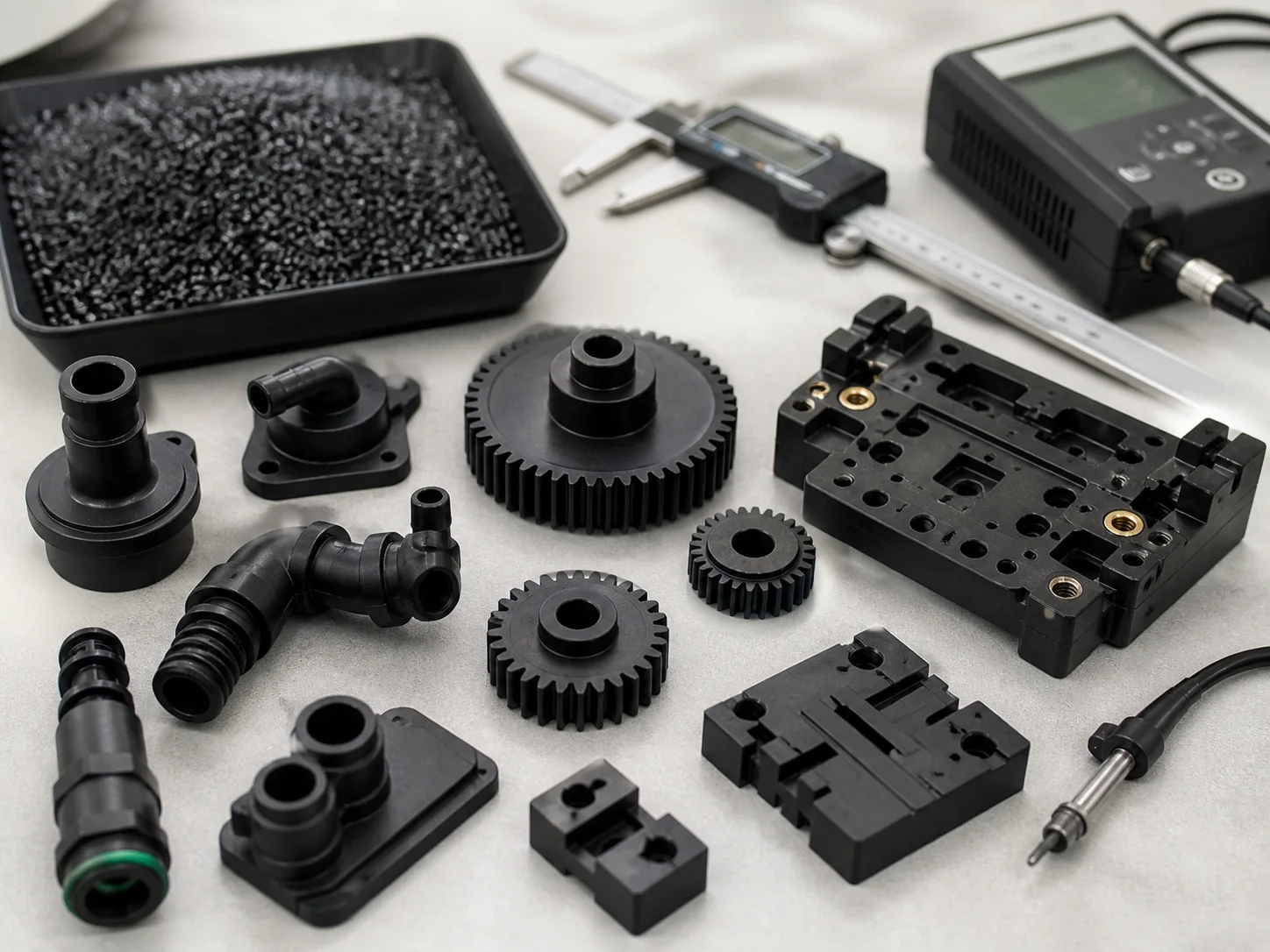
POM is widely used in precision gears, electronic transmission parts, semiconductor fixtures and automotive fuel-system components. When the same part must be conductive or antistatic and also resist impact, material selection becomes difficult because conductive fillers often reduce toughness.
Toughened conductive POM FAQ
Low-Cost Toughened Conductive POM: Two Technical Routes
Why is toughening conductive POM difficult?
POM is highly crystalline and notch sensitive. Conductive fillers can become stress concentrators and high filler loading restricts molecular-chain movement, so conductivity often reduces impact toughness.
What is the difference between DD4-5ML and DD3-4A?
DD4-5ML improves the carbon black route through internal mixing and better dispersion. DD3-4A uses CNT to build a conductive network at lower loading.
Which route is lower cost?
DD4-5ML is the lower-cost route, with a reference price around RMB 28,500 per ton. The CNT route costs more but may offer better conductivity and mechanical retention.
Which product link is most relevant?
The exact existing product page is DGK-POM DD4-5ML. DD3-4A is discussed as a technical route, but no separate product page exists in the site at this time.
In precision transmission parts, electronic equipment gears, semiconductor fixtures and automotive fuel-system components, polyoxymethylene (POM) has long held an irreplaceable position because of its high rigidity, wear resistance and dimensional stability. However, when these parts must meet both conductive or antistatic requirements and toughened impact resistance, material selection becomes difficult.
POM itself is an excellent insulator, with volume resistivity as high as 10^14-10^16 ohm-cm. The mainstream way to make POM conductive is to add conductive fillers such as conductive carbon black, carbon fiber or carbon nanotubes. But the side effect is clear: toughness drops. Too little carbon black gives unstable conductivity; too much creates rough surface and impact collapse.
Cost control is another real constraint. For high-volume parts such as electronic gears, precision sliders and antistatic trays, material unit price directly affects market competitiveness. The long-term technical question in conductive POM modification is how to balance conductivity, toughness and cost.
1. Why toughening conductive POM is difficult
POM is a high-crystallinity polymer. Its regular molecular-chain arrangement gives the material excellent rigidity and wear resistance, but it also creates inherent notch impact sensitivity. When the part is impacted, POM has relatively low resistance to crack propagation and can break in a brittle way.
After conductive fillers such as conductive carbon black are added to the POM matrix, the situation becomes worse. First, fillers become stress concentration points. Micron-scale carbon black agglomerates embedded in the POM matrix become crack initiation points under impact. Ordinary carbon black filling is often just mixing and pelletizing; if the agglomerates are not broken apart, the molded surface becomes rough and impact strength drops clearly.
Second, high filler loading restricts molecular-chain movement. To achieve stable conductivity, carbon black usually needs to reach a certain threshold. High loading limits the yielding and deformation ability of POM chains during impact, making the material more brittle.
Third, surface quality and toughness restrict each other. The root cause of rough surface in ordinary carbon-black conductive POM is not carbon black itself, but poor carbon black dispersion. Micron-scale agglomerates embedded at the molded surface appear as pitting and matte texture to the naked eye.
2. Two low-cost technical routes
To address these pain points, Yuyao Deyu Plastic Technology Co., Ltd. has laid out two conductive POM grades and two different technical paths.
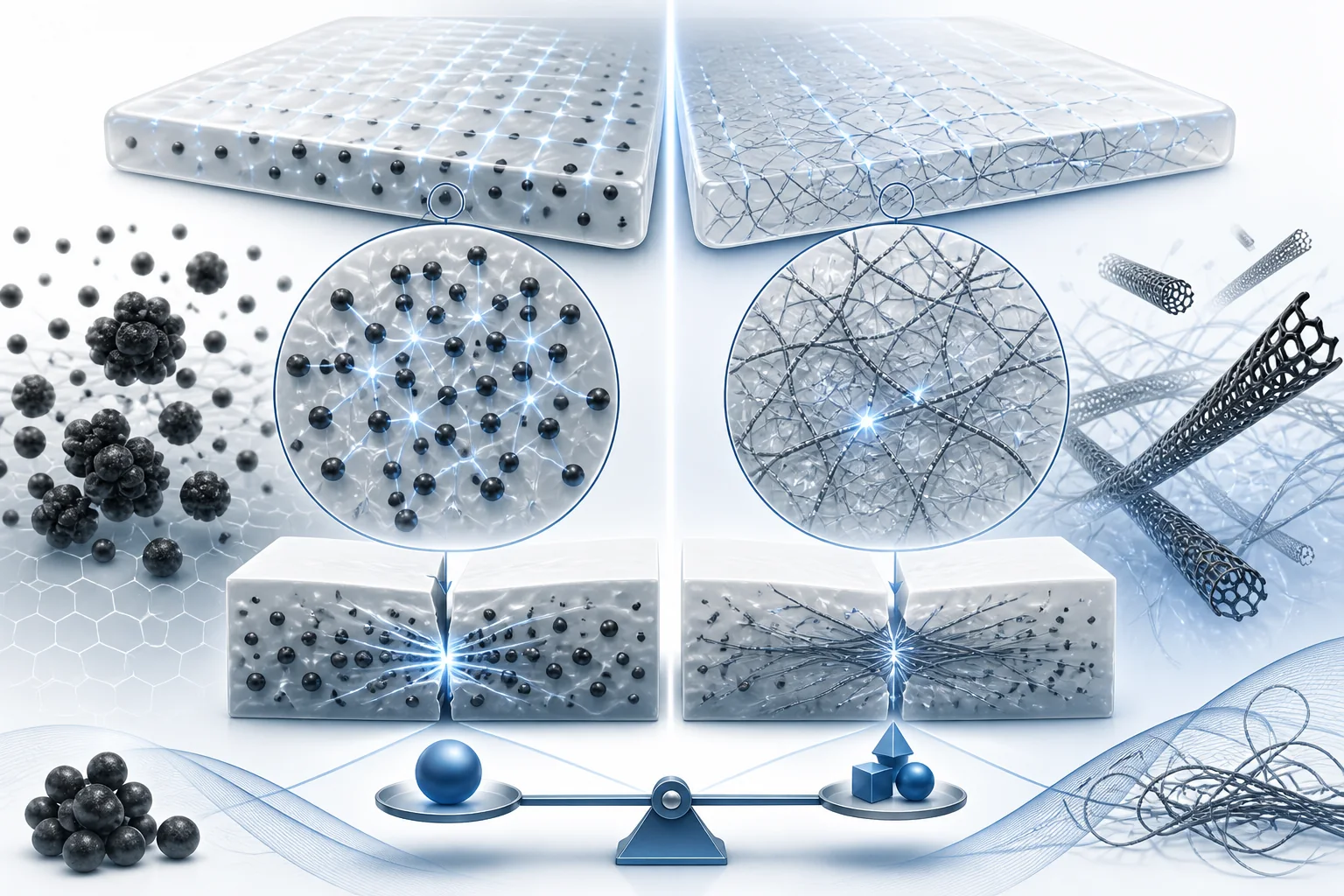
Route one: DGK-POM DD4-5ML, the carbon black internal-mixing route. The core idea is to use process innovation to compensate for the limitation of the material route. The problem in ordinary carbon black filling is that agglomerates are not broken apart. Internal mixing applies stronger shear and kneading during melt compounding of carbon black and POM, breaking carbon black agglomerates closer to primary particle size.
When dispersion improves, carbon black loading can be lower, the conductive network becomes more uniform, the surface becomes glossier and impact retention improves. This route has surface resistance of 10^4-10^5 ohm-cm, glossy surface and excellent toughness. The related existing product page is DGK-POM DD4-5ML conductive POM.
Route two: DGK-POM DD3-4A, the carbon nanotube route. The core idea is to use material innovation to bypass the limitation of carbon black from the source. Carbon nanotubes are nano-scale fibrous materials with very high aspect ratio. At only 1-3 wt%, they can build a complete conductive network, even lower than the addition level needed for carbon black internal mixing.
Lower addition has less influence on mechanical properties and surface gloss of the base resin. The fibrous CNT structure is also less likely to form stress concentration points in the POM matrix, so impact toughness is usually better than the carbon-black internal-mixing route. This route has surface resistance of 10^3-10^4 ohm-cm, higher conductivity and better mechanical retention.
The essential difference is that DD4-5ML uses process innovation to push the carbon black route close to CNT performance, while DD3-4A uses material innovation to avoid carbon black limitations from the beginning.
3. Core performance comparison
The key performance comparison between the two routes is as follows:
| Performance item | DGK-POM DD4-5ML (carbon black internal mixing) | DGK-POM DD3-4A (CNT) | Unit |
|---|---|---|---|
| Surface resistance | 10^4-10^5 | 10^3-10^4 | ohm-cm |
| Tensile strength | 47 | - | MPa |
| Yield strength | 49 | - | MPa |
| Flexural strength | 58 | - | MPa |
| Flexural modulus | 1980 | - | MPa |
| Charpy notched impact | 6.5 | - | kJ/m2 |
| Elongation at break | 5.4 | - | % |
| Melt flow rate | 9.3 | - | g/10min |
| Density | 1.46 | - | g/cm3 |
| HDT, method A | 98 | - | C |
4. Application scenarios and selection advice
Because the two routes have different performance characteristics, they fit different application scenarios.
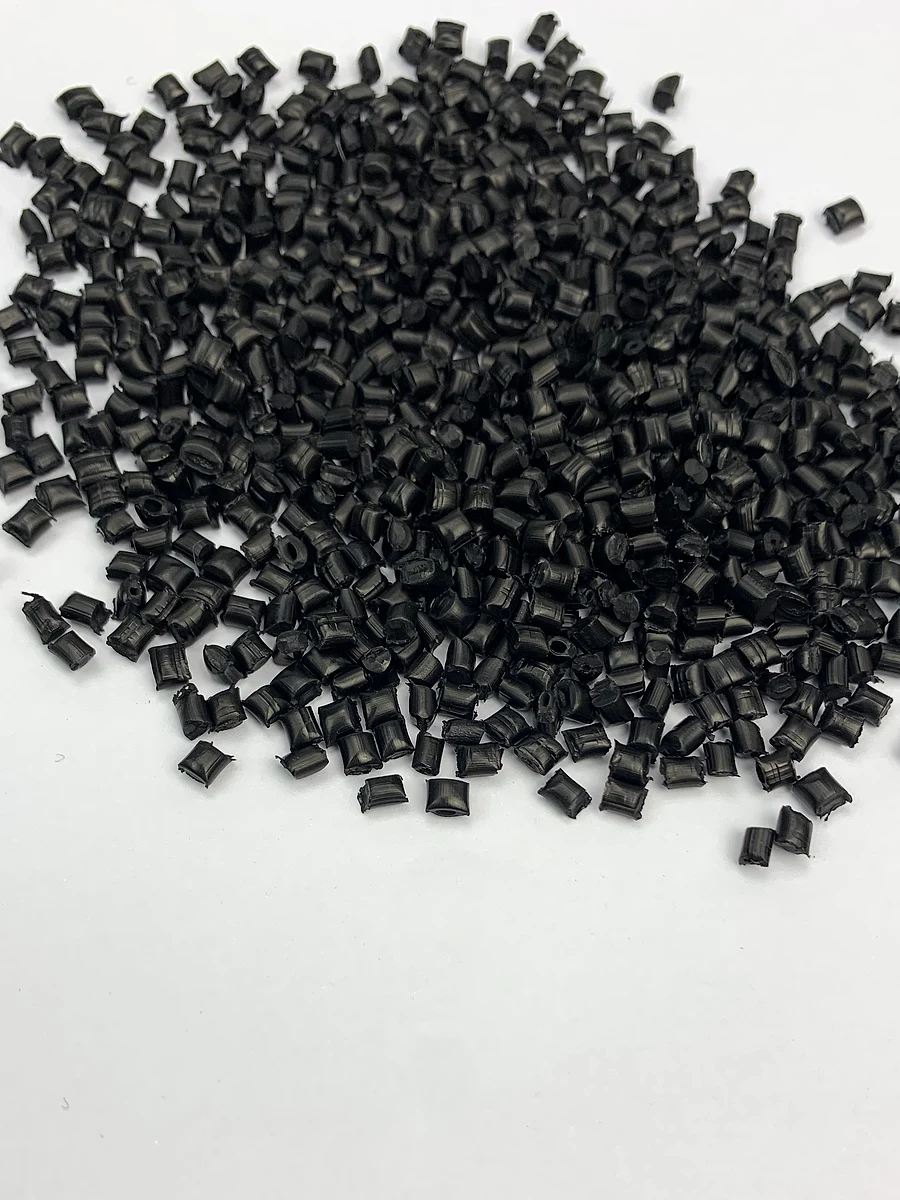
DGK-POM DD4-5ML, the carbon black internal-mixing route, is suitable for precision gears and switch components in electronic equipment; antistatic IC trays and electronic component carriers; precision sliders and guide rails in automation equipment; antistatic fuel-system components; and high-volume parts that are cost-sensitive and require a glossy surface.
DGK-POM DD3-4A, the CNT route, is suitable for precision connectors with higher conductivity requirements; semiconductor test fixtures and chip carrier trays; antistatic parts in automotive fuel systems; transmission parts requiring higher impact toughness; and applications with higher requirements for conductivity uniformity and long-term stability.
Both products keep the core advantages of POM: high rigidity, wear resistance, self-lubrication and dimensional stability. DGK-POM DD3-4A has tensile modulus up to 3000 MPa, flexural modulus of 2500 MPa and heat deflection temperature of 121 C.
For selection, use this logic: prioritize conductivity at the 10^3 ohm level and toughness -> CNT route, DGK-POM DD3-4A. Prioritize cost control and glossy surface -> carbon black internal-mixing route, DGK-POM DD4-5ML. Need both -> verify based on the exact resistivity target, part structure and impact load.
DEYU also provides related conductive POM grades such as DGK-POM DD4-5, a conductive or antistatic modified POM with tensile strength 47 MPa, flexural strength 58 MPa and flexural modulus 1980 MPa, and DGK-POM DD3-4 with surface resistance 10^3-10^4 ohm-cm and notched impact strength 7 kJ/m2. These grades cover different resistance ranges from conductive to antistatic levels.
5. Summary
The difficulty of toughening conductive POM comes from the contradiction between conductive fillers and the base resin. DEYU's two routes provide different answers. The carbon black internal-mixing route uses process breakthrough to improve dispersion, reduce roughness and retain impact performance while controlling cost. The CNT route uses material innovation to bypass carbon black limitations and achieve higher conductivity and better mechanical retention at lower loading.
The two products provide comprehensive combinations of conductivity, toughness, wear resistance and dimensional stability in surface resistance ranges of 10^4-10^5 ohm-cm for DD4-5ML and 10^3-10^4 ohm-cm for DD3-4A. For applications that need a balance between conductivity, toughness and cost, these two routes provide verifiable options. Technical data and sample information can be obtained through official channels of Yuyao Deyu Plastic Technology Co., Ltd.