
Metal-Replacement Plastics: Ultra-Strength Engineering Materials for Elevator, Bearing and Mechanical Parts
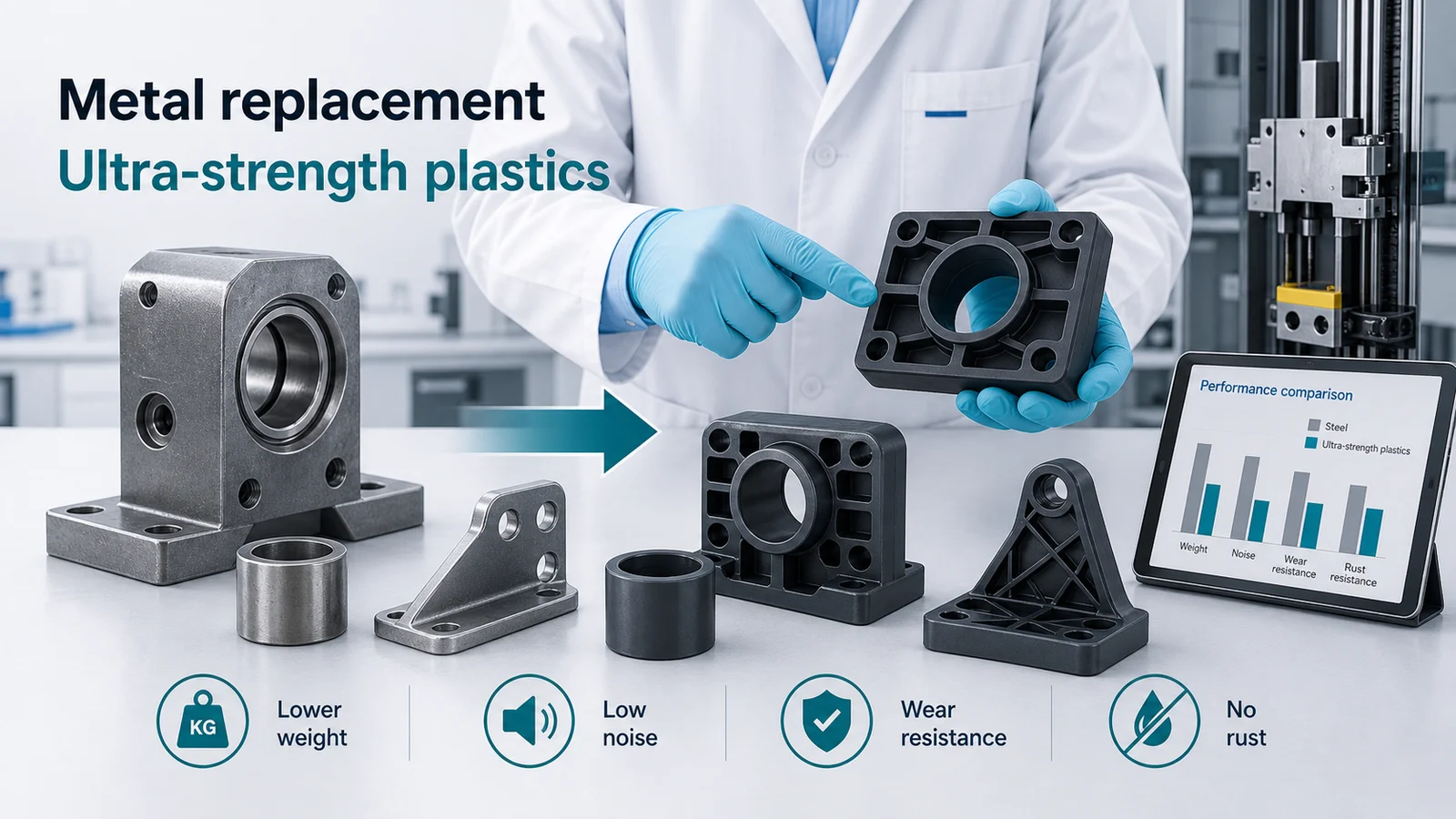
Metal-replacement plastics can replace steel, aluminum and zinc alloy in selected mechanical parts by reducing weight, noise, lubrication, corrosion and machining while retaining strength, wear resistance and dimensional stability.
Buyer and engineer FAQ
Questions engineers often ask about this material route
Where can modified plastic with a wear-resistant plastic requirement be used?
Typical fields include gears, rollers, bushings, sliding blocks, guide rails and low-noise moving parts. For this article, DEYU would first confirm the working environment, wall thickness, expected lifetime and whether reinforced plastics matches the part geometry or needs formulation adjustment.
What are the main performance indicators for the "wear-resistant plastic" target?
Focus on friction coefficient, wear depth, PV value, noise, dimensional stability and mating material compatibility. Buyers should ask for data on molded parts, not only pellet data, because gate position, filler orientation and thickness can change the final value.
What should engineers watch during injection molding or processing?
Dry PA grades correctly, control glass or aramid fiber orientation and validate wear on the real mating surface. Start from the base-resin processing window, then adjust by molded-part resistance, appearance and mechanical data.
What details help DEYU recommend reinforced plastics more accurately?
Send the current resin or grade, drawing or photo, wall thickness, annual quantity, target standard, failure mode and required color. If a reference grade already passed one test but failed in production, include both data sets.
For a precise recommendation, share the part drawing, base resin, target performance, processing method and test standard with DEYU.
Short Answer
Metal-replacement plastics are high-performance modified plastics designed to replace metal in selected parts where strength, stiffness, wear resistance, dimensional stability, low noise, corrosion resistance and weight reduction are required.
For metal-replacement projects, start from reinforced plastics and wear-resistant plastics when strength, low noise, sliding wear, and dimensional stability need to be balanced.
The goal of “plastic replacing steel” is not to replace all steel parts. It is to replace suitable metal components after mechanical design, load calculation, material testing, mold design and real-part validation.
Yuyao Deyu DEYU plastics has developed a DGK ultra-strength metal-replacement material platform. Through reinforced nylon, long-fiber systems, carbon fiber reinforcement, aramid fiber wear-resistant systems, PTFE self-lubrication, MoS2 solid lubrication and hybrid engineering plastic modification, DEYU can provide high-strength plastic materials for elevator accessories, bearing-related parts, bushings, rollers, sliders, guide blocks, gears and industrial mechanical components.
For elevator applications, this type of material is more suitable for guide components, rollers, sliders, buffer parts, bushings, wear pads, brackets, protective covers and selected non-primary safety-load components. Safety-critical components such as steel ropes, braking systems, main load-bearing structures and certified safety parts must follow elevator industry standards and cannot be replaced simply by material substitution.
Why More Mechanical Parts Are Moving from Metal to Plastic
In traditional machinery, steel and other metals are often used because of their strength, stiffness and long-term reliability. However, metal parts also bring weight, noise, lubrication demand, corrosion risk, complex machining, assembly cost, mating-surface wear and higher inertia in moving systems.
Modified engineering plastics can solve some of these problems. With reinforcement and functional modification, plastic materials can provide strength, wear resistance, self-lubrication, impact resistance, dimensional stability and lower friction.
In many applications, plastic does not replace metal by being “stronger than steel” in every property. It wins by combining multiple advantages: lighter weight, lower friction, lower noise, no rust, lower maintenance, complex injection molding, integrated design, fewer machining steps and better electrical insulation where needed.
What Is a Metal-Replacement Plastic?
A metal-replacement plastic is not ordinary plastic. It is a modified engineering plastic designed for mechanical or structural function.
Common base resins include PA6, PA66, POM, PBT, PPS, PPA, PEEK, PC/ABS, high-performance PP and selected TPU or TPE systems.
Common reinforcement and functional systems include glass fiber, long glass fiber, carbon fiber, aramid fiber, PTFE, MoS2, graphite, silicone lubricant, wear-resistant additives, impact modifiers, heat stabilizers, flame retardants and conductive or anti-static systems.
The final material must be designed according to part function. A gear, bearing cage, elevator guide block, roller, bracket and bushing do not need the same material.
Why Use Plastic Instead of Steel?
Weight Reduction
Engineering plastics are much lighter than steel. For moving parts, weight reduction can reduce inertia, improve response speed, reduce motor load and lower energy consumption. In elevator accessories, automation parts, rollers and moving mechanisms, lighter components can reduce operating noise and vibration.
Lower Noise
Plastic materials can reduce metal-to-metal impact noise. In sliding, rolling or intermittent contact applications, plastic parts often provide quieter operation. This is important for elevator guide parts, bearing cages, rollers, gears, sliders, door system parts, automation equipment and household or industrial machinery.
Self-Lubrication and Lower Friction
Materials such as POM, PA, PPS and PEEK can be modified with PTFE, MoS2, graphite, aramid fiber or silicone systems to reduce friction and improve wear resistance. This can reduce the need for grease or oil in selected parts.
Corrosion Resistance
Steel may rust in humid, chemical or outdoor environments. Plastics can provide better corrosion resistance in selected industrial, electrical and building equipment environments.
Integrated Molding
Metal parts often need machining, drilling, surface treatment, welding or assembly. Plastic parts can integrate clips, ribs, positioning structures, holes, damping features and functional shapes during injection molding. This can reduce assembly steps and improve production efficiency.
DEYU DGK Ultra-Strength Metal-Replacement Platform
DEYU’s metal-replacement platform is not a single material. It includes several technical routes.
Reinforced Nylon Route
PA6 and PA66 are widely used for metal replacement because they provide good strength, toughness, heat resistance and processability. DEYU can develop glass fiber reinforced PA66, carbon fiber reinforced PA66, aramid wear-resistant PA66, PA66/PTFE self-lubricating systems and reinforced impact-balanced PA6.
These materials are suitable for elevator accessories, brackets, bushings, bearing cages, rollers, guide blocks and mechanical structural parts.
POM Wear-Resistant Route
POM has low friction, good dimensional stability and strong wear behavior. It is suitable for precision moving parts. DEYU can develop POM/PTFE low-friction materials, POM aramid wear-resistant materials, POM carbon fiber reinforced systems and POM conductive wear-resistant materials.
These materials are suitable for bearings, gears, sliders, guide rails, bushings, rollers and precision mechanical parts.
Carbon Fiber Reinforced Route
Carbon fiber increases stiffness, dimensional stability, heat deformation resistance and conductivity in selected systems. It is suitable for high-stiffness brackets, precision support parts, conductive mechanical parts, wear-resistant structural parts and metal-replacement engineering components.
Aramid Fiber Wear-Resistant Route
Aramid fiber can improve wear resistance while reducing damage to the mating surface compared with some hard fillers. It is suitable for bearings, sliders, bushings, guide rails, wear pads, elevator guide-related components and low-wear precision parts.
Hybrid Self-Lubricating Route
For parts requiring both strength and low friction, DEYU can combine reinforcement with PTFE, MoS2, graphite or silicone systems. Typical combinations include PA66 + glass fiber + PTFE, PA66 + aramid fiber + PTFE, POM + PTFE, POM + aramid fiber, PPS + carbon fiber + PTFE and PA66 + MoS2.
Application Direction 1: Elevator Components
Elevator systems require stable operation, low noise, dimensional reliability and long service life. In selected non-primary safety-load components, metal-replacement plastics can provide practical value.
Potential applications include guide blocks, sliders, rollers, bushings, wear pads, door system parts, buffer components, protective covers, positioning brackets, insulating or damping components and selected bearing-related parts.
Elevator-related plastic parts may require high strength, wear resistance, low noise, dimensional stability, low friction, impact resistance, fatigue resistance, creep resistance, stable molding shrinkage, low moisture-related deformation and flame retardancy where required.
Metal-replacement plastics should not be used to replace elevator safety-critical components without full certification and engineering validation. They are not suitable for simple substitution of main load-bearing structures, steel ropes, brake components, safety gear core parts or certified structural safety parts.
Application Direction 2: Bearings, Bushings and Sliding Parts
Plastic bearings and bushings are a major field for metal replacement. Compared with metal bearing parts, plastic bearing materials can reduce noise, avoid rust, reduce lubrication and protect mating shafts in selected designs.
Applications include plastic bearings, bearing cages, bushings, shaft sleeves, guide sleeves, sliders, rollers, low-speed rotating parts and dry-running sliding parts.
These parts usually require low friction coefficient, wear resistance, compressive strength, dimensional stability, low water absorption if precision is required, heat resistance, low noise, fatigue resistance and mating surface protection.
DEYU may recommend POM/PTFE for low-friction precision sliding, POM aramid wear-resistant materials, PA66/PTFE for self-lubricating structural parts, PA66 aramid for high-wear nylon parts, PPS/PTFE for higher-temperature sliding and conductive wear-resistant POM when anti-static or conductivity is needed.
Application Direction 3: Gears and Transmission Components
Plastic gears are widely used in low-noise and lightweight transmission systems. Compared with metal gears, plastic gears can reduce noise and weight, but the material must be selected carefully.
Plastic gear materials need tooth strength, wear resistance, dimensional stability, fatigue resistance, low friction, low noise, molding shrinkage control and stable tooth profile accuracy.
DEYU may recommend POM/PTFE low-noise gear material, POM aramid wear-resistant gear material, reinforced PA66 gear material, PA66/PTFE self-lubricating gear material or PPS wear-resistant high-temperature gear material.
Application Direction 4: Mechanical Brackets and Structural Parts
For brackets and structural supports, plastic materials must provide strength, stiffness, creep resistance and dimensional stability.
Applications include mechanical brackets, support arms, positioning parts, equipment housings, fixture bases, industrial clips and structural covers.
DEYU may recommend glass fiber reinforced PA66, carbon fiber reinforced PA66, high-temperature reinforced PPA, reinforced PPS or reinforced and flame-retardant PC/ABS for housings.
Customer Case 1: Elevator Guide Block Material Upgrade
A customer used a metal guide-related component in an elevator accessory system. The metal part had good strength, but it created operating noise and required periodic lubrication. During long-term movement, the mating surface showed visible wear marks.
The customer wanted a material that could reduce noise and lubrication frequency while maintaining dimensional stability. DEYU recommended a PA66 ultra-strength wear-resistant compound with reinforcement, aramid wear-resistant balance, PTFE-assisted self-lubrication, dimensional stability control and impact balance for assembly.
| Item | Original metal component | DEYU PA66 ultra-strength wear-resistant material |
|---|---|---|
| Part weight | 100% reference | 42-48% |
| Operating noise | 68 dB | 57-60 dB |
| Lubrication interval | Every 15 days | Every 45-60 days |
| Mating surface wear | 0.15 mm | 0.06 mm |
| Corrosion risk | Present | No rust risk |
| Machining steps | Multiple | Injection molded integrated part |
The customer did not simply replace metal with ordinary plastic. The final solution used a reinforced wear-resistant PA66 system to reduce weight, noise, wear and lubrication frequency while maintaining functional reliability.
Customer Case 2: Plastic Bearing Bushing Replacing Metal Sleeve
A mechanical equipment customer used a metal sleeve in a low-speed rotating position. The metal sleeve had good load-bearing capability but required grease lubrication. After long operation, noise increased and the shaft surface showed wear.
DEYU recommended a POM/PTFE low-friction wear-resistant material. The formulation included POM for dimensional stability, PTFE for self-lubrication, wear-resistant additive balance, low friction coefficient and stable shrinkage for bushing tolerance.
| Item | Original metal sleeve | DEYU POM/PTFE bushing |
|---|---|---|
| Lubrication requirement | Required | Reduced or dry-running in selected conditions |
| Noise after 200 hours | 64 dB | 54-56 dB |
| Shaft surface wear | 0.10 mm | 0.03 mm |
| Bushing wear | 0.08 mm | 0.05 mm |
| Corrosion risk | Medium | No rust risk |
| Assembly weight | 100% reference | 35-45% |
For low-speed bearing sleeves, metal replacement can reduce lubrication, noise, corrosion and shaft wear. The key is not only strength, but also friction control and dimensional accuracy.
Customer Case 3: High-Strength Plastic Bracket Replacing Zinc Alloy
A customer used a zinc alloy bracket in industrial equipment. The metal part was strong but heavy and required secondary machining. The customer wanted a lighter part with integrated positioning ribs and stable mounting accuracy.
DEYU recommended a glass fiber reinforced ultra-strength PA66 material. The design direction included high-strength PA66 matrix, glass fiber reinforcement, impact balance, low warpage, heat aging stability and functional integration through molding.
| Item | Zinc alloy bracket | DEYU reinforced PA66 bracket material |
|---|---|---|
| Part weight | 100% | 45-55% |
| Secondary machining | Required | Not required after molding |
| Assembly operations | 4 steps | 2 steps |
| Dimensional repeatability | Medium | Improved after mold correction |
| Corrosion protection | Coating required | No rust risk |
| Production cycle | Long | Shorter through molding |
For structural brackets, the value of metal replacement is not only strength. It also includes weight reduction, integrated molding, fewer machining steps and more stable production.
Key Selection Targets
When selecting a plastic for metal replacement, the first question is not “can plastic replace steel?” The right questions are: what load does the part carry, is the load static or dynamic, is there impact, fatigue or vibration, is creep risk present, what temperature range is used, what mating surface is involved, and whether the part is safety-critical.
For bearings, bushings, gears, sliders and guide parts, friction and wear are often more important than tensile strength alone. For brackets and structural parts, creep resistance, stiffness, screw boss reliability and dimensional stability are critical. For elevator-related applications, certification boundary and safety responsibility must be defined before material substitution.
DEYU DGK Customization Scope
DEYU can adjust base resin, glass fiber content, carbon fiber content, aramid fiber content, PTFE content, MoS2 system, impact modifier, thermal stabilizer, flame retardancy, conductivity or anti-static function, wear direction, friction coefficient, tensile strength, flexural modulus, impact strength, dimensional stability, flowability, color and cost.
For development, DEYU recommends customers provide the current metal material, part application, load condition, temperature range, mating material, sliding or rotating condition, lubrication, current failure mode, target service life, drawing or 3D file, tolerance, impact or fatigue requirement, flame-retardant requirement, conductivity or insulation requirement, sample if available and customer test standard.
Conclusion
Metal-replacement plastics are not ordinary plastics that imitate steel. They are engineering systems that replace selected metal parts through a balance of strength, stiffness, wear resistance, low friction, self-lubrication, dimensional stability, low noise, corrosion resistance and integrated molding.
DEYU’s DGK ultra-strength metal-replacement platform covers reinforced PA66, wear-resistant POM, aramid fiber, carbon fiber, PTFE, MoS2, PPS, PPA, PEEK and hybrid routes for elevator accessories, bearings, bushings, rollers, sliders, guide blocks, brackets, gears and mechanical structural parts.
Successful plastic replacing steel requires material selection, structural design, molding validation, mechanical testing, wear testing, tolerance control and real operating verification. The best result is not simply plastic instead of metal, but a lighter, quieter, lower-maintenance and more integrated mechanical part.