
UV-Resistant PP for Outdoor Buckles, Clips and Fastening Parts
Outdoor buckles, clips, and fastening parts are among the most demanding applications for any plastic material. Unlike static housings or enclosures, these components are subjected to repeated mechanical stress —they flex, snap, latch, and release hundreds or thousands of times over their service life. They must maintain dimensional accuracy to ensure proper fit. They must resist creep and stress relaxation to maintain clamping force. And they must do all of this while exposed to UV radiation, temperature extremes, moisture, and thermal cycling.
Buyer and engineer FAQ
Questions engineers often ask about this material route
Where can PP with a UV-resistant plastic requirement be used?
Typical fields include outdoor clips, covers, housings, liners, sheets, equipment shells and exposed appearance parts. For this article, DEYU would first confirm the working environment, wall thickness, expected lifetime and whether UV-resistant plastics product category, DGK-PP 66D modified PP matches the part geometry or needs formulation adjustment.
What are the main performance indicators for the "UV-resistant plastic" target on PP?
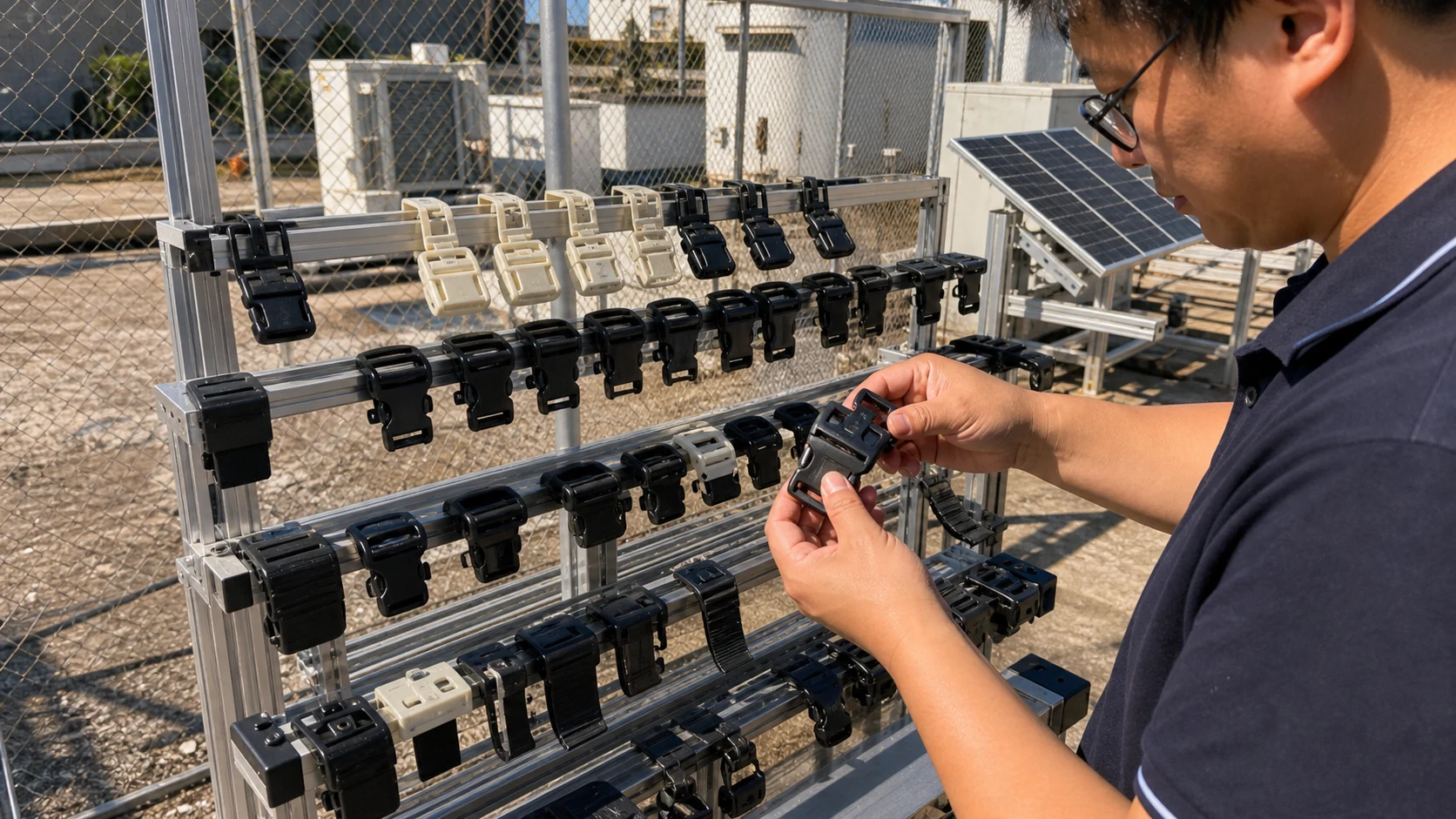
Focus on color change, gloss retention, tensile retention, impact retention and weathering hours. Buyers should ask for data on molded parts, not only pellet data, because gate position, filler orientation and thickness can change the final value.
What should engineers watch during injection molding or processing?
For PP, a practical starting window is 190-230°C melt / 30-60°C mold. Avoid overheating pigments or HALS systems, use stable black or color packages and validate outdoor aging. Final parameters should follow part thickness, gate design and the actual machine.
What details help DEYU recommend UV-resistant plastics product category, DGK-PP 66D modified PP more accurately?
Send the current resin or grade, drawing or photo, wall thickness, annual quantity, target standard, failure mode and required color. If a reference grade already passed one test but failed in production, include both data sets.
For a precise recommendation, share the part drawing, base resin, target performance, processing method and test standard with DEYU.
Background / Problem
Outdoor buckles, clips, and fastening parts are among the most demanding applications for any plastic material. Unlike static housings or enclosures, these components are subjected to repeated mechanical stress —they flex, snap, latch, and release hundreds or thousands of times over their service life. They must maintain dimensional accuracy to ensure proper fit. They must resist creep and stress relaxation to maintain clamping force. And they must do all of this while exposed to UV radiation, temperature extremes, moisture, and thermal cycling.
Related DEYU plastics material references for this selection topic: UV-resistant plastics product category and DGK-PP 66D modified PP.
Standard polypropylene (PP) offers an excellent combination of properties for clips and fasteners: low cost, good chemical resistance, excellent fatigue resistance (PP is famous for its “living hinge—capability —you can bend a PP component thousands of times without creating a stress crack), and ease of processing. However, unmodified PP has two critical limitations for outdoor fastening applications:
Poor UV resistance —PP contains unstable tertiary carbon groups that undergo photo-oxidative degradation when exposed to sunlight, leading to chain scission, surface cracking, embrittlement, and catastrophic failure under load. Basic polypropylene can lose up to 70% of its mechanical strength after extended exposure to high-intensity UV radiation.
Low-temperature embrittlement —PP homopolymer becomes brittle below approximately 0°C to 5°C. Copolymer grades offer improved low-temperature performance but still require modification for reliable winter operation. For outdoor clips that must function in cold climates, this is a critical limitation.
The combination of UV degradation and low-temperature embrittlement creates a synergistic failure mode —UV exposure raises the effective brittle transition temperature, meaning a clip that was ductile at -5°C when new may become brittle at +5°C after UV aging. This is why standard PP clips frequently fail in winter after just one or two seasons of outdoor exposure.
Technical Difficulty / Why It Happens
Photo-Oxidative Degradation of PP
When UV radiation (particularly wavelengths below 300 nm) hits a PP part, it provides sufficient energy to break C–C bonds in the polymer backbone. This process —photo-oxidation —occurs through a free radical mechanism:
Initiation —UV energy creates free radicals at tertiary carbon atoms
Propagation —free radicals react with oxygen to form peroxy radicals, which abstract hydrogen from other chains
Chain scission —the polymer backbone breaks, reducing molecular weight
Surface degradation —a brittle surface layer forms, typically 100—00 microns deep
The consequences are:
Molecular weight reduction —shorter chains mean lower mechanical properties
Surface cracking —micro-cracks initiate at the surface and propagate inward
Loss of flexibility —the material becomes stiff and brittle
Catastrophic failure —the clip snaps under load with little or no deformation
UV Degradation Is Surface-Driven and Accelerates with Temperature
The degradation depth in PP is typically confined to the exposed surface layer —approximately 100 μm. However, this thin degraded layer acts like a sharp notch, precipitating bulk mechanical failure. When a clip flexes during latching or unlatching, cracks initiate in the brittle surface layer and propagate into the unaffected core.
Temperature dramatically accelerates this process. For every 10°C increase, the rate of photo-oxidation approximately doubles. A black clip in direct sunlight can reach surface temperatures of 70—0°C, accelerating UV degradation far beyond what ambient temperature would suggest.
Low-Temperature Embrittlement
Below the glass transition temperature (Tg) of PP (approximately -10°C to 0°C for homopolymer, -10°C to -20°C for copolymer), the amorphous regions of the polymer enter a glassy state. Molecular motion is frozen, and the material loses its ability to absorb energy through plastic deformation.
Above Tg: The polymer is ductile —it can flex, yield, and absorb energy Below Tg: The polymer is brittle —it fractures with little or no deformation
For PP homopolymer, the brittle transition occurs around 0—°C. Copolymer grades can extend this to approximately -5°C to -10°C, but this is still insufficient for many outdoor applications. A clip that bends easily at 20°C can snap like glass at -10°C.
The Synergistic Effect: UV + Low Temperature
The combination is far more damaging than either factor alone:
UV degradation reduces molecular weight and creates surface micro-cracks —initiation sites for fracture
UV degradation raises the effective brittle transition temperature by 10—0°C
A clip that was ductile at -5°C when new may be brittle at +5°C after UV exposure
The brittle surface layer from UV degradation acts as a stress concentrator, and at low temperatures, cracks propagate with minimal energy absorption
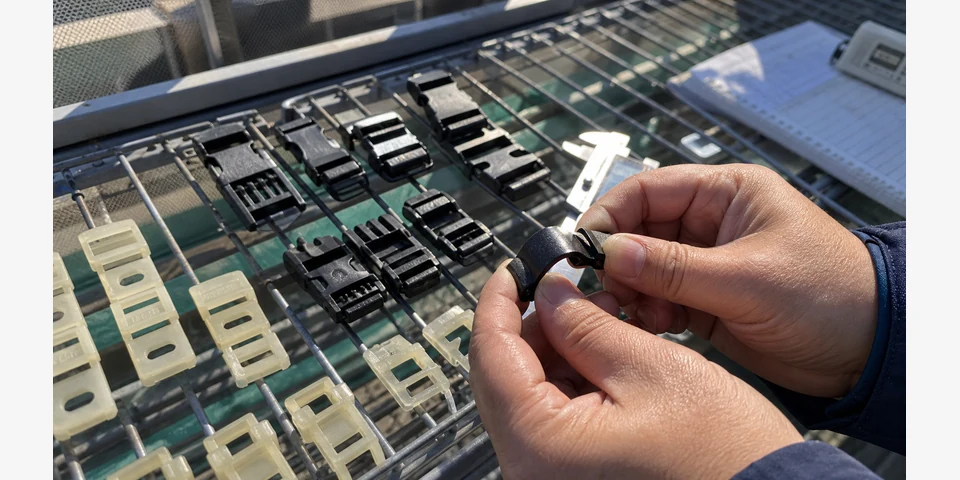
This explains why outdoor PP clips so often fail in winter after UV exposure during the preceding summer months.
Mechanical Stress and Fatigue
Clips and fasteners are not static parts. They are subjected to:
Cyclic loading —repeated flexing during latching and unlatching
Static loads —sustained clamping force that causes creep and stress relaxation
Impact loads —accidental knocks, dropped tools, wind loads
Assembly stresses —snap-fit geometry creates permanent residual stress
UV degradation accelerates fatigue failure —the micro-cracks from UV exposure propagate with each flex cycle, eventually leading to catastrophic fracture.
DEYU Material Direction
DEYU addresses the challenges of outdoor clips and fasteners through a comprehensive modification strategy that targets UV resistance, low-temperature toughness, and mechanical durability.
1. UV Stabilization System
DEYU uses a synergistic UV stabilization package combining:
Hindered amine light stabilizers (HALS) —scavenge free radicals generated during photo-oxidation
UV absorbers (benzotriazole or hydroxyphenyl triazine types) —absorb harmful UV radiation before it reaches the polymer backbone
Antioxidants —protect against thermal oxidation during processing and service
The combination of HALS and UV absorbers provides significantly better protection than either alone, preserving both surface appearance and mechanical integrity.
2. Impact Modification for Low-Temperature Performance
DEYU incorporates elastomeric modifiers that maintain low-temperature ductility:
EPDM rubber —dispersed rubber particles act as stress concentrators that initiate and arrest micro-cracks, absorbing impact energy
Compatibilizers —ensure strong adhesion between rubber particles and the PP matrix
Controlled morphology —optimized rubber particle size and distribution for maximum low-temperature performance
The rubber particles serve two critical functions:
They provide cavitation sites that absorb energy during impact
They stop crack propagation —cracks that initiate in the matrix are arrested at rubber particles
3. Balanced Crystallinity Control
DEYU uses nucleating agents and controlled cooling to achieve a crystalline structure that balances stiffness with toughness. Too much crystallinity -?stiff but brittle. Too little -?ductile but weak. The optimal balance for clips and fasteners provides:
Sufficient stiffness for secure latching and clamping
Adequate toughness for repeated flexing without fracture
Low warpage for dimensional accuracy
4. Material Family Overview
| DEYU Series | Base Resin | Key Modification | UV Stabilization | Low-Temp Impact | Typical Applications |
|---|---|---|---|---|---|
| DGK-CLIP201 | PP Copolymer | EPDM rubber + UV | Standard HALS + UVA | Good (tested at -10°C) | General outdoor clips, cable clips |
| DGK-CLIP301 | PP Copolymer | High-impact EPDM + UV | Enhanced HALS + UVA | Very Good (tested at -20°C) | Automotive clips, heavy-duty fasteners |
| DGK-CLIP401 | PP Copolymer | Super-tough + premium UV | Premium HALS + UVA | Excellent (tested at -30°C) | Critical safety fasteners, cold climates |
Reference Product Data
Below is representative data for DEYU plastics' UV-resistant PP compounds for clips and fasteners (DGK-CLIP series):
| Property | Test Method | DGK-CLIP201 | DGK-CLIP301 | Standard PP (unmodified) |
|---|---|---|---|---|
| Base Resin | —/td> | PP Copolymer + EPDM | PP Copolymer + High-impact EPDM | PP Homopolymer |
| Modification | —/td> | UV + Impact | UV + High-impact | None |
| Density | ASTM D792 | 0.91 g/cm³ | 0.91 g/cm³ | 0.90—.91 g/cm³ |
| MFR (230°C/2.16kg) | ASTM D1238 | 5— g/10min | 4— g/10min | 8—2 g/10min |
| Tensile Strength | ASTM D638 | 28—2 MPa | 25—0 MPa | 30—5 MPa |
| Flexural Modulus | ASTM D790 | 1200—500 MPa | 1000—300 MPa | 1500—800 MPa |
| Notched Impact (23°C) | ASTM D256 | 80—00 J/m | 120—50 J/m | 20—0 J/m |
| Notched Impact (-20°C) | ASTM D256 | 35—5 J/m | 60—0 J/m | <10 J/m (brittle) |
| Low-Temp Impact Retention | Internal | >40% (23°C -?-20°C) | >60% (23°C -?-20°C) | <20% (brittle failure) |
| HDT (0.45 MPa) | ASTM D648 | 110—20°C | 105—15°C | 90—00°C |
| UV Stability (xenon arc, 2000h) —ΔE | ASTM G155 | <2.0 | <1.5 | >5.0 (severe yellowing) |
| Tensile Retention (2000h UV) | ASTM D638 | >80% | >85% | <50% |
| Impact Retention (2000h UV) | ASTM D256 | >70% | >80% | <30% |
| Typical Applications | —/td> | Cable clips, pipe clamps | Automotive clips, heavy-duty | Indoor use only |
Note: Values are representative. Actual data depends on specific grade and formulation.
Customer Debugging / Validation Scenario —DEYU Internal Customer Data
Scenario: Outdoor Cable Clips —Brittle Fracture After One Winter
Background: A telecommunications infrastructure provider used standard PP copolymer cable clips for securing fiber optic cables on outdoor poles and building exteriors. The clips were installed in spring. They performed well through summer and fall.
In the first winter, when temperatures dropped below -5°C, field technicians reported that clips were snapping during routine maintenance —simply flexing the clip to remove or reposition a cable caused brittle fracture. In some cases, clips failed spontaneously under wind load.
Root Cause Analysis:
DEYU plastics' internal analysis of the failed clips revealed:
| Factor | Finding |
|---|---|
| UV degradation | Significant —surface micro-cracking detected; molecular weight reduced by 30—0% |
| Low-temperature embrittlement | Clips fractured below -5°C with no deformation |
| Impact strength at -20°C | <10 J/m (brittle failure) |
| Surface condition | Chalking and micro-cracking visible under magnification |
The material had adequate initial properties but lacked the combination of UV stabilization and low-temperature impact modification needed for year-round outdoor service.
Trial Setup —DEYU Internal Validation:
Trial quantity: 1,000 cable clips
Monthly production: 10,000 units
Test duration: 12 months outdoor exposure (temperate climate, winter lows -10°C)
Comparison: Incumbent PP clip vs. DEYU DGK-CLIP201 clip
Validation Metrics —DEYU Internal Test Data:
| Parameter | Incumbent PP Clip | DEYU DGK-CLIP201 Clip | Test Method |
|---|---|---|---|
| Trial quantity | 500 pcs | 500 pcs | —/td> |
| Initial notched impact (23°C) | 25 J/m | 85 J/m | ASTM D256 |
| Initial notched impact (-20°C) | 8 J/m | 38 J/m | ASTM D256 |
| Impact retention (-20°C vs. 23°C) | 32% | 45% | —/td> |
| Impact after 12 months (23°C) | 12 J/m | 70 J/m | ASTM D256 |
| Impact after 12 months (-20°C) | 3 J/m | 32 J/m | ASTM D256 |
| UV-exposed impact retention | 48% (loss of 52%) | 82% (loss of 18%) | —/td> |
| Field fracture rate (winter) | 6.5% | 0.2% | Field data |
| Surface cracking (12 months) | Visible micro-cracks | None | Visual/Microscopy |
| Molecular weight retention | 62% | 88% | GPC analysis |
Result Interpretation —DEYU Internal Analysis
DEYU plastics' internal validation revealed that:
The incumbent material failed because UV degradation reduced molecular weight and raised the effective brittle transition temperature. The clips that were ductile at -5°C when new became brittle at +5°C after UV exposure.
DEYU DGK-CLIP201 succeeded because:
The UV stabilization package protected molecular weight during outdoor exposure
The EPDM rubber modification maintained low-temperature ductility
The combination preserved impact strength at -20°C even after 12 months of UV exposure
The key insight: UV stabilization alone is insufficient for outdoor clips —it must be combined with low-temperature impact modification to ensure year-round reliability.
Direction After Trial —DEYU Customer Recommendation
Based on DEYU plastics' internal validation results, the customer:
Converted full production to DEYU DGK-CLIP201 for all outdoor cable clips
Updated material specification to require notched impact ≤30 J/m at -20°C after 2000h UV exposure
Implemented incoming quality control testing for low-temperature impact retention
Suitable Applications
DEYU plastics' UV-resistant PP compounds for clips and fasteners are suitable for:
| Application Category | Specific Components | Key Requirements |
|---|---|---|
| Telecommunications | Cable clips, fiber optic retainers, pole mounts | UV resistance, low-temp impact, long service life |
| Automotive | Trim clips, push-pin fasteners, harness retainers, grill clips | UV resistance, cold-climate durability, vibration resistance |
| Building Construction | Pipe clamps, HVAC fasteners, panel clips, deck fasteners | Weather resistance, thermal cycling stability |
| Outdoor Lighting | Lamp holders, fixture clips, mounting brackets | UV stability, low-temperature impact |
| Solar Equipment | Cable management clips, panel retainers, mounting clips | Long-term UV resistance, thermal cycling |
| Agricultural | Greenhouse clips, irrigation line retainers, fencing clips | UV + moisture resistance, low-temp durability |
| Consumer Products | Outdoor furniture clips, garden tool fasteners, tent clips | Aesthetic retention, impact resistance |
| Industrial | Hose clamps, pipe supports, cable management | Chemical resistance, mechanical strength |
What Buyers Should Provide
To ensure optimal material selection for outdoor clips and fasteners, DEYU recommends buyers provide:
Part drawings / 3D models —geometry, wall thickness, flexure requirements, snap-fit design
Service environment —geographic location, temperature range (min/max), UV exposure duration, humidity
Expected service life —how many years the clip must survive
Load requirements —static and dynamic loads, deflection requirements, number of flex cycles
Color requirements —dark colors absorb more heat and may require enhanced stabilization
Current material and failure data —what material is used and what failure modes are observed
Testing requirements —UV standard (ASTM G154, G155), low-temperature impact test conditions
Production volume —for cost optimization
DEYU can support with:
Material recommendations based on your specific environmental and performance requirements
Small-batch validation trials —molded clips for UV and low-temperature testing
Failure analysis —root cause analysis of existing failures
Processing optimization —injection molding parameters to minimize residual stress and optimize part performance
Conclusion
Outdoor buckles, clips, and fastening parts made from standard PP are prone to two critical failure modes: UV degradation and low-temperature embrittlement. These failure modes are synergistic —UV exposure raises the effective brittle transition temperature, meaning a clip that was ductile when new becomes brittle after weathering.
The key technical challenges are:
UV photo-oxidation —chain scission reduces molecular weight and creates surface micro-cracks
Low-temperature embrittlement —below Tg, the polymer loses ductility and fractures with little deformation
Synergistic effects —UV + low temperature creates catastrophic failure that neither factor alone would cause
Mechanical fatigue —repeated flexing accelerates crack propagation from UV-damaged surfaces
DEYU plastics' approach addresses these challenges through:
Comprehensive UV stabilization —HALS + UV absorbers + antioxidants to preserve molecular weight and surface integrity
EPDM rubber modification —dispersed rubber particles that absorb impact energy and arrest crack propagation at low temperatures
Balanced crystallinity —optimized morphology for stiffness-toughness balance
Validated performance —tested at -20°C after UV exposure to ensure year-round reliability
For engineers and buyers who need clips and fasteners that perform reliably outdoors in all seasons, DEYU offers validated, production-ready solutions that deliver year-round durability —not just summer performance.
For specific grade recommendations and trial samples, please contact DEYU with your application details and performance requirements.