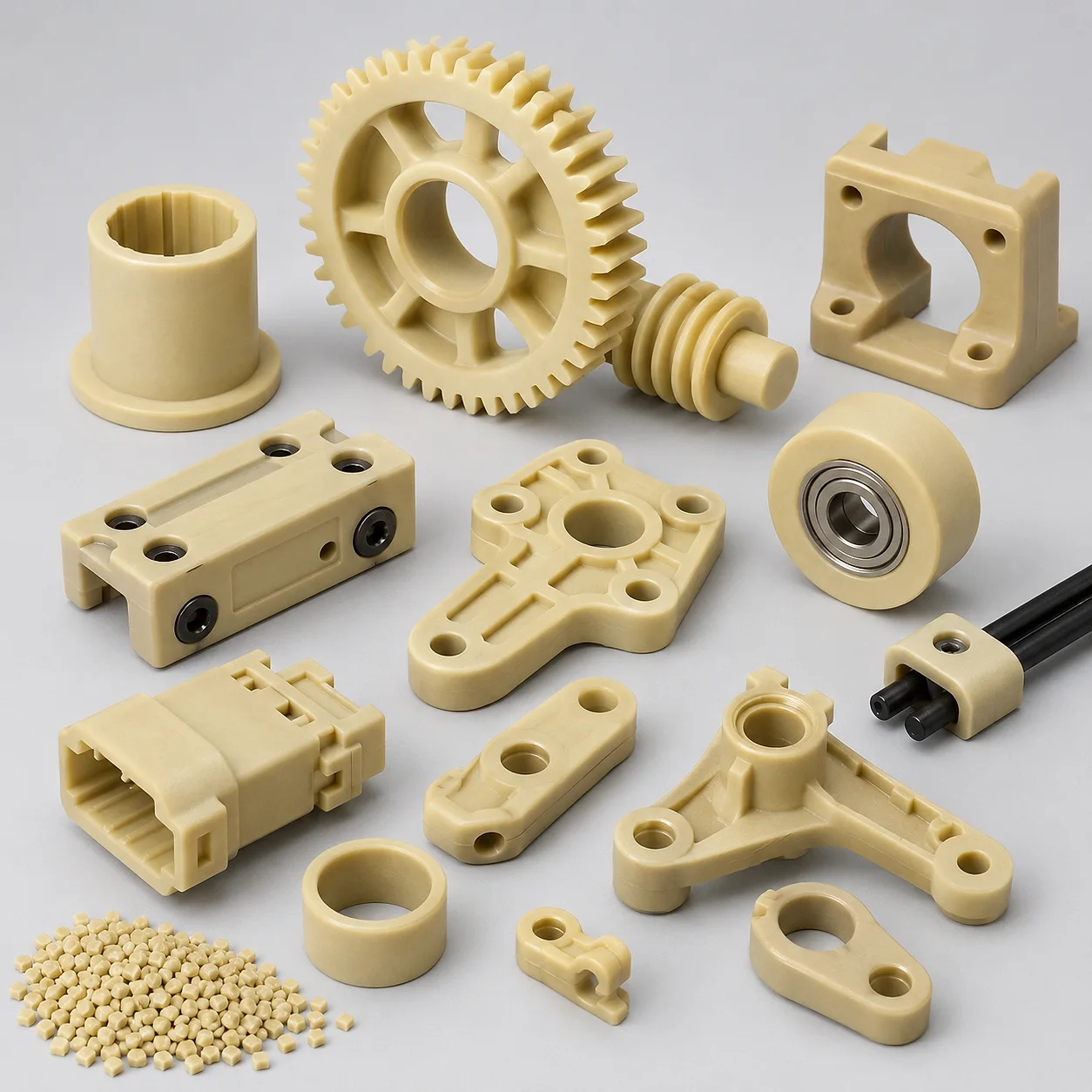
Why Does a Wear-Resistant Plastic Part Have High Scrap Rate During Injection Molding?
Some customers replace ordinary plastic with a wear-resistant material and find that the part performs better in wear tests but becomes harder to mold.

Buyer and engineer FAQ
Questions engineers often ask about this material route
Where can modified plastic with a wear-resistant plastic requirement be used?
Typical fields include gears, rollers, bushings, sliding blocks, guide rails and low-noise moving parts. For this article, DEYU would first confirm the working environment, wall thickness, expected lifetime and whether DGK-POM FL100T matches the part geometry or needs formulation adjustment.
What are the main performance indicators for the "wear-resistant plastic" target?
Focus on friction coefficient, wear depth, PV value, noise, dimensional stability and mating material compatibility. Buyers should ask for data on molded parts, not only pellet data, because gate position, filler orientation and thickness can change the final value.
What should engineers watch during injection molding or processing?
Dry PA grades correctly, control glass or aramid fiber orientation and validate wear on the real mating surface. Start from the base-resin processing window, then adjust by molded-part resistance, appearance and mechanical data.
What details help DEYU recommend DGK-POM FL100T more accurately?
Send the current resin or grade, drawing or photo, wall thickness, annual quantity, target standard, failure mode and required color. If a reference grade already passed one test but failed in production, include both data sets.
For a precise recommendation, share the part drawing, base resin, target performance, processing method and test standard with DEYU.
1. The Problem
Some customers replace ordinary plastic with a wear-resistant material and find that the part performs better in wear tests but becomes harder to mold.
DGK-POM FL100T. is a relevant aramid reinforced POM route when wear resistance and molding stability must be validated together.
Common molding problems:
short shot; flow marks; warpage; brittle edges; poor surface; unstable shrinkage; higher assembly scrap; higher reject rate during inspection.
This is especially common in filled or lubricated compounds, such as POM + PTFE, aramid reinforced PA66, glass-fiber reinforced plastic, or hybrid wear-resistant materials.
2. Why It Happens
Possible causes:
wear-resistant additive changes flowability; fiber or filler affects shrinkage direction; PTFE or lubricant affects surface and mold release; higher stiffness reduces assembly tolerance; mold temperature is not adjusted; gate position creates uneven filler orientation; the formulation focuses on wear but ignores process stability.
A wear-resistant material must be evaluated together with the molding process.
3. DEYU Material Direction
DEYU may use DEYU process tuning to balance:
wear resistance; flowability; shrinkage; surface quality; impact strength; molding window; assembly yield.
This is why DEYU often recommends small-batch validation before mass production. A material that passes wear testing but creates high molding scrap is not yet a complete solution.
4. Product Detail Fields Used for Process Tuning
The table below uses current product-detail fields for a relevant process-tuned wear-resistant POM route. Final molding settings still need part validation.
| Product field | DGK-POM FL100T |
|---|---|
| Base Resin | POM |
| Model | FL100T |
| Key Performance | POM aramid fiber composite; wear-resistant, self-lubricating and dimensionally stable. |
| Application Cases | Gears, bushings, sliders, guide blocks and precision wear parts. |
| Processing | Injection molding |
| Color Service | Supported |
5. Customer Debugging Data
| Item | First Wear-Resistant Trial | DEYU process-tuned trial |
|---|---|---|
| Trial quantity | 4,500 pcs | 6,500 pcs |
| Molding scrap rate | 6.8% | 1.9% |
| Short-shot defect | 2.1% | 0.4% |
| Warpage out-of-limit | 2.7% | 0.8% |
| Edge cracking during assembly | 3.4% | 0.9% |
| Average wear depth | 0.041 mm | 0.044 mm |
| Wear test pass rate | 94.5% | 95.2% |
| Production stability | Not stable | Improved |
6. Result Interpretation
The first trial had good wear performance, but the molding scrap rate was too high. DEYU adjusted the compound toward better flowability, shrinkage balance, and assembly toughness. The final wear depth remained close to the first trial, while production stability improved significantly.
Conclusion
Wear-resistant plastics should not be judged only by wear test results. For real production, molding scrap rate, warpage, surface quality, and assembly defects are equally important.