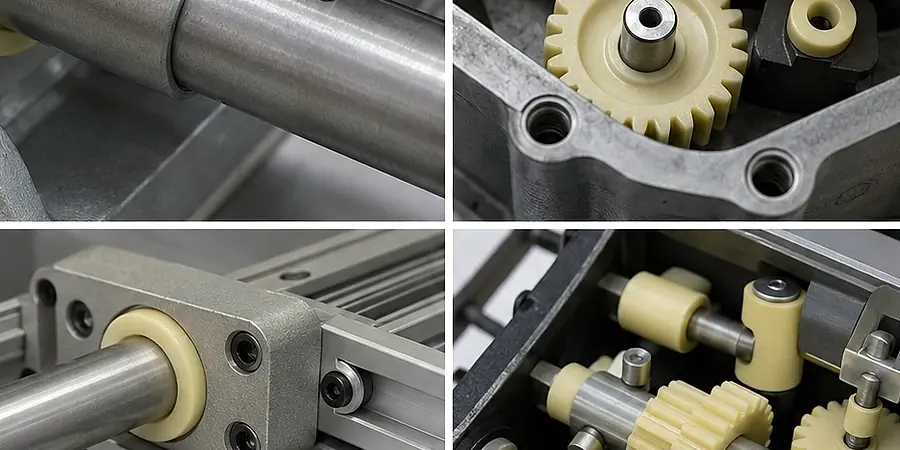
Wear-Resistant POM for Gears, Rollers, and Sliding Blocks: Selection and Validation Guide
POM, also known as acetal or polyoxymethylene, is widely used in gears, rollers, sliders, bushings, guide blocks, clips, and precision mechanisms. It offers good dimensional stability, low water absorption, rigidity, fatigue resistance, and stable injection molding behavior.
Buyer and engineer FAQ
Questions engineers often ask about this material route
Where can POM with a wear-resistant plastic requirement be used?
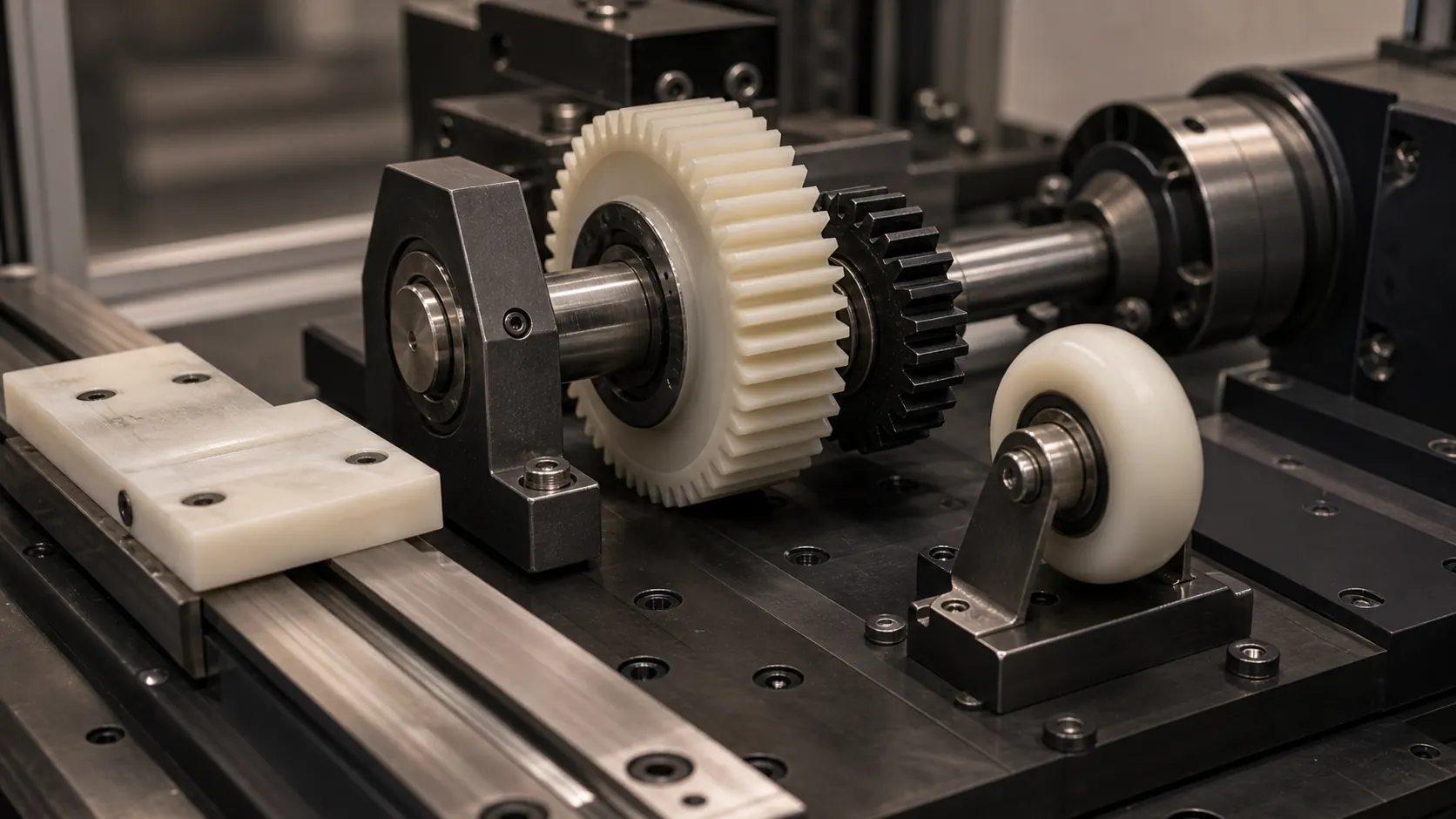
Typical fields include gears, rollers, bushings, sliding blocks, guide rails and low-noise moving parts. For this article, DEYU would first confirm the working environment, wall thickness, expected lifetime and whether DGK-POM TF90M, DGK-POM FL100T matches the part geometry or needs formulation adjustment.
What are the main performance indicators for the "wear-resistant plastic" target on POM?
Focus on friction coefficient, wear depth, PV value, noise, dimensional stability and mating material compatibility. Buyers should ask for data on molded parts, not only pellet data, because gate position, filler orientation and thickness can change the final value.
What should engineers watch during injection molding or processing?
For POM, a practical starting window is 180-210°C melt / 70-100°C mold. Dry PA grades correctly, control glass or aramid fiber orientation and validate wear on the real mating surface. Final parameters should follow part thickness, gate design and the actual machine.
What details help DEYU recommend DGK-POM TF90M, DGK-POM FL100T more accurately?
Send the current resin or grade, drawing or photo, wall thickness, annual quantity, target standard, failure mode and required color. If a reference grade already passed one test but failed in production, include both data sets.
For a precise recommendation, share the part drawing, base resin, target performance, processing method and test standard with DEYU.
1. Why POM Is Used in Moving Parts
POM, also known as acetal or polyoxymethylene, is widely used in gears, rollers, sliders, bushings, guide blocks, clips, and precision mechanisms. It offers good dimensional stability, low water absorption, rigidity, fatigue resistance, and stable injection molding behavior.
DGK-POM TF90M and DGK-POM FL100T. PTFE and aramid reinforced POM routes are useful comparison points for gears, rollers, sliders, and guide parts
However, standard POM is not enough for every friction condition. Long service cycles may cause noise, polishing marks, debris, clearance growth, start-up sticking, or surface roughening.
2. Main Wear-Resistant POM Routes
POM/PTFE is selected when the main target is low friction, low noise, anti-stick-slip behavior, and smoother movement. It is common in small gears, sliders, bushings, rollers, and guide parts.
POM with aramid fiber is considered when the part needs higher wear durability and toughness. It can help protect the wear surface and improve service-life stability.
Lubricated POM uses internal lubricant systems to improve slip, reduce noise, and support smoother movement in medium-load mechanisms.
Reinforced POM may be selected when stiffness or dimensional control is the main issue, but the mating surface must be checked because hard reinforcement may increase abrasion.
3. Application Scenario: POM Gear Noise and Tooth Wear
A small POM gear may run well at first but develop noise after long operation. Possible causes include insufficient lubrication, unsuitable mating gear material, high local tooth pressure, molding stress, or surface roughening.
DEYU would compare POM/PTFE, lubricated POM, POM/aramid, and reinforced POM depending on the load and noise target. Gear tooth wear, noise, tooth surface condition, dimensional change, and molded shrinkage should be checked together.
4. Application Scenario: Roller and Slider Wear
Rollers and sliders often work under repeated movement, dry sliding, or intermittent start-stop conditions. Standard POM may show stick-slip, wear debris, or increased friction after running-in.
For low friction and smooth start-up, POM/PTFE is usually a first route. For higher wear life and toughness, POM/aramid may be tested. If deformation is the problem, reinforced POM or a structural change may be required.
5. Validation Indicators
| Indicator | Why It Matters |
|---|---|
| Friction coefficient | Shows sliding resistance and start-up behavior |
| Wear depth | Shows material loss and service-life trend |
| Noise | Important for gears, rollers, and precision movement |
| Surface roughness | Shows whether the surface is polishing or tearing |
| Dimension change | Affects clearance, fit, and motion accuracy |
| Impact strength | Prevents brittle failure in thin sections |
| Shrinkage | Affects gear mesh and assembly fit |
6. DEYU Support for POM Parts
DEYU can compare PTFE modified POM, aramid reinforced POM, lubricated POM, reinforced POM, black or natural color systems, high-flow grades, low-noise grades, and formulations for gears, rollers, bushings, and sliders.
The best input from the customer is the actual part drawing, counter material, load, speed, current problem, processing method, and service-life target.
Conclusion
Wear-resistant POM is a practical choice for gears, rollers, sliders, bushings, and precision moving parts. The right route depends on whether the main problem is friction, noise, wear depth, deformation, shrinkage, or toughness.