
Antistatic Additive Blooming in White Rigid PVC and the DEYU DGK-PVC KJD789JC Solution
White rigid PVC must hold surface resistance at 10^6-10^9 ohm without powder bloom, oily films or cleanroom contamination. This article explains why conventional migrating antistatic agents fail and how DGK-PVC KJD789JC maintains a white, colorable surface through a permanent non-migrating antistatic network.
Buyer and engineer FAQ
Questions engineers often ask about this material route
Why does antistatic agents bloom out of white rigid PVC?
Conventional small-molecule antistatic agents are only physically blended with PVC. Heat, aging and temperature or humidity changes drive them toward the surface, where they form powder bloom or an oily film.
How does DGK-PVC KJD789JC maintain antistatic performance without migration?
It uses a polymeric permanent antistatic system that is chemically associated or highly entangled with the PVC matrix. Static charge dissipates through a network distributed inside the material rather than through a sacrificial surface layer.
Can DGK-PVC KJD789JC remain white and be color matched?
Yes. The non-carbon-black system provides a white base and supports colors such as gray or light blue. The surface resistance remains around 10^7-10^8 ohm after suitable color matching.
Can hardness and melt flow be adjusted for different molds?
Yes. Formulation hardness can be reduced when more clip flexibility is required. Melt flow can also be adjusted for thin-wall injection molding or specific extrusion equipment. Any numeric hardness target must use the scale and method defined in the approved test record.
1. Industry Background and Problem Definition
Antistatic PVC is widely used in electronics, cleanrooms, medical products and mining. Its core requirement is stable surface resistance in the 10^6-10^9 ohm range. However, the industry has long faced a structural conflict: antistatic performance and resistance to additive blooming are difficult to achieve simultaneously in white rigid PVC.
Most mainstream white antistatic PVC products are based on flexible PVC. Because flexible PVC contains a large amount of plasticizer, its molecular chains have greater mobility and antistatic-agent molecules have sufficient migration channels to replenish the surface. Even conventional migrating small-molecule antistatic agents can therefore maintain their function for a relatively long period.
Rigid PVC, or unplasticized PVC, has a glass-transition temperature of about 87 C. At room temperature its chain segments are effectively frozen, so the diffusion coefficient of antistatic agents inside the matrix is extremely low. Once the surface antistatic layer is depleted by friction, wiping or aging, the internal agent cannot replenish it quickly and resistance rises sharply.
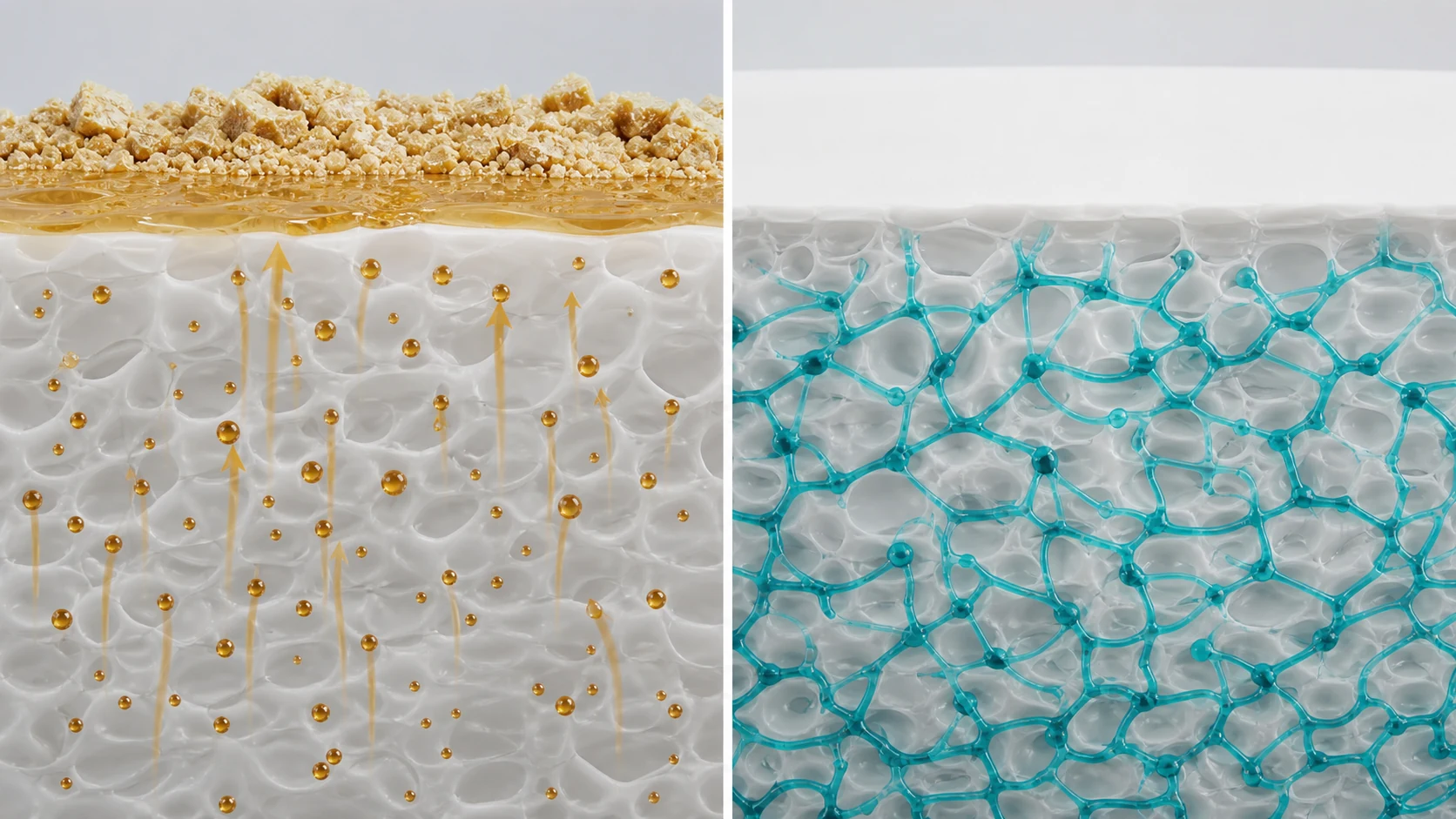
At the same time, conventional small-molecule antistatic agents are only physically blended with rigid PVC and are not chemically bonded to it. These highly active, poorly stabilized additives continuously migrate from the interior to the surface during high-temperature injection molding, room-temperature aging and changes in temperature or humidity. The migrated agent forms white powder crystals or an oily, slippery film. Parts feel greasy, surfaces turn white and, in severe cases, cleanroom particle monitoring alarms are triggered.
The contradiction is particularly severe in white rigid PVC. Carbon-based conductive fillers avoid organic additive blooming but make the material black. Stable antistatic behavior on a white substrate therefore requires an organic antistatic system, whose migration behavior is very difficult to control in rigid PVC. Additive blooming in white rigid antistatic PVC has consequently remained a long-standing technical problem.
2. Failure Mechanisms of Traditional Routes
The two white rigid PVC antistatic routes commonly used in the industry have distinct failure paths.
2.1 Migrating small-molecule antistatic agents
This route adds a small-molecule surfactant that is only partly compatible with PVC, including nonionic, anionic or cationic antistatic agents. Limited compatibility is used deliberately so the agent migrates slowly after molding and forms a conductive surface layer.
Initial blooming can become uncontrolled. During high-temperature injection molding or extrusion, heat accelerates migration. A large amount of agent reaches the mold surface and transfers to the part, creating an excessively thick oily layer and a greasy feel.
Long-term performance then declines. After friction or wiping removes the surface layer, the frozen chain segments of rigid PVC prevent efficient replenishment. Surface resistance can drift from an initial 10^7-10^8 ohm to above 10^11 ohm.
The route is also sensitive to temperature and humidity. Both migration rate and moisture-assisted surface conduction vary with the environment, so resistance can fluctuate beyond the acceptable range.
Finally, poor compatibility causes continued accumulation. The agent can crystallize as white powder bloom or form an oily film, and the deposit increases with time.
2.2 Online antistatic-liquid coating
Some pipe and profile producers extrude ordinary PVC and then apply antistatic liquid online. The failure mechanism is more direct: coating life is limited and resistance decay can appear after about one year of installation.
Active surfactant components can also collect and bloom in slots, corners and other recessed areas. Visible deposits may trigger particle-monitoring alarms in cleanrooms. The coating step also adds process complexity, while solvent odor affects the workshop environment.
3. DEYU Technical Route: A Non-Migrating Antistatic System
Yuyao Deyu Plastic Technology Co., Ltd. developed DGK-PVC KJD789JC white antistatic PVC pellets for this problem. The technical route has three layers.
3.1 Polymeric permanent antistatic modification
DGK-PVC KJD789JC uses polymeric permanent antistatic modification instead of conventional small-molecule physical blending. The antistatic component remains stable inside the PVC matrix through chemical association or strong chain entanglement and does not need to migrate to the surface to function.
This is the essential difference: traditional systems create a conductive path by allowing additive molecules to migrate out, whereas the DEYU system dissipates static electricity through a uniformly distributed network inside the matrix. Because the antistatic component is stable in the bulk, there is no continuous migration driving force and the blooming problem is removed at its source.
3.2 White non-carbon-black base
Traditional conductive and antistatic routes often depend on carbon black and are limited to black products. DGK-PVC KJD789JC uses a non-carbon-black antistatic system to obtain a white base. DEYU also produces it on a dedicated line that is not shared with carbon-black systems, reducing cross-contamination risk.
The white base supports color matching with gray, light blue and other light masterbatches. After suitable color matching, surface resistance shows no significant difference from the natural white grade and remains in the 10^7-10^8 ohm range.
3.3 Platform-based formulation design
The basic DGK-PVC KJD789JC formulation remains stable, while hardness and flow can be adjusted within a controlled range for different equipment and mold structures. The starting formulation can be softened when a molded clip needs more flexibility, and melt flow can be adjusted from the standard version. Any numeric hardness target must identify the agreed scale and method in the approved test record. This configurable platform allows one base grade to serve multiple molds and processing situations.
4. Technical Indicators and Performance Comparison
| Comparison | Migrating antistatic agent | Online antistatic coating | DGK-PVC KJD789JC |
|---|---|---|---|
| Antistatic mechanism | Small molecules migrate to the surface | Conductive surface coating | Polymeric permanent antistatic agent uniformly distributed in the matrix |
| Surface resistance | Initially 10^7-10^8 ohm; drifts above 10^11 ohm | Initially 10^7-10^8 ohm; decays after one year | Stable 10^7-10^8 ohm; batch fluctuation <= +/-5% |
| Blooming | White powder or oily film accumulates | Deposits in slots and corners | No deposit after 60 C / 90% RH / 72 h accelerated aging |
| Color capability | White base, but blooming affects appearance | Depends on substrate color | White base and colorable |
| Temperature and humidity | Sensitive; resistance fluctuates widely | Coating is humidity sensitive | Not affected by small temperature or humidity changes |
| Processing | Injection and extrusion, with high blooming risk | Requires an added online coating step | Supports both injection molding and extrusion |
| Long-term stability | Poor; antistatic function declines | Limited coating life | Permanent antistatic performance; resistant to wiping and washing |
5. Customer Validation: South China Cleanroom Partition Profile Extruder
5.1 Customer and original route
A South China extrusion factory specializes in PVC cleanroom partition profiles, with annual capacity of about 3,000 tonnes. Its main products are cleanroom partition frames, observation-window frames and antistatic door-frame profiles. The previous route used ordinary PVC pellets followed by online antistatic-liquid coating.
Three core problems emerged: resistance declined about one year after installation; a pharmaceutical customer found antistatic-liquid deposits at the root of profile slots, triggering a cleanroom particle alarm; and solvent odor from online coating affected the workshop environment.
5.2 DEYU pre-adaptation
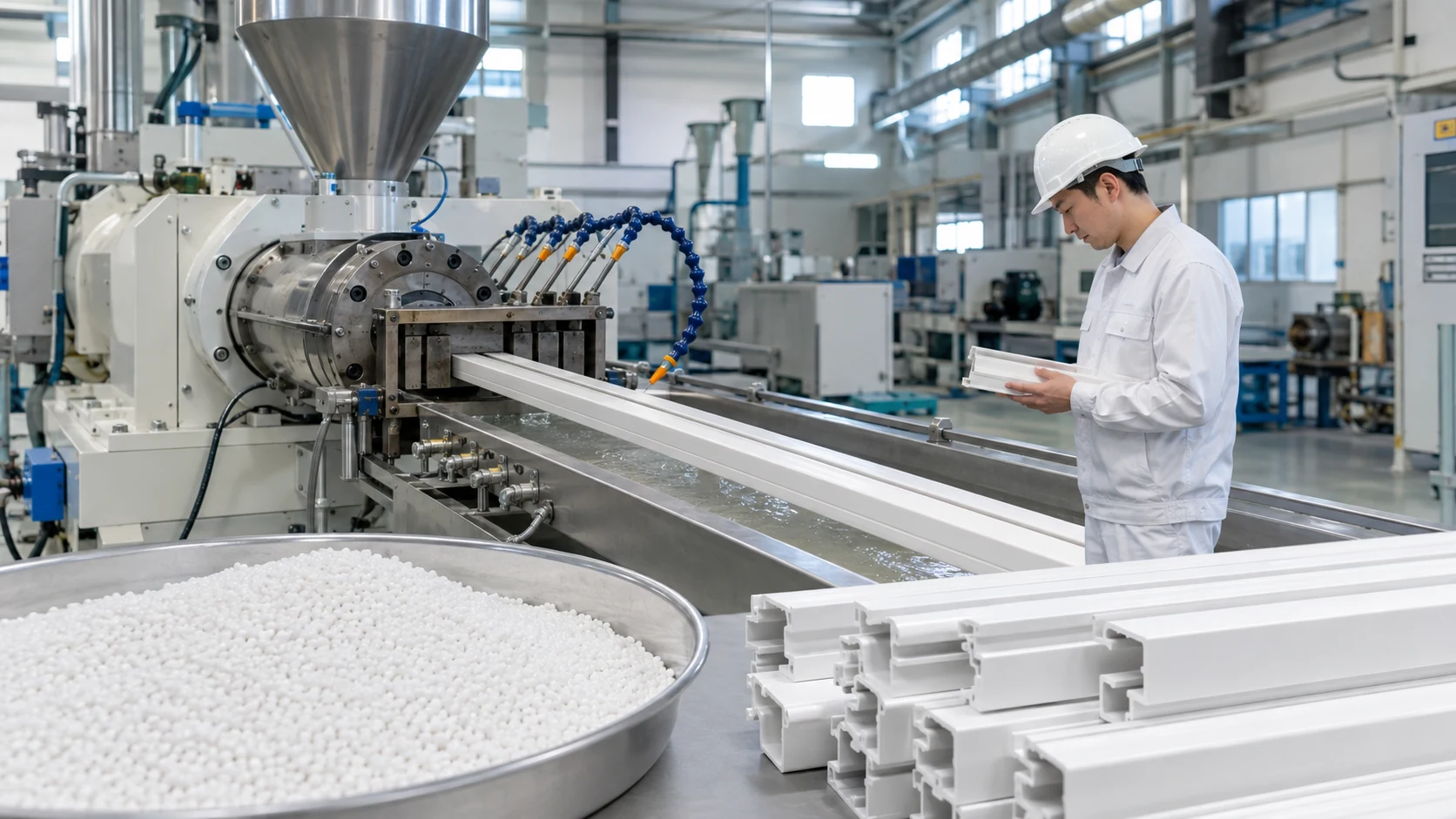
Before formal trial production, the DEYU team reviewed the customer's equipment: a diameter 65 conical twin-screw extruder, a 60 mm x 40 mm die section, 1.8 mm wall thickness, and profile geometry with slots and sealing lips. Because the customer wanted to increase haul-off speed after removing coating, DEYU adjusted KJD789JC flow before shipment to achieve a better melt-strength and flow balance on the conical twin-screw line.
5.3 Trial settings
| Process parameter | Setting |
|---|---|
| Drying | 70 C / 2 h |
| Barrel zone 1 | 165 C |
| Barrel zone 2 | 172 C |
| Barrel zone 3 | 178 C |
| Barrel zone 4 | 175 C |
| Die temperature | 178 C |
| Calibration cooling-water temperature | 18 C |
| Haul-off speed | 3.0 m/min |
5.4 Validation data and results
The first trial continuously extruded 80 m. Profile shape and cross-section were fully qualified. The surface was uniformly white, and full inspection found no black spots, pits or yellow lines. Samples were taken every 10 m along the length; every section measured 10^7-10^8 ohm surface resistance, with a coefficient of variation below 15%. After 60 C / 90% RH / 72 h accelerated aging, no surface deposit appeared and resistance remained within the same order of magnitude.
| Comparison | Original coating route | KJD789JC route |
|---|---|---|
| Initial surface resistance | 10^7-10^8 ohm | 10^7-10^8 ohm |
| Resistance retention after one year | Some parts out of specification | Under validation; improvement expected |
| Blooming risk | Present; customer alarm triggered | None |
| Haul-off speed | 2.5 m/min | 3.0 m/min, 20% increase |
| Online coating | Required | Eliminated |
| Workshop solvent odor | Present | None |
5.5 Conversion result
Within one month after the successful trial, the factory converted all cleanroom partition-profile orders to KJD789JC. Eliminating online coating removed solvent vapor odor from the extrusion workshop and operators reported a clear improvement. The factory regained eligibility for pharmaceutical-plant bids that had been suspended after blooming complaints. By reviewing equipment parameters and adjusting pellet flow before the trial, DEYU reduced on-site exploration and achieved first-pass approval.
6. Technical Summary
The technical essence of DGK-PVC KJD789JC is the conversion of antistatic function from a surface effect that depends on additive migration into a bulk effect created by a uniformly distributed internal network. Polymeric permanent antistatic modification keeps the antistatic component stable in the PVC matrix, so static charge can dissipate without migration to the surface.
This simultaneously addresses three long-standing problems: greasy feel and whitening caused by additive blooming, resistance drift and failure after long service, and the difficulty of combining a white base with stable antistatic behavior.
The solution has completed a production conversion at the South China cleanroom profile factory. On a diameter 65 conical twin-screw extruder it ran continuously at 3.0 m/min with uniform resistance along the profile and no deposits after accelerated aging.
The material has also completed hardness-adjustment validation in injection-molded medical packaging trays. After the higher-hardness starting formulation was reduced to the customer-approved lower-hardness setting, clip bending life recovered from 25 cycles to more than 50 cycles. The signed test record should identify the hardness scale and method; unverified Shore D values are not used here. In thin-wall tray molding, increasing MFR by about 30% resolved short shots. Together, these cases verify the engineering adaptability of DGK-PVC KJD789JC in both extrusion and injection molding.