
Antistatic / ESD Plastics: Technical Routes, Resistance Targets and Selection Logic
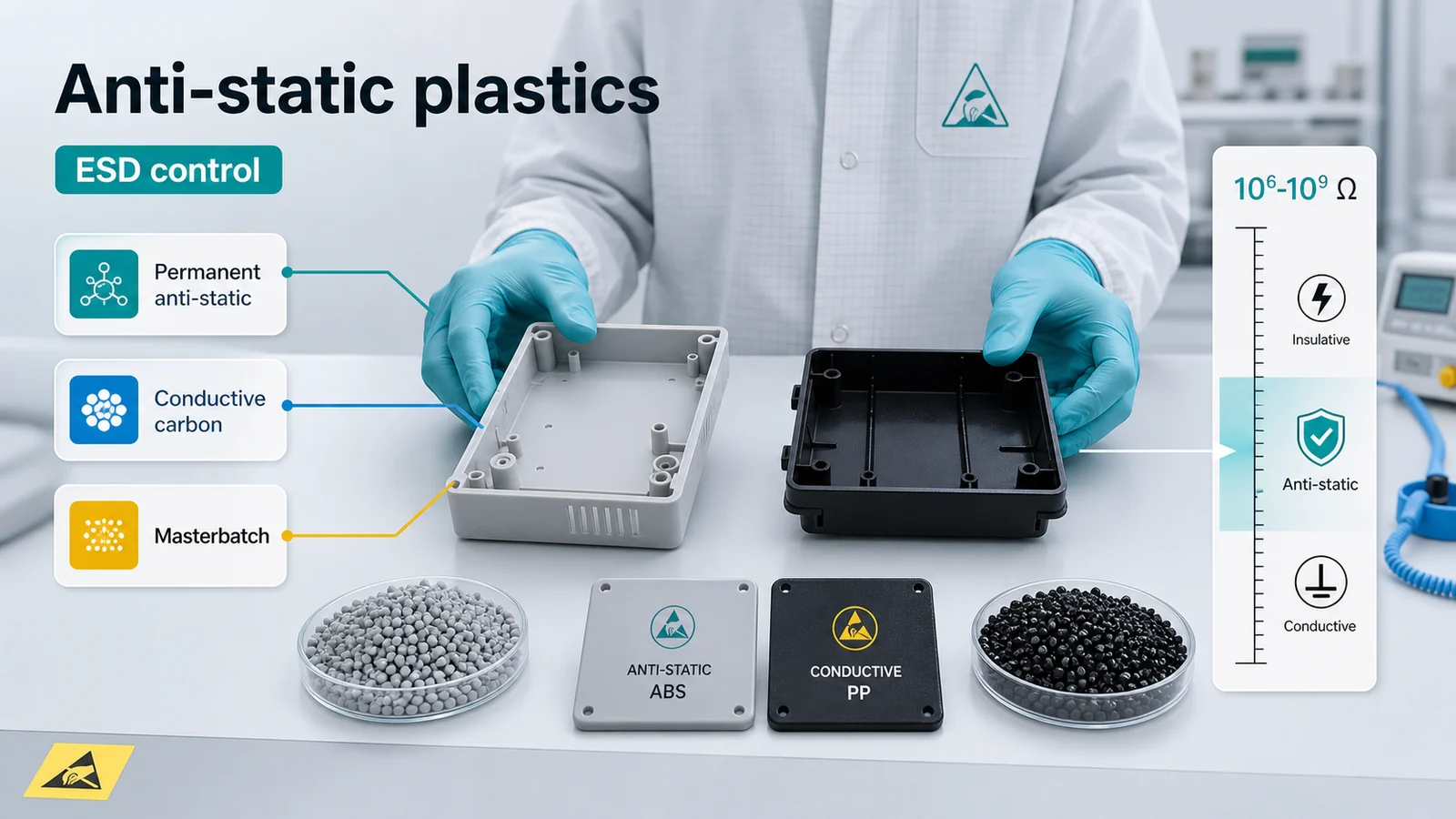
Anti-static plastics can be developed through migratory additives, permanent anti-static systems, conductive carbon black, CNT networks, conductive masterbatches, carbon fiber and hybrid routes. The right choice depends on resistance target, color, transparency, toughness, flame retardancy, wear resistance and long-term stability.
Buyer and engineer FAQ
Questions engineers often ask about this material route
Where can modified plastic with a antistatic plastic requirement be used?
Typical fields include clear covers, electronic packaging, dust-control parts, trays and clean-area components. For this article, DEYU would first confirm the working environment, wall thickness, expected lifetime and whether DGK-ABS KJD678R-BZ permanent anti-static ABS, DGK-PP KJD789R-A1 permanent anti-static PP matches the part geometry or needs formulation adjustment.
What are the main performance indicators for the "antistatic plastic" target?
Focus on stable surface resistance, dust attraction, transparency or color, humidity sensitivity and long-term antistatic decay. Buyers should ask for data on molded parts, not only pellet data, because gate position, filler orientation and thickness can change the final value.
What should engineers watch during injection molding or processing?
Avoid over-drying antistatic systems, confirm resistance after conditioning and after part cleaning. Start from the base-resin processing window, then adjust by molded-part resistance, appearance and mechanical data.
What details help DEYU recommend DGK-ABS KJD678R-BZ permanent anti-static ABS, DGK-PP KJD789R-A1 permanent anti-static PP more accurately?
Send the current resin or grade, drawing or photo, wall thickness, annual quantity, target standard, failure mode and required color. If a reference grade already passed one test but failed in production, include both data sets.
For a precise recommendation, share the part drawing, base resin, target performance, processing method and test standard with DEYU.
Short Answer
Anti-static plastics can be produced through several technical routes, including migratory anti-static agents, permanent anti-static systems, conductive carbon black, carbon nanotubes, conductive masterbatches, carbon fiber, conductive polymers and hybrid conductive networks.
The correct route depends on the customer’s selection target. Some parts only need to reduce dust adhesion and static accumulation. Some ESD parts need controlled static dissipation. Some industrial components need stronger conductivity for grounding, powder handling, rollers or mechanical equipment.
Yuyao Deyu DEYU plastics develops DGK anti-static and conductive compounds according to resistance target, resin system, molding process, color, transparency, mechanical strength and long-term validation. Existing related product directions include DGK-ABS KJD678R-BZ permanent anti-static ABS and DGK-PP KJD789R-A1 permanent anti-static PP.
Anti-Static Plastics Are Not One Single Material
Many customers ask for “anti-static plastic”, but the real requirement can be very different from project to project.
One customer may want to reduce dust on a plastic cover. Another may need an ESD-safe tray for electronic components. A packaging line may need caps or films to release smoothly. A roller may need both conductivity and wear resistance. A transparent housing may need static control while keeping visual clarity. A black industrial part may need conductive performance, stiffness and dimensional stability.
These are not the same material target. The first step is to define the real function:
- dust reduction
- ESD protection
- controlled static discharge
- conductive grounding
- powder anti-adhesion
- transparent or colored anti-static appearance
- long-term permanent anti-static performance
- high-conductive industrial function
Only after this is clear can the correct technical route be selected.
Resistance Targets: Anti-Static, Static-Dissipative and Conductive
Anti-static plastics are often divided by electrical resistance range. Different industries may use different boundary values, but the following direction is commonly used for material selection.
| Level | Typical surface resistance direction | Main effect | Typical applications |
|---|---|---|---|
| Anti-static | 10^9-10^12 ohm | Reduce static accumulation and dust attraction | Housings, packaging, covers, low-risk ESD parts |
| Static-dissipative | 10^6-10^9 ohm | Controlled discharge of static electricity | ESD trays, fixtures, electronic handling parts |
| Conductive | 10^3-10^6 ohm | Faster charge transfer | Industrial parts, rollers, conductive POM / PA parts |
| High-conductive | 10^2-10^3 ohm or lower | Strong conductive pathway | Special industrial components and grounding-related parts |
The lower the resistance target, the harder the formulation becomes. Low resistance can increase cost, darken color, reduce toughness, affect flowability and change surface appearance. Customers should not simply ask for the lowest resistance. The right target is the range that solves the real problem while preserving the product’s other requirements.
Technical Route 1: Migratory Anti-Static Agents
Migratory anti-static agents are a traditional route. These additives migrate to the surface and absorb moisture from the air, forming a weak conductive layer that reduces static accumulation.
This route is low cost, easy to process and has limited influence on color. It can be useful for short-life packaging, temporary-use products and low-cost applications where strict resistance stability is not required.
The limitations are also clear. The effect depends on humidity, performance may decay with time, wiping or washing can remove the surface layer, and long-term ESD stability is limited. DEYU usually recommends migratory systems only when the requirement is short-term anti-static behavior and cost is the main priority.
Technical Route 2: Permanent Anti-Static Systems
Permanent anti-static systems are designed to provide longer-lasting anti-static or static-dissipative performance. They usually rely on polymeric anti-static agents, ion-conductive systems or compatible functional phases inside the resin.
This route gives better long-term stability than migratory systems and better color feasibility than carbon black systems. It can support white, gray, blue, green, natural-color or translucent-looking materials depending on the resin and target resistance.
Permanent systems are often selected for colored anti-static housings, light-colored ESD trays, anti-static ABS, anti-static PC/ABS, anti-static PMMA and anti-static PP. The main checks are resin compatibility, humidity sensitivity, flame-retardant compatibility, pigment influence and long-term resistance drift.
Technical Route 3: Conductive Carbon Black
Conductive carbon black is widely used for static-dissipative and conductive plastics. It forms a conductive network inside the resin and offers a strong cost-performance balance.
This route is suitable for black ESD trays, conductive PP parts, conductive ABS covers, conductive POM gears and sliders, powder handling components and black industrial parts. It is mature, stable and compatible with many resin systems when dispersion is controlled.
The tradeoff is color. The material usually becomes black. Higher filler loading may reduce impact strength, lower flowability and affect surface smoothness. Dispersion quality strongly affects resistance stability, so compounding control is critical.
Technical Route 4: Carbon Nanotube Systems
Carbon nanotubes can form conductive pathways at lower addition levels because of their high aspect ratio and network-forming ability. In selected systems they can help retain more mechanical performance than heavy carbon black loading.
This route is useful for high-end ESD parts, thin-wall anti-static parts and engineering plastics that require a better balance between conductivity and toughness. It can be applied in PC/ABS, PA, POM, PP and other systems when the project justifies the cost and process control.
The risks are higher cost, difficult dispersion, dark color direction and resistance variation caused by flow orientation or part thickness.
Technical Route 5: Conductive Masterbatch
Conductive masterbatch is a concentrated conductive additive system. It improves dispersion, feeding stability, resistance control and production flexibility.
This route is useful for PP conductive compounds, ABS conductive compounds, POM conductive compounds, nylon static-dissipative systems and customer-specific small-batch materials. It also helps reduce dust during processing and makes it easier to adjust dosage during trials.
The carrier resin must match the final resin system. Dosage must be matched with the target resistance, and mechanical properties, surface quality and molding stability must still be validated.
Technical Route 6: Carbon Fiber and Hybrid Conductive Networks
Carbon fiber can provide conductivity, reinforcement, dimensional stability, stiffness and lower shrinkage. It is used when anti-static or conductive performance must coexist with mechanical strength.
Hybrid conductive networks combine different routes to reduce total loading and improve balance. Examples include conductive carbon black plus PTFE, carbon fiber plus PTFE, CNT plus carbon black, permanent anti-static system plus conductive filler, and conductive filler plus flame-retardant or wear-resistant systems.
This route is practical for conductive PA66 structural parts, conductive POM precision parts, PPS conductive components, mechanical equipment parts and wear-resistant conductive parts.
Route Comparison
| Route | Main target | Color feasibility | Stability | Cost | Suitable scenario |
|---|---|---|---|---|---|
| Migratory anti-static agent | Short-term anti-static | Good | Limited | Low | Temporary packaging |
| Permanent anti-static system | Long-term anti-static / dissipative | Good | Medium to high | Medium | Colored ESD parts and housings |
| Conductive carbon black | Static-dissipative / conductive | Mainly black | High if dispersed well | Low to medium | Industrial black parts |
| Carbon nanotube | Efficient conductive network | Dark colors | High if dispersed well | High | High-end ESD parts |
| Conductive masterbatch | Adjustable conductivity | Depends on route | High | Adjustable | Customized compounds |
| Carbon fiber | Conductive + reinforcement | Black / dark | Medium to high | Medium to high | Structural conductive parts |
| Hybrid network | Multi-function balance | Depends on system | High | Adjustable | Conductive + wear / flame / strength requirements |
What Changes After Anti-Static Modification?
A properly selected anti-static plastic brings practical improvements beyond resistance data.
Dust adhesion can be reduced because the part no longer holds static charge as easily. Feeding and release can become more stable in packaging, conveyor and automation systems. ESD risk can be reduced when electronic components are handled by trays, fixtures or housings with controlled dissipation. Production interruption can decline because sticking, sensor instability and surface contamination are reduced.
In mechanical equipment, anti-static plastics can also reduce dust accumulation and wear powder adhesion, improving long-term operation stability.
Customer Case 1: Anti-Static PP Tray for Lightweight Packaging Parts
A packaging equipment customer used ordinary PP trays to transfer lightweight plastic caps. The trays were low-cost and easy to mold, but static charge caused caps to stick to the tray surface.
The original tray showed frequent release abnormalities, dust adhesion after one shift, manual correction during production and lower production speed. DEYU recommended a PP-dedicated conductive masterbatch route.
| Item | Original PP tray | DEYU anti-static / conductive PP |
|---|---|---|
| Surface resistance | >10^13 ohm | 10^7-10^9 ohm direction |
| Cap release abnormality | 12-18 times / hour | 1-2 times / hour |
| Dust adhesion after 8 hours | 3.6 g/m2 | 0.8 g/m2 |
| Production speed | 84% of target | 97% of target |
| Rejection due to feeding issue | 3.2% | 0.5% |
| Cleaning frequency | 2 times / shift | 1 time / shift |
The key was not only lowering resistance. DEYU also adjusted PP base resin, conductive masterbatch dosage, cooling balance and impact balance so that the tray could keep molding stability and acceptable corner toughness.
Customer Case 2: Colored Anti-Static ABS Housing
A customer used ABS housings for industrial control equipment. The original ABS had good appearance and impact strength, but dust accumulated near airflow outlets during long-term use. The customer required gray color, good surface appearance, anti-static performance, impact retention and stable injection molding.
DEYU selected a permanent anti-static ABS direction instead of a black conductive carbon route. The formulation was adjusted around color, resistance, impact strength and surface gloss. After trial optimization, the housing kept a gray appearance while reducing dust accumulation and maintaining acceptable molding performance.
This case shows why anti-static route selection must consider color and appearance from the beginning. A black conductive route may reach lower resistance, but it can fail the customer’s product design requirement.
Customer Case 3: Static-Dissipative POM Sliding Part
A mechanical equipment customer used ordinary POM sliders. The original POM had low friction and good dimensional stability, but static accumulation and wear dust created unstable sliding and cleaning problems.
DEYU recommended a static-dissipative wear-resistant POM formulation. The recipe combined a conductive network for static dissipation, PTFE balance for lower friction, POM dimensional stability control and wear-resistant additives.
| Item | Ordinary POM | DEYU static-dissipative wear-resistant POM |
|---|---|---|
| Surface resistance | >10^13 ohm | 10^6-10^9 ohm direction |
| Friction coefficient | 0.30 | 0.18 |
| Wear depth | 0.16 mm | 0.06 mm |
| Wear dust accumulation | Medium to high | Low |
| Cleaning interval | Every 8 hours | Every 24 hours |
| Sliding abnormalities | 4 times / 200 hours | 0-1 time / 200 hours |
For sliding parts, anti-static effect should be developed together with wear resistance. A material that only dissipates static but wears quickly may not solve the real equipment problem.
Selection Guide
If the goal is dust reduction, a permanent anti-static system or a cost-controlled migratory route may be enough. Target resistance often sits in the higher anti-static range.
If the goal is ESD protection, the material usually needs static-dissipative performance, stable resistance after molding and multi-point testing across the actual part.
If the goal is industrial conductivity, powder anti-adhesion or grounding, conductive carbon black, conductive masterbatch, carbon nanotube, carbon fiber or hybrid networks may be needed.
If the goal is transparent or light-colored anti-static material, avoid high-loading carbon black and first evaluate permanent anti-static systems or special low-color-impact static-control routes.
DEYU DGK Anti-Static Material Platform
DEYU can support DGK-PP anti-static series, DGK-PP conductive masterbatch series, DGK-ABS anti-static series, transparent anti-static ABS series, DGK-PC/ABS static-dissipative series, DGK-POM conductive wear-resistant series, DGK-PA6 anti-static series, DGK-PA66 conductive reinforced series, DGK-PMMA anti-static transparent series, DGK-PC anti-static series, DGK-TPU anti-static and conductive series, anti-static flame-retardant materials, anti-static wear-resistant materials, anti-static UV-resistant materials, colored anti-static materials and transparent anti-static materials.
DEYU can adjust base resin, surface resistance range, volume resistance range, anti-static route, conductive masterbatch dosage, color, transparency, impact strength, flowability, flame retardancy, wear resistance, UV resistance, surface appearance, wall thickness and long-term stability.
Information to Provide Before Development
For accurate selection, DEYU recommends customers provide the target resin, application, current material, current resistance, target resistance range, whether the part needs anti-static / static-dissipative / conductive performance, color, transparency, molding process, wall thickness, mechanical requirements, flame-retardancy requirement, wear-resistance requirement, outdoor UV requirement, current static-related problem, sample part or drawing, test method and acceptance criteria.
Conclusion
Anti-static plastics can be developed through migratory additives, permanent anti-static systems, conductive carbon black, carbon nanotubes, conductive masterbatches, carbon fiber, conductive polymers and hybrid conductive networks. Each route has different resistance capability, color feasibility, cost, mechanical influence, processing behavior and long-term stability.
The correct selection target should come from the application. Dust reduction, ESD protection, controlled dissipation, industrial conductivity, transparent appearance and wear-resistant sliding parts all require different formulation logic.
Yuyao Deyu DEYU plastics provides DGK anti-static, static-dissipative, conductive, transparent anti-static, colored anti-static, wear-resistant anti-static and flame-retardant anti-static solutions for PP, ABS, PC/ABS, POM, PA6, PA66, PMMA, PC, TPU and other resin systems.