
The Toughness Dilemma of Antistatic ABS: When ESD Performance Starts to Mean Cracking
Antistatic ABS often solves static risk but creates a new failure mode: brittle snap-fits, cracked housings and stress-cracked thin-wall claws. This case guide explains the toughness loss mechanism and shows how DGK-ABS KJD678R-BZ balances 10^7-10^9 Ω surface resistance with high impact strength.
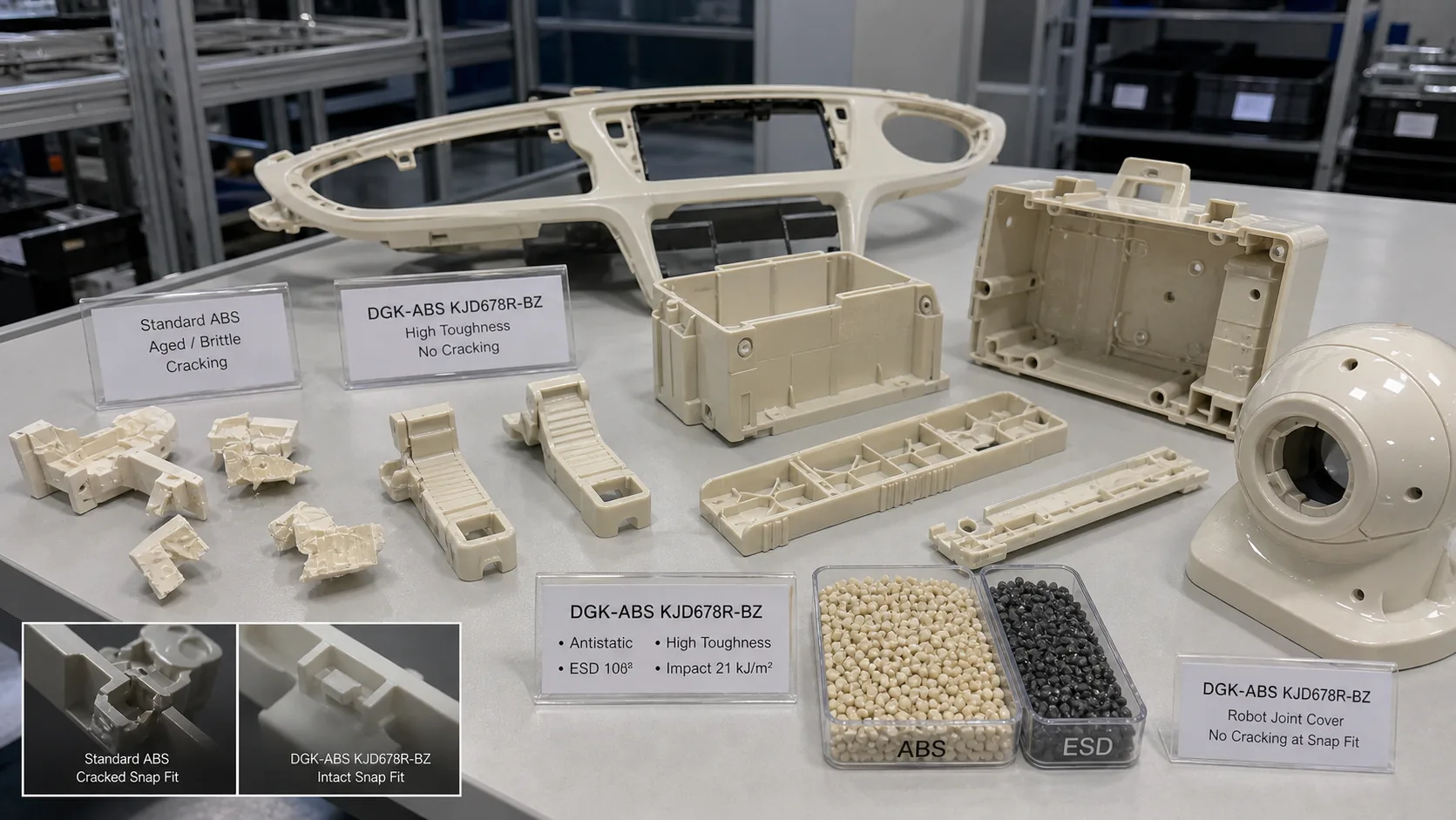
Failure-analysis notes
The Toughness Dilemma of Antistatic ABS: When ESD Performance Starts to Mean Cracking
Why does antistatic ABS crack more easily?
The second phase used for static control can disturb ABS toughening morphology. Poor compatibility, high filler loading or excessive antistatic agent creates stress-concentration sites.
What resistance range does KJD678R-BZ target?
The grade targets 10^7-10^9 Ω surface resistance, a dissipative range suitable for many electronic and industrial housings.
Which data matters for snap-fit parts?
Notched impact, elongation at break, molded-part resistance uniformity and real assembly fracture rate matter more than pellet resistance alone.
Can it replace imported antistatic ABS?
In the cases shown, KJD678R-BZ replaced imported or conventional grades while improving toughness and reducing cost, but each part still needs molding validation.
In electronic housings, automotive interior parts and industrial control panels, ABS is valued for impact toughness, surface gloss and processing flow. Once ordinary ABS is modified for antistatic function, however, a hidden problem appears: antistatic agents or conductive fillers can reduce impact toughness, causing snap-fit fracture, drop cracking and assembly-stress cracking.
Engineers often face a dilemma. If antistatic performance is strong, toughness may be sacrificed. If toughness is kept, resistance stability may be weak. Many antistatic ABS grades also show wide resistance fluctuation. A grade that can control static while keeping impact strength solves a real selection problem for molded housings.
Why Antistatic Modification Reduces Toughness
Antistatic ABS is usually modified by conductive fillers such as carbon black or CNTs, or by antistatic agents, either migrating or permanent. Both routes introduce a second phase into the ABS matrix, and that second phase can disturb the original rubber-toughened ABS morphology.
With permanent antistatic agents, increasing dosage lowers surface resistance, but too much additive reduces stiffness and toughness. When compatibility with ABS is limited, dispersed domains become stress-concentration sites under impact, triggering crazing and crack propagation.
Conductive carbon black has the same risk. High loading helps form an effective conductive network, but carbon black does not toughen ABS; it restricts chain mobility and can make the material brittle. This is the long-standing ESD-toughness see-saw: better static control often means more toughness loss.
DGK-ABS KJD678R-BZ Breaks the ESD-Toughness See-Saw
DEYU developed DGK-ABS KJD678R-BZ antistatic ABS to balance static dissipation and impact strength. Surface resistance is stable at 10^7-10^9 Ω, while Charpy notched impact reaches 21 kJ/m² and Izod notched impact reaches 24 kJ/m², a high level among comparable antistatic ABS grades.
The grade uses a permanent antistatic modification route. The antistatic component is distributed in polymer form inside the matrix and is not easy to migrate out, so antistatic effect can last for years. At the same time, flexural strength reaches 52 MPa, flexural modulus 1921 MPa and HDT 80°C, keeping a mechanical profile close to general ABS.
For the broader product-positioning page, see the existing DEYU guide to DGK-ABS KJD678R-BZ for injection-molded housings. This page focuses on cracking and toughness cases.
Core Performance Comparison
| Property | DGK-ABS KJD678R-BZ | Typical competitor A | Low-cost competitor B | Standard |
|---|---|---|---|---|
| Surface resistance | 10^7-10^9 Ω | 10^9-10^11 Ω | 10^5-10^7 Ω | GB/T 1401 |
| Charpy notched impact | 21 kJ/m² | 12-15 kJ/m² | 8-10 kJ/m² | GB/T 1043.1 |
| Izod notched impact | 24 kJ/m² | 15-18 kJ/m² | 10-12 kJ/m² | GB/T 1843 |
| Flexural strength | 52 MPa | 45-48 MPa | 40-42 MPa | GB/T 9341 |
| HDT | 80°C | 72-75°C | 68-70°C | GB/T 1633 |
| Antistatic durability | Permanent, non-migrating | Migrating, gradual decay | Permanent, poor toughness | - |
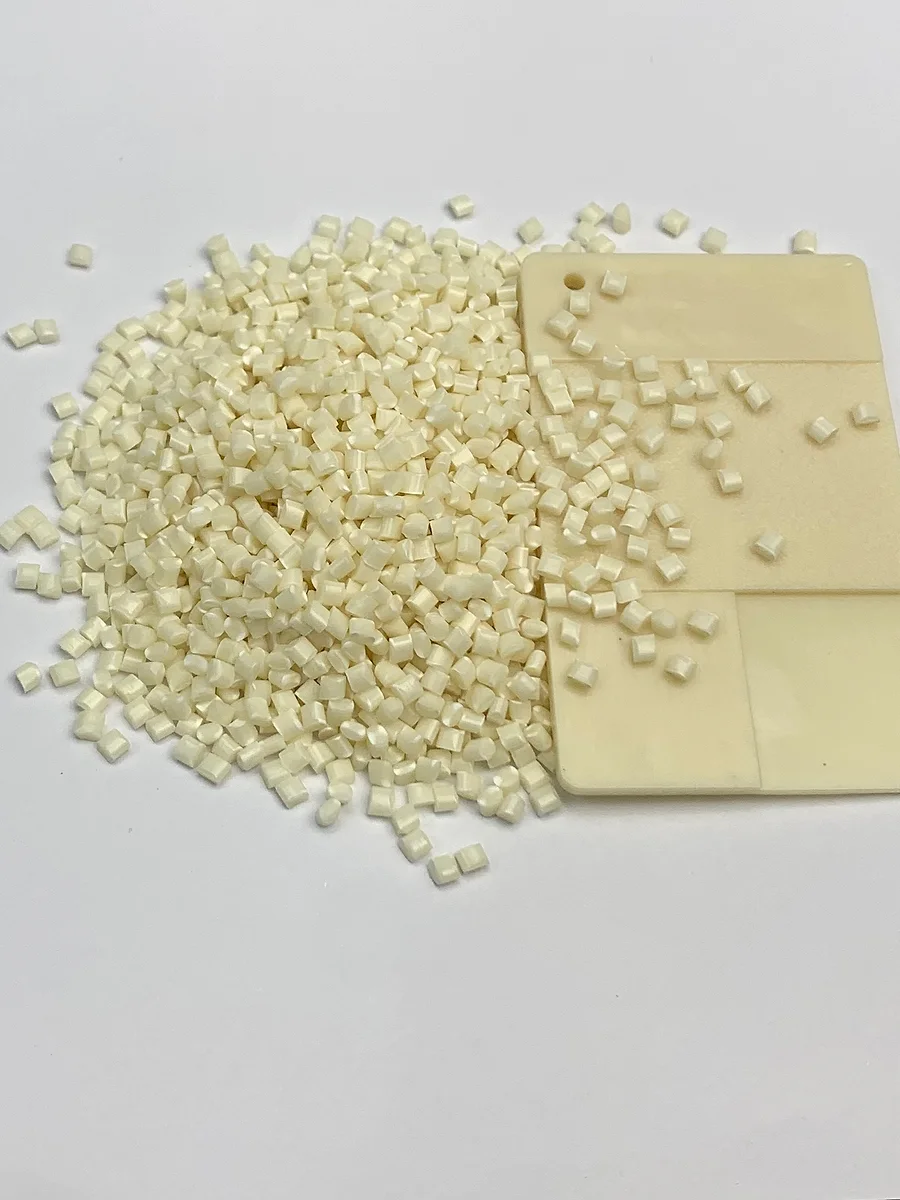
Case 1: Printer Internal Bracket
A printer manufacturer in East China produced a high-speed laser printer. Its internal paper-path bracket needed antistatic performance to reduce dust attraction from fast-moving paper, while several snap-fits had to bend during assembly.
The previous antistatic ABS had initial surface resistance around 10^9 Ω, but bracket snap-fit fracture during assembly reached 8%. Operators broke clips while inserting the bracket, and the fracture surface showed brittle failure. Process tuning did not solve the issue because the material's notched impact was only 12.5 kJ/m².
DEYU switched the project to KJD678R-BZ without changing the existing mold. Three injection trials were run. Fracture fell from 8.2% to 0.3%, while resistance stayed in the 10^8 Ω range. Scrap dropped from about 160 parts per batch to 6, cycle time shortened by about 5%, and more than 500,000 brackets have been delivered over 18 months with no snap-fit complaint.
Validation Data
| Round | Material | Injection temp. | Mold temp. | Snap-fit fracture | Surface resistance |
|---|---|---|---|---|---|
| 1 | Original | 220°C | 60°C | 8.2% | 10^9 Ω |
| 2 | KJD678R-BZ | 210°C | 70°C | 0.8% | 5×10^8 Ω |
| 3 | KJD678R-BZ | 200°C | 70°C | 0.3% | 8×10^8 Ω |
Case 2: Industrial Robot Joint Cover
A Pearl River Delta robot manufacturer used ABS joint covers to protect precision transmission components on six-axis robots. The cover needed antistatic dust control and high impact resistance for occasional collision during high-speed motion.
The original domestic antistatic ABS passed early lab checks but developed stress cracks after 3-6 months in real production lines. Cracks began around screw holes and corner transitions. In the first 2,000 robots, more than 300 units had cover cracking, creating high service cost. Failure analysis showed creep cracking under long-term vibration; Izod notched impact was only 16 kJ/m².
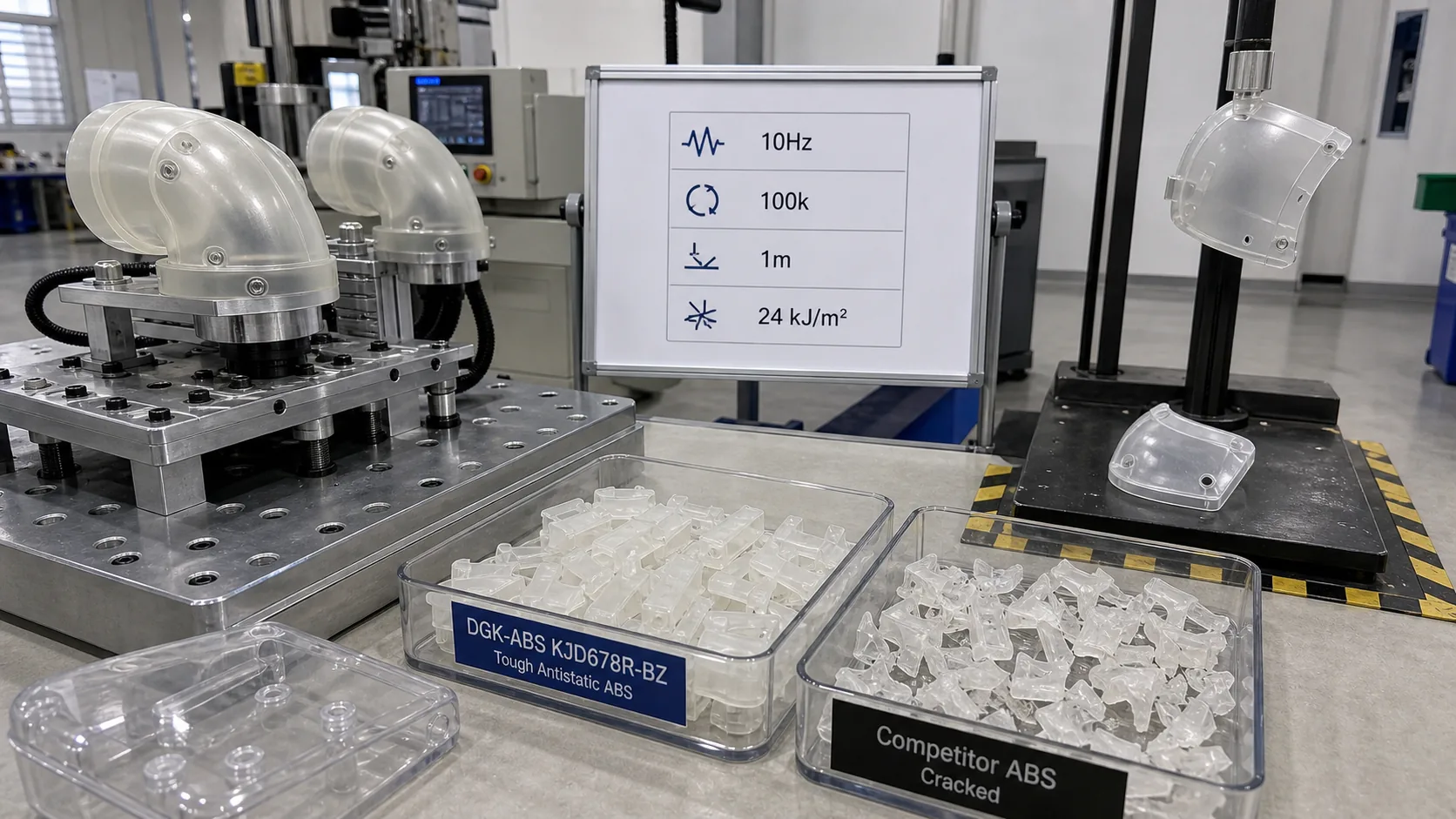
DEYU compared KJD678R-BZ with the original material and an imported antistatic ABS over eight weeks. KJD678R-BZ achieved 24 kJ/m² Izod impact, 21 kJ/m² Charpy impact, passed 100,000 vibration cycles without cracks, survived three 1 m drop assemblies and retained 85% impact after 85°C/85%RH aging. More than 150,000 covers have been delivered with no in-service cracking complaint, while material cost was about 25% lower than the imported route.
Validation Data
| Test | Original | Imported competitor | KJD678R-BZ |
|---|---|---|---|
| Izod impact | 16 kJ/m² | 20 kJ/m² | 24 kJ/m² |
| Charpy impact | 13 kJ/m² | 17 kJ/m² | 21 kJ/m² |
| Surface resistance | 5×10^8 Ω | 3×10^8 Ω | 8×10^8 Ω |
| Vibration 10 Hz | Crack at 12k | Crack at 38k | No crack at 100k |
| 1 m drop, 3 times | Crack at 2nd | Crack at 3rd | 3 times intact |
| Impact retention after 85°C/85%RH 500 h | -42% | -28% | -15% |
Case 3: Automotive Instrument Trim Frame
A Tier 1 automotive supplier molded an instrument-panel decorative frame for a joint-venture vehicle. The frame required antistatic behavior to reduce dust on visible surfaces, and thin snap claws of 1.2 mm wall thickness had to engage with the instrument panel body.
The imported antistatic ABS kept 10^8-10^9 Ω resistance, but the thin claws broke during demolding and assembly. Demolding breakage reached 12%, and any broken claw scrapped the whole appearance part. The root cause was low elongation at break, only 6%, so small deformation during demolding caused fracture.
KJD678R-BZ raised elongation to 13.5% and Izod notched impact to 24 kJ/m². Demolding breakage fell from 12% to 1.2%, assembly breakage from 3% to 0.2%, and total yield rose from 85% to 98.6%. The grade has supplied the frame for 24 months, with more than 800,000 parts delivered and about 30% lower material cost than the imported option.
Validation Data
| Metric | Imported material | KJD678R-BZ |
|---|---|---|
| Elongation at break | 6% | 13.5% |
| Izod impact | 18 kJ/m² | 24 kJ/m² |
| Demolding claw breakage | 12% | 1.2% |
| Assembly claw breakage | 3% | 0.2% |
| Total yield | 85% | 98.6% |
Summary and Selection Advice
The antistatic-toughness see-saw is a real material-selection problem. KJD678R-BZ uses an optimized permanent antistatic formulation to keep 10^7-10^9 Ω surface resistance while reaching 21 kJ/m² Charpy notched impact and 24 kJ/m² Izod notched impact.
For molded parts that need both ESD control and impact resistance, such as electronic snap-fit structures, robot covers and automotive thin-wall interior parts, KJD678R-BZ gives a multi-case validated balance.
Improvement Summary
| Application | Core pain | Before | After | Improvement |
|---|---|---|---|---|
| Printer bracket | 8% snap-fit fracture | 8% | 0.3% | -96% |
| Robot joint cover | Vibration cracking | Crack at 12k | No crack at 100k | 8x+ |
| Automotive trim | 12% demolding breakage | 12% | 1.2% | -90% |
DEYU provides technical data, physical-property sheets and sample support. Recommended processing window: drying 85°C for 4-5 h, injection temperature 195-210°C and mold temperature 70°C.