
CNT Composite PP for Very Large Conductive Plastic Parts, Surface Resistance 10^2-10^3 Ohm
In conductive plastic engineering, a repeated rule is clear: the lower the surface resistance, the harder injection molding becomes. DGK-PP DD2-3A uses a CNT route to keep 10^2-10^3 ohm/sq conductivity while retaining injection moldability for large PP parts.
CNT conductive PP FAQ
CNT Composite Conductive PP for Very Large Injection Molded Parts
What surface resistance can DGK-PP DD2-3A achieve?
Its surface resistance is stable at 10^2-10^3 ohm/sq.
What injection molding parameters are recommended?
Dry at 90 C for 4-5 hours, use 210-220 C injection temperature and 80 C mold temperature.
What is the CNT addition level?
The engineering formula uses 5-10 wt% CNT while balancing conductivity, processing stability and batch consistency.
What are the advantages over carbon black?
It reaches similar conductivity with much lower loading, 5-10% versus 15-25%, so flow and surface quality are affected less.
Where is it mainly used?
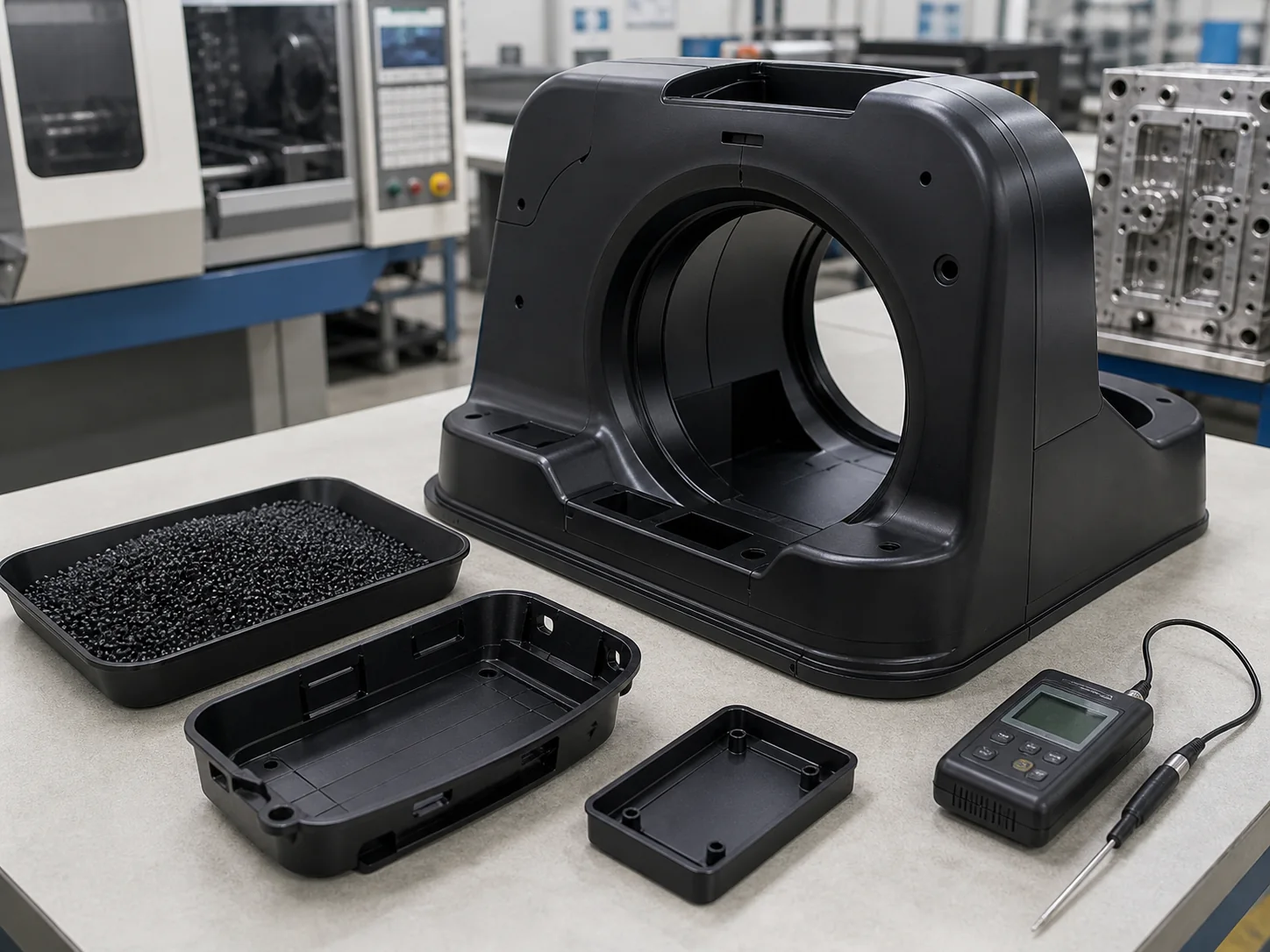
EMI shielding parts, conductive electrical accessories, military and aerospace electronics, medical housings and antistatic trays.
Can it make large-size molded parts?
Yes. Customers have stably molded medical housings with the longest side above 400 mm, reducing scrap from 15% to below 3%.
In conductive plastic engineering practice, one rule has been verified repeatedly: the lower the surface resistance, the harder injection molding becomes. To reach the super-conductive 10^2-10^3 ohm level, traditional carbon black routes usually require 15-25% filler. At that loading, PP flow is almost destroyed. Large-part injection molding becomes nearly impossible, and even if the part is barely molded, the surface often shows water marks and flow lines.
This contradiction, where conductivity is enough but injection molding fails, or injection molding works but conductivity is not enough, has troubled the compounding industry for many years.
The answer given by DEYU plastics through DGK-PP DD2-3A CNT conductive PP is to change the technical route.
1. Why carbon nanotubes break this deadlock
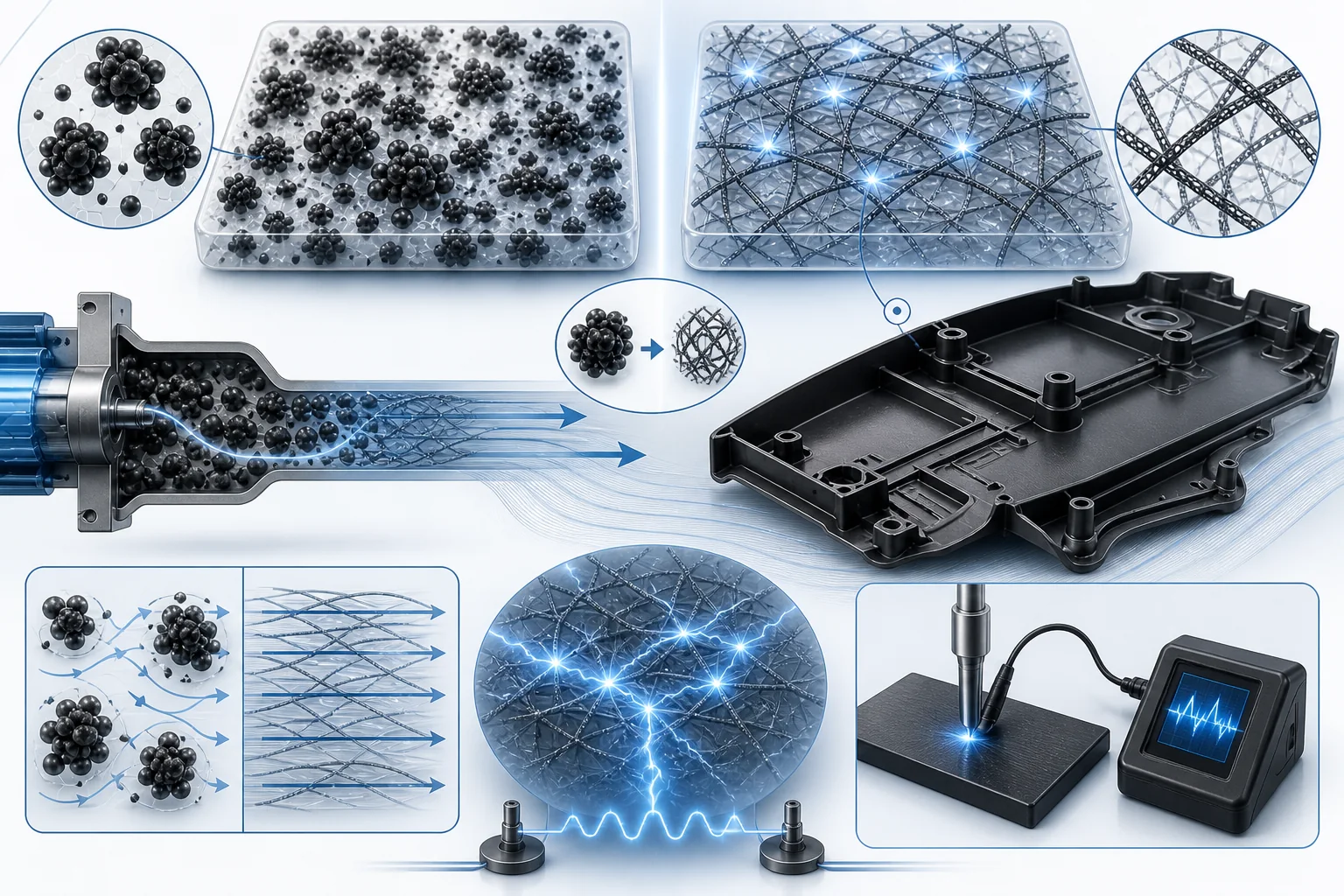
Carbon nanotubes are one-dimensional fibrous materials. Their diameter is only a few nanometers, their length can reach the micron level, and their aspect ratio can exceed 1000. At the same weight, carbon nanotubes provide far more conductive contact points than spherical carbon black particles. Academic research has shown that the electrical percolation threshold of PP / multi-wall carbon nanotube composites can be as low as about 1.5 vol%.
DGK-PP DD2-3A uses 5-10 wt% carbon nanotube loading to build a complete conductive network in the PP matrix, keeping surface resistance stable at 10^2-10^3 ohm/sq. To reach the same level with carbon black, 15-25% is often required. When filler content drops by about two thirds, flowability is naturally preserved.
2. Customer case one: Shenzhen medical accessory supplier, from 15% scrap to stable mass production
A medical device accessory supplier in Shenzhen was one of the earlier users of DD2-3A. The customer produced conductive medical device housings and antistatic medical trays used in monitoring equipment and cleanroom environments.
The customer's previous solution was a carbon-black-filled conductive PP from another brand. Its nominal resistance could also reach the 10^3 ohm level, but three problems remained.
Problem one: high scrap rate in large-part injection molding. The housing size was large, with the longest side above 400 mm. The carbon black route had poor melt flow, unstable filling, frequent short shots and weld lines. The customer calculated that the scrap rate of large housings was around 15%, mostly caused by incomplete filling or resistance exceeding specification at weld lines.
Problem two: severe surface water marks. With high carbon black loading, filler enriched on the surface during flow in the cavity, creating obvious white flow marks. This was not only an appearance issue. The water-mark areas had resistance 1-2 orders higher than normal areas, making the whole panel electrically nonuniform.
Problem three: powder-shedding risk in the cleanroom. Medical cleanrooms strictly control particles. The carbon black route had rougher surfaces and could shed carbon powder after friction, creating contamination risk.
After contacting DEYU DD2-3A in 2023, the customer ran a complete replacement test.
In the first trial, the customer directly used the previous carbon black injection parameters: mold temperature 60 C and injection temperature 200 C. The molded plate showed high resistance, around 10^5-10^6 ohm, two orders above the nominal value.
DEYU technicians investigated on site and found that the mold temperature was too low. During melt filling, CNTs are pulled into orientation by shear. During cooling, they need enough time to rebuild a three-dimensional conductive network. At a 60 C mold temperature, PP cooled too quickly and CNTs were frozen in an oriented state, so network connectivity was insufficient.
The adjustment was to raise mold temperature from 60 C to 80 C, raise injection temperature from 200 C to 215 C, and strictly dry at 90 C for 4 hours.
In the second trial, resistance stabilized at 10^3-10^4 ohm, and point-to-point deviation was controlled within two times. Surface water marks almost disappeared, and appearance passed the customer's quality standard.
After the customer switched to DD2-3A in mass production, the scrap rate of large housings dropped from 15% to below 3%. Resistance uniformity improved significantly: different points on the same panel changed from order-level drift to a deviation within two times. The cleanroom powder-shedding issue was also reduced because the CNT route produced a smoother surface with no obvious shedding after friction.
This customer has used DD2-3A stably for more than three years, with current monthly purchase volume in the 5-10 ton range.
3. Customer case two: electronic tray company, from specification limit to batch stability
Another representative case came from the electronic tray field.
A compounding company making conductive trays for semiconductor packaging had reached a bottleneck with its existing PP + carbon fiber formula. In electronic tray application, surface resistance stayed at 6.0 x 10^4 ohm-cm, exactly near the upper limit of the end customer's specification. When batches fluctuated, resistance occasionally exceeded the limit and the whole tray batch was returned.
The customer did not want to redesign the whole formula. Carbon fiber was already locked at the 15% mechanical critical point; adding more carbon fiber would reduce impact toughness by more than 20%. Conductivity was missing only the last mile, but how could it be solved?
DEYU's solution was a PP-based high-conductivity masterbatch, DGK-PP GCFML, added at 2.8% to the customer's existing formula. Fine conductive particles in the masterbatch filled microscopic gaps in the carbon fiber network, increasing conductive pathway density.
After addition, surface resistance dropped from 6.0 x 10^4 ohm-cm to 4.5 x 10^3 ohm-cm, a reduction of more than one order of magnitude. More importantly, flexural modulus, notched impact strength, tensile strength and other mechanical indicators remained basically unchanged. Surface floating fiber and poor filling did not worsen.
This case shows an important engineering logic: conductive performance optimization does not always require starting over. Precise reinforcement on the customer's existing formula is often the lowest-cost and lowest-risk path.
4. Injection molding process: why 80 C mold temperature is not arbitrary
The DD2-3A data sheet clearly marks the injection molding window:
| Parameter | Setting |
|---|---|
| Drying temperature | 90 C |
| Drying time | 4-5 hours |
| Injection temperature | 210-220 C |
| Mold temperature | 80 C |
Process logic
These parameters look conventional, but each one has process logic directly related to conductivity.
Drying is the easiest step to ignore. PP itself has low water absorption, and ordinary injection molding sometimes skips drying. But DD2-3A clearly requires drying at 90 C for 4-5 hours. The formula may contain moisture-sensitive interface modifiers or surface treatments on conductive fillers. Trace moisture vaporizes in the high-temperature melt, causing not only silver streaks but also microscopic voids at the filler-matrix interface, interrupting conductive pathways. One customer reported that after skipping drying during the rainy season, trays showed slight pitting and unstable resistance; after drying, the issue disappeared.
An 80 C mold temperature is relatively high for PP. The purpose is not surface gloss, but giving the conductive network time to rebuild. After melt filling, CNTs orient in the shear field. During cooling, they need a time window to reform a three-dimensional connected conductive network. If mold temperature is too low and cooling is too fast, fillers are frozen in the flow-oriented state, network connectivity is insufficient, resistance rises and anisotropy becomes obvious. The 80 C mold temperature is a balance between PP crystallization and conductive-network reconstruction kinetics.
The 210-220 C injection temperature is not a case of higher being better. Too high a temperature can degrade PP chains and reduce shear effectiveness for filler dispersion. Too low a temperature makes melt viscosity too high and filling difficult. Academic research indicates that under high melt temperature and low injection speed, CNT dispersion can improve and conductive networks can become better, allowing PP / CNT injection molded parts to reduce surface resistance by about five orders of magnitude.
Conductive plastic injection molding is essentially network maintenance: during the whole journey from screw to cavity, the three-dimensional conductive network must be preserved as much as possible.
5. More than DD2-3A: DEYU's full layout in ultra-conductive materials
DD2-3A is a mature DEYU grade in conductive PP, but it is not the only one.
In the ultra-conductive direction, DEYU's layout already covers PA, PP, PE, PVC, TPV and POM, and has built differentiated technical accumulation in steel-fiber synergy, CNT PP medical applications, TPV elastic conductivity and battery-electrode ultra-conductive materials.
DGK-PP DDL28 reaches volume resistivity of 0.04-0.05 ohm-cm, thousands of times more conductive than conventional carbon-black-filled conductive PP. Conductivity reaches 28 S/cm, approaching the technical requirement of ultra-high conductivity for flow-battery bipolar plates. This means PP-based materials can now be seriously evaluated for battery electrode directions.
Across conductive and antistatic materials, DEYU covers the full resistance range from antistatic 10^6-10^11 ohm, conductive 10^2-10^6 ohm and ultra-conductive below 10^2 ohm. Material bases include ABS, PP, PA, POM, PC, PE, PVC, TPV and other mainstream engineering plastics.
6. Summary
What DGK-PP DD2-3A does can be summarized in one sentence: it makes ultra-conductive PP no longer a special laboratory material, but an engineering plastic that can run stable large parts on injection molding machines.
From the Shenzhen medical accessory supplier reducing scrap from 15% to 3%, to the electronic tray company moving resistance from the specification limit to batch stability, these cases repeatedly verify one fact: at the ultra-conductive level, the CNT route can solve conductivity and injection molding at the same time, even though these demands used to conflict.
If you are looking for an ultra-conductive PP solution and do not want to choose between conductivity and injection molding, DD2-3A is worth trial molding.
DEYU plastics provides small-batch sample service from 5 kg. For standard grades, the fastest cycle from requirement communication to sample shipment is 3-5 working days. When injection process settings are uncertain, engineers can assist on site.