
Technical Challenges of Conductive PE Chemical Transport Drums and the DEYU DGK-PE Solution
Chemical transport drums for hazardous solvents and flammable materials need stable 10^3-10^5 conductive performance, low-temperature drop resistance, corrosion resistance and blow molding stability. This article explains the three engineering bottlenecks and how DEYU's DGK-PE system solves them through formulation, processing and mold coordination.
Buyer and engineer FAQ
Questions engineers often ask about this material route
What conductivity range is discussed for chemical transport drums?
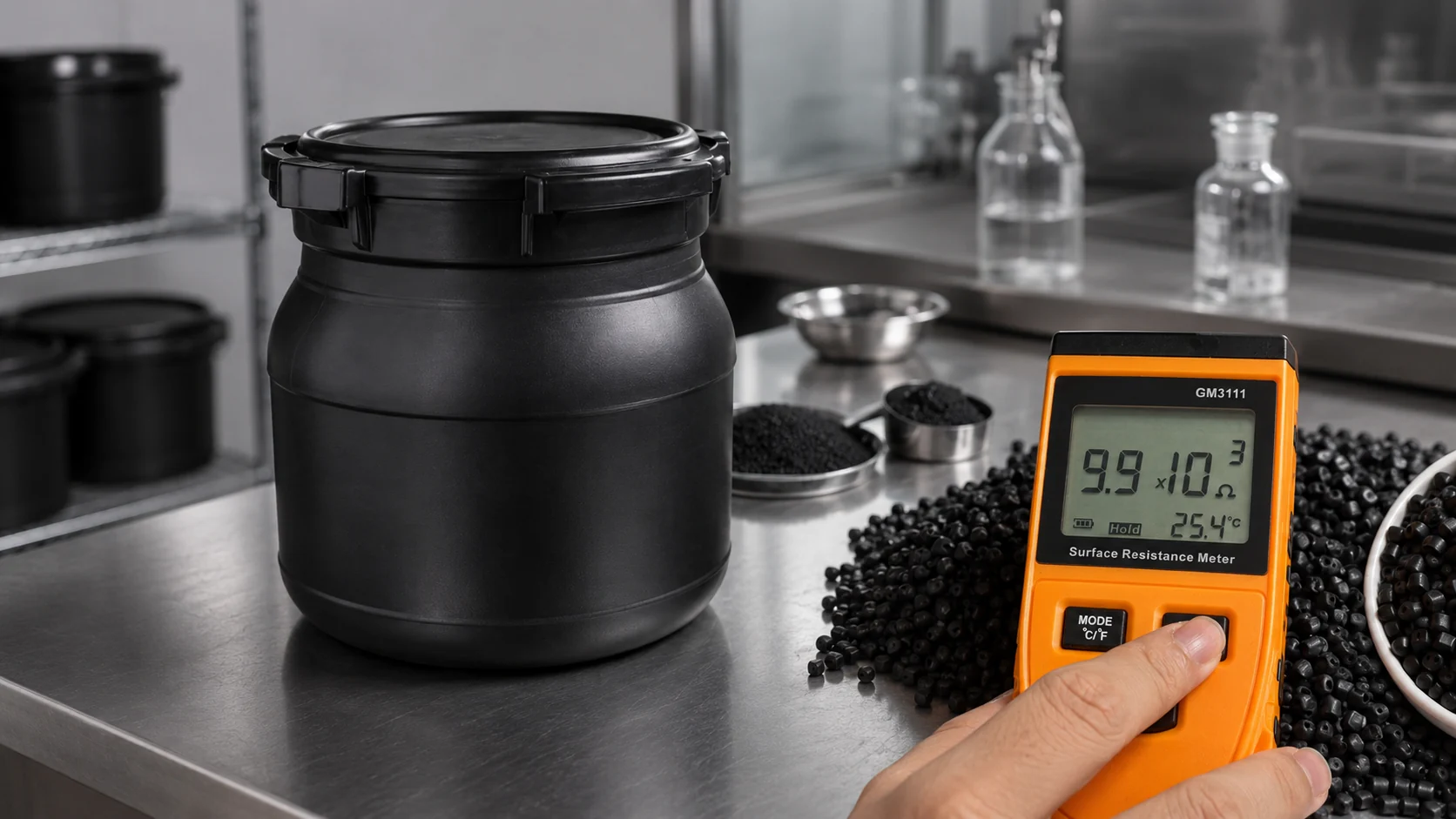
The case targets 10^3-10^5 ohm-cm for the drum body and 10^4-10^5 ohm-cm for the drum lid. The final test range must still be confirmed by the customer's safety standard, test position and molded-part geometry.
Why does conductive PE become brittle when carbon black is added?
Traditional conductive PE depends on high carbon black loading. As filler content rises, the HDPE matrix loses elongation, impact resistance and stress-crack resistance, so low-temperature drop and transport impact become difficult to pass.
Why is melt flow index critical for blow molded conductive PE drums?
If MFR is too low, parison extrusion becomes difficult; if it is too high, parison sag and wall-thickness variation increase. The DGK-PE direction is designed around 1.8-2.5 g/10 min at 190 C/2.16 kg for blow molding suitability.
How does DEYU address bottom thin-shell failure in blow molded drums?
The solution combines material rheology control, parison wall-thickness programming, mold bottom flow and cooling optimization, mold temperature control and blow-pressure holding, rather than relying on one process setting.
For a precise recommendation, share the part drawing, base resin, target performance, processing method and test standard with DEYU.
1. Industry Background and Challenges
In the storage and transport of hazardous chemicals, solvents and flammable or explosive materials, electrostatic accumulation is a core safety risk because it may trigger ignition or explosion. Ordinary plastic drums have poor antistatic performance, insufficient rigidity and a tendency to crack at low temperature. Metal drums avoid part of the electrostatic problem, but they are heavy, costly and prone to corrosion.
Conductive polyethylene drums have therefore become an important development direction for the industry. The material must reach the 10^3-10^5 conductive range while also passing demanding requirements for low-temperature drop, chemical corrosion resistance and impact resistance.
Yuyao Deyu Plastic Technology Co., Ltd. has worked in conductive plastics for more than twenty years and uses eight fully automatic production lines for standardized production. DEYU's DGK-PE solution is a conductive HDPE compound system tailored for chemical transport drums. It solves the application problem from three angles: material formulation, processing adaptation and mold cooperation. DGK is DEYU plastics' conductive plastic product series code and covers PE, PP, ABS, PA, POM, PVC and other resin systems.
2. Three Technical Difficulties
Difficulty 1: Conductive 10^3-10^5 PE tends to crack because toughness is not enough
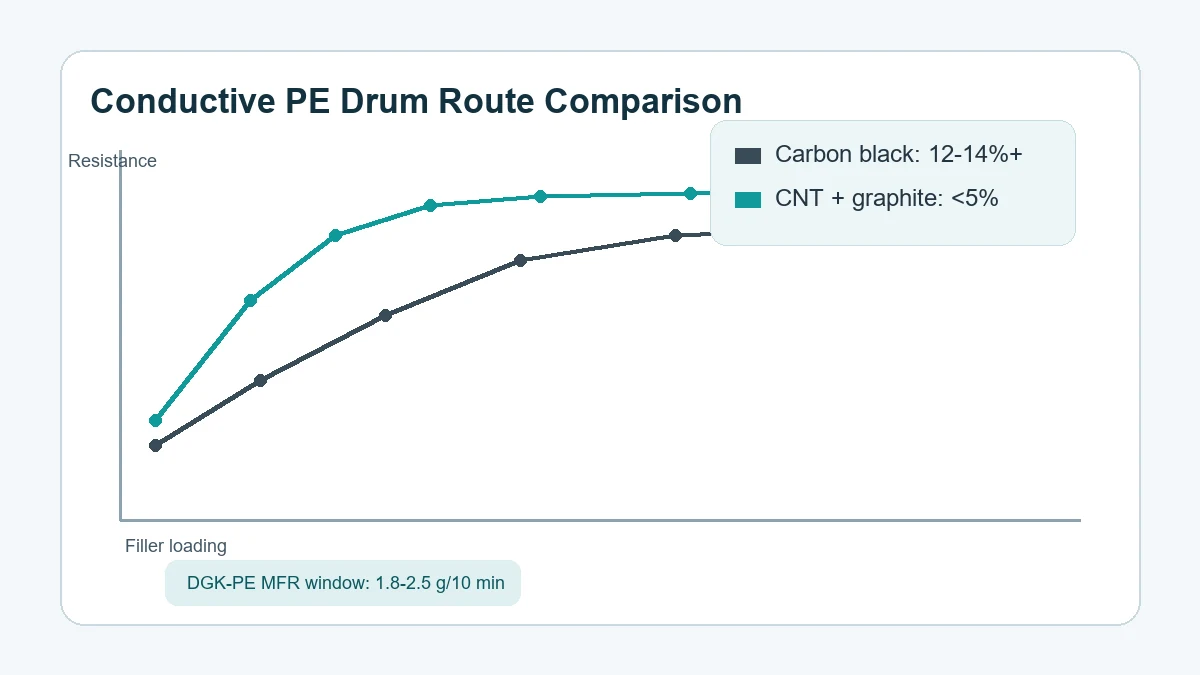
To make insulating polyethylene conductive, the traditional route is to add conductive carbon black into HDPE. However, carbon black significantly worsens mechanical performance. When the carbon black loading reaches about 14%, the material's mechanical and processing properties decline severely.
A large amount of engineering practice shows a clear balance point between mechanical performance and conductivity for carbon-based fillers. When the filler loading approaches the upper limit that impact toughness can tolerate, conductivity is often still one order of magnitude away from the end user's requirement. If the filler is increased further, conductivity improves only slightly while impact toughness may drop by more than 20%.
The result is a long-standing engineering trap: add more filler and the part becomes brittle; keep toughness and conductivity is not enough. In low-temperature drop tests or under assembly stress, the product is very easy to crack.
Difficulty 2: Melt flow cannot match the blow molding process
Blow molding has strict requirements for melt flow rate. If the melt index is too low, parison extrusion becomes difficult; if it is too high, parison sag becomes serious and wall thickness becomes uneven.
After about 6% high-quality conductive carbon black is added to HDPE, the compound may appear to meet conductivity requirements before processing, but conductivity can disappear after blow molding. If about 14% carbon black is added, conductivity can be retained, but processability deteriorates sharply, hollow blow molding becomes difficult and yield becomes extremely low.
This high-cost and low-yield route can make hollow conductive containers sell at about ten times the price of ordinary polyethylene products, which is not suitable for commercial production.
Difficulty 3: Mold issues create a thin bottom shell and drop tests fail
During blow molding, the bottom area of the parison is often the first region to contact the mold and the first to cool. Uneven mold temperature causes cooling-rate differences and then affects wall-thickness distribution.
Because conductive fillers change melt flow behavior, the parison's stretching ability at the mold bottom is further reduced. Bottom thin-shell defects therefore appear easily. At -40 C, the impact toughness of the thin area drops sharply and the drop test fails.
This issue cannot be solved only by adjusting a single molding parameter. The mold must be adapted from the source to the special rheology of conductive materials.
3. DEYU DGK-PE Solution: A Systematic Answer
DEYU's DGK-PE solution is not a single material substitution. It is a system built from conductive filler architecture, base resin formulation design and processing coordination.
Solution 1: CNT plus superconductive graphite hybrid network to solve brittleness
Traditional conductive PE relies on carbon black filling, and high filler loading inevitably sacrifices toughness. The DGK-PE solution moves away from a single carbon black route and uses a hybrid conductive network formed by carbon nanotubes (CNT) and superconductive graphite.
Carbon nanotubes have extremely high aspect ratio and can form a three-dimensional conductive network at very low addition levels. Superconductive graphite fills the microscopic gaps inside the CNT network and increases the density of conductive contact points. The two materials work together as a line-plus-plane conductive architecture: CNTs provide long-range conductive channels and build the backbone network, while graphite fills network gaps and increases contact density.
The advantage of this hybrid route is that it reaches the 10^3-10^5 conductive range with far lower filler loading than traditional carbon black, so the HDPE matrix loses much less toughness. Through DEYU's self-developed high-conductivity masterbatch technology, a 2%-3% addition level can raise conductivity by one order of magnitude while keeping the original mechanical performance from declining. Elongation at break and low-temperature impact strength can be retained, which directly addresses the industry's brittle conductive PE problem.
DEYU's conductive filler platform extends beyond this route. The DGK series also includes steel-fiber composite conductive plastics based on HDPE, with steel-fiber loading around 60 wt%. These materials can reach very low resistance while retaining HDPE flexibility, with elongation at break of 120%-250% and resistivity change below 40% after 10,000 bending cycles. DEYU has also developed polymeric permanent antistatic technology, where antistatic components are anchored inside the base resin in polymer form and do not show order-of-magnitude resistance drift after repeated washing or alcohol wiping. The DGK-PE solution is a result of combining this broader technical accumulation.
Solution 2: Precise melt index control for blow molding
For the melt flow requirements of blow molding, the DGK-PE solution is controlled from two levels: HDPE base resin selection and conductive filler system optimization.
On the resin side, DEYU uses more than twenty years of modified plastic experience to select and compound the HDPE base resin directionally. DEYU's modified products cover ABS, PP, PA6, PA66, PC, POM, PBT, PE, PVC and other bases, and its PE formulation database makes it possible to select a suitable molecular weight distribution so that the base resin rheology falls inside the blow molding process window.
On the filler side, the low-addition CNT/graphite hybrid system does not significantly change the base resin's rheology, avoiding the melt-index runaway caused by high carbon black loading. In dispersion, DEYU optimizes the screw combination and kneading section of twin-screw extrusion so that conductive fillers remain evenly dispersed at very low loading, ensuring batch-to-batch MFR consistency.
Specifically, the DGK-PE solution is designed into the blow-molding HDPE suitability range: 1.8-2.5 g/10 min under 190 C/2.16 kg. The material system can support both blow molding and injection molding: the drum body uses an HDPE base suitable for blow molding, while the lid is adapted to injection molding. One material system can therefore cover two molding methods and simplify material management for customers.
Solution 3: Mold-source coordination to eliminate the bottom thin shell
A distinctive feature of the DGK-PE solution is that technical service extends to mold design and production-line trial adjustment. For the common thin-bottom problem in blow molding, DEYU engineers provide a systematic plan covering mold runner design, parison wall-thickness programming and cooling system optimization.
Mold runner optimization means adjusting the runner cross-section and blow-up ratio around the mold bottom according to the special rheology of DGK-PE conductive material, so that enough material is supplied to the bottom area.
Parison wall-thickness programming means using the wall-thickness control system to create differentiated axial wall thickness in the parison. The bottom section is preset thicker to compensate for stretching and thinning during inflation.
Precise mold temperature control means using a mold temperature controller to keep the mold stable, usually 40-60 C for HDPE products, so that cooling is consistent and the bottom does not cool too early and lose stretchability.
DEYU also provides an integrated solution of technical-parameter matching, custom production and batch delivery. This material-plus-mold-plus-process cooperation solves bottom thin-shell failure from the source and helps drums pass drop testing at -40 C.
4. Customer Case and Practical Data
The DGK-PE solution has been validated in real chemical transport drum applications.
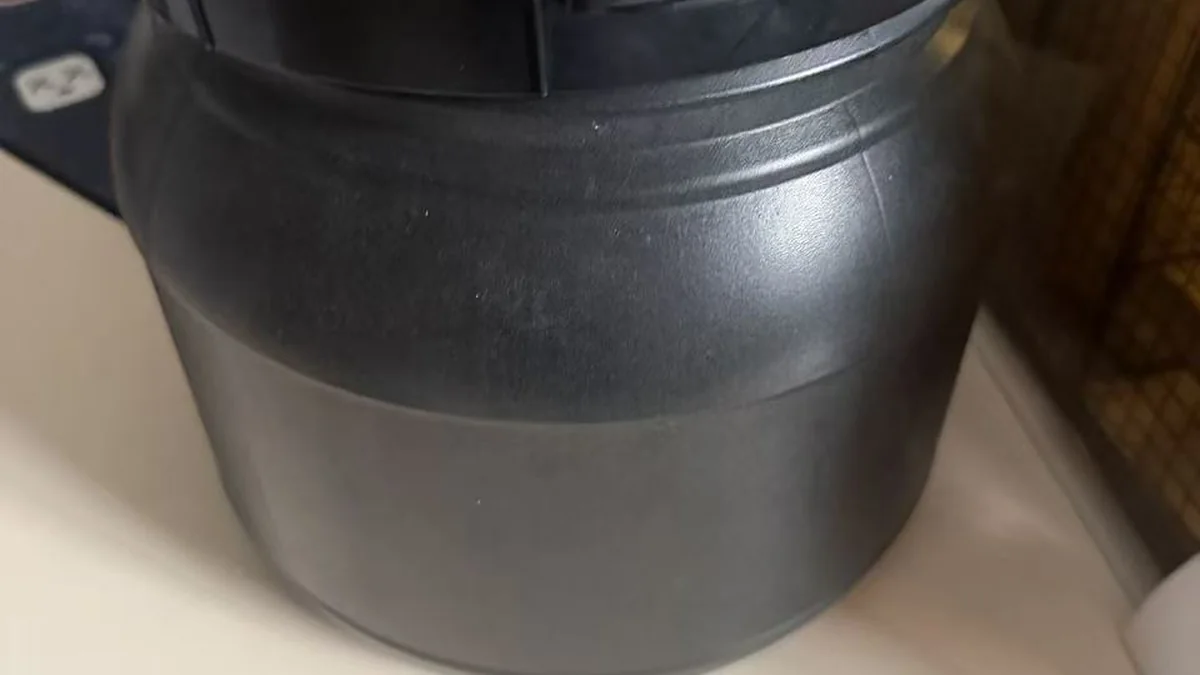
Customer background: a hazardous chemical packaging company produces 220 L blow molded drums for flammable solvent storage and transport. The requirement is 10^3-10^5 conductivity for the drum body, 10^4-10^5 conductivity for the lid, and passing a -40 C low-temperature drop test.
Initial attempt: the customer used a traditional conductive carbon-black-filled HDPE route. Carbon black loading reached 12%-14% and barely met the 10^3-10^5 conductivity requirement, but three problems appeared: parison sag was severe during blow molding and wall thickness was difficult to control; finished drum bottom wall thickness was insufficient and the -40 C drop-test cracking rate exceeded 30%; material brittleness was high and stress cracking appeared during use and transport.
| Item | Traditional carbon black route | DEYU DGK-PE solution |
|---|---|---|
| Conductive filler system | Single conductive carbon black, 12%-14% | CNT plus superconductive graphite hybrid, total addition below 5% |
| Drum body conductivity | 10^3-10^5 ohm-cm, barely qualified | 10^3-10^5 ohm-cm, stably qualified |
| Lid conductivity | Unstable after injection molding | 10^4-10^5 ohm-cm, stably qualified |
| MFR at 190 C/2.16 kg | Difficult for blow molding | 1.8-2.5 g/10 min, suitable for blow molding |
| -40 C drop-test pass rate | Below 70% | Above 98% |
| Bottom wall-thickness uniformity | Deviation +/-25% | Deviation +/-8% |
| Product yield | About 60% | Above 92% |
Process parameters: drying at 80-90 C for 2-3 hours; barrel temperature 170-200 C and die temperature 190-210 C for blow molding; mold temperature 40-60 C with separate control of the bottom area; gradual blow pressure increase and 15%-20% longer holding time to improve bottom forming; bottom parison wall-thickness preset increased by 20%-30%.
Customer feedback: after adopting the DGK-PE solution, product yield increased from below 60% to above 92%, the -40 C low-temperature drop-test pass rate increased from below 70% to above 98%, drum toughness improved significantly, and cracking complaints during transport and use were eliminated.
5. Technical Depth Behind the DGK-PE Solution
The success of DGK-PE is not accidental. It is supported by more than twenty years of DEYU experience in conductive plastics.
Full resistance-range coverage: DEYU has mature grades from ultra-conductive systems below 0.1 ohm-cm volume resistivity, to conductive 10^2-10^6 ohm systems, and then to static dissipative and antistatic 10^6-10^11 ohm systems.
Multi-resin platform capability: DEYU conductive technologies can be reused across ABS, PP, PA6, PA66, PC, POM, PBT, PE, PVC and other mainstream plastics.
Formulation matching from the base layer: DEYU does not rely only on general off-the-shelf conductive masterbatch. Instead, it optimizes carbon black selection, dispersion process and formulation system together.
Colored conductive customization: DEYU conductive materials can be customized in color, ending the assumption that conductive plastics must always be black.
6. Summary
The three difficult points of conductive PE for chemical transport drums - brittleness, melt-index adaptation and bottom thin-shell failure - all originate from the double damage caused by high-loading traditional carbon black systems to mechanical performance and processability.
DEYU's DGK-PE solution uses a low-addition CNT plus superconductive graphite hybrid conductive route, accurate melt-index control and material-plus-mold-plus-process technical service to solve these problems systematically.
The DGK-PE solution has already been used at scale by chemical packaging customers. Its actual production performance proves its suitability and reliability for hazardous chemical storage and transport, providing a practical material solution for electrostatic safety.