
Conductive PE for Gas-Pipeline Corrugated Protection: How DGK-PE DD4JC Balances Static Dissipation and Flexibility
How DGK-PE DD4JC balances static dissipation, flexibility, cathodic-protection compatibility and extrusion processing for gas-pipeline corrugated pipe and coatings.
Buyer and engineer FAQ
Questions engineers often ask about this material route
What is the surface resistance of DGK-PE DD4JC?
The surface resistance is 10³–10⁴ Ω·cm, providing a path for static-charge dissipation in gas-pipeline corrugated pipe and coatings.
How does DD4JC retain flexibility?
Its hybrid carbon-nanotube conductive technology retains an elongation at break of 538% and a Charpy notched impact strength of 35 kJ/m² at 23°C.
What are the reference processing conditions?
Dry at 90°C for 3–4 hours. The injection-molding temperature is 225–230°C; extrusion is adjusted to the die, coating thickness and line speed. The melt flow rate is 3.2 g/10 min.
Which applications does DD4JC cover?
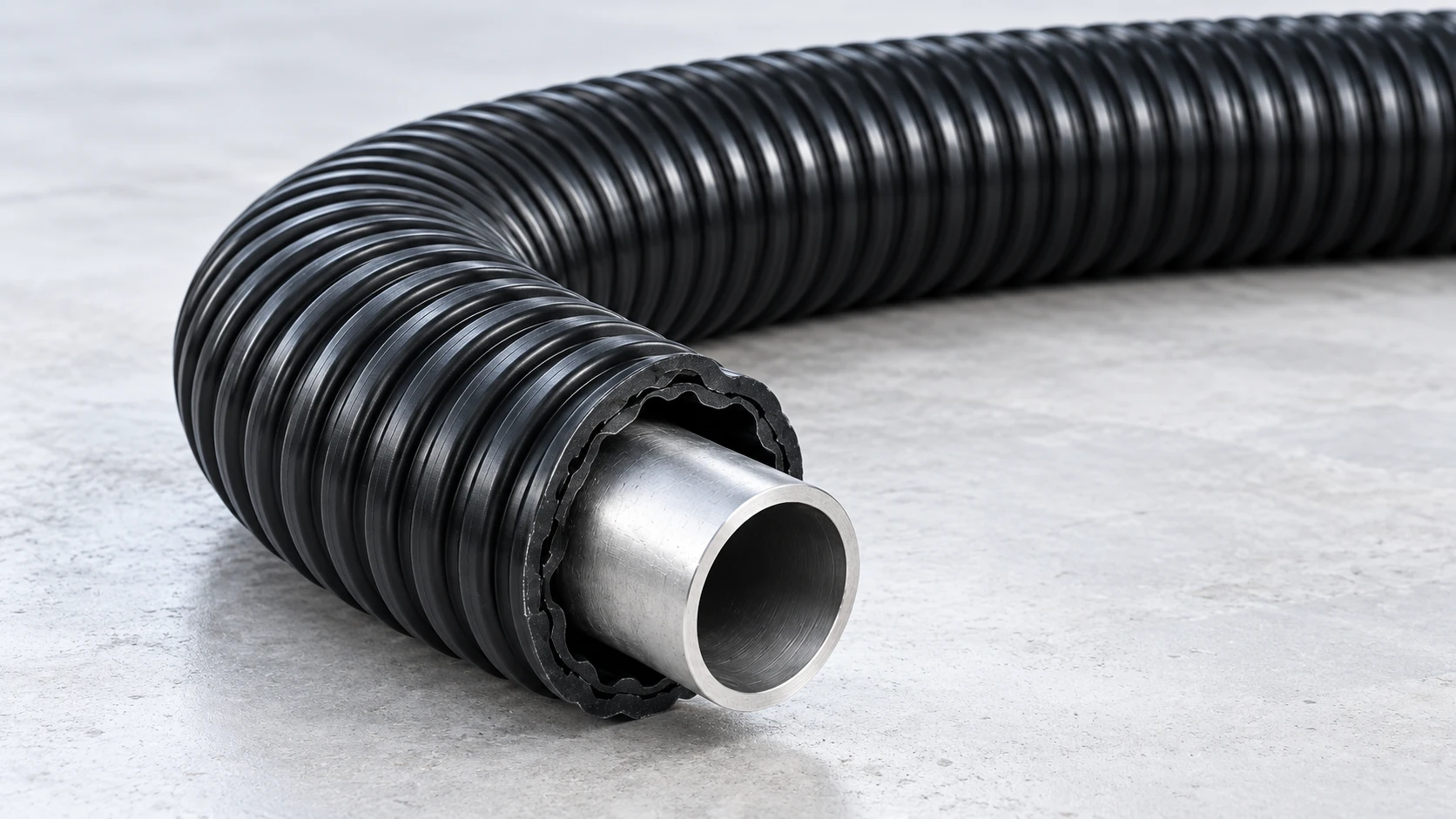
Gas-pipeline corrugated pipe and protective coatings, repair patches, joint-wrapping tapes and heat-shrink tape substrates.
PE is almost the default choice when selecting materials for gas-pipeline corrugated pipe or coating: it offers corrosion resistance, flexibility, low density and mature processing technology. Yet ordinary PE has a critical limitation in gas applications: it is an insulator, with surface resistance typically above 10¹⁵ Ω, so static charges cannot dissipate on their own. High-speed natural-gas flow inside the pipeline and friction against the soil during installation pullback can both cause charge to accumulate on PE surfaces. Without a dissipation path, these charges can attract soil and sand, affecting the contact between the coating and the pipe. In more severe cases, they can cause spark discharge or pinhole perforation of the PE pipe wall, creating a trigger for fire or explosion.
The direct solution is to make PE conductive. But conductive-PE formulation has a constraint that is easily underestimated: adding conductive filler must not come at the expense of PE's flexibility and low-temperature toughness. Gas-pipeline corrugated pipe must accommodate pipe displacement, soil settlement and thermal cycling during service, while installation subjects it to pullback, bending and impact. If a conductive PE meets its electrical target but its elongation at break falls below 200%, the risk of cracking rises considerably at the crests and valleys that undergo repeated flexing.
The data sheet for DEYU DGK-PE DD4JC demonstrates a balance achieved under this constraint.
The engineering meaning of the key physical properties
The physical-property data for DGK-PE DD4JC come from DEYU's test report dated August 20, 2020, with testing primarily based on GB/T standards. Examining the values individually shows that each one corresponds to a specific operating condition in corrugated-pipe service.
Surface resistance of 10³–10⁴ Ω·cm (GB/T 1401-2002). This range is the material's core electrical specification. At the high-resistance end, ordinary PE exceeds 10¹⁵ Ω and cannot dissipate static charge. At the other end, resistance below 10² Ω·cm allows current to discharge too quickly and may introduce new electrochemical risks under certain conditions. The 10³–10⁴ Ω·cm range provides a window that is conductive enough to dissipate static charge without becoming excessively conductive. DEYU's technical information shows that the corresponding surface potential can be controlled below 50 V, while the cathodic-protection potential of the main pipe inside the sleeve can remain within the compliant range of ≤−0.85 V CSE. This is particularly important for the outer coating of steel pipelines: an ordinary PE protective sleeve can shield the transmission of cathodic-protection current and compromise corrosion protection of the main pipe, whereas conductive PE preserves a current path for cathodic protection while dissipating static charge.
Elongation at break of 538% (GB/T 1040-2006). Conventional conductive PE generally has an elongation at break of 200–400%. A value of 538% gives corrugated pipe a greater deformation margin during pipe bending, pullback and soil settlement without cracking. Corrugated geometry is itself designed to accommodate displacement; high material elongation and structural compensation through the corrugations provide two complementary forms of protection.
Charpy notched impact strength of 35 kJ/m² at 23°C, with no break in the unnotched impact test (GB/T 1043.1-2008). PE's low-temperature embrittlement temperature can be as low as −70°C, and installation above −30°C generally requires no special protective measures. The notched impact value of 35 kJ/m² shows that this conductive PE achieves conductivity while retaining HDPE's low-temperature toughness, rather than gaining conductivity at the cost of embrittlement.
Melt flow rate of 3.2 g/10 min (GB/T 3682-2000). This value falls within a suitable range for extrusion-grade PE. Corrugated-pipe extrusion places greater demands on melt strength than straight-pipe extrusion: after leaving the die, the melt must be blown or vacuum-formed against the corrugator blocks. Insufficient melt strength can cause corrugation crests to collapse or produce uneven wall thickness. The MFR of 3.2 g/10 min provides a workable processing window between sufficient flow and the ability to hold the corrugated shape.
Density of 0.91 g/cm³ and heat-deflection temperature of 95°C (Method A, GB/T 1633-2000). The density of 0.91 g/cm³ is close to the lower end of HDPE and retains its lightweight advantage. The heat-deflection temperature of 95°C covers the operating-temperature range of gas pipelines, preventing dimensional relaxation under summer heat or the temperature of the transported medium.
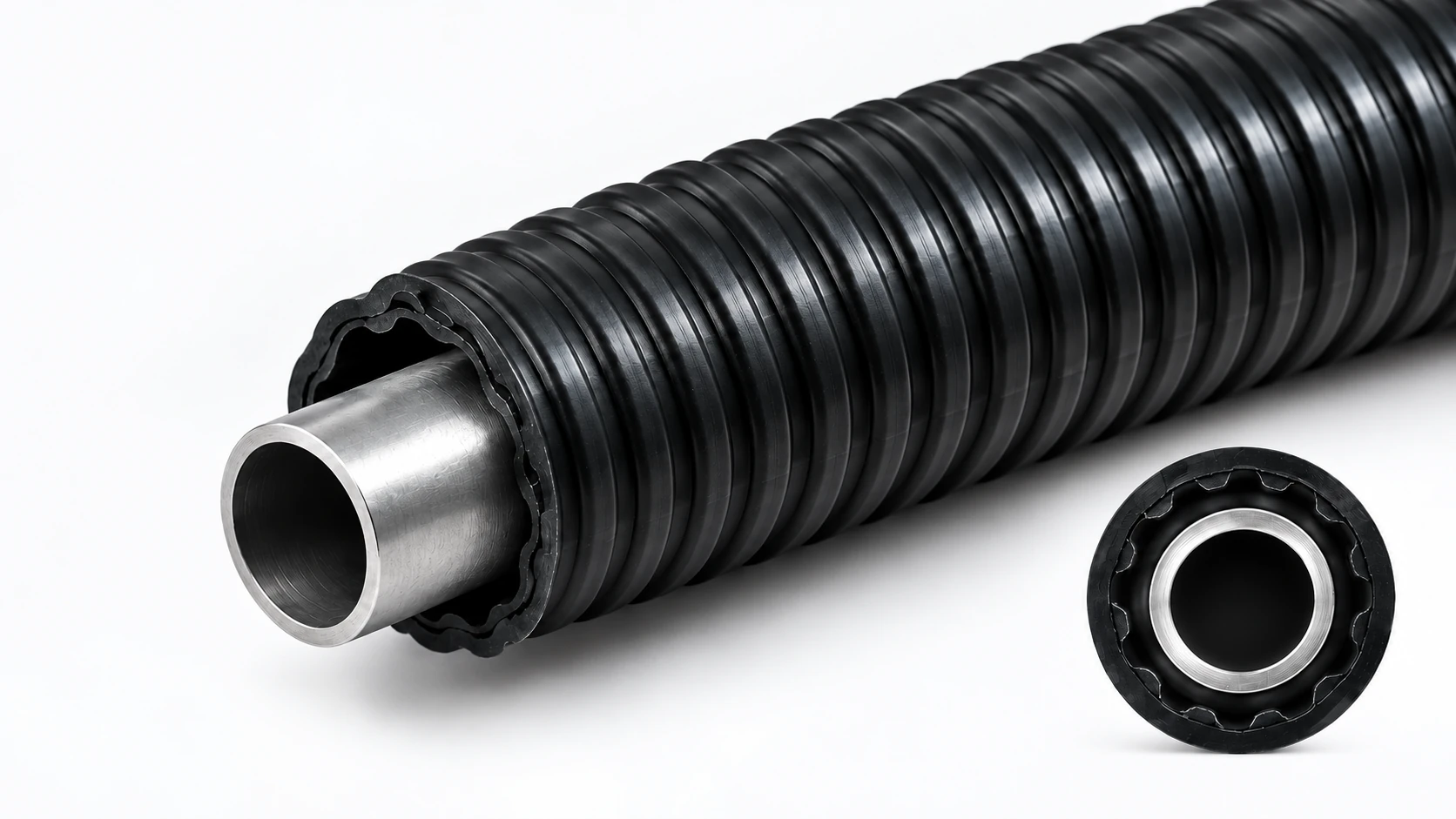
Tensile strength of 18 MPa, yield strength of 8.7 MPa and flexural modulus of 361 MPa. The flexural modulus is key to understanding the material's positioning: it is considerably lower than that of conventional HDPE structural parts, which is generally around 800–1200 MPa. DD4JC is therefore designed for compliant coating rather than rigid load-bearing structures. The role of the corrugated protective sleeve is to form a conductive isolating layer around a steel pipe that moves with it, not to act as an independent pressure-bearing structure. A low modulus is a feature matched to this operating condition, not a weakness.
Choosing the conductive system: why a carbon-nanotube hybrid
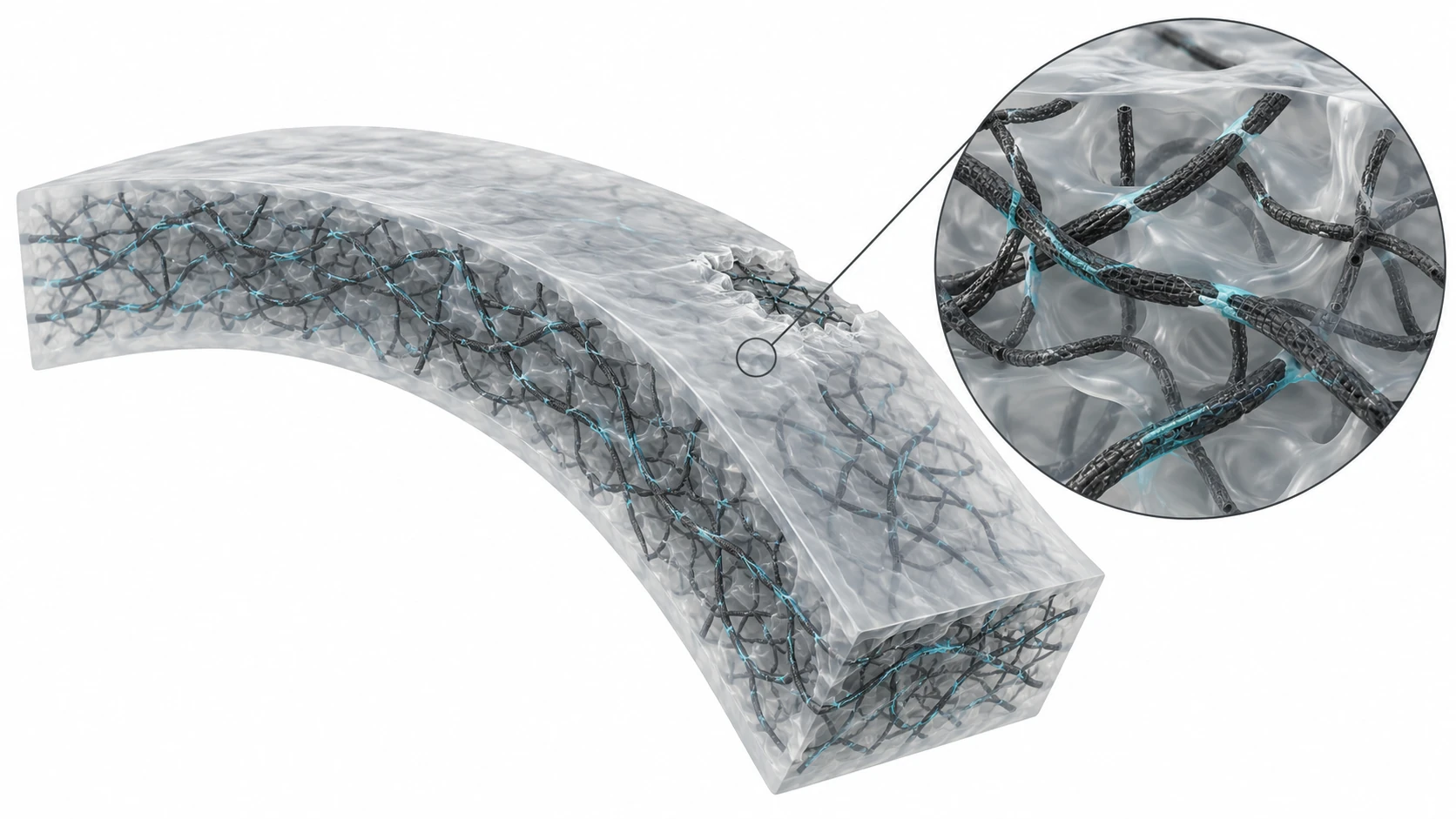
DGK-PE DD4JC uses hybrid carbon-nanotube conductive technology instead of a traditional, highly filled single-carbon-black approach. This choice directly affects the balance between flexibility and conductivity described above.
To reach a resistance of 10³–10⁴ Ω·cm, traditional carbon-black-filled compounds often need a filler loading above 20%. That high loading substantially reduces elongation at break and impact strength, shifting PE from flexible toward brittle and rigid. Carbon nanotubes have a much higher aspect ratio than spherical carbon-black particles and can form a three-dimensional conductive pathway throughout the matrix at the same or a lower loading. Lower filler content restricts the movement of PE molecular chains less, preserving the 538% elongation at break and 35 kJ/m² impact strength.
From a service-reliability perspective, the nanotube network offers another engineering benefit: conductivity does not depend on an intact material surface. Minor surface abrasion is unavoidable during corrugated-pipe installation. If conductivity comes from a surface coating or a surface-enriched layer, an abraded area becomes a break in the static-dissipation path. DD4JC's conductive network is distributed inside the matrix, forming a bulk conductive pathway; local surface wear exposes material that remains conductive. For buried or coated applications that must retain static-dissipation capability throughout their service life, this matters more than the initial resistance value alone.
From pellets to corrugated pipe: matching the extrusion process
DD4JC can be processed by both injection molding and extrusion, but the gas-pipeline corrugated-pipe application places more specific demands on extrusion matching.
The reference processing conditions are drying at 90°C for 3–4 hours and an injection-molding temperature of 225–230°C; extrusion conditions should be adjusted according to the die, coating thickness and line speed. For corrugated-pipe extrusion, die pressure and melt temperature are two variables that must be set in coordination with the material's MFR of 3.2 g/10 min. If the melt temperature is too high, low-MFR PE may exhibit insufficient die swell and reduced corrugation definition. If it is too low, die pressure rises, output is restricted and melt fracture may appear on the surface. The adjustment margin provided by the 3.2 g/10 min flow rate is a processing window built into the material design.
The material's application range extends beyond the corrugated pipe or protective jacket itself to repair patches, joint-wrapping tapes and heat-shrink tape substrates. Using one conductive PE for both the main pipe coating and field-joint work reduces the number of materials and process changes required by the installation contractor. It also reduces the risk of inconsistent conductivity between the joint area and the main pipe.
The technical positioning of a dedicated compound for corrugated pipe
Viewed against gas-pipeline corrugated-pipe operating conditions, the role of DGK-PE DD4JC is clear: it does not pursue an extreme value for one property, but delivers a verifiable balance among static dissipation, flexible service, cathodic-protection compatibility and extrusion processability. The resistance of 10³–10⁴ Ω·cm addresses the fundamental problem that PE is not conductive. The 538% elongation at break and 35 kJ/m² impact strength show that conductivity has not been introduced at the expense of PE's inherent toughness. The MFR of 3.2 g/10 min and flexural modulus of 361 MPa show that the formulation was designed from the outset for compliant coating extrusion, rather than rigid structural parts.
For corrugated-pipe producers, material selection is not about choosing the most impressive number on a data sheet. It means checking whether the surface resistance falls within the dissipation window, whether elongation at break can accommodate the maximum deformation caused by pipe movement, whether the MFR matches the existing extrusion die and line speed, and whether the material offers processing consistency in supporting operations such as joint repair and wrapping. DD4JC provides corresponding values and test references for each of these questions, defining the practical scope of a dedicated compound more clearly than the general category name “conductive PE.”