
Conductive PP Housings: ESD Control, UL94 Risk and Molded-Part Validation
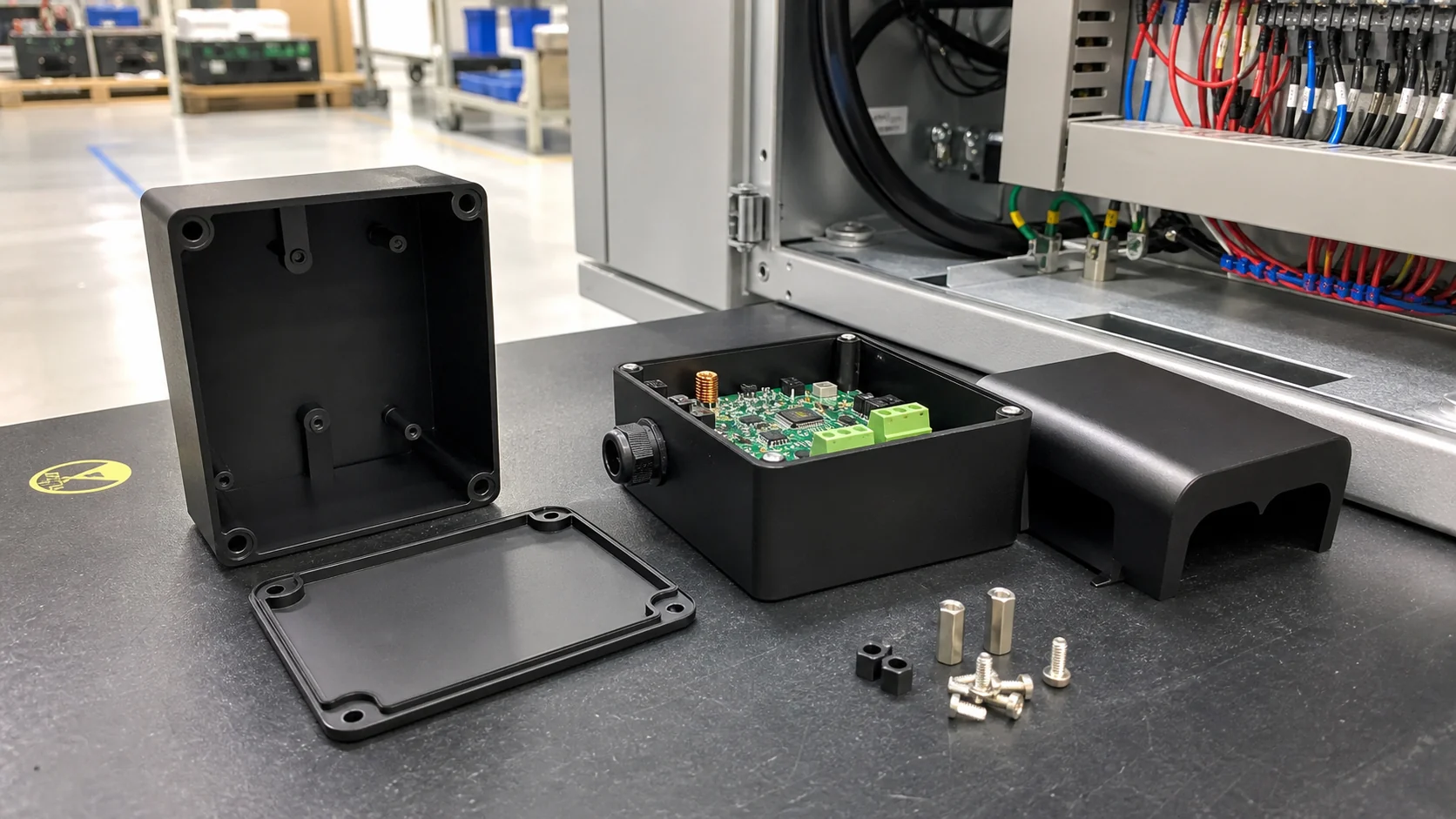
Electrical housings and industrial covers need more than a low resistance number. The grade must hold ESD performance, molded-part fit, chemical-cleaning resistance and, in many cases, UL94 V-0 compliance on the actual enclosure geometry.
Article FAQ
Conductive PP Housings: ESD Control, UL94 Risk and Molded-Part Validation
Should electrical housings use conductive PP or only anti-static PP?
For ESD-safe control boxes and sensitive electronics, static dissipative or conductive PP is usually safer than a weak anti-static grade. The final decision depends on the required resistance range and test standard.
Why can a molded enclosure fail after the plaque passes?
Filler orientation, gate position, weld lines, ribs and screw bosses can change resistance distribution and warpage. Final parts need resistance mapping and fit validation.
When is UL94 V-0 conductive PP necessary?
It is needed when the electrical enclosure or industrial cover has a fire-safety requirement at a defined wall thickness. The resistance target and flame rating must be validated together.
Is the product image copied into this article folder?
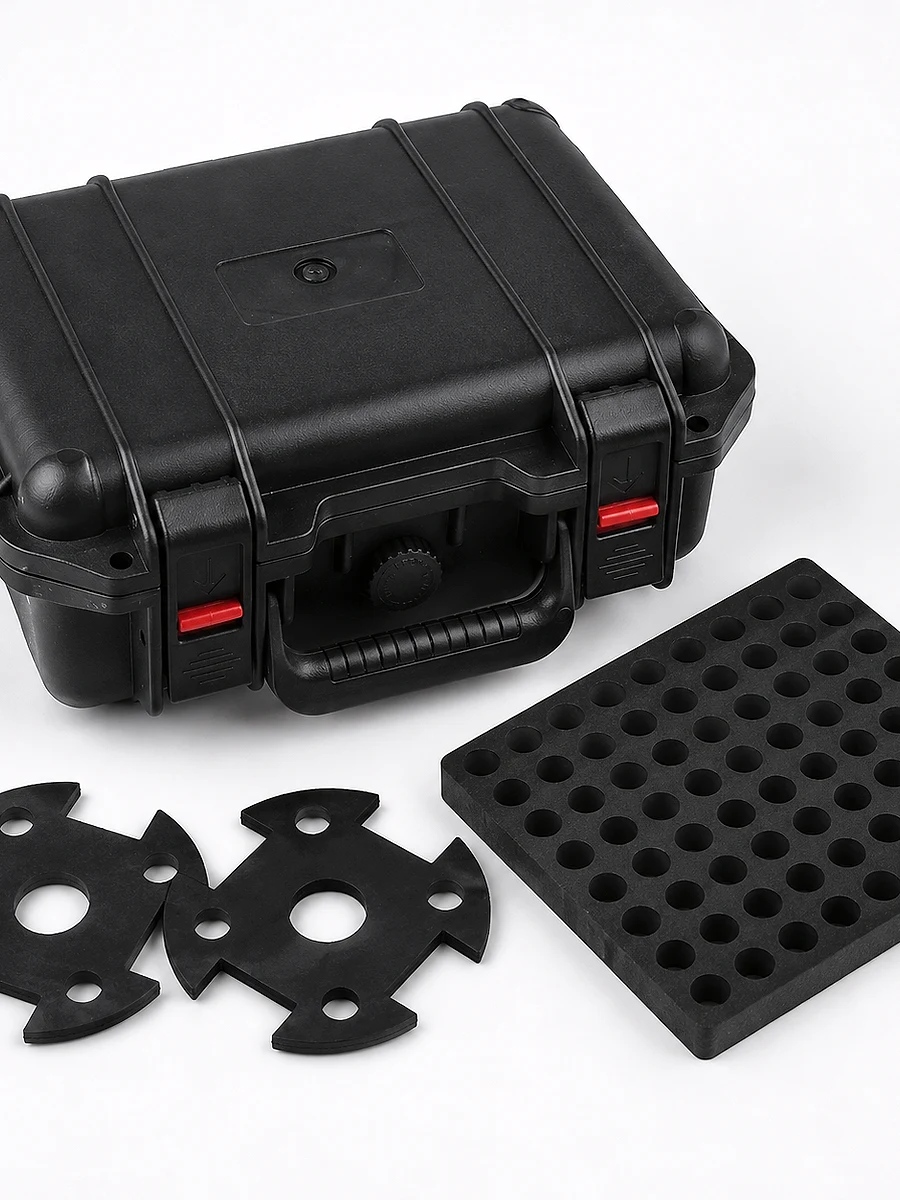
No. The product figure references one existing DGK-PP DD4-5A-JC site image to avoid increasing site package size. Only the generated cover and related figure are stored in this article folder.
Background and Problem
Polypropylene is one of the most widely used thermoplastics in industrial and electrical applications because it combines low density, chemical resistance, useful mechanical strength, heat resistance and cost efficiency. In its unmodified state, however, PP is an electrical insulator with volume resistivity commonly in the 10^16-10^20 ohm-cm range.
Many control boxes, junction boxes, instrument housings and industrial covers require electrostatic discharge protection. Static charge can damage sensitive electronics, attract dust into sealing surfaces or create ignition risk in volatile environments. Conductive fillers such as carbon black, carbon fibers or hybrid systems are therefore incorporated into PP to create a permanent conductive network through the material.
Common applications include electrical equipment enclosures, machine guards, ESD-safe component housings, PCB racks, covers for test equipment, cleanroom enclosures and components for ATEX-style risk environments.
| Classification | Surface Resistivity | Typical Application |
|---|---|---|
| Conductive | < 10^6 ohm | EMI shielding, explosive environments, grounding contacts |
| Static dissipative | 10^6-10^9 ohm | Standard ESD-safe housings, equipment enclosures, covers |
| Anti-static | 10^9-10^12 ohm | Low-risk packaging, non-critical covers |
Why Material Selection Matters
The first decision is electrical range. Electrical housings and covers normally fall into the static dissipative range or the conductive range, depending on component sensitivity, grounding design and environmental risk. The buyer should specify the test standard, electrode geometry and whether the target is measured on pellets, plaques or final parts.
The second decision is mechanical and structural. A cover that passes a flat plaque test can still fail at screw bosses, sealing lips, snap fits or thin corners. Impact strength, flexural modulus, tensile strength, HDT and shrinkage consistency must be validated on the molded enclosure, not only on a standard coupon.
The third decision is environment. PP is attractive because it resists IPA, detergents, coolants, oils, acids and moisture better than many amorphous plastics. Conductive PP should keep its electrical level after cleaning and humidity exposure, because a surface-only coating can drift after repeated wiping.
Processing is the fourth decision. Injection molding is used for complex housings and covers; extrusion and fabrication are used for sheet stock or fabricated guards. High-flow grades are preferred for thin walls, while mineral-filled or flame-retardant conductive grades are used when warpage and UL94 V-0 are critical.
| Requirement | Why it matters | Typical specification |
|---|---|---|
| Impact resistance | Protects internal components from physical damage | Charpy notched impact strength |
| Stiffness / flexural modulus | Maintains structural integrity under load | Flexural modulus >= 1200 MPa |
| Dimensional stability | Ensures proper fit and sealing | Low warpage, consistent shrinkage |
| Tensile strength | Withstands assembly and service loads | Tensile strength >= 25 MPa |
| Heat deflection temperature | Survives operating temperatures | HDT >= 80°C at 0.45 MPa |
DEYU Material Direction
DEYU recommends conductive PP compounds built around carbon black, carbon fiber or hybrid filler systems. For electrical housings with V-0 requirements, DGK-PP DD4-5A-JC flame-retardant conductive PP is a relevant public grade direction. For low-resistance molded PP parts and EMI shielding, DGK-PP DD2-3A conductive PP is a closely related grade family.
The key characteristics are targetable surface resistivity, permanent non-migrating conductivity, dimensional stability, resistance to industrial cleaning, fabrication flexibility and RoHS / REACH compliance. Conductive PP for enclosures should be specified by the application, not only by a broad word such as conductive or anti-static.
| Filler system | Conductivity | Mechanical properties | Recommended for |
|---|---|---|---|
| Carbon black only | Moderate, 10^6-10^9 ohm | Balanced | General ESD housings and covers |
| Carbon fiber reinforced | High, 10^4-10^5 ohm | High stiffness and strength | Structural housings, load-bearing covers |
| Hybrid carbon black + mineral | Good, 10^6-10^8 ohm | Excellent dimensional stability | Precision enclosures, PCB racks |
| Flame-retardant + conductive | Good, 10^6-10^8 ohm | UL94 V-0 rated | Fire-safe electrical enclosures |
Reference Product Data
| Property | Unit | Test method | DEYU conductive PP carbon black | DEYU conductive PP carbon fiber | DEYU FR conductive PP |
|---|---|---|---|---|---|
| Filler system | - | - | Carbon black | Carbon fiber 20% | CB + FR additives |
| Surface resistivity | ohm | ANSI/ESD STM11.11 | 10^6-10^8 | 10^4-10^5 | 10^6-10^8 |
| Volume resistivity | ohm-cm | ASTM D257 | 10^4-10^5 | 10^3-10^4 | 10^4-10^5 |
| Density | g/cm3 | ASTM D792 | 0.98-1.05 | 1.05-1.15 | 1.10-1.20 |
| MFR 230°C/2.16kg | g/10min | ASTM D1238 | 2-12 | 3-10 | 2-8 |
| Tensile strength | MPa | ASTM D638 | 25-30 | 40-60 | 22-28 |
| Flexural modulus | MPa | ASTM D790 | 1200-1800 | 4000-8000 | 1500-2500 |
| Notched impact, Charpy | kJ/m2 | ISO 179 | 20-30 | 10-20 | 15-25 |
| HDT at 0.45 MPa | °C | ISO 75 | 80-90 | 100-120 | 85-95 |
| UL94 rating | - | UL94 | HB | HB | V-0 at 3 mm |
| Mold shrinkage | % | ISO 294-4 | 1.2-1.8 | 0.5-1.0 | 0.8-1.2 |
Processing Guidelines
Conductive PP can run on standard injection molding equipment, but the process window must be confirmed by grade. Drying is recommended before molding even though PP absorbs little moisture; contamination or residual water can still create surface defects. Regrind up to 20% can be considered only when it is clean and electrically consistent.
Excessive shear or very low mold temperature may create non-uniform filler orientation and part-to-part resistance variation. For sealed housings, the validation should include resistance maps around the gate, weld line, ribs, screw posts and gasket channels.
| Parameter | Recommendation |
|---|---|
| Drying temperature | 80-90°C |
| Drying time | 2-4 hours |
| Moisture target | < 0.1% |
| Parameter | Recommended range |
|---|---|
| Cylinder temperature | 180-240°C |
| Mold temperature | 30-50°C |
| Injection speed | Medium |
| Injection pressure | 60-100 MPa |
Customer Debugging and Validation Scenario
A manufacturer of industrial automation equipment was developing ESD-safe control enclosures for electronics assembly lines. The enclosure target included surface resistivity below 10^9 ohm per ANSI/ESD S20.20, impact durability, IPA and coolant resistance, dimensional stability for sealing and UL94 V-0 fire safety.
The first carbon-black-filled PP from a general supplier showed surface resistivity from 10^7 to 10^10 ohm within the same batch. Some parts failed ESD limits entirely. Molded enclosures also warped, IPA cleaning caused surface cracking, and UL94 V-0 results were inconsistent.
DEYU's root-cause review found poor filler dispersion, insufficient mineral support for dimensional stability, an unstable flame-retardant package and injection settings that were not matched to the conductive PP grade.
| Parameter | Original material | DEYU conductive PP grade | DEYU FR conductive PP grade |
|---|---|---|---|
| Filler system | CB only | CB + mineral hybrid | CB + mineral + FR package |
| Target resistivity | 10^6-10^9 ohm | 10^6-10^8 ohm | 10^6-10^8 ohm |
| UL94 rating | V-0, inconsistent | HB | V-0 |
| Trial quantity | 100 enclosures | 100 enclosures | 100 enclosures |
| Target monthly production | 1000 units | 1000 units | 1000 units |
Result Interpretation
Both DEYU conductive PP routes outperformed the original material. The FR grade gave the best total balance when fire safety was mandatory, while the non-FR conductive grade gave the lowest defect rate when HB was acceptable.
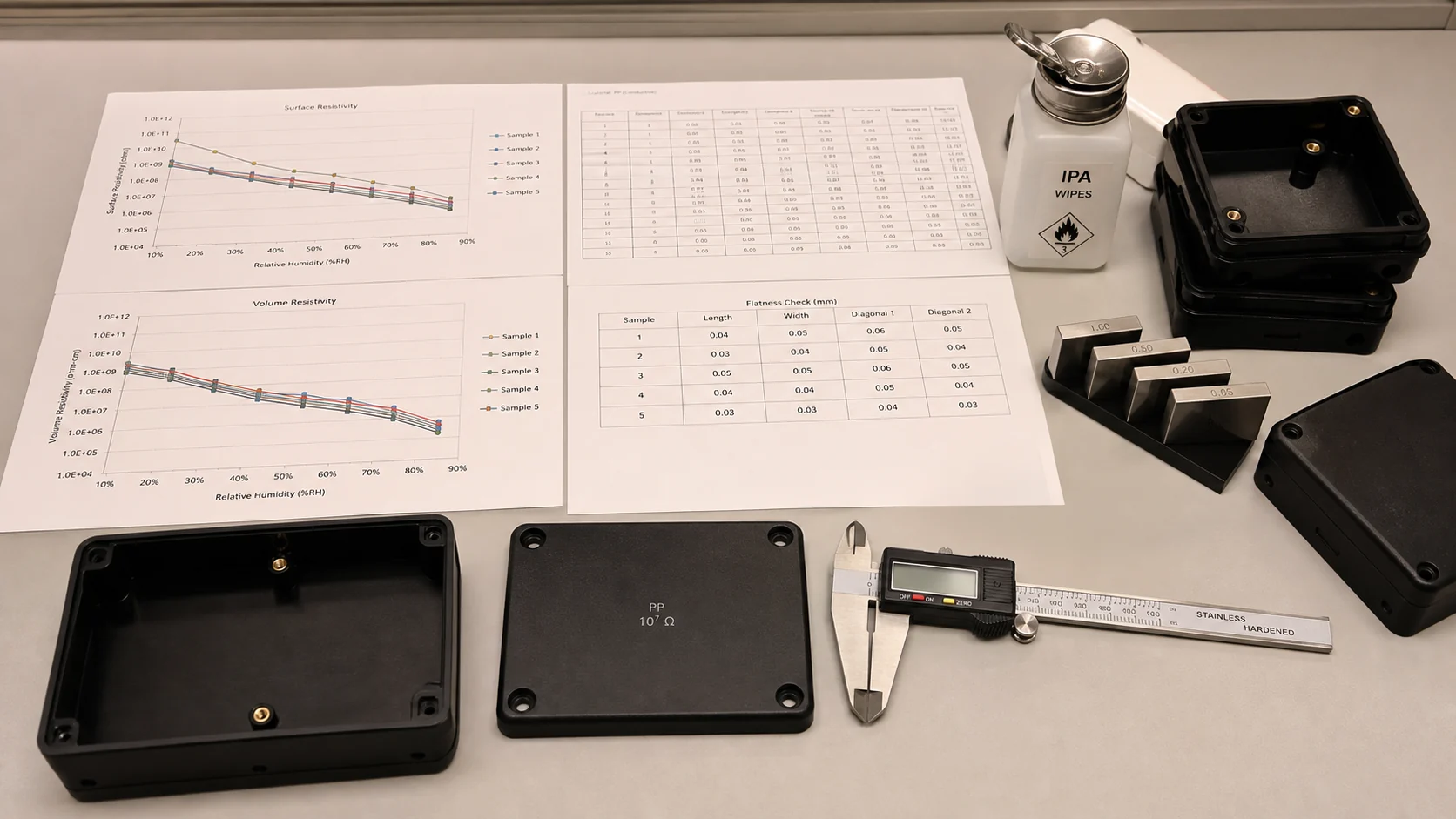
Electrical consistency improved from ±2 orders between parts to ±0.3-0.4 orders. After 50 IPA cleaning cycles, the original material drifted by 2.2 orders, while the DEYU grades changed only 0.3-0.4 orders and stayed inside their target ranges.
Dimensional stability also improved. Warpage decreased from 0.35 mm to 0.08-0.10 mm, enough to restore gasket fit. The FR route achieved a 100% UL94 V-0 pass rate in the trial, and total processing defects fell from 18% to 4-6%.
| Parameter | Original material | DEYU conductive PP grade | DEYU FR conductive PP grade |
|---|---|---|---|
| Surface resistivity, initial average | 5x10^8 ohm | 3x10^7 ohm | 5x10^7 ohm |
| Part-to-part variation | +/-2 orders | +/-0.3 orders | +/-0.4 orders |
| Within-part variation | +/-1.5 orders | +/-0.2 orders | +/-0.3 orders |
| Resistivity after 50 IPA cycles | 8x10^10 ohm | 8x10^7 ohm | 9x10^7 ohm |
| Increase after cleaning | +2.2 orders | +0.4 orders | +0.3 orders |
| Warpage, flatness deviation | 0.35 mm | 0.08 mm | 0.10 mm |
| Shrinkage consistency | +/-0.3% | +/-0.1% | +/-0.15% |
| Tensile strength | 26 MPa | 30 MPa | 27 MPa |
| Impact behavior | Brittle corners after assembly | No corner cracking | No corner cracking |
| UL94 V-0 pass rate | 70-80% batch dependent | Not specified, HB route | 100% in trial |
| Processing defect rate | 18% | 4% | 6% |
Suitable Applications
Suitable applications include control and junction boxes, instrument housings, industrial automation enclosures, PCB racks, sensor covers, connector housings, machine guards, ESD-safe tote box lids, cleanroom covers, chemical-processing covers and antistatic work surfaces.
For explosive-environment components or fire-safe electrical boxes, the material brief must include both ESD level and flame-retardancy thickness. A part that meets resistance but fails flame or fit is not a qualified enclosure material.
What Buyers Should Provide
- Part drawing or 3D model, with wall thickness and sealing surfaces.
- Target electrical specification and test method.
- UL94 rating and test thickness.
- Impact, flexural, tensile and HDT requirements.
- Service temperature and chemical exposure, especially IPA, oils and coolants.
- Flatness, shrinkage and warpage limits.
- Processing method and machine details.
- Monthly or annual volume and current material failure modes.
Conclusion
Conductive PP gives electrical housings and industrial covers a useful balance of low density, chemical resistance, moldability and permanent static dissipation. The engineering risk is not whether conductive PP exists; it is whether the selected grade keeps resistance, fit, flame rating and cleaning stability on the actual molded enclosure. The best validation plan combines standard data with molded-part resistance mapping, warpage measurement and environmental exposure.