
DEYU Wear-Resistant Plastic Compounds for POM, PA66 and PP Engineering Parts
Many projects do not need an off-the-shelf resin only. They need a compound that matches a real moving part, a real counter material, and a real service cycle. DEYU supports this process by comparing resin routes, additive packages, processing windows, and validation targets.
Buyer and engineer FAQ
Questions engineers often ask about this material route
Where can PA6 / PA66 / PC/ABS / POM / PP / TPU with a wear-resistant plastic requirement be used?
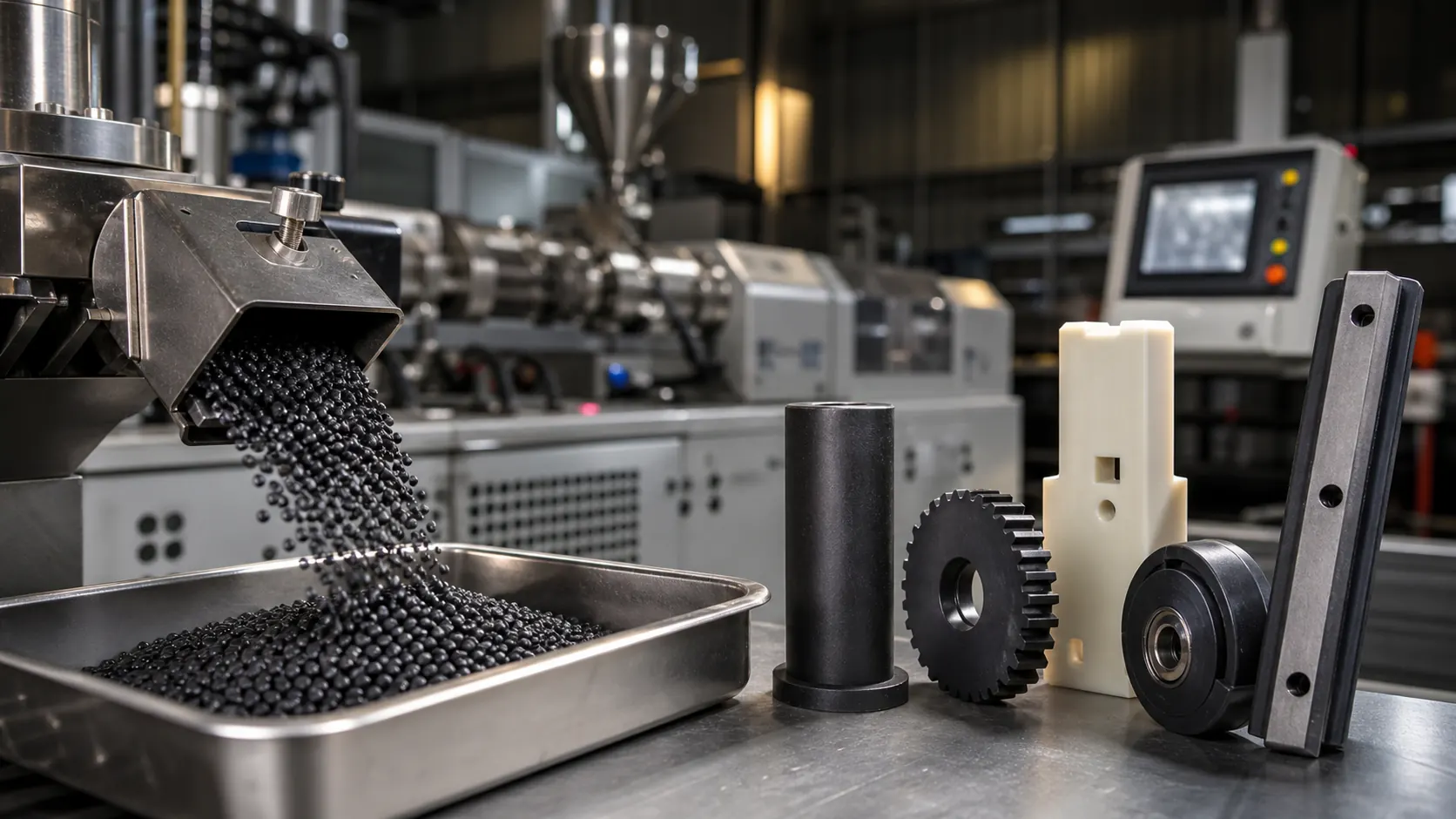
Typical fields include gears, rollers, bushings, sliding blocks, guide rails and low-noise moving parts. For this article, DEYU would first confirm the working environment, wall thickness, expected lifetime and whether DEYU wear-resistant plastics, DGK-POM FL100T matches the part geometry or needs formulation adjustment.
What are the main performance indicators for the "wear-resistant plastic" target on PA6 / PA66 / PC/ABS / POM / PP / TPU?
Focus on friction coefficient, wear depth, PV value, noise, dimensional stability and mating material compatibility. Buyers should ask for data on molded parts, not only pellet data, because gate position, filler orientation and thickness can change the final value.
What should engineers watch during injection molding or processing?
For PA6 / PA66 / PC/ABS / POM / PP / TPU, a practical starting window is 235-270°C melt / 70-95°C mold, dry before molding. Dry PA grades correctly, control glass or aramid fiber orientation and validate wear on the real mating surface. Final parameters should follow part thickness, gate design and the actual machine.
What details help DEYU recommend DEYU wear-resistant plastics, DGK-POM FL100T more accurately?
Send the current resin or grade, drawing or photo, wall thickness, annual quantity, target standard, failure mode and required color. If a reference grade already passed one test but failed in production, include both data sets.
For a precise recommendation, share the part drawing, base resin, target performance, processing method and test standard with DEYU.
1. DEYU's Role in Wear-Resistant Plastic Projects
Many projects do not need an off-the-shelf resin only. They need a compound that matches a real moving part, a real counter material, and a real service cycle. DEYU supports this process by comparing resin routes, additive packages, processing windows, and validation targets.
DEYU wear-resistant plastics and DGK-POM FL100T. The platform covers resin selection, compound tuning, trial batches, and final-part validation for moving components
Wear-resistant compound development usually begins with a failure mode: noise, high friction, wear debris, clearance growth, deformation, cracking, surface roughening, or damage to the mating part.
2. Resin Platforms
POM is used when the part needs low water absorption, dimensional stability, and smooth movement. It is common in gears, rollers, sliders, bushings, and precision mechanisms.
PA6 and PA66 are used when the part needs strength, toughness, heat resistance, and load-bearing ability. They are common in bushings, guide rails, structural moving parts, brackets, textile parts, and industrial components.
PP is used for lightweight, cost-sensitive, and lower-load moving parts. It may be modified with internal lubricants, reinforcement, or fillers when the application allows.
PC/ABS, PBT, PET, TPU, TPE, PPS, and other engineering plastics can also be tuned for wear, friction, noise, and dimensional requirements.
3. Additive and Reinforcement Options
DEYU can evaluate PTFE, MoS2, aramid fiber, glass fiber, carbon fiber, silicone, wax, UHMWPE, mineral fillers, and hybrid packages. Each system has tradeoffs. A low-friction additive may reduce strength if overused. A reinforcement may improve stiffness but increase counter-surface wear. A lubricant may help noise but affect painting or bonding.
The formulation should be matched to the part, not selected by additive name alone.
4. Application Areas
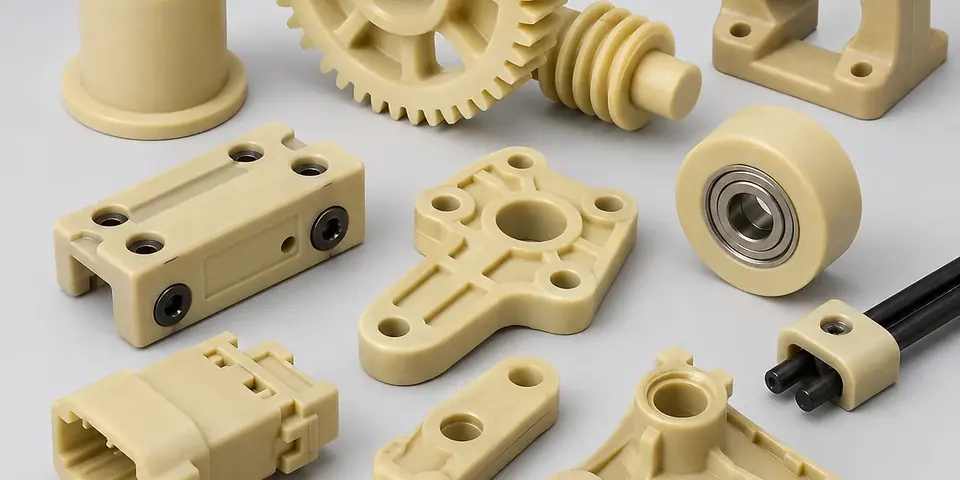
Typical applications include gears, bushings, guide rails, sliding blocks, rollers, bearing cages, textile machine parts, conveyor components, automotive moving mechanisms, appliance sliders, office equipment parts, valves, and low-noise consumer product mechanisms.
For each application, DEYU checks load, speed, movement type, counter material, lubrication, temperature, humidity, service-life target, wall thickness, gate location, shrinkage, and color requirements.
5. Development Workflow
The workflow normally includes problem definition, resin route selection, first compound proposal, sample pellets, molding or extrusion trial, wear and friction testing, noise observation, dimension check, and formulation adjustment.
When the part is sensitive, DEYU recommends comparing at least two routes. For example, POM/PTFE may be compared with POM/aramid, or PA66/aramid may be compared with reinforced PA66 plus lubricant.
6. What Buyers Should Provide
The most useful information includes part drawing, part photo, current material, failure mode, counter material, load, speed, movement type, dry or lubricated condition, operating temperature, service-life target, color requirement, processing method, and annual volume.
With this information, DEYU can avoid blind material recommendations and focus on a realistic validation path.
Conclusion
Wear-Resistant Compound Selection Table
Wear-resistant plastic selection starts with the movement pair. A chair caster, a textile machine slider, a small gear and a conveyor guide do not fail in the same way. Some need low noise, some need clearance stability, some need low wear powder, and some need to protect a metal or plastic mating surface. DEYU uses this failure mode to narrow the route before preparing trial pellets.
| Typical part | Likely failure mode | Preferred material route | Validation focus |
|---|---|---|---|
| Gear, small transmission part | Noise, tooth wear, stick-slip | POM/PTFE or POM lubricant system | Noise, friction coefficient, tooth surface after cycling |
| Bushing, sleeve, guide block | Clearance growth, heat and dry sliding wear | PA66/aramid, PA6/MoS2 or reinforced nylon | Load, sliding speed, dimensional change and wear depth |
| Roller or chair caster | Surface abrasion, deformation, unstable rolling | POM, PA or PP compound with lubricant package | Rolling resistance, debris, surface condition and impact |
| Textile or conveyor sliding part | Friction heat, dust, mating surface damage | Low-friction POM/PA route with controlled hardness | Counter material wear and continuous running temperature |
For purchasing teams, the most useful request is not only “wear-resistant plastic pellets”. A stronger inquiry includes the part name, current material, counter material, load, speed, temperature, lubrication condition and the main failure. This allows DEYU to recommend a route that is close to the real working condition instead of a generic wear-resistant compound.
DEYU wear-resistant plastic compounds are developed around the actual application. The goal is not only to reduce wear, but also to balance friction, strength, toughness, molding stability, appearance, cost, and long-term reliability.
Engineering decision path
This page is intended to work as a material-selection brief, not only as a product introduction. The engineering route starts with the failure mode, then narrows the base resin, additive package, molding window, and validation method.
- Define the wear mechanism before selecting the material: adhesive wear, abrasive wear, stick-slip noise, dry friction, or clearance growth need different formulations.
- POM, PA66, and PP are not interchangeable bases; each has different moisture behavior, heat resistance, stiffness, cost, and molding shrinkage.
- Additives such as PTFE, MoS2, aramid fiber, silicone, and carbon fiber must be balanced against toughness, color, surface finish, and tool wear.
- Validation should combine friction testing with dimensional inspection, cycling, mating-material review, and molded-part surface evaluation.
Anonymous customer cases
Case 1: quiet sliding rail for a consumer mechanism
The buyer originally asked only for a low-friction grade. DEYU reframed the request around noise, repeated movement, and mating plastic, then used sample comparison to avoid an over-filled compound that would have created surface defects.
Case 2: industrial guide component with abrasive dust
A machine builder needed better wear life but could not change the part drawing. DEYU focused on resin route, additive package, and processing window so the compound could improve wear behavior without forcing new tooling.
How DEYU supports the project
- DEYU can adjust conductivity, wear resistance, toughness, flame-retardant direction, color, and processing flow as a combined formulation target instead of treating each property separately.
- Sample batches can be aligned with customer molds, part thickness, gate position, and expected tests before commercial supply.
- For international inquiries, DEYU engineers help translate application requirements into resin route, test items, sample plan, and risk points for purchasing and technical teams.