
DGK-PP DD2-3A Conductive PP Compound Selection Guide
DGK-PP DD2-3A is a conductive PP compound from DEYU plastics designed for parts that need a stronger conductive pathway than ordinary antistatic PP or static-dissipative PP.
Buyer and engineer FAQ
Questions engineers often ask about this material route
Where can PP with a conductive plastic requirement be used?
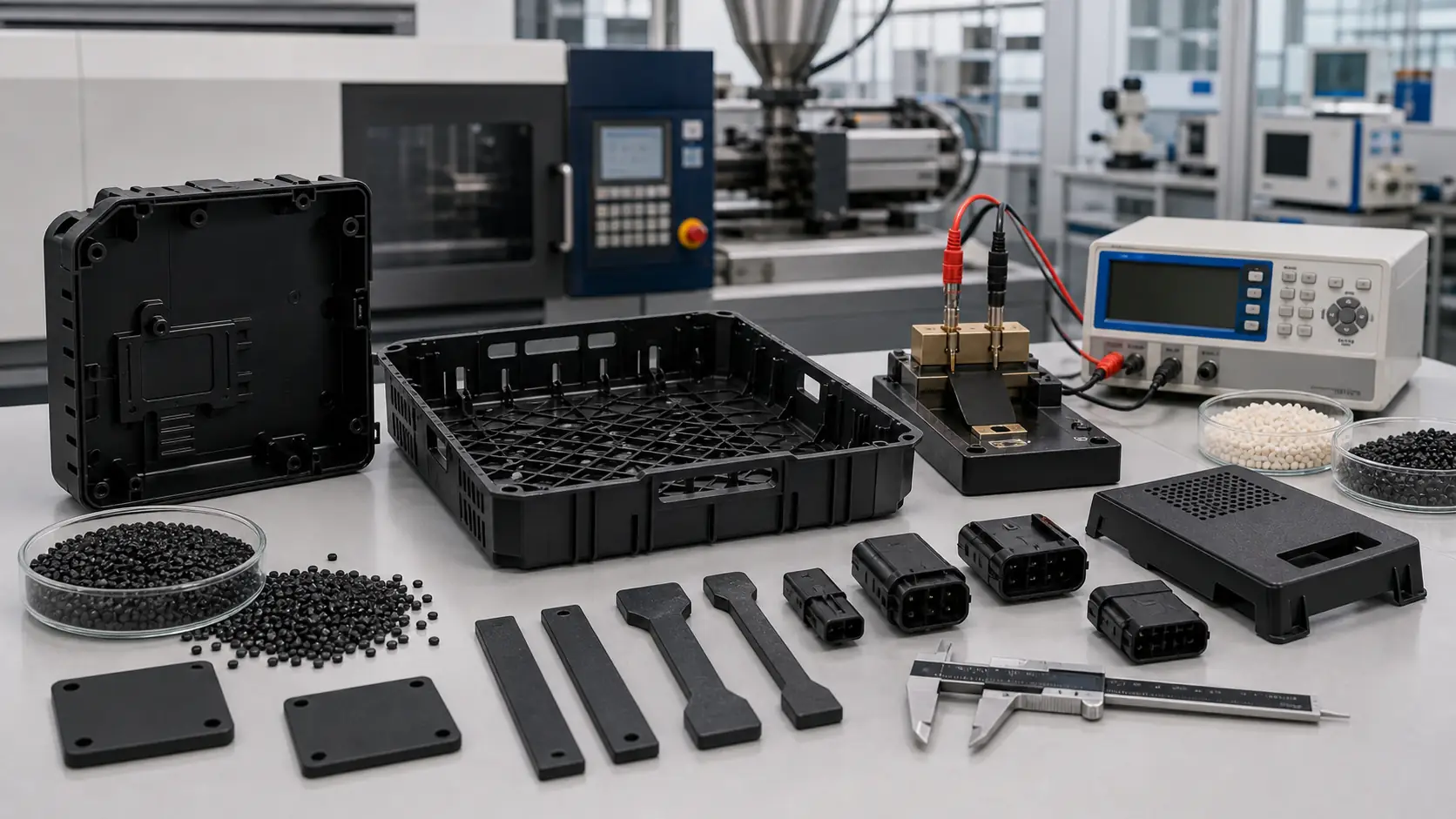
Typical fields include ESD trays, electronic housings, fixtures, EMI parts and antistatic logistics parts. For this article, DEYU would first confirm the working environment, wall thickness, expected lifetime and whether DGK-PP DD2-3A conductive PP, conductive plastics platform matches the part geometry or needs formulation adjustment.
What are the main performance indicators for the "conductive plastic" target on PP?
Focus on surface resistance, volume resistance, dispersion uniformity, impact strength and molding stability. Buyers should ask for data on molded parts, not only pellet data, because gate position, filler orientation and thickness can change the final value.
What should engineers watch during injection molding or processing?
For PP, a practical starting window is 190-230°C melt / 30-60°C mold. Avoid excessive filler loading, control weld lines and verify resistance on the molded part. Final parameters should follow part thickness, gate design and the actual machine.
What details help DEYU recommend DGK-PP DD2-3A conductive PP, conductive plastics platform more accurately?
Send the current resin or grade, drawing or photo, wall thickness, annual quantity, target standard, failure mode and required color. If a reference grade already passed one test but failed in production, include both data sets.
For a precise recommendation, share the part drawing, base resin, target performance, processing method and test standard with DEYU.
Product Summary
DGK-PP DD2-3A is a conductive PP compound from DEYU plastics designed for parts that need a stronger conductive pathway than ordinary antistatic PP or static-dissipative PP.
For direct product selection, review DGK-PP DD2-3A conductive PP and the broader conductive plastics platform. DEYU can adjust resistance, stiffness, shrinkage, flowability, impact balance and additional functions around the actual molded part.
Its key feature is low surface resistance in the 10^2-10^3 ohm direction, making it suitable for applications where static charge must be transferred quickly, or where plastic parts need conductive, shielding, or resistance-connection functions.
Compared with ordinary PP, DGK-PP DD2-3A provides:
lower surface resistance; black conductive appearance; lightweight polypropylene base; injection molding processability; good stiffness for PP-based conductive parts; controlled shrinkage direction; customizable formulation potential.
This material is not positioned as a general antistatic PP. It is more suitable for conductive PP applications where stronger electrical performance is required.
1. Main Material Characteristics
| Item | DGK-PP DD2-3A Typical Direction |
|---|---|
| Base material | PP composite compound |
| Color | Black |
| Form | Pellets / granules |
| Processing method | Injection molding |
| Surface resistance | 10^2-10^3 ohm |
| Density | 0.99 g/cm3 |
| Heat distortion temperature | 107 C |
| Flammability | UL94 HB |
| Mold shrinkage | 0.3-0.7% |
| Main feature | Low-resistance conductive PP |
The surface resistance direction makes DGK-PP DD2-3A different from ordinary antistatic PP. In many projects, antistatic PP targets 10⁹–10¹² Ω, static-dissipative PP targets 10^6-10^9 ohm, while DGK-PP DD2-3A is designed toward a much lower resistance range.
2. Mechanical Performance Direction
DGK-PP DD2-3A is not only a conductive material. It also needs to maintain practical mechanical performance for injection-molded parts.
Typical data direction:
flexural strength: 36.2 MPa; flexural modulus: 3472 MPa; tensile modulus: 5570 MPa; tensile strength: 23.1 MPa; elongation at break: >14%; Izod notched impact strength: 112 J/m.
For conductive PP compounds, electrical performance often affects toughness, flowability, and surface quality. The value of DGK-PP DD2-3A is that it provides a low-resistance conductive network while still keeping a usable stiffness and molding window for industrial parts.
3. Why Choose Conductive PP Instead of Ordinary PP?
Ordinary PP is lightweight and cost-effective, but it is an insulating material. In dry, high-speed, powder-contact, or electronic equipment environments, ordinary PP may cause:
static charge accumulation; dust adhesion; powder sticking; unstable part release; feeding interruption; ESD risk; sensor interference; difficulty in grounding design.
DGK-PP DD2-3A is more suitable when the problem is not simply dust reduction, but stronger charge transfer or conductive function.
Typical selection logic:
choose antistatic PP when only dust reduction is needed; choose static-dissipative PP when controlled discharge is required; choose DGK-PP DD2-3A when low resistance and stronger conductivity are required.
4. Application Scenarios
4.1 Shielding and Electronic Equipment Components
DGK-PP DD2-3A can be used in plastic parts where conductive PP is required for shielding-related or electronic equipment applications.
Typical parts:
shielding housings; electronic equipment covers; conductive connectors; industrial electronic components; interference-control parts; custom molded conductive PP parts.
Selection focus:
surface resistance on the final part; part thickness; grounding design; dimensional stability; impact requirement; assembly method.
4.2 Conductive Connectors and Resistance-Connection Parts
The low surface resistance direction of DGK-PP DD2-3A makes it suitable for molded parts that need a conductive path or resistance-connection function.
Typical requirements:
stable resistance after molding; black conductive surface; injection molding repeatability; low shrinkage fluctuation; sufficient stiffness for assembly.
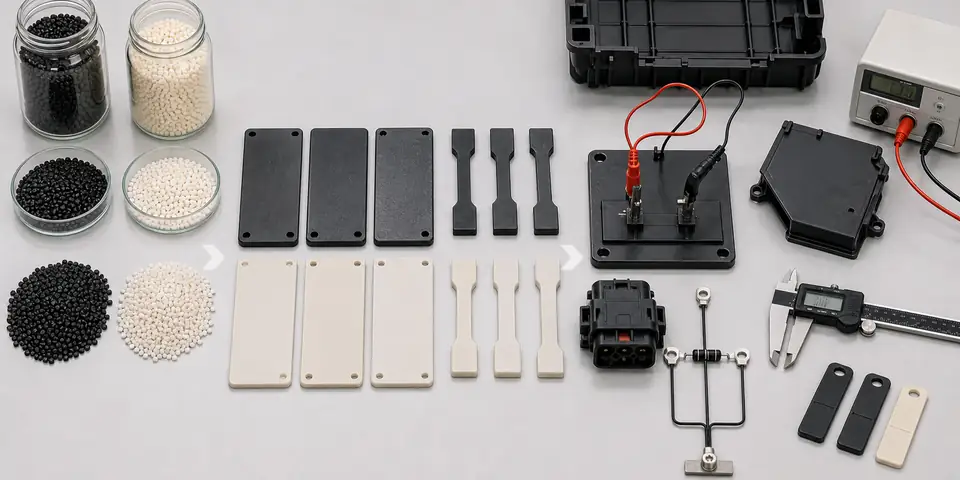
The final resistance should be tested on the actual molded part, because conductive filler orientation, wall thickness, gate position, and molding parameters can affect measured resistance.
4.3 Industrial Trays, Covers, and Functional Parts
DGK-PP DD2-3A may also be considered for industrial trays, covers, and parts where ordinary PP causes static-related problems.
Typical problems it can help address:
dust accumulation; powder adhesion; part sticking; unstable feeding; static-related handling issues; need for lightweight conductive plastic.
For parts requiring wear resistance, flame retardancy, UV resistance, or low warpage, DEYU can further adjust the formulation based on the target application.
5. Processing Reference
Typical injection molding reference:
drying temperature: 90 C; drying time: 4–5 hours; injection temperature: 210-220 C; mold temperature: around 80 C.
Processing should be adjusted according to machine type, mold structure, part thickness, flow length, gate design, and final resistance target.
For conductive PP compounds, processing stability is important because dispersion and flow orientation may affect resistance consistency. DEYU recommends validating both standard test pieces and final molded parts.
6. Purchasing and Validation Guide
Before purchasing DGK-PP DD2-3A, buyers should confirm the following points.
Electrical Requirement
target surface resistance; surface or volume resistance test method; testing on standard specimen or final part; humidity and temperature during testing; grounding or shielding design requirement.
Part Requirement
part thickness; injection molding process; gate position; shrinkage tolerance; warpage requirement; assembly method; impact requirement.
Additional Function
flame retardancy; wear resistance; UV resistance; low-temperature toughness; surface smoothness; color requirement; cost target.
A clear inquiry should not only say “conductive PP.” It should define the resistance range, application, test method, part drawing, and mechanical requirements.
7. DEYU DGK Conductive PP Platform
DEYU plastics can develop conductive PP materials according to different resistance and application targets.
Available directions include:
DGK-PP DD2-3A low-resistance conductive PP; conductive PP masterbatch route; static-dissipative PP; conductive PP for trays and covers; conductive PP for powder-contact parts; conductive PP with low-warpage adjustment; conductive PP with impact balance; conductive PP with flame-retardant modification; conductive PP with UV-resistant modification.
DGK-PP DD2-3A is suitable when customers need a black conductive PP compound with a low surface resistance direction and injection molding processability.
Conclusion
DGK-PP DD2-3A is a DEYU conductive polypropylene compound designed for low-resistance PP applications. Its 10^2-10^3 ohm surface resistance direction makes it more suitable for conductive, shielding, resistance-connection, and industrial static-control parts than ordinary antistatic PP.
For buyers, the key is to confirm whether the project really needs conductive PP or only antistatic PP. If the product only needs dust reduction, a higher-resistance antistatic PP may be more suitable. If the product requires strong charge transfer, shielding-related function, or low-resistance conductive performance, DGK-PP DD2-3A is a practical material direction.
Final selection should be based on actual molded-part testing, including resistance, shrinkage, impact, surface quality, and application performance.
Engineering decision path
This page is intended to work as a material-selection brief, not only as a product introduction. The engineering route starts with the failure mode, then narrows the base resin, additive package, molding window, and validation method.
- Use DGK-PP DD2-3A when the project needs a conductive PP route stronger than ordinary antistatic polypropylene.
- Define the target function first: charge transfer, ESD tray, conductive housing, shielding-related component, or low-resistance industrial part.
- Check conductivity together with impact strength, shrinkage, weld lines, flow marks, and part weight; chasing lower resistance alone can create brittle parts.
- Validate molded samples at several measurement points and compare resistance before and after conditioning or storage.
Anonymous customer cases
Case 1: conductive PP tray for electronics handling
The customer needed a lighter alternative to a heavier material while keeping stable charge transfer. DEYU recommended DGK-PP DD2-3A trials on the actual tray geometry, with resistance checks on corners, ribs, and flat areas.
Case 2: industrial housing with low-resistance requirement
The project had visible flow-mark risk and a tight molding window. DEYU adjusted the evaluation around gate position, surface quality, and conductivity so the buyer could judge both function and appearance before approval.
How DEYU supports the project
- DEYU can adjust conductivity, wear resistance, toughness, flame-retardant direction, color, and processing flow as a combined formulation target instead of treating each property separately.
- Sample batches can be aligned with customer molds, part thickness, gate position, and expected tests before commercial supply.
- For international inquiries, DEYU engineers help translate application requirements into resin route, test items, sample plan, and risk points for purchasing and technical teams.